Whole Foods and gluten: 365 labels, the hot bar, bulk bins and the counters
Short answer
Read each kind of Whole Foods food against its own statement:
- A packaged 365 item: its label claim. Whole Foods says packaged 365 Everyday Value products labeled gluten-free are third-party certified1, and on a food FDA regulates the claim also requires any unavoidable gluten to be under 20 parts per million2.
- Bulk bins, hot bars, salad bars, prepared foods and baked goods: the store’s cross-contact statement, which says people with food-ingredient allergies should not consume these products3. It does not use the word gluten4.
- Everything else, including other makers’ products: the package. Whole Foods says to contact the manufacturer with questions about brands other than 365 and Whole Foods Market5, and to check packaging for the most recent ingredient information6.
Part of Store guides: warehouse, discount and natural grocers, 8 guides
Key points
- Whole Foods says packaged 365 Everyday Value products labeled gluten-free are third-party certified1; the pages we read do not name the certification program7.
- On a food FDA regulates, a gluten-free claim also requires that any unavoidable gluten be under 20 parts per million2.
- The store’s cross-contact statement names bulk products, prepared foods, baked goods, salad bars, hot bars and in-store eating venues, and is written for food-ingredient allergies3; it does not use the word gluten4.
- The Bulk, Bakery, Prepared Foods and Cheese department pages we read do not mention gluten or allergens8, 9, 10, 11.
What Whole Foods says about gluten, and which page says it
Whole Foods words its gluten-free statements differently from page to page, and one of the pages is a 2012 post. The table sets them side by side.
| Where we read it | What it says | Date the page shows |
|---|---|---|
| Customer-service FAQ, dietary preference filters | Gluten-Free means packaged products in compliance with FDA regulations, or certain single-ingredient foods with no gluten ingredients and no statement that they are made in a facility that also processes gluten ingredients12. Packaged 365 Everyday Value products labeled gluten-free are third-party certified1. | None shown (footer reads 2026)7 |
| Gluten-free grocery list | All 365 by Whole Foods Market products labeled “gluten-free” have been third-party tested and certified13. | None shown (footer reads 2026)14 |
| Post, “Gluten-Free Shopping 101” | A gluten-free claim should mean below 20 ppm and be backed by quality assurance and testing, and products with a gluten-free shelf tag had been reviewed at headquarters15. | October 5, 201215 |
Neither current page names the certification program7, 14. The shelf-tag review appears in the 2012 post; the current pages we read describe third-party certification instead15, 1, 13.
How to read a 365 “gluten-free” claim
Start with FDA’s rule for packaged foods24. On a food FDA regulates, “gluten-free” means the food is inherently gluten free or has no gluten-containing grain as an ingredient, no ingredient made from one unless it was processed to remove gluten and the food stays under 20 parts per million (ppm), and any unavoidable gluten under 20 ppm2. A food that carries the claim and fails the rule is deemed misbranded16.
Whole Foods adds a second statement: packaged 365 Everyday Value products labeled gluten-free are third-party certified1. The pages we read do not say which program7, 14. FDA lets makers print a certification program’s logo if its use is truthful and not misleading, and does not endorse any program17. So look on the pack for a mark. One example of how a program works: GFCO counts a product as certified when it appears on its list and carries one of its marks18. The first page of a search of that list for “whole foods” includes 365 rows for chicken nuggets (named gluten free), ice cream, popcorn, whipped topping and teriyaki sauce19; we did not check any 365 pack for the mark.
The ingredient list still matters
Whole Foods says allergens present in the ingredients of a 365 Everyday Value or Whole Foods Market brand product are called out by their common or usual name, including common allergens in natural flavors or spices20. It also says that for an ingredient FDA or CFIA has not designated a common allergen, suppliers of its 365 Everyday Value or Whole Foods Market brand products are not required to tell it whether the ingredient is in the facility, and it recommends reviewing the product label21.
A post dated October 5, 2012 said 365 and Whole Foods Market brand labels call out rye, barley and oats in the ingredients statements, sub-ingredients included22. The current policy answer does not use the words barley or rye4, so treat that sentence as history. Whole Foods’ own advice today is to double-check the label even when a food appears to be gluten-free23, and it says product formulations change6.
Packaged food versus counter and self-serve food
FDA says its gluten-free regulation applies to packaged foods, which may be sold in some retail and food-service establishments24. For unpackaged food it will monitor reported information and share complaints with state and local government partners25. At a counter or a bar, the store’s own wording is the first thing to read.
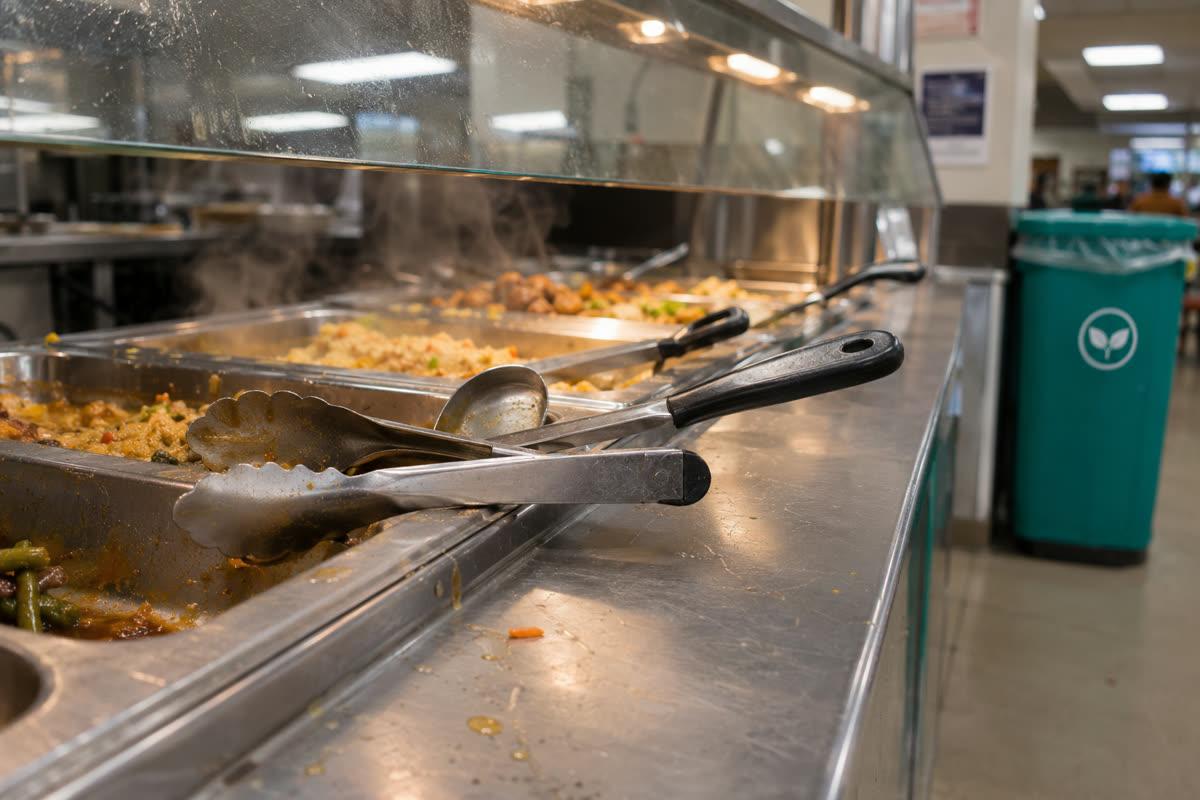
Whole Foods’ wording is one sentence in its customer-service answer: because of the possibility of cross contact, people with food-ingredient allergies should not consume bulk products, prepared foods and baked goods, salad bars, hot bars and in-store eating venues3. It is written for food-ingredient allergies and does not use the word gluten4. Whether the store means it to cover gluten is a question for the store, and we found no page that answers it.
Bulk bins, hot bar, salad bar, bakery, deli and cheese counters
| Area | What the store’s pages state, and where they are silent |
|---|---|
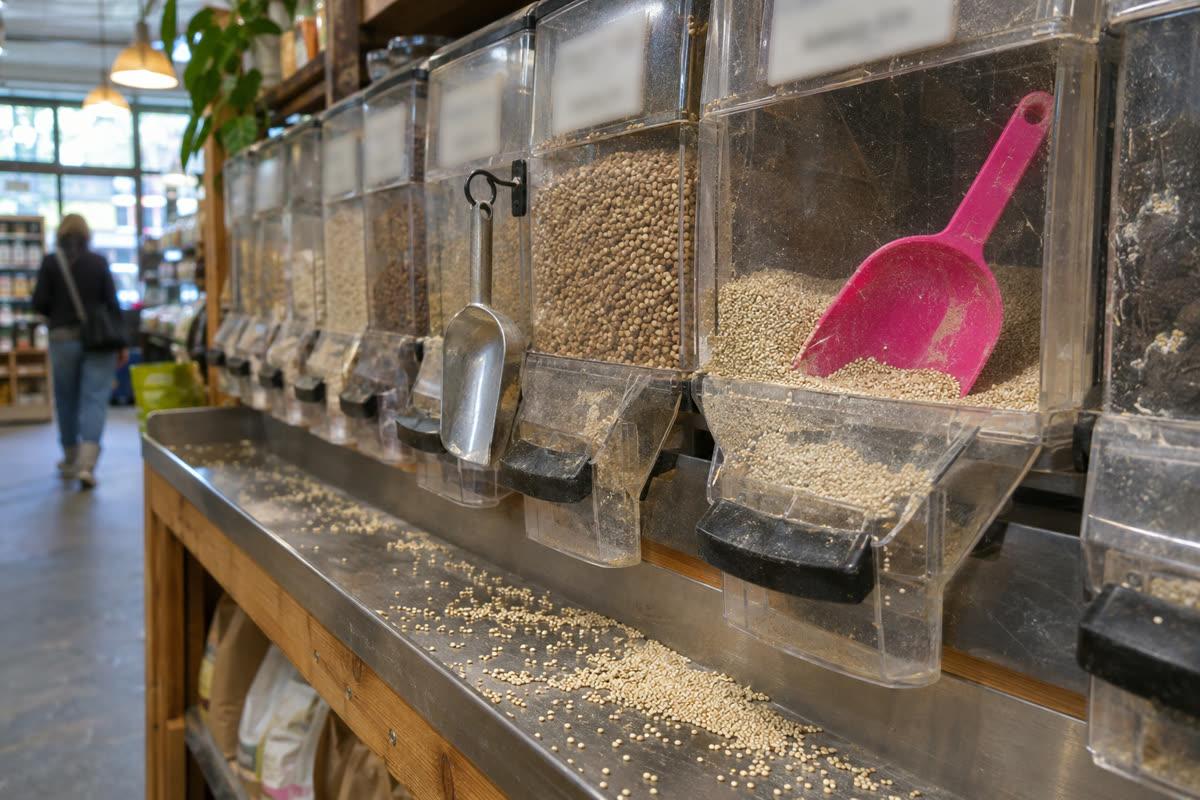
| Bulk bins | Named in the cross-contact statement as products “sold in bins by the pound”3. The Bulk Department page describes grains, beans, nut butters, nuts and seeds26; it and the page on how to shop the bins do not mention gluten or allergens8, 27. |
| Hot bar and salad bar | Both named in the cross-contact statement3. The Prepared Foods Department page and the store’s salad-bar tips page do not mention gluten or allergens10, 28. |
| Prepared foods counter and sandwiches | “Prepared foods” are named in the cross-contact statement3. The sandwich menu says items are prepared in kitchens that handle the major food allergens, including wheat, that cross-contact may occur, and that allergen information is based on standard recipes29. |
| Bakery | “Baked goods” are named in the cross-contact statement3. The Bakery Department page does not mention gluten or allergens9. The store’s gluten-free list names Udi’s Gluten Free and Canyon Gluten Free Bakehouse in its bakery section30. |
| Deli counter | The statement does not name a deli counter3, and we found no Whole Foods page saying whether it counts deli food as prepared foods. The store’s special-diet list says products that may contain gluten include deli meats31. |
| Cheese counter | The statement does not name a cheese counter3. The Cheese Department page does not mention gluten or allergens11. |
What a gluten charity advises about bins and salad bars
The Gluten Intolerance Group advises staying clear of a store’s bulk section, because gluten-containing ingredients could linger on scoops or surrounding bins32. It says a salad bar typically combines naturally gluten-free food, such as vegetables and fruit, with gluten-containing food such as croutons, crackers and some salad dressings, and that serving utensils might be used in both33. That is the charity’s advice for stores in general, not a statement about Whole Foods.
Our verdicts for foods on a Whole Foods list
Whole Foods’ gluten-free grocery list is a starting point, and the store says selection varies by store34. For the foods below, our verdict pages show what makers and charities said, with the date we read it.
- Deli meat: the store’s special-diet list names deli meats among products that may contain gluten31. Our verdict covers sliced, packaged deli meat from five brands; it does not cover deli-counter slicing or store-brand packs.
- Cheese: the gluten-free list names cheese among its dairy picks35. Our verdict separates plain natural cheese from breaded cheese snacks and a cheese-and-cracker kit.
- Rice vinegar: the list’s vinegar line names apple cider, balsamic, red wine and champagne, not rice vinegar35. Our verdict is “depends on the product”: read the bottle’s ingredient list.
- Rice: the list names white, brown and wild rice35, and the bulk bins hold grains and beans26. For rice from a bin, use the bulk row above.
- Bread: the store’s list names two gluten-free bread makers in its bakery section30, and its gluten-free product page lists 365 multigrain and white gluten-free breads36.
- Chicken: the list says to read labels carefully on options in its Beef, Poultry & Pork section that contain marinades, spice rubs and breading37. The Prepared Foods Department page lists rotisserie chicken as a meal category10, so read it against the counter statement3.
- Hummus: the list names hummus among its dips35. Our verdict goes tub by tub.
For other chains, see our guides to Costco, Walmart and Kroger. For label wording across brands, see how to read food labels and may-contain wheat labels.
A short checklist for the store
- On a packaged item, read the claim and the ingredient list on the package itself; the store’s web pages say product formulations change6.
- On a 365 pack, look for a certification mark; the pages we read do not say which program certifies them7.
- At the bulk bins, hot bar, salad bar and bakery, start from the store’s cross-contact statement3, then ask the department what it can tell you about gluten specifically.
- At the deli and cheese counters, ask to see the package or ingredient list of the item being sliced or cut.
Verdicts in this guide
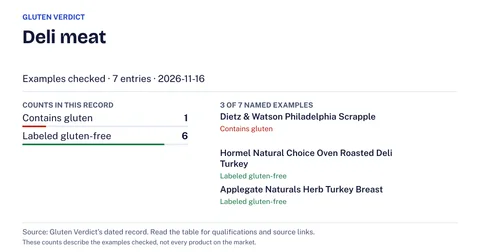 Deli meatDepends on the product1 of 7 products we checked contains gluten: Dietz & Watson Philadelphia Scrapplechecked Nov 16, 2026
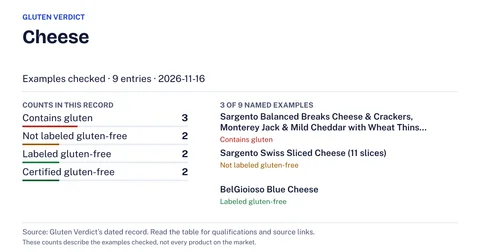 CheeseNaturally gluten-free3 of 9 products we checked contain gluten: Sargento Balanced Breaks Cheese & Crackers, Monterey Jack & Mild Cheddar with Wheat Thins Mini (6-pack); Farm Rich Mozzarella Sticks; and Farm Rich Cheddar Cheese Curdschecked Nov 16, 2026
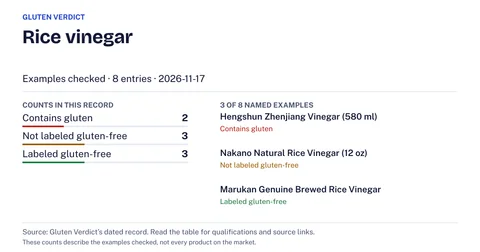 Rice vinegarDepends on the product2 of 8 products we checked contain gluten: Hengshun Zhenjiang Vinegar (580 ml) and Gold-Plum Chinkiang Vinegar (18.6 fl oz)checked Nov 17, 2026
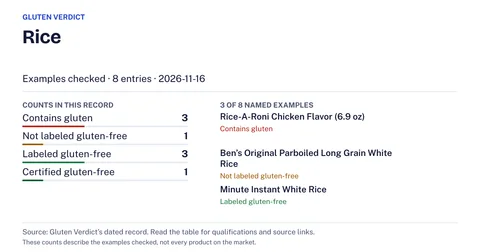 RiceNaturally gluten-free3 of 8 products we checked contain gluten: Rice-A-Roni Chicken Flavor (6.9 oz), Near East Original Rice Pilaf, and Ben’s Original Ready Rice Rice PilafBuy it labeled gluten-freechecked Nov 16, 2026
 BreadContains glutenchecked Nov 16, 2026
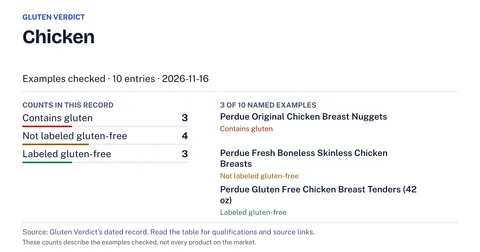 ChickenNaturally gluten-free3 of 10 products we checked contain gluten: Perdue Original Chicken Breast Nuggets, Bell & Evans Breaded Chicken Tenders, and Foster Farms Chicken Nuggets (33.6 oz)checked Nov 16, 2026
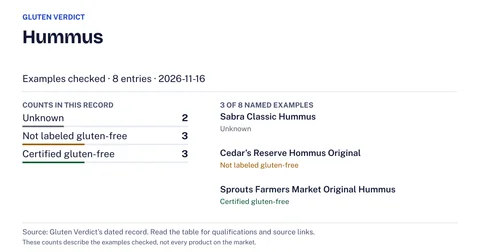 HummusDepends on the productchecked Nov 16, 2026
Questions people ask
Are Whole Foods 365 gluten-free products certified?
Whole Foods says packaged 365 Everyday Value products labeled gluten-free are third-party certified1. The pages we read do not name the certifier7, so look for a mark on the pack.
Does Whole Foods say anything about gluten at the hot bar or salad bar?
Its customer-service answer names hot bars and salad bars among the areas with a possibility of cross contact, and says people with food-ingredient allergies should not consume these products3. The answer does not use the word gluten4.
Does FDA’s gluten-free rule apply to bakery or deli food made in the store?
FDA says its regulation applies to packaged foods, and that for unpackaged food it monitors reported information and shares complaints with state and local government partners25.
More in Store guides: warehouse, discount and natural grocers
 Gluten-free at Sprouts: the collection, bulk bins and wording that is not a claimWhat Sprouts says about gluten on its own pages, how its collection and bulk bins differ from a package claim, and what organic or wheat-free leaves open.
 Costco and gluten: which items make a claim and which only list ingredientsSort a Costco cart into claim, ingredient list only, or nothing to read, using Costco’s own item pages and what FDA’s gluten-free rule requires.
 Wegmans and gluten: what the Wellness Keys and in-store labels meanWhat Wegmans says its Gluten Free Wellness Key means, how in-store food is labeled, and how to check any other Wegmans item before you buy.
 Sam’s Club and gluten: reading a listing, a bulk pack and the café sheetHow to use Sam’s Club’s gluten-free page as a shortlist, read the pack in your cart, and tell sealed packs from café food and sample tables.
 Gluten-free at Target: claims, badges and ingredient lists on Good & Gather and Favorite DaySort Target items into gluten-free claim, no claim, or gluten grain listed, using Target’s own Good & Gather and Favorite Day pages and FDA’s rule.
 Gluten-free at dollar stores, drugstores and small chains: what the chain says and what the pack saysWhat Dollar General, Dollar Tree, Five Below, CVS, Walgreens, Lidl, The Fresh Market and Natural Grocers say about gluten, and how to read a pack.
All 8 guides in Store guides: warehouse, discount and natural grocers
Related guides
 Deli, bakery and bulk-bin counters on a gluten-free dietFor each store counter (deli, bakery, bulk bins, bars): skip it, ask first, or buy the packaged item, and what a store’s own statement tells you.
 A price-per-ounce worksheet for comparing gluten-free staples at any store, club or onlineA worksheet for comparing gluten-free staples by price per ounce across stores, clubs and online, with a column for the gluten-free statement.
 Store-brand gluten-free: what the tag, claim or seal rests onSort a store-brand item into certified, maker-stated or ingredient-only, see what each lets you conclude, and know what to ask the store.
 Gluten in sausage, hot dogs and deli meat: fillers, binders and flavoringsHow to read sausage, hot dog, deli meat and jerky labels for wheat, malt, starch and soy sauce, and which USDA label rules apply to meat.
Sources
- [1, 3, 4, 5, 7, 12, 20, 21] Whole Foods Market, Product Information FAQ: dietary preference filter criteria, checked Nov 17, 2026.
Read the answer headed “What is your allergen labeling policy in the U.S. and Canada?” on 2026-11-17: the words “gluten”, “celiac”, “barley” and “rye” appear nowhere in it.
Read the answer headed “What criteria are used for the dietary preferences filters?” on 2026-11-17: its Gluten-Free entry says packaged 365 Everyday Value products labeled gluten-free “are third-party certified” and names no certification program; the page shows no date other than a footer line reading “Copyright 2026 Whole Foods Market IP, Inc.”
- [2, 17, 24, 25] US Food and Drug Administration, Questions and Answers on the Gluten-Free Food Labeling Final Rule, checked Nov 17, 2026.
- [6, 13, 14, 23, 30, 34, 35, 37] Whole Foods Market, How to Build a Gluten-Free Grocery List, checked Nov 17, 2026.
Read the “Try our 365 brand” tip on 2026-11-17: it says 365 by Whole Foods Market products labeled “gluten-free” “have been third-party tested and certified” and names no certification program; the page shows no date other than a footer line reading “Copyright 2026 Whole Foods Market IP, Inc.”
Read on 2026-11-17: the “Our picks” lists name “Rice: white, brown and wild” and “Vinegar: apple cider, balsamic, red wine and champagne” under Pantry Essentials, “Dips: guacamole, salsa, hummus, tzatziki” under Snacks, Chips, Salsas & Dips, and Cheese under Dairy & Eggs. The Pantry Essentials list does not name rice vinegar.
- [8, 26] Whole Foods Market, Bulk Department, checked Nov 17, 2026.
Read the Bulk Department page on 2026-11-17: the words “gluten”, “allergen” and “cross” appear nowhere on it.
- [9] Whole Foods Market, Bakery Department, checked Nov 17, 2026.
Read the Bakery Department page on 2026-11-17: the words “gluten” and “allergen” appear nowhere on it.
- [10] Whole Foods Market, Prepared Foods Department, checked Nov 17, 2026.
Read the Prepared Foods Department page on 2026-11-17: it lists Rotisserie Chicken among its meal categories, and the words “gluten” and “allergen” appear nowhere on it.
- [11] Whole Foods Market, Cheese Department, checked Nov 17, 2026.
Read the Cheese Department page on 2026-11-17: the words “gluten” and “allergen” appear nowhere on it.
- [15, 22] Whole Foods Market, Gluten-Free Shopping 101 (post dated October 05, 2012), checked Nov 17, 2026.
- [16] Electronic Code of Federal Regulations, 21 CFR 101.91 Gluten-free labeling of food, checked Nov 17, 2026.
- [18, 19] Gluten-Free Certification Organization, GFCO Product Finder, checked Nov 17, 2026.
Read the first page of results for “whole foods” on 2026-11-17: one row is named “365 WHOLE FOODS GLUTEN FREE ORGANIC CHICKEN NUGGETS”, brand “WFM Private Label, L.P.”, category Meats, sales region US. The other 365 rows on that page are ice cream, popcorn, whipped topping and teriyaki sauce, none with a gluten-free name.
- [27] Whole Foods Market, How to Shop the Bulk Bins at Whole Foods Market, checked Nov 17, 2026.
Read the page on 2026-11-17: it gives three steps (bag or container, bin PLU number, checkout) and the words “gluten”, “allergen” and “cross” appear nowhere on it.
- [28] Whole Foods Market, Salad Bar Hacks, checked Nov 17, 2026.
Read the page on 2026-11-17: the words “gluten” and “allergen” appear nowhere on it.
- [29] Whole Foods Market, Market Sandwich Menu, checked Nov 17, 2026.
- [31] Whole Foods Market, How to Make a Grocery List For Your Special Diet (gluten-free list), checked Nov 17, 2026.
- [32, 33] Gluten Intolerance Group, 25 Ways Cross-Contact Could Happen (And How to Avoid It), checked Nov 17, 2026.
- [36] Whole Foods Market, Shop Gluten-Free Products & Meals, checked Nov 17, 2026.
Read the page on 2026-11-17: its Breads, rolls & bakery list includes “365 By Whole Foods Market, Gluten Free Multigrain Bread, 20 Ounce”, “365 by Whole Foods Market, Bread White Gluten-Free, 20 Ounce”, “Canyon Bakehouse Gluten-Free Mountain White Bread” and “Udis Gluten Free Foods Whole Grain Bread, 12 Ounce”.