What “may contain wheat” and “made in a facility with wheat” mean on a US label
Short answer
A “may contain wheat” or “made in a facility with wheat” line is a voluntary advisory statement, not a required one1, 2. What it means for you depends on what else is on the pack:
- With a gluten-free claim: the food must still meet FDA’s limit of less than 20 parts per million of gluten, whatever advisory line sits beside the claim3, 4.
- With a gluten-free certification mark: Gluten Intolerance Group (GIG) says that on a certified gluten-free product the certification applies regardless of “may contain” type statements and means 10 ppm gluten or less5.
- With neither: the line is the maker’s own voluntary signal1. The National Celiac Association recommends contacting the manufacturer about its processing procedures6.
Part of Label reading and gluten-free claims, 17 guides
Key points
- Advisory lines are voluntary. FDA says the allergen-labeling provision of the law does not address them and that they cannot be used in place of good manufacturing practices2, 7.
- FDA describes “may contain wheat” as describing the potential of unintended wheat allergen presence due to cross-contact. The wording gives no amount, and FDA says it has not established specific thresholds for any food allergen8, 9.
- A gluten-free claim and an advisory line can share a pack. The claim has to be met either way10, 3.
- “Contains wheat” is a different statement: wheat is an ingredient. FDA says it is not appropriate to pair it with a “may contain” line for the same allergen11, 12.
- In one 2022 study of ordinary foods with no gluten ingredients, 3 of 77 with a “may contain wheat/gluten” type line and 3 of 51 without one had gluten at 20 mg/kg or more13, 36.
Who decides to print these lines, and what FDA says they are
Statements such as “may contain wheat”, “made in a facility that also processes wheat” and “made on shared equipment” are advisory statements that makers add on their own. The National Celiac Association (NCA) says they are voluntary and not required1, and FDA’s Q&A on the gluten-free rule calls “made in a facility that also processes wheat” a voluntary advisory label statement10.
FDA’s allergen guidance says the allergen-labeling section of the Food, Drug, and Cosmetic Act does not address allergen advisory statements, including statements about unintended allergen presence from the manufacturing process2. Outside FDA the same statements are often called precautionary allergen labeling, or PAL14.
FDA adds that such a statement must be truthful and not misleading15, and that it cannot be used in lieu of good manufacturing practices and preventive controls7.
On what the line describes, FDA says an advisory statement such as “may contain wheat” describes the potential of unintended wheat allergen presence due to cross-contact8. The wording gives no amount, and FDA says it has not established specific thresholds for any food allergens9.
In May 2023 FDA released a draft Compliance Policy Guide on major food allergen labeling and cross-contact, written as guidance for FDA staff16. It describes requirements for firms to implement controls to prevent or significantly minimize allergen cross-contact17. FDA’s page for it, read on 2026-11-17, still carries the draft marking “Not for implementation. Contains non-binding recommendations.”18
“May contain”, “facility” and “equipment”: three wordings you may see
FDA’s allergen guidance uses “may contain [allergen]” as its example of an advisory statement15, and its gluten-free Q&A uses “made in a facility that also processes wheat”10. GIG treats “may contain” and “shared equipment” statements together, as voluntary statements that alert wheat-allergic consumers to wheat in a manufacturing facility19.
| Wording on the pack | What the words describe | What a source says |
|---|---|---|
| May contain wheat | The food itself | FDA: describes the potential of unintended wheat allergen presence due to cross-contact8 |
| Made in a facility that also processes wheat | The building | FDA: a voluntary advisory label statement that can appear on a food that also carries a gluten-free claim10 |
| Made on shared equipment with wheat | The machines and lines | FDA, on gluten cross-contact: shared production equipment used for foods with and without gluten could result in it20 |
| Contains wheat | An ingredient | FDA: the Contains statement signals the use of major food allergen ingredients in a food11 |
This page does not rank the three advisory wordings. If the wording matters for your decision, ask the maker which situation it describes.
GIG says the statements are there to alert wheat-allergic consumers, because people with wheat allergies can react to wheat fractions other than gluten and current testing cannot identify all non-gluten proteins in wheat19.
How these lines differ from the Contains line
What is required is the declaration of major food allergens. The food source of a major food allergen must be declared either in the ingredient list or in a “Contains” statement printed immediately after, or adjacent to, the ingredient list21. Wheat is on FDA’s list of major food allergens; barley and rye are not22.
A “Contains wheat” line therefore means wheat is an ingredient. FDA says the Contains statement and the ingredient list signal the use of major food allergen ingredients, while an advisory statement implies that the food is not intended to contain the major food allergen as ingredients11. FDA also says it is not appropriate to use both for the same allergen on one product12.
A may-contain line about wheat is a line about wheat only. Barley and rye are not on the allergen list22, so the ingredient list is where to look for barley, rye and malt. Our guide on how to read a food label covers those names.
A gluten-free claim and a facility line on the same pack
FDA says a label can carry both. The gluten-free regulation does not prohibit a voluntary advisory statement such as “made in a facility that also processes wheat” on a label that also has a voluntary “gluten-free” claim, provided the statement is truthful and not misleading10.
FDA also says it evaluates such labels case by case to judge whether a specific advisory statement beside a claim would be potentially misleading, and that any food bearing a gluten-free claim, whether or not it also has an advisory statement, must comply with 21 CFR 101.913.
The rule’s cross-contact condition is that any unavoidable presence of gluten in the food bearing the claim is below 20 ppm gluten, which is below 20 mg of gluten per kg of food4. A food that bears the claim and fails the rule is deemed misbranded23. FDA gives shared production equipment for foods with and without gluten as one way gluten cross-contact can arise20.
FDA does not require manufacturers to test for gluten to make the claim, but says they are responsible for ensuring the food complies24. FDA says it enforces the rule through post-market monitoring that includes sampling, inspections, label reviews, complaint follow-up and, when needed, gluten analyses25.
Two charities read it the same way. GIG says that on a product labeled gluten-free in compliance with FDA regulations, the product should comply with the FDA standard of less than 20 ppm gluten26. NCA says foods labeled gluten free must contain less than 20 ppm of gluten regardless of ingredients or cross contact27.
“Wheat-free” is a different claim from “gluten-free”. FDA’s allergen FAQ says it is not appropriate to use an allergen-free claim such as “wheat-free” with an advisory statement such as “may contain wheat” for the same allergen28.
One more pairing: a pack that lists wheat or says “Contains wheat” can also carry a gluten-free claim only with a qualifying statement. Under 21 CFR 101.91, such a food is deemed misbranded unless the wheat is followed by a symbol that refers to the statement “The wheat has been processed to allow this food to meet the Food and Drug Administration (FDA) requirements for gluten-free foods.”29
A may-contain line on a pack with no gluten-free claim
FDA’s rule makes a food that bears the gluten-free claim and fails the requirements misbranded23; a pack without the claim makes no such promise, so the line is the maker’s own voluntary signal1. GIG says that on a product that is neither certified nor labeled gluten-free but appears gluten-free from its ingredients, this type of statement “could indicate some risk”30.
For foods not labeled gluten free, NCA says to watch for six words on the label: wheat, rye, barley, malt, brewer’s yeast and oats31. It also recommends contacting the manufacturer for more detailed information about processing procedures6, and suggests these questions:
- Is gluten used on the same belt/equipment?32
- Do you have a cleaning process between products?32
- What are your procedures for preventing cross-contact?32
Our guide on what to ask a manufacturer about gluten goes further.
What two studies measured
A 2015 market survey in Food Chemistry analysed 186 foods that were not labeled gluten-free and listed no wheat, rye or barley on the ingredient label33. Of those, 19.4% (36 foods) had more than 20 ppm of gluten by at least one test kit, and 19 foods had more than 100 ppm34. The authors also reported finding gluten in a significant number of foods with gluten or wheat-related advisory warnings35.
A 2022 study in Food and Chemical Toxicology, by authors at the Technical University of Denmark, analysed ordinary foods without gluten ingredients, with or without a “May contain wheat/gluten” statement or similar wording36. It reported gluten at 5 mg/kg or more in 20 of 77 products with the statement and 10 of 51 without it, and at 20 mg/kg or more in 3 of 77 with it and 3 of 51 without it13.
Each is one study of the foods it sampled, and neither describes the pack in your hand.
What a certification mark adds
GFCO is GIG’s product certification program37. GIG says that on a product that is certified gluten-free, the certification applies regardless of any “may contain” type statements and means the product contains 10 ppm gluten or less5.
GFCO describes its own controls. It says it certifies products, not brands or manufacturing facilities38. For established brands it requires ongoing regular testing of ingredients, shared equipment and finished products, and says testing frequency is affected by the risks in the manufacturing facility, such as a shared facility39. It also says it confirms its cross-contact protocols during annual, in-person audits at every manufacturing facility where GFCO-certified products are made40.
Because GFCO certifies physical products displaying its mark38, look for the mark on the pack in your hand rather than assuming a brand’s other products carry it. This section covers GFCO because its pages are the ones we read; other certifiers publish their own terms.
How makers word these lines on products in our records
We read the maker pages below on 2026-11-17. Where we have a verdict record for the product, the link goes to it; the record shows what the maker said and the date we read it.
| Product | What the maker’s page shows |
|---|---|
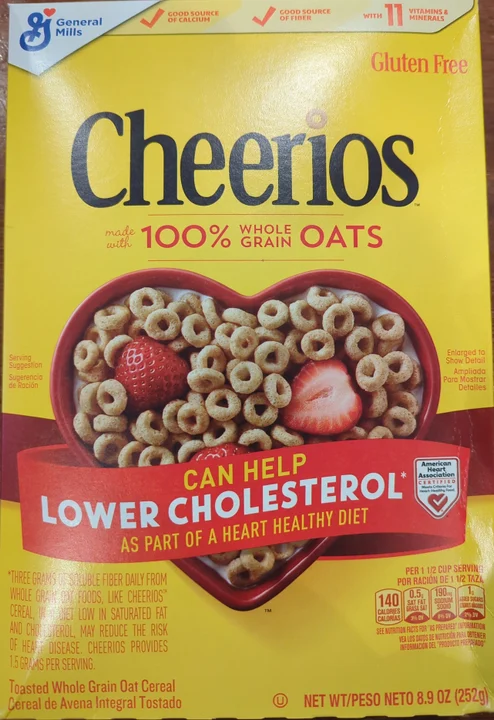
| Original Cheerios | A gluten-free cereal claim41; the Allergens / Disclaimers field reads “Does not contain declaration obligatory allergens”, with no may-contain or facility line42 |
| Cheerios Oat Crunch Cinnamon | “May contain wheat ingredients.”43 The page makes no gluten-free claim for it44 |
| Honey Nut Cheerios | General Mills’ FAQ says “Both original and Honey Nut Cheerios are gluten free”45 |
| Chex Mix Traditional | “Contains wheat and soy ingredients.”46 |
| Chex Mix Muddy Buddies Peanut Butter & Chocolate | “Contains peanut, milk and soy; may contain wheat ingredients.”47 |
| Snickers milk chocolate bar | “CONTAINS PEANUTS, MILK, EGG AND SOY. MAY CONTAIN TREE NUTS.”48 |
| Snickers Crunchy Peanut Butter ice cream bar | “CONTAINS MILK, PEANUTS AND SOY. MAY CONTAIN TREE NUTS AND WHEAT.”49 |
| Nature Valley Crunchy granola bars | Oats ’n Honey page: “Contains soy; may contain peanut, almond and pecan ingredients.”50 The FAQ says all Crunchy flavors may contain peanut, almond and pecan ingredients51 |
Three patterns show in the table. One maker’s pages show a wheat advisory on one cereal and none on another: Oat Crunch Cinnamon carries one, Original Cheerios does not43, 42. A wheat line can sit in the Contains statement, as on Chex Mix Traditional, or only as a may-contain line, as on Muddy Buddies46, 47. And a may-contain line names the allergen the maker means: Nature Valley’s names peanut, almond and pecan, not wheat50.
For what stands behind its gluten-free Cheerios, General Mills says it separates the oats from grains that contain gluten52 and tests multiple composited samples of finished product to ensure every production lot meets FDA’s standard for gluten-free foods53. That is the maker’s own description of its process.
Maker pages change. Betty Crocker’s page for its Bisquick Gluten Free mix says to see the physical product’s packaging for the most up-to-date information on ingredients and allergen statements54. The package in your hand has the final word.
What to check next, in order
- Look on the front and in the ingredient list for a gluten-free claim: “gluten-free”, “free of gluten”, “without gluten” or “no gluten”. All four have to meet the same requirements55, and an advisory line beside the claim does not change that3.
- Read the ingredient list and the Contains line for wheat, and the ingredient list alone for barley, rye and malt, which the allergen list does not name22.
- Look for a certifier’s mark. GFCO says it certifies physical products displaying its mark, not brands or facilities38.
- With no claim and no mark, ask the maker. NCA suggests asking whether gluten is used on the same belt or equipment, what cleaning happens between products, and what procedures prevent cross-contact32.
- If you cannot get a clear answer, another product is the straightforward choice. Our verdicts, A to Z show what the makers’ own pages said for the foods we have checked.
Verdicts in this guide
 CheeriosLabeled gluten-freeWheat warning on 1 of 8 varieties we checkedGeneral Mills · checked Nov 16, 2026
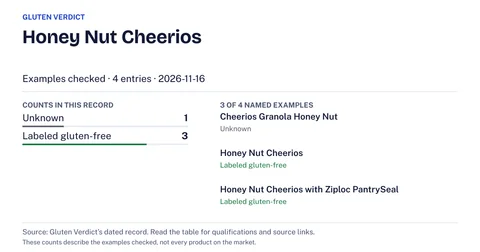 Honey Nut CheeriosLabeled gluten-freeGeneral Mills · checked Nov 16, 2026
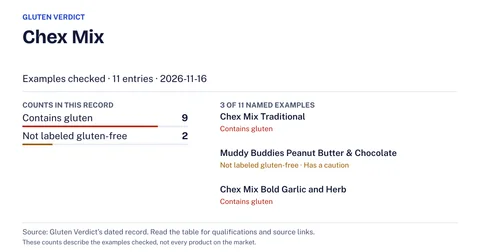 Chex MixContains glutenGeneral Mills · checked Nov 16, 2026
 SnickersNot labeled gluten-freeWheat warning on 1 of 7 varieties we checkedMars Wrigley · checked Nov 16, 2026
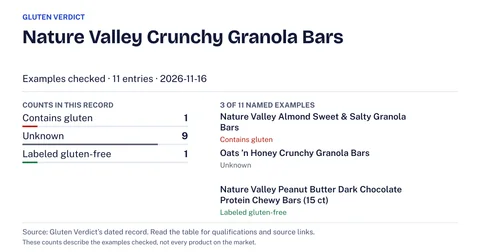 Nature Valley Crunchy Granola BarsUnknown1 of 11 varieties we checked contains gluten: Nature Valley Almond Sweet & Salty Granola BarsGeneral Mills · checked Nov 16, 2026
Questions people ask
Does “may contain wheat” mean the food has gluten in it?
FDA says an advisory statement such as “may contain wheat” describes the potential of unintended wheat allergen presence due to cross-contact, not an ingredient8, 11. If the pack also carries a gluten-free claim, the food must still meet the rule’s limit of less than 20 ppm3, 4. The wording itself gives no amount, and FDA has not established specific thresholds for any food allergens9.
Is a “may contain” line required by law?
No. NCA says these statements are voluntary and not required1, and FDA’s allergen guidance says the allergen-labeling section of the law does not address them2. What is required is the declaration of major food allergens in the ingredient list or a Contains statement21.
Can a gluten-free food say it was made in a facility that processes wheat?
FDA says the regulation does not prohibit it, provided the statement is truthful and not misleading10. The food still has to comply with 21 CFR 101.913.
Why does a pack warn about wheat but say nothing about barley or rye?
FDA’s major food allergen list names wheat, not barley or rye22, and GIG says may-contain and shared-equipment statements are voluntarily included to alert wheat-allergic consumers19. What a maker puts in a voluntary line is the maker’s choice1, so ask the maker about barley and rye.
Does a certified gluten-free mark override a may-contain line?
GIG says that on a product certified gluten-free, the certification means it is gluten-free regardless of any “may contain” type statements and contains 10 ppm gluten or less5. That is GIG’s statement about its own program.
More in Label reading and gluten-free claims
 How to check whether a packaged food is gluten-freeA four-step check for one packaged food: the claim, the ingredient and allergen lines, the maker’s dated page and the certifier’s directory.
 When a gluten-free label looks wrong: what to keep, who to tell, where to lookFound wheat, barley or malt in a food labeled gluten-free? What to keep, whom to tell, which US agency takes the report, and where recalls are listed.
 How to read a US food label for glutenWhere gluten shows up on a US food label: the gluten-free claim, the Contains line, the ingredient list and may-contain lines, and what each means.
 The FDA gluten-free rule: what 21 CFR 101.91 requires and what 20 ppm measuresWhat FDA’s gluten-free rule requires, which claim words it covers, what 20 ppm means for a portion of food, and how FDA checks that a claim holds.
 The Contains line names wheat, not barley or rye: what US allergen labels coverWhat the US allergen Contains line covers, why it names wheat but not barley or rye, and which ingredient-list names stand in for them.
 What to ask a food maker about gluten, and how to read the replyHow to write to a food maker about gluten: what to include, questions that get a usable answer, and how to sort the reply.
Related guides
 Gluten-free certification programs compared: limit, testing and auditsHow GFCO, GFFP, NSF and the BRCGS-based marks differ on gluten limit, testing and audits, set against FDA’s 20 ppm rule for every claim.
 Gluten cross-contact at home: where it happens and what to do about itHow gluten reaches gluten-free food at home, whether to separate, wash or ask for each route, and which rules have lab data behind them.
 Gluten-free baby food: what the makers’ labels say about wheat, barley and oatsWhat baby cereal, puff, snack and pouch makers print about wheat, barley, oats and gluten, read from their own pages, with the date we read them.
 Teaching a child to read gluten-free labels, one skill at a timeFour label skills to teach a gluten-free child in order, a cupboard practice game, and the questions an adult still answers.
Sources
- [1, 6, 27, 32] National Celiac Association, Manufactured in shared facility (NCA Celiac Disease Questions), checked Nov 17, 2026.
Read on 2026-11-17: the list after “Here are some questions to ask:” names three questions: “Is gluten used on the same belt/equipment?”, “Do you have a cleaning process between products” and “What are your procedures for preventing cross-contact?”
- [2, 7, 9, 12, 14, 15, 21, 22] US Food and Drug Administration, Questions and Answers Regarding Food Allergens, Including the Food Allergen Labeling Requirements (Edition 5, January 2025), checked Nov 17, 2026.
Read on 2026-11-17: the table under Question A.1 lists milk, eggs, peanuts, wheat, soybeans and sesame as foods, and fish, crustacean shellfish and tree nuts as food groups. Barley and rye are not in it.
- [3, 10, 20, 24, 25, 55] US Food and Drug Administration, Questions and Answers on the Gluten-Free Food Labeling Final Rule, checked Nov 17, 2026.
- [4, 23, 29] Electronic Code of Federal Regulations (eCFR), 21 CFR 101.91 Gluten-free labeling of food, checked Nov 17, 2026.
- [5, 19, 26, 30] Gluten Intolerance Group, Can you explain the “may contain” statements and why those with celiac disease do not need to worry about them? (GIG FAQ), checked Nov 17, 2026.
- [8, 11, 28] US Food and Drug Administration, Frequently Asked Questions: Food Allergen Labeling Guidance for Industry, checked Nov 17, 2026.
- [13, 36] PubMed (Food and Chemical Toxicology), Risk of consuming products with or without precautionary wheat or gluten labelling for persons with coeliac disease (Food Chem Toxicol 2022), checked Nov 17, 2026.
- [16, 17] US Food and Drug Administration, FDA Releases Draft Compliance Policy Guide on Major Food Allergen Labeling and Cross-Contact (May 16, 2023), checked Nov 17, 2026.
- [18] US Food and Drug Administration, CPG Sec 555.250 DRAFT: Major Food Allergen Labeling and Cross-contact, checked Nov 17, 2026.
- [31] National Celiac Association, Can I eat a product that is not labeled gluten free but does not contain ingredients with gluten? (reviewed April 8, 2025), checked Nov 17, 2026.
Read on 2026-11-17: under “If something is not labeled GF watch out for these six words on the label:” the list names wheat, rye, barley, malt, brewer’s yeast and oats.
- [33, 34, 35] PubMed (Food Chemistry), Gluten detection in foods available in the United States - a market survey (Food Chem. 2015), checked Nov 17, 2026.
- [37, 38, 39, 40] Gluten Intolerance Group, How Does GFCO Certify Gluten-Free Food?, checked Nov 17, 2026.
- [41, 42] General Mills (Cheerios), Original Cheerios (product page), checked Nov 17, 2026.
Read on 2026-11-17: the product page shows “Does not contain declaration obligatory allergens” under Allergens / Disclaimers, and the words “may contain”, “facility”, “shared” and “equipment” do not appear on the page.
- [43, 44] General Mills (Cheerios), Cheerios Oat Crunch Cinnamon (product page), checked Nov 17, 2026.
Read on 2026-11-17: the product description, consumer statements, ingredients and allergen lines on the page make no gluten-free claim for this cereal; “Gluten Free” appears only as navigation links in the site menu and footer.
- [45] General Mills (Cheerios), Cheerios FAQs, checked Nov 17, 2026.
- [46] General Mills (Chex Mix), Chex Mix Traditional (product page), checked Nov 17, 2026.
- [47] General Mills (Chex Mix), Muddy Buddies Peanut Butter & Chocolate (product page), checked Nov 17, 2026.
- [48] Mars Wrigley (Snickers), SNICKERS Full Size Milk Chocolate Candy Bar, 1.86 oz (product page), checked Nov 17, 2026.
- [49] Mars Wrigley (Snickers), SNICKERS Milk Chocolate Crunchy Peanut Butter Ice Cream Bars, 2.62 Oz Bar (product page), checked Nov 17, 2026.
- [50] Nature Valley (General Mills), Oats ’n Honey Crunchy Granola Bars (product page), checked Nov 17, 2026.
- [51] Nature Valley (General Mills), Nature Valley FAQs, checked Nov 17, 2026.
- [52, 53] General Mills (Cheerios), Gluten Free (Cheerios), checked Nov 17, 2026.
- [54] Betty Crocker (General Mills), Bisquick Gluten Free Pancake & Baking Mix (product page), checked Nov 17, 2026.