Gluten in sausage, hot dogs and deli meat: fillers, binders and flavorings
Short answer
Plain meat is naturally gluten-free, but sausage, hot dogs and deli meat are processed, and what the maker adds decides it1, 2, 5. Meat labels follow USDA rules, not FDA’s gluten-free regulation10. On the pack in your hand, check:
Part of Hidden gluten in ingredients, sauces and processed foods, 21 guides
Key points
- Meat is naturally gluten-free without additives or some seasonings; hot dogs and sausages are among the foods where gluten may be found1, 2.
- FDA’s gluten-free regulation does not apply to meat and poultry, which USDA regulates10.
- On meat labels, “spices” and “flavoring” may be declared as a group12, and a Contains line is voluntary13.
- Starch or dextrin on a meat product could come from any grain, including wheat25.
- Old Trapper’s Teriyaki jerky and SPAM Teriyaki list soy sauce made with wheat, per the makers’ own pages47, 48.
Plain meat is naturally gluten-free; processed meat depends on what is added
NIDDK says many foods, such as meat, are naturally gluten-free when they come without additives or some seasonings1. The Celiac Disease Foundation likewise lists meat and poultry among its naturally gluten-free food groups4.
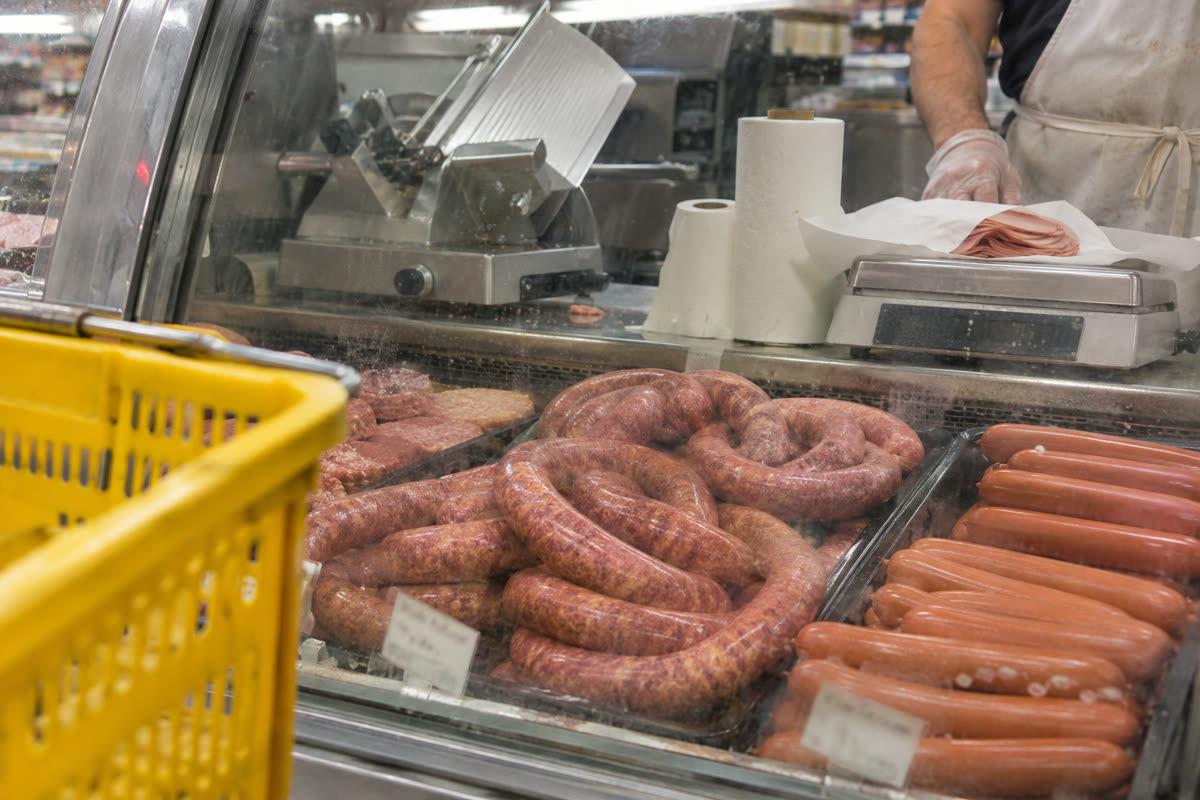
Processing is where that changes. NIDDK lists hot dogs and sausages among the foods where gluten may be found2, and the Celiac Disease Foundation puts processed lunch meats, pre-seasoned meats, self-basting poultry and starch or dextrin on a meat product on its list of foods to verify by reading the label or checking with the maker5.
USDA’s sausage standard allows some of the additions. It says certain sausage may contain binders and extenders6, and that sausage is usually seasoned with “condimented proportions of condimental substances”7. For the cooked sausages covered by the standard for frankfurters, hot dogs and similar products, a binder or extender has to be named in the ingredient list by its common or usual name8, and the label may not say “All Meat”9.
The standard points to other regulations for which binders and extenders are permitted6, so it does not tell you which one a given product uses. The ingredient list does8.
Whose rules a meat label follows
FDA’s gluten-free labeling regulation does not apply to foods whose labeling USDA regulates, which are generally meats, poultry and certain egg products10. NIDDK says the same3. For these products the rules and guidance come from USDA, through its FSIS, and four points matter to a shopper:
- Ingredients have to be declared. FSIS says all ingredients used to make a meat, poultry or egg product must be in the ingredients statement11, other than processing aids51. But “spices” and “flavoring” may be declared as a group instead of one by one12.
- A Contains line is voluntary. FSIS describes statements that alert people to specific ingredients as voluntary13. FSIS says gluten is not one of the “Big 9” major food allergens14, and that products with no wheat but with rye or barley could also contain gluten15. A meat label that does not name wheat therefore does not clear the rest of the list.
- Advisory lines are limited. FSIS’s allergen labeling guideline, which is guidance and not a regulation52, says a “may contain” statement or a statement about the plant may only be used where the establishment shows its sanitation procedures cannot effectively eliminate the cross-contact problem16.
- A gluten-free statement is a special claim. FSIS’s label-approval guideline lists negative claims such as “gluten free” among special statements and claims19, and says special statements and claims that are generally not defined in its regulations or its Food Standards and Labeling Policy Book must be submitted to FSIS for approval20.
FSIS inspectors now check gluten as an ingredient. In a directive revised in September 2025, FSIS says its inspectors will verify that establishments accurately control and label gluten similar to the major allergens17. The task is about labeling gluten when it is in the product’s formulation18.
Because FDA’s regulation does not cover these products10, we attribute a gluten-free statement on a meat product to its maker, as our verdicts do. Our guide on who regulates gluten-free claims lays out the FDA, USDA and TTB split.
Names to look for in a processed-meat ingredient list
These names come from FSIS’s own inspector lists, from two charities and from makers’ pages. FSIS says its lists are not comprehensive21, so an unfamiliar grain-sounding word is a reason to ask.
| Name on the label | What the sources say |
|---|---|
| Flour, bread crumbs, cracker meal, wheat gluten, hydrolyzed wheat protein, wheat starch | FSIS’s inspector list names these among ingredients that mean a meat, poultry or egg product likely contains wheat21. |
| Rusk | A twice-baked, gluten-containing bread used as a cereal filler in some sausages, such as British “banger” sausages, the Gluten Intolerance Group says28. |
| Malt extract, malt flavoring, malt syrup, barley flour, rye flour, yeast extract | FSIS’s list names these among ingredients that mean a meat, poultry or egg product likely contains rye or barley22. |
| Starch, modified food starch, dextrin | Starch or dextrin on a meat or poultry product could be from any grain, including wheat, the Celiac Disease Foundation says25. The Gluten Intolerance Group says sliced deli meats may contain thickeners such as wheat-derived dextrin or modified food starch, and that these additives are not always, but sometimes, made from gluten grains31. |
| Soy sauce, teriyaki, soy sauce powder | FDA says soy sauce made from soybeans and wheat may not carry a gluten-free claim24, and FSIS’s list names soy sauce among foods where wheat is sometimes found23. Two product pages below list wheat inside the soy sauce. |
| “Spices” or “flavoring” | On a meat label these may be declared as a group rather than named one by one12. If the list stops there, the maker is the one who can say what they contain. |
| Surimi, imitation crab | FSIS’s list names surimi among foods where wheat is sometimes found23, and the Gluten Intolerance Group says some imitation crab uses wheat starch to bind33. |
Meatless sausage is a different question. The Gluten Intolerance Group notes that some specialty or plant-based sausages could contain wheat gluten29; see our guide to plant-based meat and seitan.
Product by product
The pages below are makers’ own statements, read on 2026-11-17. They show where the differences sit; they are not a rule for the whole category, and a recipe can change. For each food’s full verdict, follow the links.
Sausage and breakfast links
The standard allows binders and extenders in certain sausage6, and the Gluten Intolerance Group names rusk as a cereal filler in some types28. A plain list is possible: Applegate’s Classic Pork Breakfast Sausage page lists pork, water, cane sugar, salt and spices35 and carries a “Gluten Free” tag36. Our sausage verdict covers the products we checked.
Hot dogs and corn dogs
USDA’s standard for frankfurters, hot dogs and similar products lets binders and extenders be used, and requires any that are added to be listed by name8. Applegate’s Beef Hot Dog page lists grass-fed beef, water, sea salt, vinegar, garlic, paprika, spices, onion and cultured celery powder37 and carries a “Gluten Free” tag38. See hot dogs.
For corn dogs the coating is where one brand’s two products differ. Foster Farms’s regular Honey Crunchy Corn Dogs list a batter with wheat flour and malted barley flour39 and a Contains line naming wheat40. Its Gluten Free Honey Crunchy Corn Dogs list a batter that includes corn meal, corn flour, corn starch, tapioca starch and rice flour41, and the page calls them gluten free42. See corn dogs.
Deli meat, ham, bacon and scrapple
For sliced deli meats, see the starch and dextrin row in the table above31. Makers differ even within one brand: Dietz & Watson says all but two of its meat selections are gluten free, naming its Scrapple and Bockwurst45, and its Philadelphia Scrapple page lists whole wheat flour46.
For bacon, the Gluten Intolerance Group says some brands or varieties contain gluten due to additives and flavorings34, so a flavored or seasoned variety needs its own label read. Our verdicts: deli meat, ham, bacon, salami and pepperoni.
Jerky and teriyaki-style meats
The Gluten Intolerance Group says certain flavors of beef jerky, such as teriyaki, contain soy sauce30. Old Trapper’s Teriyaki jerky page lists soy sauce powder made with wheat47, and SPAM Teriyaki lists soy sauce made from soybeans and wheat48. Flavors of one brand can differ, so read each flavor’s list. See beef jerky and SPAM.
Meatballs and breaded items
Farm Rich’s Homestyle Meatballs (26 oz and 60 oz packs) list bread crumbs made with wheat flour43 and a Contains line naming soy and wheat44. The Celiac Disease Foundation lists breading and coating mixes among common foods that contain gluten26, which is the thing to check on breaded items such as chicken nuggets. See meatballs; for coatings on frozen vegetables and fries, see our guide on frozen coatings.
Imitation crab
The Gluten Intolerance Group says some imitation crab uses wheat starch to bind and that, unless labeled or certified, wheat starch cannot be assumed to be gluten-free33. Trans-Ocean’s Crab Classic page lists pea starch and potato starch among its ingredients49 and says the product is certified gluten-free by the National Foundation for Celiac Awareness50. See imitation crab.
At the counter: what to read and ask
Work from the package or the maker’s own list, not the name on the case:
- Ask to read the package or the maker’s ingredient list for that exact product, and read all of it, since a Contains line is voluntary on meat13.
- Look for the names in the table above: wheat, flour, bread crumbs, rusk, malt, barley, rye, yeast extract, starch, dextrin and soy sauce.
- Treat “spices” and “flavoring” as a question for the maker, since they may be declared as a group12.
- If the label is not enough, contact the maker. The Gluten Intolerance Group’s advice for deli meats, which are USDA-regulated, is to contact the manufacturer with questions32. Our guide on what to ask a manufacturer has wording.
- Ask how the slicer is handled. The Gluten Intolerance Group warns about cross-contact when deli workers use the same slicing machines for all products, and says pre-packaged lunch meats labeled or certified gluten-free are one way around it32. More in our guide to deli, bakery and bulk-bin counters.
The Celiac Disease Foundation’s advice when you cannot verify the ingredients, or the list is unavailable, is not to eat the item27.
For other places gluten hides in packaged food, see where gluten hides in everyday foods.
Verdicts in this guide
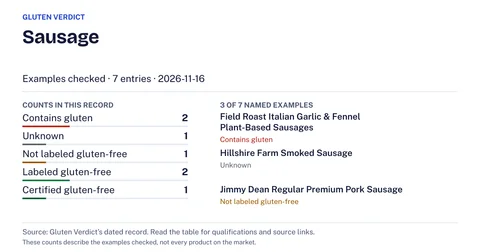 SausageDepends on the product2 of 7 products we checked contain gluten: Field Roast Italian Garlic & Fennel Plant-Based Sausages and Tofurky Plant-Based Italian Sausagechecked Nov 16, 2026
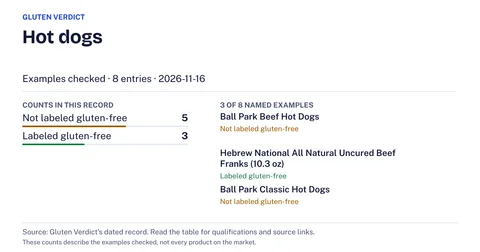 Hot dogsDepends on the productchecked Nov 16, 2026
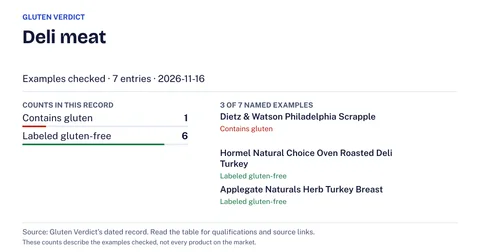 Deli meatDepends on the product1 of 7 products we checked contains gluten: Dietz & Watson Philadelphia Scrapplechecked Nov 16, 2026
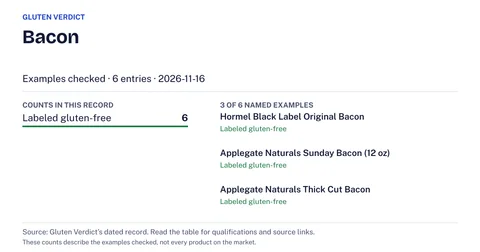 BaconDepends on the productchecked Nov 16, 2026
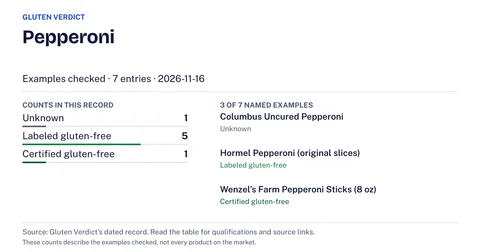 PepperoniDepends on the productchecked Nov 16, 2026
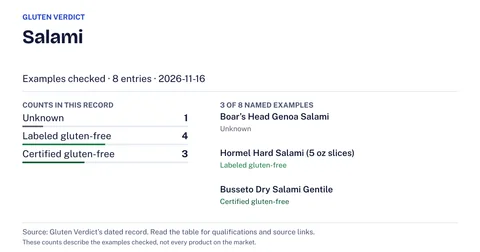 SalamiDepends on the productchecked Nov 16, 2026
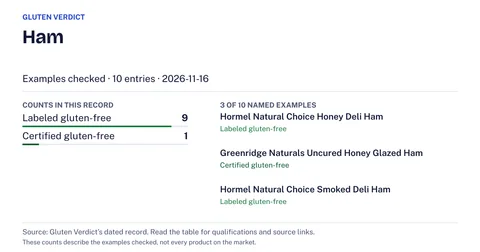 HamDepends on the productchecked Nov 16, 2026
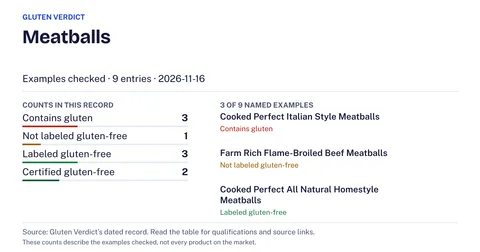 MeatballsDepends on the product3 of 9 products we checked contain gluten: Cooked Perfect Italian Style Meatballs, Cooked Perfect Restaurant Style Meatballs, and Farm Rich Homestyle Meatballschecked Nov 16, 2026
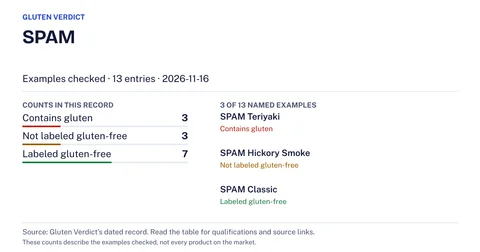 SPAMLabeled gluten-free3 of 13 varieties we checked contain gluten: SPAM Teriyaki, SPAM Korean BBQ, and SPAM Bachan’s Original Japanese Barbecue Sauce FlavoredHormel Foods · checked Nov 16, 2026
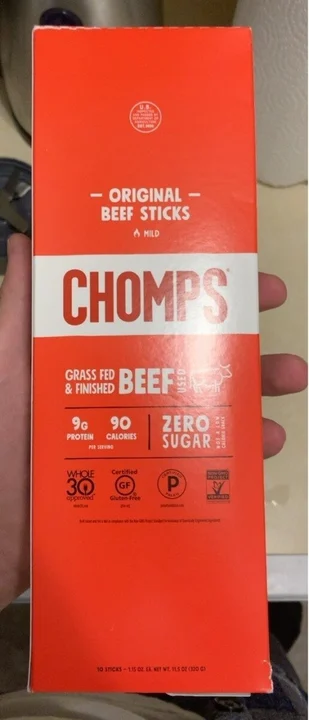 Beef jerkyDepends on the product3 of 8 products we checked contain gluten: Jack Link’s Original Beef Jerky, Jack Link’s Teriyaki Beef Jerky, and Old Trapper Teriyaki Beef Jerky (bulk)checked Nov 16, 2026
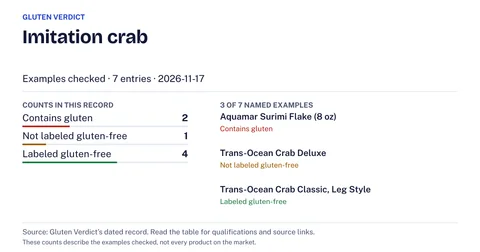 Imitation crabDepends on the product2 of 7 products we checked contain gluten: Aquamar Surimi Flake (8 oz) and Aquamar Surimi Stick (8 oz)checked Nov 17, 2026
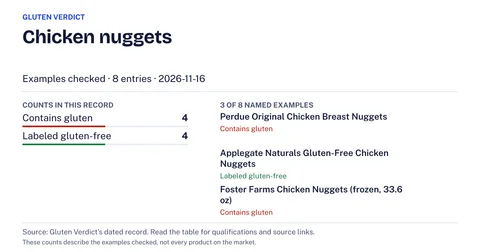 Chicken nuggetsDepends on the product4 of 8 products we checked contain glutenchecked Nov 16, 2026
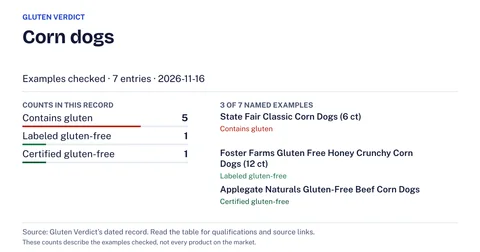 Corn dogsDepends on the product5 of 7 products we checked contain glutenchecked Nov 16, 2026
Questions people ask
Do hot dogs have gluten?
It depends on the product. NIDDK names hot dogs among the foods where gluten may be found2, so read the list on the pack. Applegate’s Beef Hot Dog page, for one, lists no gluten grain37. Our hot dog verdict covers the brands we checked.
Does the FDA’s gluten-free rule cover sausage and deli meat?
No. FDA says its gluten-free regulation does not apply to foods whose labeling USDA regulates, generally meats, poultry and certain egg products10.
If a meat label has no “Contains wheat” line, is it free of gluten?
Not necessarily. A Contains line is voluntary on meat13, and FSIS says products with rye or barley but no wheat could also contain gluten15. Read the whole ingredient list.
Is bacon gluten-free?
The Gluten Intolerance Group says some brands or varieties of bacon contain gluten due to additives and flavorings34. Our bacon verdict lists what the makers we checked state.
More in Hidden gluten in ingredients, sauces and processed foods
 Plant-based meat, tofu and seitan: finding the wheat glutenSeitan and some meat substitutes are made from wheat gluten. How to spot it on a plant-based label, with ingredient lists from maker pages.
 Where wheat, barley and rye hide in processed food: 15 places to checkFifteen processed foods where wheat, barley or rye turn up, the label step that catches each, and what US allergen law does and does not flag.
 Foods that contain gluten, aisle by aisle, and the label words that give them awayA store-order map of foods that contain gluten, which depend on the brand, and which need a cross-contact check, with the label words to look for.
 Wheat, barley and rye on an ingredient list: the names to look forLook up wheat, barley and rye names on a US ingredient list, from durum to malt, and sort each as contains gluten, depends on the maker, or lookalike.
 Soy, hoisin, oyster, teriyaki and fish sauce: which bottles carry wheatSoy, hoisin, oyster, teriyaki and fish sauce compared by the ingredient lists of Kikkoman, Lee Kum Kee, San-J and Red Boat, plus what to ask at a counter.
 What to use instead of soy sauce when you eat gluten-freeTamari, gluten-free soy sauce, coconut aminos and liquid aminos: what each maker says, how to confirm it on the bottle, and what changes when you cook.
All 21 guides in Hidden gluten in ingredients, sauces and processed foods
Related guides
 Frozen fries, hash browns and vegetables: where wheat hides in the coating, seasoning and sauceHow to tell a plain frozen potato or vegetable bag from one with a wheat batter, coating, seasoning or sauce, using the ingredient list and Contains line.
 Who regulates a gluten-free claim: FDA, USDA or TTBWhich agency sets the rules for a gluten-free claim on packaged food, meat, eggs, beer, wine and spirits, and what to check when a label is unclear.
 Gluten-free high-protein foods: where gluten hides in bars, powders, jerky and marinadesCheck each protein product type for its gluten trap: seitan, jerky, bars, powders, sausage and broth, with what makers say on their own pages.
 Deli, bakery and bulk-bin counters on a gluten-free dietFor each store counter (deli, bakery, bulk bins, bars): skip it, ask first, or buy the packaged item, and what a store’s own statement tells you.
Sources
- [1, 2, 3] NIDDK (NIH), Eating, Diet, & Nutrition for Celiac Disease, checked Nov 17, 2026.
- [4] Celiac Disease Foundation, Gluten-Free Foods, checked Nov 17, 2026.
Read on 2026-11-17: the list introduced as “naturally gluten-free food groups” names fruits, vegetables, meat and poultry, fish and seafood, dairy, and beans, legumes, and nuts.
- [5, 25, 26, 27] Celiac Disease Foundation, Sources of Gluten, checked Nov 17, 2026.
Read on 2026-11-17: the list headed “Foods That May Contain Gluten”, introduced by “These foods must be verified by reading the label or checking with the manufacturer/kitchen staff.”, names processed lunch meats, starch or dextrin on a meat or poultry product, self-basting poultry and pre-seasoned meats, among other foods.
Read on 2026-11-17: the list headed “Common Foods That Contain Gluten” names “Breading & Coating Mixes”, with panko breadcrumbs under it.
- [6, 7] Electronic Code of Federal Regulations (US National Archives and GPO), 9 CFR 319.140 Sausage, checked Nov 17, 2026.
- [8, 9] Electronic Code of Federal Regulations (US National Archives and GPO), 9 CFR 319.180 Frankfurter, frank, furter, hotdog, weiner, vienna, bologna, garlic bologna, knockwurst, and similar products, checked Nov 17, 2026.
- [10, 24] US Food and Drug Administration, Questions and Answers on the Gluten-Free Food Labeling Final Rule, checked Nov 17, 2026.
- [11, 13, 16, 52] USDA Food Safety and Inspection Service, Allergens - Voluntary Labeling Statements (FSIS guideline 2013-0010), checked Nov 17, 2026.
- [12, 14, 17, 18, 51] USDA Food Safety and Inspection Service, FSIS Directive 7230.1, Revision 4 (issued Sep 11, 2025), checked Nov 17, 2026.
- [15] USDA Food Safety and Inspection Service, FSIS Directive 7000.6, Allergen Verification Sampling Program, Revision 1, checked Nov 17, 2026.
- [19, 20] USDA Food Safety and Inspection Service, FSIS Compliance Guideline for Label Approval (July 2020), checked Nov 17, 2026.
- [21, 22, 23] USDA Food Safety and Inspection Service, FSIS Directive 7230.1 Rev. 4, Attachment 1: Allergenic Ingredients and Foods, checked Nov 17, 2026.
Read on 2026-11-17: under “9. Wheat”, which says that if meat, poultry or egg products contain any of the listed ingredients they likely contain wheat, the attachment lists bread crumbs, cereal extract, cracker meal, flour, hydrolyzed wheat protein, semolina, spelt, vital wheat gluten, wheat gluten, wheat malt, wheat protein isolate and wheat starch, among others. The attachment says of its lists: “This is not a comprehensive list”.
Read on 2026-11-17: under “B. Gluten”, which says that if meat, poultry or egg products contain any of the listed ingredients they likely contain rye or barley, the attachment lists malt extract, malt flavoring, malt syrup, malted milk, malt vinegar, brewers yeast, yeast extract, spent grains, rye flour and barley flour, among others.
Read on 2026-11-17: under “Additionally, wheat is sometimes found in the following foods”, the attachment lists baking powders (particularly imported), bouillon, glucose syrup, soy sauce, starch, surimi and Worcestershire sauce.
- [28, 29, 30, 31, 32, 33] Gluten Intolerance Group, 43 Foods Where Gluten May Be Hidden, checked Nov 17, 2026.
- [34] Gluten Intolerance Group, Indulge in Joyful Holiday Feasts with Bacon, checked Nov 17, 2026.
- [35, 36] Applegate, Applegate Naturals Classic Pork Breakfast Sausage, checked Nov 17, 2026.
Read on 2026-11-17: the product description on the page is followed by the tags “Casein Free” and “Gluten Free”. The page gives no gluten test level.
- [37, 38] Applegate, Applegate Naturals Beef Hot Dog, checked Nov 17, 2026.
Read on 2026-11-17: the product description on the page is followed by tags that include “Casein Free” and “Gluten Free”. The page gives no gluten test level.
- [39, 40] Foster Farms, Honey Crunchy Corn Dogs, Frozen - 16 ct, checked Nov 17, 2026.
- [41, 42] Foster Farms, Gluten Free Honey Crunchy Corn Dogs, Frozen - 12 ct, checked Nov 17, 2026.
- [43, 44] Farm Rich, Flame-Broiled Homestyle Meatballs, checked Nov 17, 2026.
- [45] Dietz & Watson, Gluten Free, checked Nov 17, 2026.
- [46] Dietz & Watson, Philadelphia Scrapple, checked Nov 17, 2026.
- [47] Old Trapper, Teriyaki Bulk Beef Jerky, checked Nov 17, 2026.
- [48] SPAM (Hormel Foods), SPAM Teriyaki, checked Nov 17, 2026.
- [49, 50] Trans-Ocean, Crab Classic, flake style, checked Nov 17, 2026.