Frying at home with celiac disease: fresh oil, a separate fryer or an air fryer
Short answer
Oil that has fried breaded food can carry gluten into the next batch, and Coeliac UK’s advice is to use clean oil or a separate fryer for frying gluten-free food1, 2. The 2026 shared-fryer study sampled restaurants, not home pots: six of 55 fry orders measured above 20 ppm and all 43 tortilla chip samples measured below 5 ppm, and its lead author says it is not a green light for any shared fryer3, 4, 5. GIG advises against using one air fryer for both kinds of cooking8.
Part of Cross-contact and the home kitchen, 19 guides
Key points
- Coeliac UK advises clean oil or a separate fryer for frying gluten-free food1.
- In an FDA-led lab study reported by Gluten Free Watchdog, oil that had fried breaded shrimp held about 260 ppm of detectable gluten after ten batches6, and all the foods fried in oil previously used to fry breaded shrimp measured above 20 ppm2.
- The 2026 study sampled food service establishments, so it does not measure a home pot or fryer3, 7.
- GIG advises against using the same air fryer for gluten-free and gluten-containing cooking8.
- Filtering reduced gluten in lab oil, but the tests used set sieves, filter papers and filter aids, and no source we cite tested a home strainer9, 10.
How oil that cooked breaded food ends up carrying gluten
Coeliac UK’s advice for frying gluten-free food at home is to use clean oil or a separate fryer1. The reason shows up in the lab data: Gluten Free Watchdog reports an FDA-led study in which oil that fried breaded shrimp held about 51 parts per million (ppm) of detectable gluten after one batch and about 260 ppm after ten11, 6.
Food fried afterwards picked it up. According to Gluten Free Watchdog’s report, the study’s authors found that all the foods fried in oil previously used to fry breaded shrimp showed a gluten content above 20 micrograms per gram, which is the same as 20 ppm2. That was a laboratory experiment12, so it shows the route, not how much gluten a home cook will meet.
The amount moved depends on the food. With oil spiked at 1,000 ppm, the lab study measured transfer of about 6.3% to French fries, 20.2% to tater tots and 9.3% to chicken breast bites13. Its authors tie the amount to how much oil the food absorbs14.
Heat is not a fix. In its advice on grills, GIG says gluten cannot be burned off by high temperature15, and in the lab study gluten was still detectable in oil after frying at 180°C (356°F)6.
What the shared-fryer studies measured
Five studies are worth knowing. They measured different things, so their numbers do not add up to one figure. The FDA-led figures below are as Gluten Free Watchdog reports them; we could not read that paper’s own abstract.
| Study | What was tested | What it found |
|---|---|---|
| Thompson et al., Gluten Free Watchdog, 2021 | 20 orders of fries bought from 10 restaurants whose fryers also cooked wheat-containing foods16 | The sandwich ELISA test found gluten in 9 of 20 orders, from 7 to over 80 ppm; a second test, the competitive ELISA, found it in 3 of 2017. The authors wrote that 25% of fry orders would not be considered gluten-free18. |
| Parsons et al., Brigham Young University, 2021 | Gluten-free food fried in a fryer also used for gluten-containing food, plus a shared toaster and sandwich spreads applied with a knife used on gluten-containing bread19 | Small amounts of cross-contact; the majority of results (93.6%), across all three practices together, showed no significant cross-contact20. |
| Jiang et al., FDA and Florida State University, Food Control, 2025 | Lab frying: fries, tater tots and chicken breast bites fried in oil spiked with gluten; gluten measured in oil after frying breaded shrimp11, 13 | Gluten in the oil rose from about 51 ppm after one shrimp batch to about 260 ppm after ten6; foods fried in the shrimp oil measured above 20 ppm2. |
| Jiang et al., FDA and Florida State University, Journal of Food Protection, 2025 | Filtering gluten-spiked oil and oil from 10 batches of breaded shrimp through sieves and filter papers9 | Passive filtration cut the gluten in the oil by over 80%, and active filtration with filter aids by more than 99.7%10. |
| Weisbrod et al., Celiac Disease Foundation and partners, Nutrients, 2026 | 98 samples of naturally gluten-free fries (55) and tortilla chips (43) from fryers shared with gluten-containing foods, in food service establishments in 14 US states3 | Six of the 55 fry orders (about 11%) exceeded 20 ppm, from 29.6 ppm to over 80 ppm; all 43 tortilla chip samples measured below 5 ppm4. |
In the 2026 study, none of the 39 samples from places reporting daily oil replacement exceeded 20 ppm, against four of 35 from places reporting weekly replacement. The Foundation notes that an observational study cannot show the oil change itself caused the difference21. Its lead author says the study “is not a green light to eat from any shared fryer”5.
Heat and measuring gluten
Gluten Free Watchdog reports that in the FDA-led lab study, 73% of gluten in oil was still detectable after 1 minute of frying at 180°C (356°F), and about 44% after 10 minutes22. It argues that deep frying makes gluten harder to detect and that test results may underestimate how much is present23. The 2026 study’s authors write that the temperatures used in commercial fryers are not known to reliably impair detection with standard sandwich ELISA tests24, and Gluten Free Watchdog says the FDA data and its own findings suggest otherwise25.
That is a live disagreement between researchers, so a result such as “below 5 ppm” is a measurement with a caveat, not an all-clear.
Do the restaurant results apply to a pot at home?
Not directly. The 2026 samples came from food service establishments, and the oil-change frequency was reported by restaurant staff and not independently verified3, 26. The authors list what they did not assess: fryer design, how much and what kind of gluten-containing food went through the fryer, oil volume, filtration, food turnover, temperature and cleaning procedures7. The study did not measure those factors in any setting, so we do not turn a restaurant figure into a home figure.
The authors conclude that shared fryers are not inherently high-risk sources of gluten cross-contact and highlight daily oil replacement as a key factor27. The Foundation adds that more research is needed before the findings can inform changes to dietary guidance28, and its lead author says they can help move from blanket assumptions toward conversations with healthcare providers about risk, frequency of exposure and individual circumstances29.
Gluten Free Watchdog’s caution goes with the oil-change finding: a daily change does not solve the problem of gluten accumulating during the hours between changes30.
Fresh oil in a clean pot, or a separate fryer
Coeliac UK names both options: clean oil or a separate fryer1. Our reading of the first is oil that has not cooked gluten-containing food, in a pot that has been washed; the second is a fryer that never meets breaded food.
For the washing, Coeliac UK says standard washing-up liquid or a dishwasher will remove gluten, and to clean pots, pans and utensils with hot soapy water31, 32.
If your fryer has a base or other parts that cannot go in water, GIG’s advice for appliances with parts like that (its list names Crock Pots, Instant Pots, food processors, blenders, stand mixers and waffle irons) is to make sure no bits of gluten-containing food remain on the non-washable parts and to wipe all parts thoroughly before using them with gluten-free food33. GIG’s page does not name deep fryers, so this is our reading of its advice for your fryer.
When you eat out, the same logic is the advice to look for a dedicated fryer: Gluten Free Watchdog recommends choosing dedicated gluten-free fryers over shared fryers with wheat whenever possible34. Restaurant fryer policies are in what fast-food chains say about shared fryers, and the wider home picture is in gluten cross-contact at home and setting up a gluten-free kitchen.
Reusing and straining oil
The lab data describe what happens as breaded batches pass through oil: more gluten in the oil after ten batches than after one6. Oil kept from frying breaded food is the kind of reused oil these studies describe.
Filtering was tested in a lab, in two ways. Passive filtration let oil run by gravity through metal sieves with pores from 25 µm to 2 mm and cellulose filter papers with pores from 11 to 25 µm9. Active filtration stirred filter aids such as diatomaceous earth and perlite into oil cooled to 105 °C, with mixing times of 5 to 30 minutes35. The authors report over 80% reduction in the gluten in the oil with passive filtration and a filtration efficiency above 99.7% with active filtration10.
Those are lab set-ups, and none of the sources we cite tested a home strainer. A reduction is also not removal. Gluten Free Watchdog says an optimized filtration system would help, while a daily oil change alone does not solve the build-up30. For a home cook the plainer route stays Coeliac UK’s: clean oil, or a separate fryer1.
Air fryers
An air fryer circulates hot air around the food. GIG says that fan motion could blow particles of previously cooked, gluten-containing food onto the gluten-free food, and advises against using the same air fryer for gluten-free and gluten-containing cooking8.
The studies above are about frying in oil, so GIG’s air-fryer advice stands on how the appliance works rather than on a measurement.
Coated frozen foods and what goes in the pot
Fries are only one of the foods that get fried. In the lab study, of the foods tested, tater tots showed the highest gluten transfer from reused oil, and the authors link that to how much oil a food absorbs14.
Breaded foods are the other half of the question: in the lab study, breaded shrimp is what put gluten into the oil6. For the coated and battered foods that go in the oil, our verdicts show what we read on each: onion rings, mozzarella sticks, chicken nuggets, fish and chips and tempura. For the foods you would fry in the clean oil, see french fries and tater tots, where seasoning and coatings differ by product.
The oil itself is a separate question from the cross-contact route in this guide: see our verdicts for vegetable oil, corn oil and peanut oil.
Verdicts in this guide
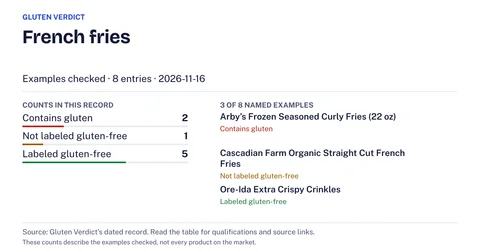 French friesDepends on the product2 of 8 products we checked contain gluten: Arby’s Frozen Seasoned Curly Fries (22 oz) and Checkers Frozen Crispy Seasoned Fries (28 oz)checked Nov 16, 2026
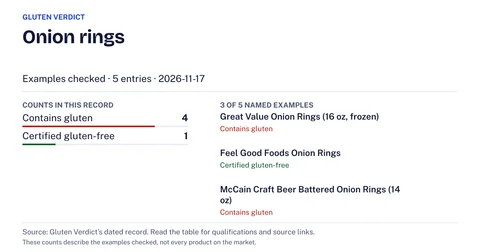 Onion ringsDepends on the product4 of 5 products we checked contain glutenchecked Nov 17, 2026
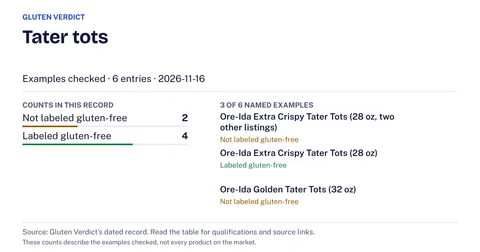 Tater totsDepends on the productchecked Nov 16, 2026
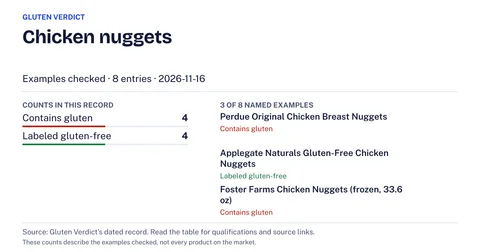 Chicken nuggetsDepends on the product4 of 8 products we checked contain glutenchecked Nov 16, 2026
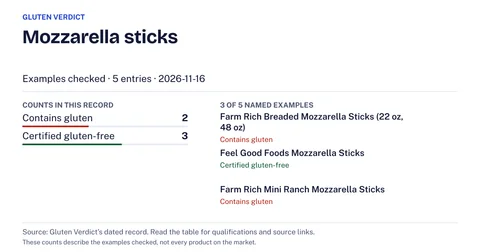 Mozzarella sticksDepends on the product2 of 5 products we checked contain gluten: Farm Rich Breaded Mozzarella Sticks (22 oz, 48 oz) and Farm Rich Mini Ranch Mozzarella Stickschecked Nov 16, 2026
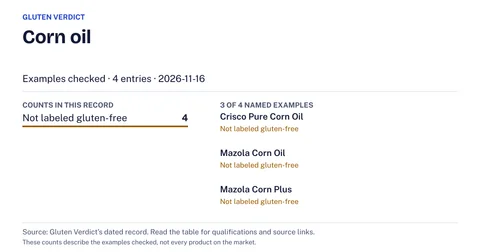 Corn oilUnknownchecked Nov 16, 2026
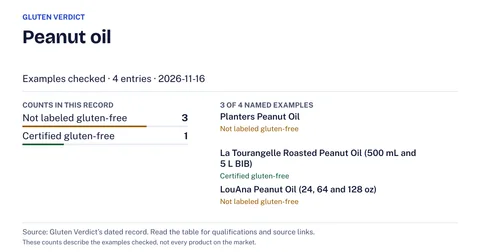 Peanut oilUnknownchecked Nov 16, 2026
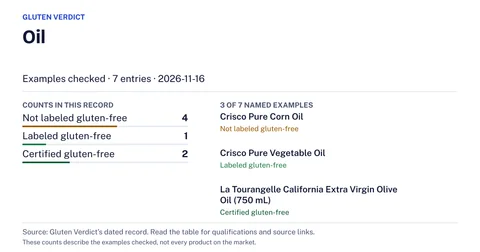 OilUnknownchecked Nov 16, 2026
 TempuraDepends on the product3 of 6 products we checked contain gluten: Kikkoman Tempura Batter Mix, Kikkoman Tempura Dipping Sauce, and Nongshim Tempura Udon Cupchecked Nov 16, 2026
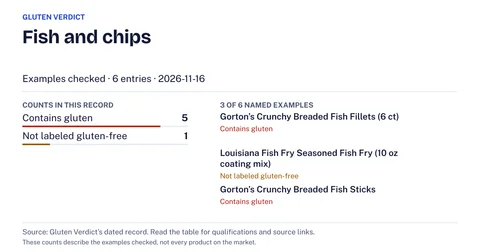 Fish and chipsDepends on the product5 of 6 products we checked contain glutenchecked Nov 16, 2026
Questions people ask
Does hot oil burn gluten off?
Not on the evidence here. GIG says, in its advice on grills, that gluten cannot be burned off by high temperature15, and the FDA-led lab study reported gluten in oil after frying at 180°C (356°F)6.
Can I reuse the oil for gluten-free food if I strain it?
Filtering reduced gluten in lab oil, by over 80% for passive filtration10. A reduction is not removal, and no source we cite tested a home strainer. Coeliac UK’s advice is clean oil or a separate fryer1.
Is a daily oil change enough?
In the 2026 restaurant study, none of 39 samples from places reporting daily oil replacement exceeded 20 ppm, against four of 35 from weekly21. Gluten Free Watchdog says a daily change does not solve gluten building up between changes30.
Do tortilla chips behave like fries in a shared fryer?
In the 2026 restaurant sample, all 43 tortilla chip samples measured below 5 ppm while six of 55 fry orders exceeded 20 ppm4. It is one study of restaurant samples, and its authors list fryer design, oil volume and other factors they did not assess7.
More in Cross-contact and the home kitchen
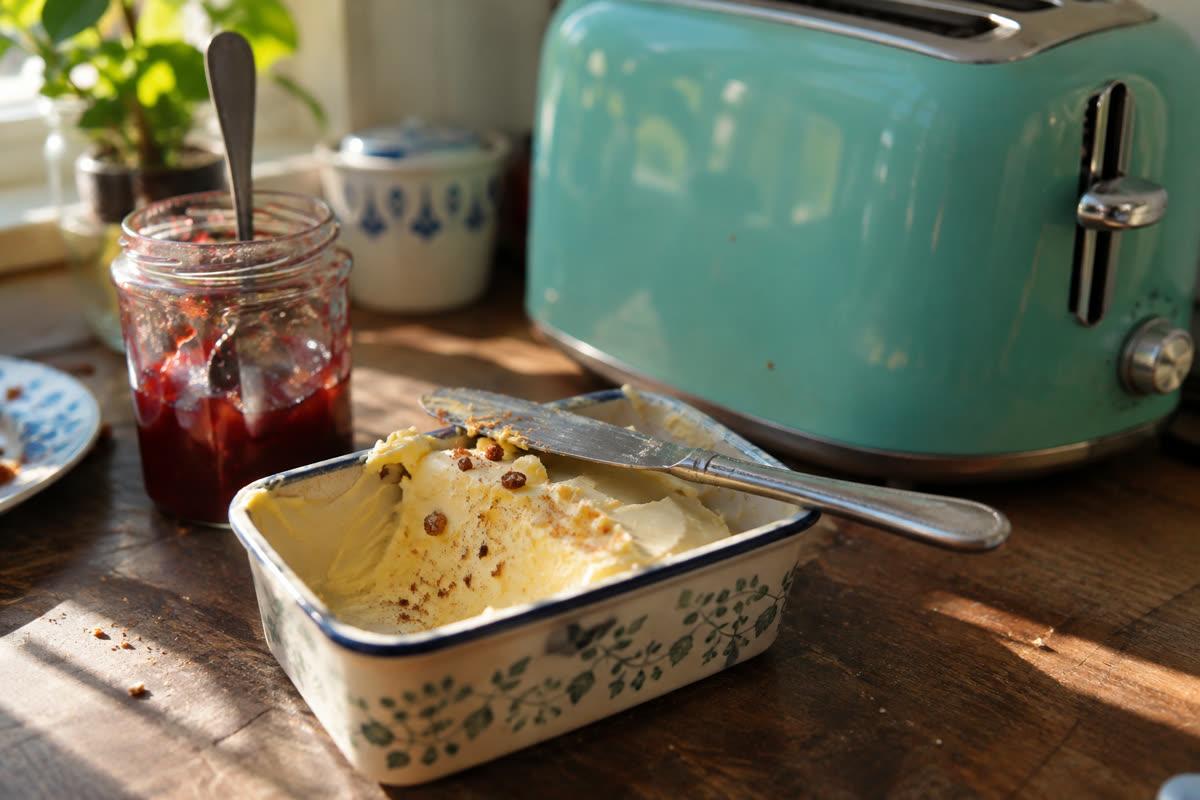 Gluten cross-contact at home: where it happens and what to do about itHow gluten reaches gluten-free food at home, whether to separate, wash or ask for each route, and which rules have lab data behind them.
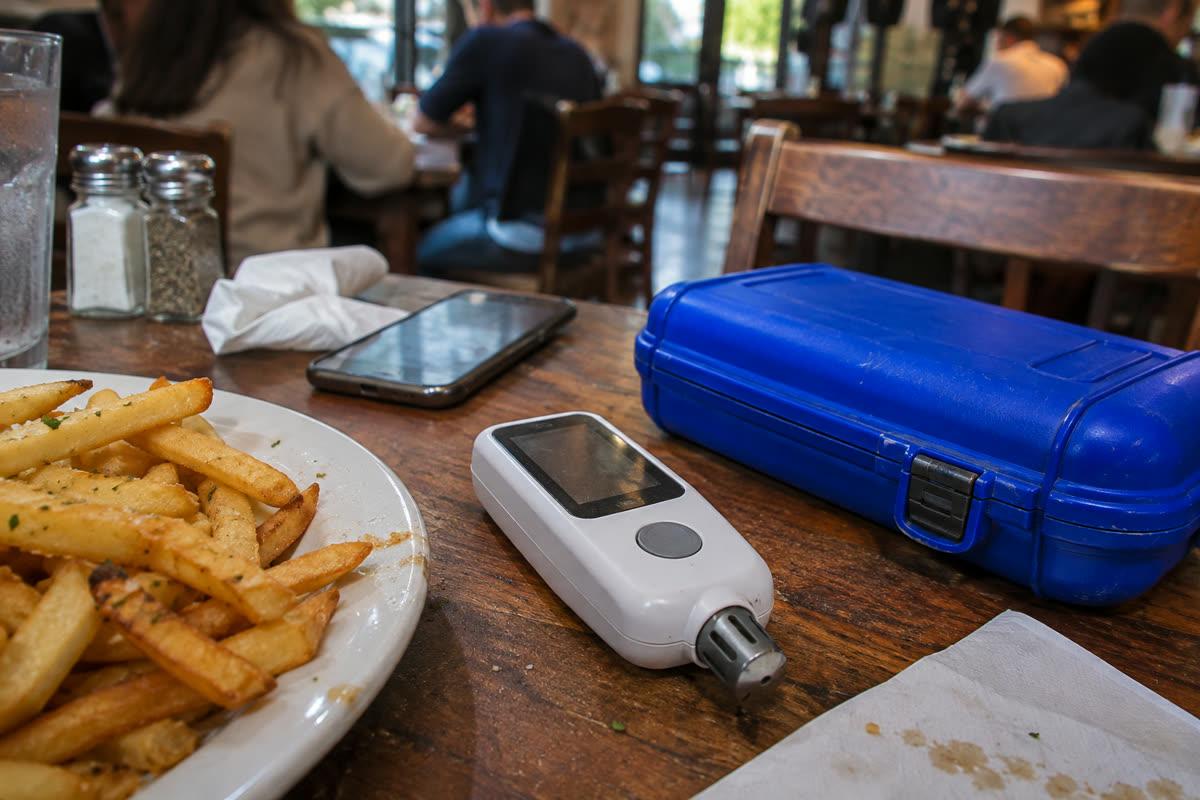 Do home gluten tests work? What a strip or pocket sensor can and cannot showWhat a home gluten test strip or pocket sensor checks, how to read a maker's detection limit, and why a negative on one bite does not clear a meal.
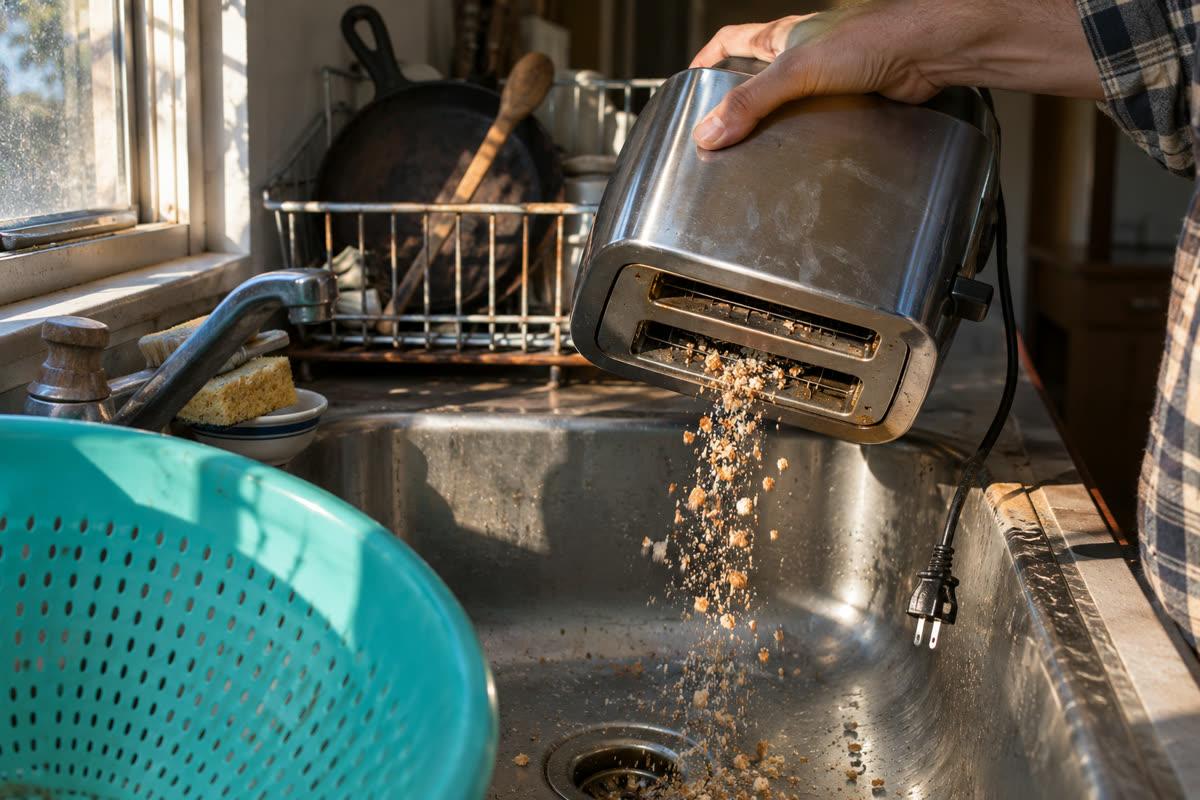 Toasters, colanders, cast iron, wood and air fryers: which can be cleanedWhich kitchen items the charities say to keep, wash or replace after going gluten-free, item by item, with what the studies we found measured.
 Airborne flour and celiac disease: what the sources sayWhat charities and studies say about wheat flour dust in the air, what is only a hypothesis, and the wipe-down and cover steps the charities suggest.
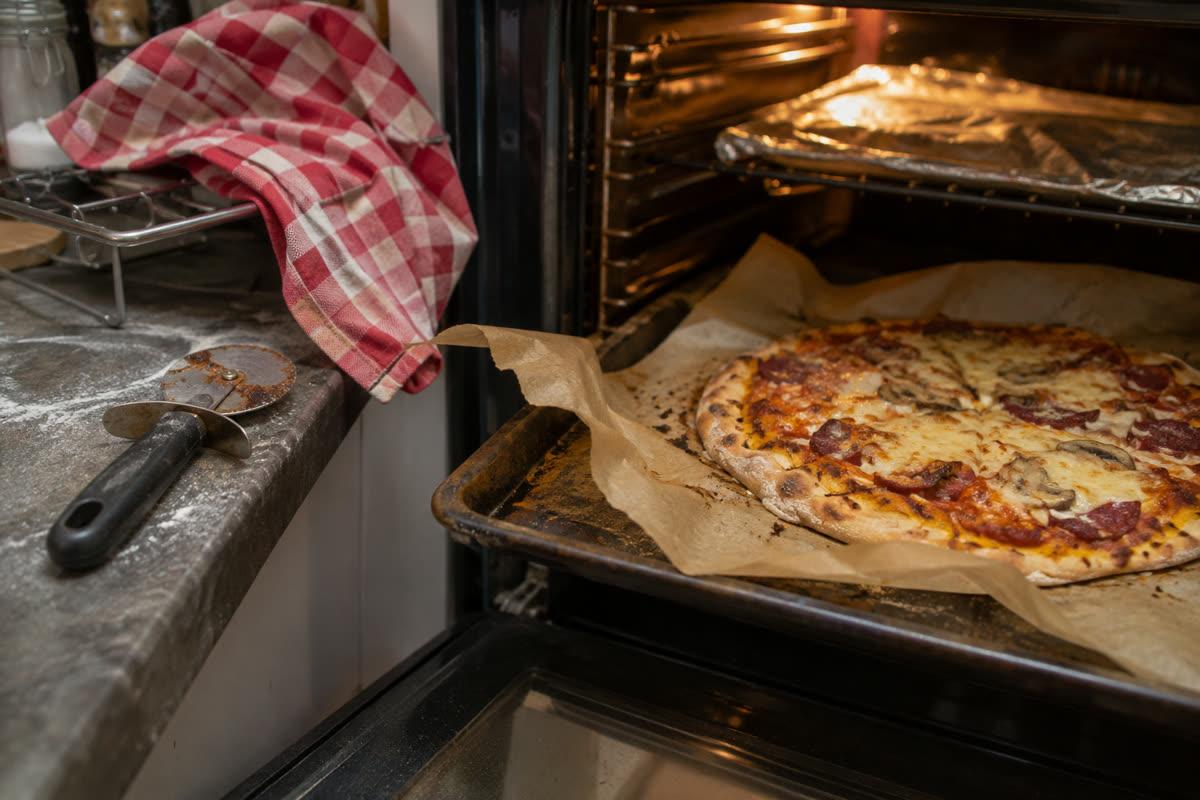 Gluten-free pizza at home: check each part, then keep it apart in the ovenCheck the crust, sauce, cheese and toppings against each maker’s own statement, then set up stone, parchment and oven so a gluten-free pizza stays apart.
 Baking gluten-free in a home where someone else bakes with wheat flourA baking-day plan for a shared kitchen: order, counters, flour storage, tools and oven, and which timing rules have no published source.
Related guides
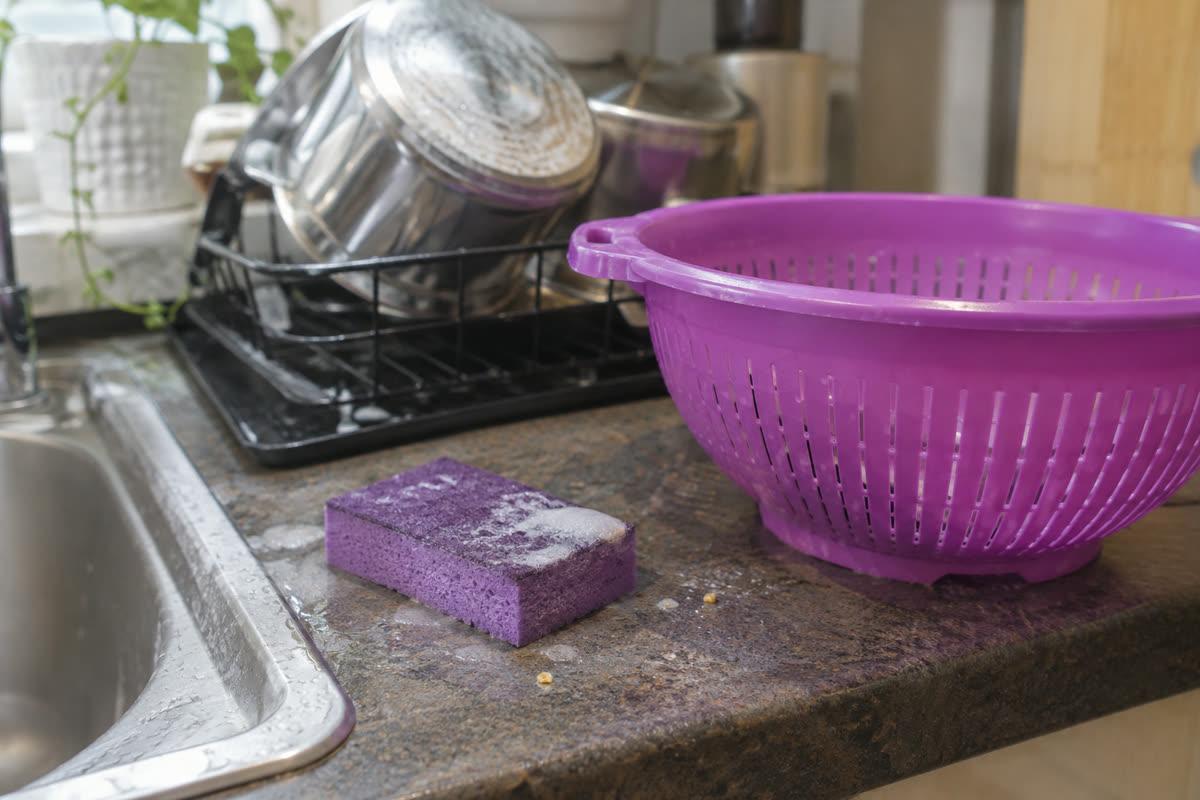 Setting up a gluten-free kitchen: what to replace, wash or shareWalk each kitchen zone and decide, item by item, what to replace, what to wash and what a mixed household can keep sharing, with charity sources.
 Eating out with celiac disease: what to check, ask and watch forPlan a restaurant meal with celiac disease: what to check before you go, the questions to ask in order, how to read the answers, and what studies measured.
 What fast-food chains say about shared fryers, and what a shared-fryer study measuredEach chain's own sentence on fryer oil, with its document and date, plus what a 2026 study measured in fries and chips from shared fryers.
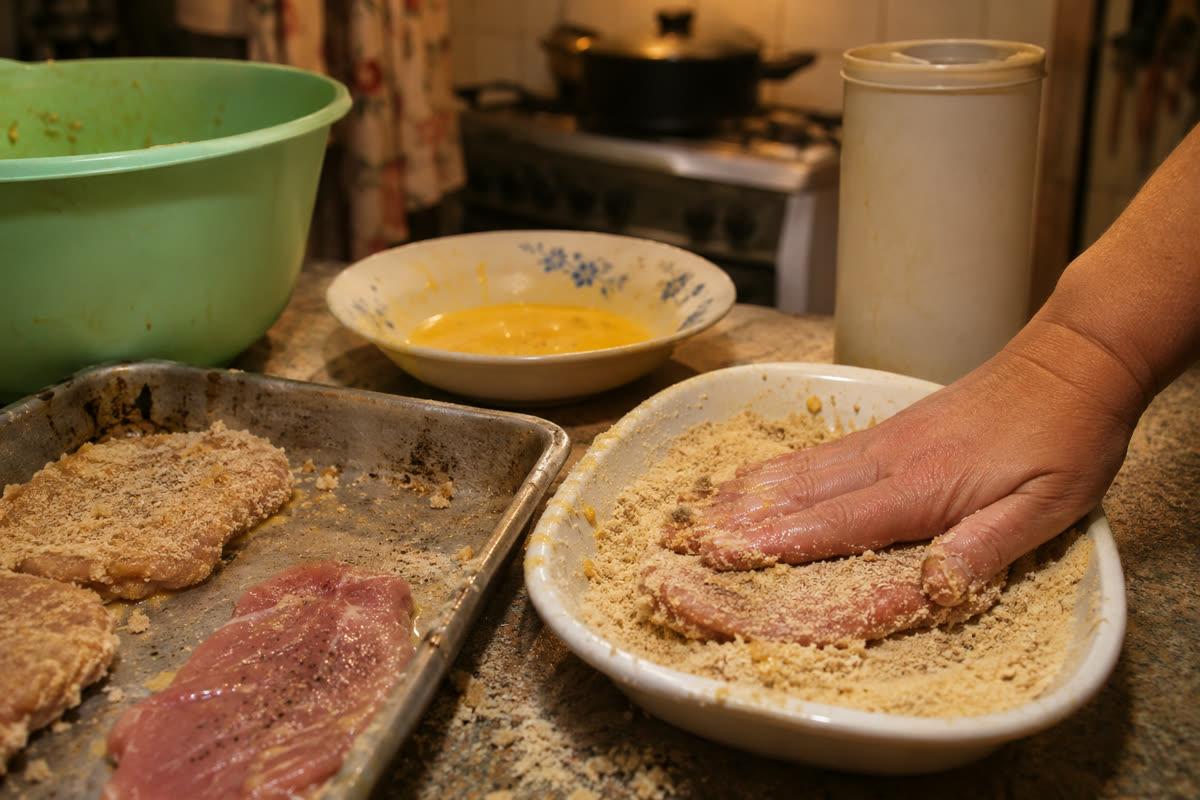 Gluten-free breadcrumbs, panko and coatings: what to read on the packHow to read a crumb, panko or batter mix for wheat, which gluten-free crumbs makers state, and what their pages say about baking and frying.
Sources
- [1, 31, 32] Coeliac UK, Avoid gluten free cross-contamination at home, checked Nov 17, 2026.
- [2, 6, 11, 12, 13, 14, 22, 23, 25, 30, 34] Gluten Free Watchdog, Gluten Cross-Contact in Shared Fryers: What Four Studies (Two FDA-Led) Tell Us, checked Nov 17, 2026.
- [3, 4, 5, 21, 28, 29] Celiac Disease Foundation, New Study Quantifies Gluten Cross-Contact Risk in Shared Fryers, checked Nov 17, 2026.
- [7, 24, 26, 27] Nutrients (Weisbrod et al., via PubMed Central), Shared Fryers May Not Always Be as Risky for Gluten Cross-Contact in Celiac Disease as Dietary Guidance Suggests, checked Nov 17, 2026.
- [8, 15, 33] Gluten Intolerance Group, Appliances: Risks of Cross-Contact, checked Nov 17, 2026.
- [9, 10, 35] Journal of Food Protection (Jiang et al., via PubMed), Mitigating Gluten Cross-Contact in Shared Frying Oil through Passive and Active Filtration, checked Nov 17, 2026.
- [16, 17, 18] Frontiers in Nutrition (Thompson et al., via PubMed), Gluten-Free Foods Cooked in Shared Fryers With Wheat: A Pilot Study Assessing Gluten Cross Contact, checked Nov 17, 2026.
- [19, 20] Clinical Nutrition (Parsons et al., via PubMed), Gluten cross-contact from common food practices and preparations, checked Nov 17, 2026.