Airborne flour and celiac disease: what the sources say
Short answer
Gluten Intolerance Group says that in commercial kitchen spaces gluten-containing flours may be airborne and settle on surfaces, utensils and gluten-free products2. Whether breathing flour dust affects people with celiac disease is not established in the sources we read: one study reports a correlation with living near flour mills, and its authors call for controlled experimental studies19, 20.
Part of Cross-contact and the home kitchen, 19 guides
Key points
- Gluten Intolerance Group (GIG) says flour or baking mixes could make dust, and that in commercial kitchen spaces gluten-containing flours may be airborne and settle on surfaces, utensils and gluten-free products1, 2.
- A Coeliac UK pilot in commercial kitchens found that 2 m from wheat flour use was needed to hold gluten in test dishes at or below 20 parts per million after 4.0 hours of flour use. It measured gluten landing in food, not breathing13, 15.
- The one study we found that relates celiac-related antibodies in people to living near flour mills reports a correlation, and its authors note possible confounding variables19, 20.
- Baker’s asthma, caused by inhaling flour, belongs to the wheat allergy literature, a separate topic from this guide26.
- The page we checked for smell, or children’s play with flour, says nothing on either28.
What the charities say about flour in the air
The Gluten Intolerance Group (GIG), a US celiac charity, describes flour as a source of dust: “Flour or baking mixes could make dust”1. Its home-kitchen guidance adds that cross-contact can happen when cooking or baking at home, or in commercial kitchen spaces where gluten-containing flours may be airborne and settle on surfaces, utensils, and gluten-free products2.
GIG defines cross-contact as gluten crumbs or particles getting into gluten-free ingredients or food in amounts that could cause an adverse reaction3. The NIDDK, part of the US National Institutes of Health, says cross-contact can occur at any time, including when foods are grown, processed, stored, prepared or served11.
So GIG names flour as a source of dust, and airborne flour as something that may settle in commercial kitchen spaces, and the concern it states is gluten ending up in food1, 2, 3. The GIG page we read for this guide does not say how much dust matters28. The NIDDK page and Coeliac UK’s page on cooking at home do not mention airborne flour at all10, 12.
Swallowed, touched or breathed: what the sources address
The definitions above are about gluten reaching food3. On the charity and agency pages we read, none states that breathing in flour dust causes a reaction in celiac disease, and none rules it out10, 12, 28.
The one comment on a route other than food on the GIG page we read is about skin: “To date, medical research does not show that the topical application of gluten to the skin causes a reaction related to celiac disease”7. It says this about lotions, sunscreen and bug spray, not flour, and adds that the main concern is a topical that gets into the mouth and is ingested7.
That leaves breathing as an open question. The authors of the Argentine study described below propose that flour in the air “could be both inhaled and swallowed”21, and say that they believe theirs is the first work to raise this hypothesis and that more studies are needed to confirm it22.
What has been studied, and what it can and cannot say
| Study | What it did | What it can and cannot say |
|---|---|---|
| Coeliac UK pilot in commercial kitchens (Miller, McGough and Urwin, 2016) | Dishes of gluten-free rice pudding were set at distances from 0.5 to 2 m from a site of wheat flour use15. The pilot found that 2 m was needed to hold gluten at or below 20 ppm after 4.0 hours of flour use13. | It measured gluten in dishes. A minimum of 2 m plus good hygiene worked at all five study sites, and the authors say kitchens vary14. The abstract reports no measurement of breathing or of a reaction in a person15. |
| Italian pizza-house study (Vincentini and colleagues, 2016), as described in a 2024 mini-review | The review reports 154 pizzas analysed: one contaminated sample, and all the others below 20 ppm17. The study also tested gluten-free flour for rolling out dough in pizza houses16. | The review says no definitive conclusion could be drawn on wheat flour for rolling dough, because of the study’s method18. We read the review, not the original paper. |
| Argentine population study (de Diego and colleagues, 2024) | Measured celiac-related antibodies in samples from 537 volunteers, 34 of them with a celiac diagnosis23. Positive anti-transglutaminase (a-tTg) results and the number of celiac-associated symptoms appear to correlate with proximity to flour mills19. | A correlation. The authors note that other confounding variables could influence the association, and say controlled experimental studies and detailed exposure assessments are warranted to establish the causal relationship20. |
| Letter in the New England Journal of Medicine (Kasim, Moriarty and Liston, 2007) | Titled “Nonresponsive celiac disease due to inhaled gluten”24. | We could not open the text, so we do not describe what it reports24. |
The first two studies ask how far gluten travels in a kitchen and how it reaches food. Only the Argentine study, which proposes inhalation as one possible explanation for an association with living near flour mills, and the letter’s title concern breathing in people with celiac disease; the first is an association and the second we could not read19, 21, 24.
A PubMed search on 2026-11-17 turned up no other record with a title naming inhaled gluten among the first 15 it returned25. That is a limit of our search, not proof that nothing else exists.
Baking at home: the charities’ precautions
The sources we read do not test any of these steps against inhaled flour25, 28. They are charity guidance on cross-contact in general, and we present them as precautions, not as protection against breathing flour dust.
- Wipe down surfaces: GIG advises wiping down any food prep or cooking surface often, and always after making dishes with gluten-containing ingredients4. Coeliac UK’s steps for home also say to wipe down surfaces and clean pots, pans and cooking utensils with hot soapy water9.
- Store with flour dust in mind: GIG notes that flour or baking mixes could make dust, and suggests, if you store both kinds of food in the same fridge or cupboard, putting gluten-free packages above gluten-containing ones and keeping them securely packaged1.
- Sifters and similar tools: GIG says colanders, sifters and waffle irons are harder to clean and should not be shared between gluten-free and other use if possible5.
- Ovens: GIG says a convection oven’s fan blows air through the oven, so wheat dust or food particles could be blown onto gluten-free food, and advises covering the gluten-free item, even when it is the only thing in the oven6.
- Rolling out dough: the Italian pizza-house authors suggest gluten-free flour for rolling out both kinds of pizza, because wheat flour residue can be aerosolized when handled, as the 2024 review reports29.
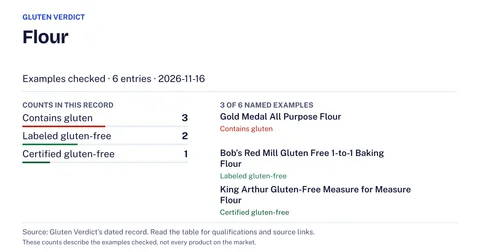
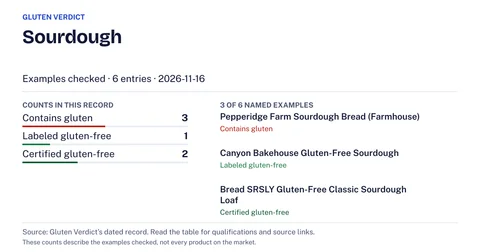
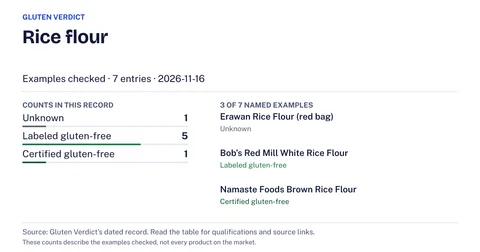
Our verdicts on the flours themselves: flour, rice flour and sourdough. For the wider kitchen routine, see cross-contact in the home kitchen and setting up a gluten-free kitchen.
Pizzerias and bakeries
The kitchen measurements we found are about food prepared near flour, not about sitting nearby. The Coeliac UK pilot analysed dishes of rice pudding15, and the Italian study, as the review describes it, analysed pizzas17.
For eating out, GIG tells readers to check the questions to put to the wait staff, manager, cook or chef about how they handle gluten-free food8. Our own pages: eating out with celiac disease, where gluten hides in restaurant kitchens and the pizza verdict.
Work around flour
People who breathe flour dust at work have a condition with its own literature. A 2026 review of wheat allergy describes baker’s asthma and rhinitis as among the most common IgE-mediated occupational respiratory diseases caused by inhalation of wheat or other cereal flours26, and says their incidence and severity are closely correlated with airborne flour dust concentration in the workplace27.
That is the wheat allergy literature. We do not use it to say anything about celiac disease. Whether flour dust at a particular job matters for a particular person is not something the sources we read settle, and this guide cannot answer it.
What we could not find a source for
- Whether the smell of baking carries gluten, or whether children’s play with flour or dough matters: the GIG page we read says nothing on either28.
- A level of gluten in air that matters: the studies above measured gluten in food or antibodies in blood, not gluten in air15, 17, 19.
- What the 2007 New England Journal of Medicine letter reports: we could not open it24.
Where to read next
Cross-contact in the home kitchen, what the shared-kitchen studies show and setting up a gluten-free kitchen.
Verdicts in this guide

Questions people ask
Can you get glutened from airborne flour?
GIG says that in commercial kitchen spaces gluten-containing flours may be airborne and settle on surfaces, utensils and gluten-free products2. Whether breathing flour dust causes a reaction in people with celiac disease is not established in the sources we read: the one study we found that relates celiac-related antibodies to living near flour mills reports a correlation, and its authors call for controlled experimental studies19, 20.
How far should gluten-free food be from wheat flour?
In one Coeliac UK pilot in commercial kitchens, 2 m from wheat flour use was needed to hold gluten in test dishes at or below 20 ppm after 4.0 hours of flour use13. A minimum of 2 m plus good hygiene worked at all five study sites, though the authors say kitchens vary14.
Can a convection oven blow wheat dust onto food?
GIG says the fan in a convection oven blows air through the oven, and wheat dust or food particles could be blown onto gluten-free food6.
Is baker’s asthma the same as a reaction to gluten in celiac disease?
A 2026 review of wheat allergy describes baker’s asthma and rhinitis as among the most common IgE-mediated occupational respiratory diseases caused by inhaling wheat or other cereal flours26. We do not use it to say anything about celiac disease.
More in Cross-contact and the home kitchen
 Baking gluten-free in a home where someone else bakes with wheat flourA baking-day plan for a shared kitchen: order, counters, flour storage, tools and oven, and which timing rules have no published source.
 What to clean after wheat flour lands in a gluten-free kitchenThe order of jobs after wheat flour reaches a gluten-free kitchen, what charities and studies say about each item, and what no source covers.
 Gluten cross-contact at home: where it happens and what to do about itHow gluten reaches gluten-free food at home, whether to separate, wash or ask for each route, and which rules have lab data behind them.
 Gluten-free pizza at home: check each part, then keep it apart in the ovenCheck the crust, sauce, cheese and toppings against each maker’s own statement, then set up stone, parchment and oven so a gluten-free pizza stays apart.
 Setting up a gluten-free kitchen: what to replace, wash or shareWalk each kitchen zone and decide, item by item, what to replace, what to wash and what a mixed household can keep sharing, with charity sources.
 A weekly gluten-free kitchen routine: wipe, label, restock, re-checkA one-page weekly pass for a gluten-free kitchen: what to wipe, label, restock and do with leftovers, and where the charities and small studies differ.
Related guides
 Gluten-free flour and baking mix cost per cup, with each maker’s statementWhat a cup of gluten-free flour or baking mix costs from each maker’s own price and label, shown beside what the maker says about gluten.
 Gluten-free thickeners: cornstarch, tapioca, arrowroot, potato starch and rice flourPick a gluten-free thickener for gravy, soup or pie filling, follow the maker's directions, choose slurry or roux, and spot wheat thickeners.
 Gluten-free substitutes: the swap for each wheat ingredient and the label check it needsA lookup table of gluten-free swaps for wheat flour, pasta, bread, soy sauce, beer and more, with the one label check each swap needs.
 Gluten-free flours and starches: what each one is and how to read the bagWhich flours and starches are gluten-free by nature, what a claim and a certification mark on the bag each mean, and how to read a blend’s list.
Sources
- [1, 3, 4, 5, 7, 8, 28] Gluten Intolerance Group, 25 Ways Cross-Contact Could Happen (And How to Avoid It), checked Nov 17, 2026.
Read the page on 2026-11-17: the only sentence about flour in the air is “Flour or baking mixes could make dust.” No sentence says that breathing in flour causes a reaction or that it does not, and none mentions the smell of baking or children’s play with flour or dough.
- [2] Gluten Intolerance Group, 7 Tips for Avoiding Gluten Cross-Contact at Home, checked Nov 17, 2026.
- [6] Gluten Intolerance Group, Appliances and the Risk of Cross-Contamination, checked Nov 17, 2026.
- [9, 10] Coeliac UK, Cross-contamination (cooking at home), checked Nov 17, 2026.
Read the page headed “Cross contamination” on 2026-11-17: its list headed “Simple steps to avoid cross-contamination at home” covers washing up, wiping surfaces, frying oil, condiments, bread boards and toasters; no sentence on the page mentions flour, dust, airborne particles or breathing.
- [11, 12] National Institute of Diabetes and Digestive and Kidney Diseases (NIDDK), Eating, Diet, & Nutrition for Celiac Disease, checked Nov 17, 2026.
Read the “Cross-contact” section of the page on 2026-11-17: it defines cross-contact and says when it can occur; no sentence on the page mentions airborne flour, dust or inhaling.
- [13, 14, 15] Miller, McGough and Urwin (Coeliac UK), Journal of Food Protection, Catering Gluten-Free When Simultaneously Using Wheat Flour (2016), checked Nov 17, 2026.
- [16, 17, 18, 29] Damasceno and colleagues, Nutrients, Risk of Gluten Cross-Contamination Due to Food Handling Practices: A Mini-Review (2024), checked Nov 17, 2026.
- [19, 20, 21, 22, 23] de Diego and colleagues, Heliyon, Prevalence of celiac disease-specific antibodies and their association with clinical status and environmental factors (2024), checked Nov 17, 2026.
- [24] Kasim, Moriarty and Liston, New England Journal of Medicine (PubMed record), Nonresponsive celiac disease due to inhaled gluten (letter, 2007), checked Nov 17, 2026.
Read the PubMed record on 2026-11-17: a letter in N Engl J Med 2007;356(24):2548-9 by Kasim S, Moriarty KJ and Liston R, titled “Nonresponsive celiac disease due to inhaled gluten”. The record has no abstract, and the journal’s own page returned an access block (HTTP 403), so we did not read the letter.
- [25] PubMed (US National Library of Medicine), PubMed search: celiac or coeliac with airborne, inhalation, inhaled or flour dust, and gluten, checked Nov 17, 2026.
Ran this PubMed search on 2026-11-17 and read the titles of the first 15 records it returned: the only title that names inhaled gluten is “Nonresponsive celiac disease due to inhaled gluten” (2007); the other titles do not name inhaled gluten.
- [26, 27] Review of wheat allergy, Allergy, Asthma and Immunology Research, Wheat Allergy: Clinical Phenotypes, Diagnostic Approaches, and Management Strategies (2026), checked Nov 17, 2026.