Gluten-free pizza at home: check each part, then keep it apart in the oven
Short answer
Each part of the pizza needs its own check, and the stone, board and oven need their own plan:
- Crust: under FDA’s rule, a food labeled “gluten-free” must contain less than 20 parts per million of gluten4.
- Sauce, cheese and toppings: read each label or maker page. NIDDK says gluten may be found in foods such as condiments, hot dogs and sausages18, and FDA’s gluten-free rule does not apply to foods whose labeling USDA regulates, generally meat and poultry2.
- Stone and board: GIG says not to use one pizza stone for both conventional and gluten-free pizza, or to put the gluten-free pizza on parchment paper if you do20.
- Oven: GIG says to bake gluten-free and gluten-containing items separately when you can, and otherwise to put the gluten-free item on the higher rack24.
Part of Cross-contact and the home kitchen, 19 guides
Key points
- A crust can be made with wheat starch and still meet FDA’s rule, if the starch was processed to remove gluten and the food stays under 20 ppm1. King Arthur’s pizza flour is made with gluten-free wheat starch5.
- A label that says only “made with no gluten-containing ingredients” is not a gluten-free claim: FDA says not to assume the food meets its rule without one3.
- GIG says the high heat of baking does not neutralize gluten26, and that gluten is not destroyed by heat and has to be physically removed28.
- One study analyzed 154 pizzas from a bakery school kitchen and five pizza houses, in Italy, and found one contaminated sample; every other pizza measured below 20 ppm. The review says shared production apparently need not cause cross-contamination as long as employees are properly trained37. It did not test a home kitchen34, 32.
What to check on each part of the pizza
A pizza is several foods on one crust, and each has its own label or maker. Use this as a checklist, then read the sections below for the detail.
| Part | What to read | What the sources say |
|---|---|---|
| Crust: ready-made, frozen, mix or flour | The “gluten-free” claim and the ingredient list | A food labeled gluten-free has to meet FDA’s rule, including less than 20 ppm4. |
| Sauce | The jar’s claim or ingredient list | NIDDK lists condiments among foods where gluten may be found18. |
| Cheese | The ingredient list, especially on shredded or flavored cheese | GIG says to confirm no gluten-containing ingredients were added as flavorings14. |
| Pepperoni, sausage, bacon | The maker’s own page or label | FDA’s gluten-free rule does not apply to foods USDA regulates, generally meat and poultry2; NIDDK names hot dogs and sausages18. |
| Spices and dried herbs | A gluten-free claim or certification mark | GIG advises choosing spices labeled gluten-free or GFCO-certified15. |
| Oil for the crust or the pan | Its label; see our verdict | See olive oil. |
Where we have read a food’s maker pages, our verdict says what they showed and on what date: pizza, pepperoni, sausage, bacon, mozzarella, Parmesan and ricotta. Makers change recipes, so the package in your hand has the final word.
The crust: claim, ingredients and what the maker says
FDA’s rule covers four phrases: “gluten-free”, “no gluten”, “free of gluten” and “without gluten”. A food carrying any of them must contain less than 20 parts per million (ppm) of gluten4. The claim is the first thing to look for on a frozen crust or a boxed mix.
A crust can still list wheat starch. FDA’s rule allows an ingredient derived from a gluten grain and processed to remove gluten, as long as the food stays under 20 ppm1. King Arthur says its Gluten-Free Pizza Flour is made with gluten-free wheat starch5. Our wheat starch page shows what the makers we read said.
Mixes, flours and frozen pizzas
- Bob’s Red Mill describes its Gluten Free Pizza Crust Mix as making two 12-inch gluten free pizza crusts6, and its ingredient list names brown rice, potato, millet, sorghum and tapioca flours7.
- Freschetta calls its Gluten Free Four Cheese Pizza a pizza that “just happens to be Gluten Free”8.
- GFCO’s Product Finder is the certifier’s own list. It says a product on the list is certified only if it also carries a certification mark, and a product on the list without the mark on its packaging is not certified11. Its results for “pizza” include crusts, frozen pizzas and pizza sauces12.
For what a seal does and does not add, see certified or naturally gluten-free; for shared-facility lines on a box, see may-contain labels; for what a flour bag is named for, see 1-to-1, all-purpose and bread flour blends.
“Made with no gluten-containing ingredients” is a different statement from a gluten-free claim. FDA says that unless the label also bears a “gluten-free” claim, consumers should not assume the food meets the rule3.
Sauce, cheese and toppings
Sauce
NIDDK says gluten may be found in a variety of foods, including condiments18, so a jar of sauce gets the same read as the crust: the claim first, then the ingredient list. GFCO’s Product Finder’s results for “pizza” include pizza sauces from Mezzetta, Good Graces and Michaels of Brooklyn12. For flavorings and starches in a list, see natural flavors, caramel color and modified food starch.
Cheese
Cheese is where pre-shredded bags raise a question. Sargento says it uses powdered cellulose or potato starch as anti-caking agents on some of its cheeses, and that neither is derived from wheat, rye, barley or their cross-bred hybrids13. That is one maker’s statement about its own cheese; for any other bag, GIG’s advice is to read the ingredient list for gluten-containing ingredients added as flavorings14.
Pepperoni, sausage and bacon
FDA’s gluten-free rule does not apply to foods whose labeling USDA regulates, which generally means meat and poultry2, so a meat topping’s own page or label is what to read. NIDDK names hot dogs and sausages among foods where gluten may be found18. Our verdicts show what each maker’s page said: pepperoni, sausage and bacon.
Spices and shared topping bowls
For dried herbs and spice blends, GIG advises choosing spices labeled gluten-free to FDA’s rule or GFCO-certified15; see also our spices page. In a household that is also making a wheat pizza, one spoon in two bowls is a route for crumbs: GIG calls the shared serving utensil one of the most common ways gluten crumbs reach gluten-free food16. Give the gluten-free pizza its own bowls and spoons.
Stone, board, parchment and the tools around them
The surface under the dough matters because a baking stone is porous. GIG says traditional pizza stones could harbor gluten after baking a pizza that is not gluten-free, and advises not using the same stone for both kinds, or putting the gluten-free pizza on parchment paper if you do. For a big pizza fan it suggests a dedicated gluten-free stone20.
| Tool | What GIG says |
|---|---|
| Pizza stone | Do not use the same stone for both kinds; if you do, put the gluten-free pizza on parchment paper20. |
| Cutting board | If a board is pitted or scratched, gluten could settle into crevices21. Coeliac UK, the UK charity, says you may want separate bread boards for gluten-free and gluten-containing bread30. |
| Wooden rolling pin | Best shelved if it was used on gluten-containing items22. |
| Oven mitts | Wash them before gluten-free baking, or keep a separate pair23. |
For counters and tools you can wash, GIG says counters and prep areas should be washed with hot soapy water and a clean cloth or paper towel before gluten-free preparation begins27. Coeliac UK likewise says to wipe down surfaces and clean pots, pans and utensils with hot soapy water29. Heat will not do this job: gluten is a protein that heat does not destroy, and it has to be physically removed28.
For the full sort of what to replace, wash or share across a kitchen, see setting up a gluten-free kitchen and gluten cross-contact at home.
The oven: rack, pan and fan
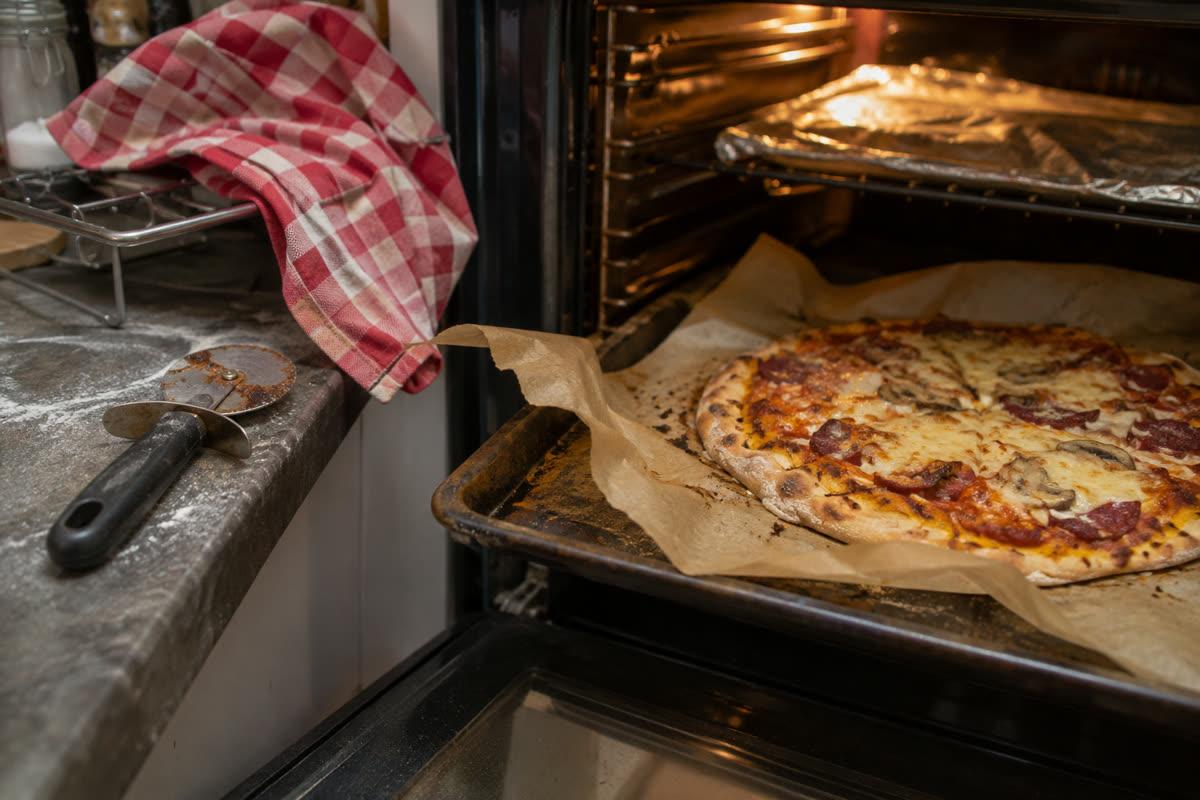
GIG’s advice for a standard oven is to bake or broil gluten-free and gluten-containing items separately when you can. When that is not possible, it says to put the gluten-free items on the higher rack so crumbs or bits of gluten-containing food do not fall onto them24.
The rack and oven floor are where crumbs collect. GIG says that before making a gluten-free dish in a shared oven you can wipe down the racks and interior, use a fresh sheet of foil on the rack, or set the dish on a clean baking sheet as a barrier, and that the high heat of baking does not neutralize gluten26.
That matters for frozen pizzas, because the makers’ directions put the pizza on the rack or a pan. Freschetta’s gluten-free pizza directions give one bake directly on the center rack and one on a pan on the bottom rack9, and Banza recommends baking directly on the oven rack, or on a stone or baking sheet if you prefer10. If you bake on the rack in an oven that has baked wheat pizza, wipe the rack first, or use the pan or sheet the maker allows26.
A convection oven adds a fan. GIG says wheat dust or food particles could be blown onto gluten-free food by the fan, and suggests not cooking the two together if possible, or covering the gluten-free item25.
If a wheat pizza is in the oven too: what one study measured
One study tested this in Italy. It looked at gluten-free pizzas made in restaurants and pizza houses that also make wheat pizzas, where the gluten-free pizzas are prepared with gluten-free raw materials and procedures meant to limit cross-contact32.
In a bakery school kitchen the researchers compared three set-ups: baking gluten-free and wheat pizzas at the same time in one oven; alternating batches in one oven; and using separate ovens33. Of 154 pizzas analyzed, the authors found one contaminated sample, from the simultaneous bake in the school kitchen34, 33. Every other pizza, from the school kitchen and the five pizza houses, measured below 20 ppm34. The 2024 review that summarizes the study says these results suggest sharing the oven simultaneously or alternately does not present a significant risk35. The review adds that, apparently, producing both kinds of food in one environment with the same equipment will not necessarily trigger cross-contamination, as long as employees are properly trained37.
This is one study in a bakery school kitchen and five pizza houses, not a home. A bakery school and five pizza houses are not a household oven with a stone, a rack and a sink34. GIG’s advice for a home oven is still to bake separately when you can, or to use the higher rack24. We did not find a study of a home oven.
Flour dust while you shape the dough
GIG says cross-contact can happen when baking at home, and that in commercial kitchens gluten-containing flours may be airborne and settle on surfaces, utensils and gluten-free products31. It also notes that flour or baking mixes could make dust, and advises storing gluten-free packages above gluten-containing ones, securely packaged17.
The authors of the pizza study suggested using gluten-free flour to roll out both kinds of pizza, because wheat flour residue can be aerosolized when handled. They could not draw definitive conclusions about that from their own method36. We did not find a measurement of flour dust in a home kitchen, so treat this as a precaution rather than a measured effect.
An order for the night
NIDDK’s advice for a household is to store and prepare gluten-free foods separately from family members’ foods that contain gluten, to prevent cross-contact19. This sequence is ours, built from the sources above; each step cites the passage it rests on.
- Read the crust, sauce, cheese and topping labels or maker pages before you start, and put aside anything you could not check4, 18.
- Wash the counter, board and tools you will use with hot soapy water, since gluten has to be physically removed27, 28.
- Shape and top the gluten-free pizza first, before wheat flour is open on the counter, with its own bowls and spoons17, 16.
- Use its own stone, or parchment if the stone is shared, or set it on a clean baking sheet20, 26.
- In the oven, bake it separately if you can, or put it on the higher rack24; in a convection oven, avoid baking both together, or cover the gluten-free pizza25.
- Cut it on a clean board with a clean tool, and wash the mitts or use a separate pair21, 23.
Verdicts in this guide
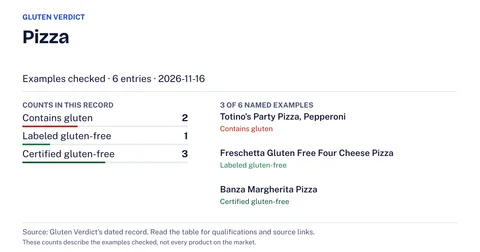 PizzaContains glutenchecked Nov 16, 2026
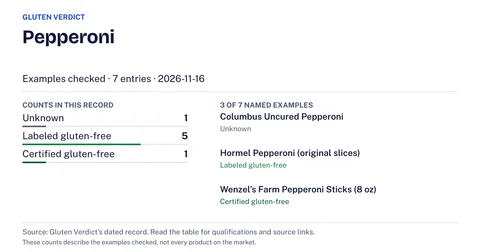 PepperoniDepends on the productchecked Nov 16, 2026
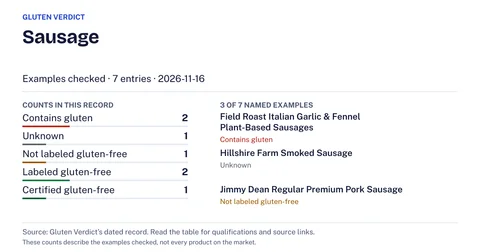 SausageDepends on the product2 of 7 products we checked contain gluten: Field Roast Italian Garlic & Fennel Plant-Based Sausages and Tofurky Plant-Based Italian Sausagechecked Nov 16, 2026
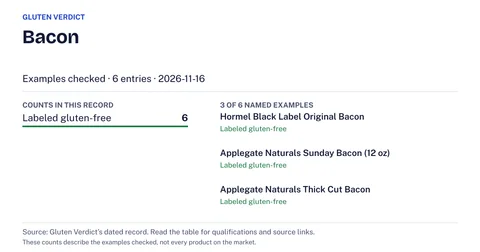 BaconDepends on the productchecked Nov 16, 2026
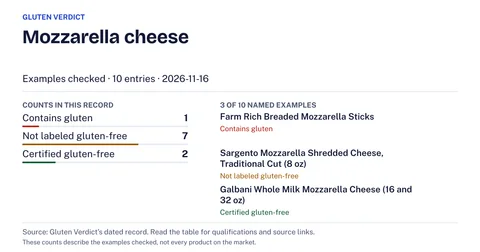 Mozzarella cheeseNaturally gluten-free1 of 10 products we checked contains gluten: Farm Rich Breaded Mozzarella Stickschecked Nov 16, 2026
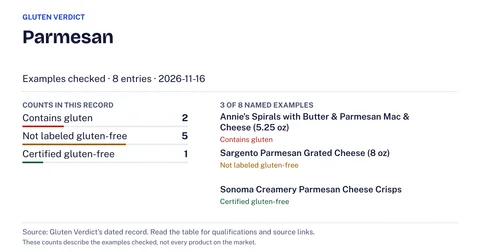 ParmesanNaturally gluten-free2 of 8 products we checked contain gluten: Annie's Spirals with Butter & Parmesan Mac & Cheese (5.25 oz) and Annie's Super! Mac Shells & Parmesan (6 oz)checked Nov 16, 2026
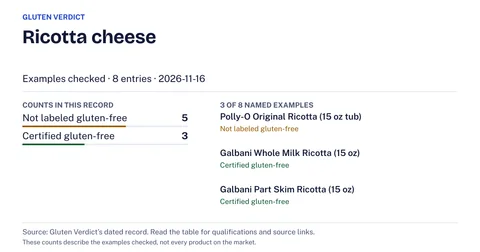 Ricotta cheeseNaturally gluten-freechecked Nov 16, 2026
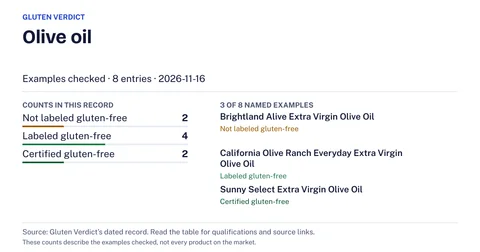 Olive oilUnknownchecked Nov 16, 2026
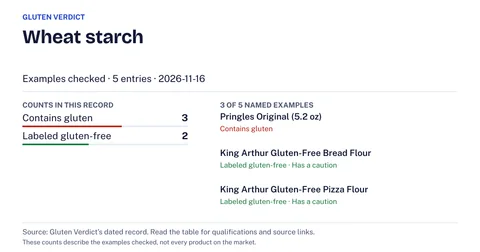 Wheat starchDepends on the product3 of 5 products we checked contain gluten: Pringles Original (5.2 oz), Jiffy Corn Muffin Mix, and Chex Mix Bold Garlic and Herbchecked Nov 16, 2026
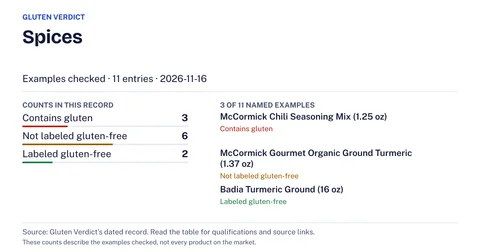 SpicesDepends on the product3 of 11 products we checked contain gluten: McCormick Chili Seasoning Mix (1.25 oz), Lawry’s Chili Spices & Seasonings Mix (1.48 oz), and McCormick Cheesy Taco Seasoning Mix (1.12 oz)checked Nov 16, 2026
Questions people ask
Can I use my old pizza stone for a gluten-free pizza?
GIG says not to use the same stone for conventional and gluten-free pizza, because stones are porous. If you do, it says to put the gluten-free pizza on parchment paper20.
More in Cross-contact and the home kitchen
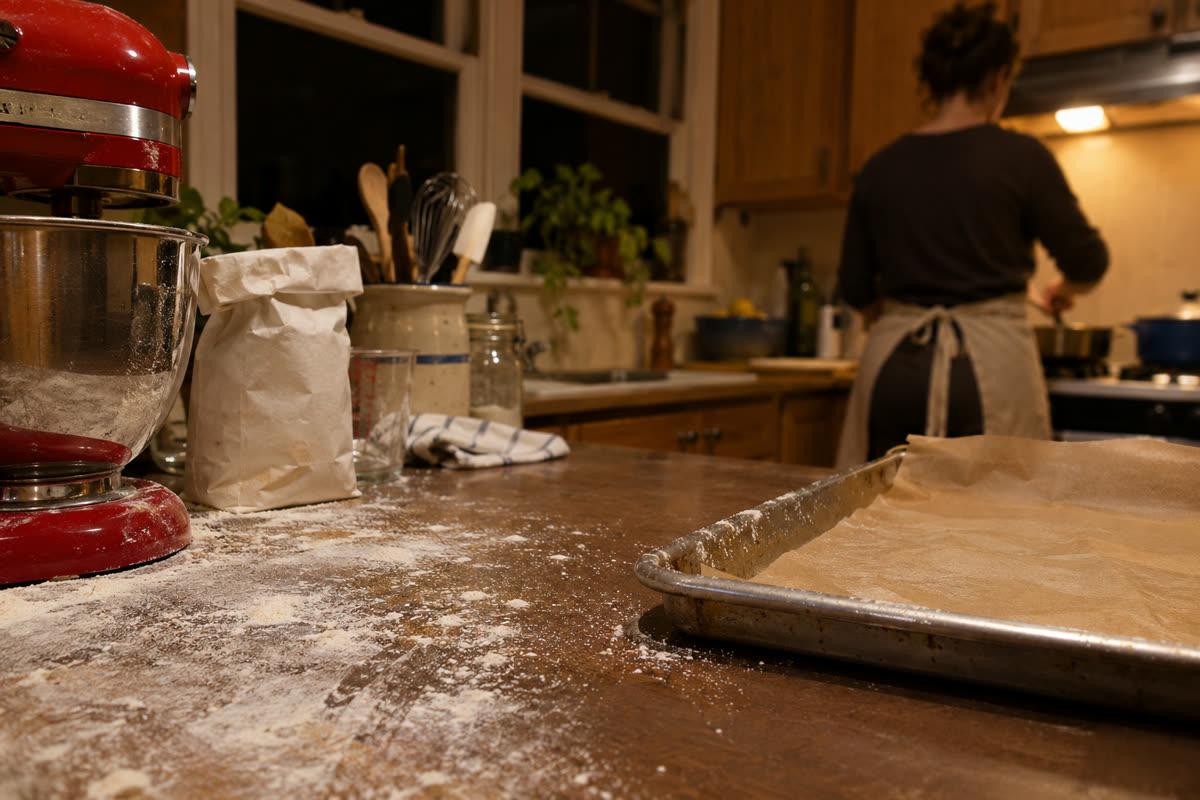 Baking gluten-free in a home where someone else bakes with wheat flourA baking-day plan for a shared kitchen: order, counters, flour storage, tools and oven, and which timing rules have no published source.
 Gluten-free grilling and cookouts: what to wrap, clean, bring and askHow to keep gluten off the grill at a cookout: foil, clean grates, sauces, buns, sides, a note to send the host and a bring-your-own list.
 Airborne flour and celiac disease: what the sources sayWhat charities and studies say about wheat flour dust in the air, what is only a hypothesis, and the wipe-down and cover steps the charities suggest.
 Gluten cross-contact at home: where it happens and what to do about itHow gluten reaches gluten-free food at home, whether to separate, wash or ask for each route, and which rules have lab data behind them.
 How to cook dinner for a guest with celiac diseaseA host's plan for one dinner: what to ask the guest, a menu with few risk points, which labels to read, the cooking order, clean tools and serving.
 What to clean after wheat flour lands in a gluten-free kitchenThe order of jobs after wheat flour reaches a gluten-free kitchen, what charities and studies say about each item, and what no source covers.
Related guides
 Eating out with celiac disease: what to check, ask and watch forPlan a restaurant meal with celiac disease: what to check before you go, the questions to ask in order, how to read the answers, and what studies measured.
 Ordering gluten-free pizza at a pizza place: what to ask the kitchenWhat to ask a pizza place before you order a gluten-free crust: flour, oven, cutter, sauce and toppings, with what studies and charities say.
 Pizza chain gluten-free crusts: what each chain says about its kitchenWhat Domino's, Papa Johns, Pizza Hut and Little Caesars say on their own pages about gluten-free crust, shared kitchens and celiac customers.
 Gluten-free pizza crust, pie crust and cookie problems: what the makers sayMatch a gummy pizza, cracking pie dough or flat cookies to hydration, heat, fat or chill, with what flour and mix makers say and where they stay silent.
Sources
- [1, 2, 3] US Food and Drug Administration, Questions and Answers on the Gluten-Free Food Labeling Final Rule, checked Nov 17, 2026.
- [4] US Food and Drug Administration, Gluten and Food Labeling, checked Nov 17, 2026.
- [5] King Arthur Baking Company, Gluten-Free Pizza Flour, checked Nov 17, 2026.
- [6, 7] Bob’s Red Mill Natural Foods, Gluten Free Pizza Crust Mix, checked Nov 17, 2026.
- [8, 9] Freschetta (Schwan’s), FRESCHETTA Gluten Free Four Cheese Pizza, checked Nov 17, 2026.
- [10] Banza, Margherita Pizza, checked Nov 17, 2026.
- [11, 12] Gluten-Free Certification Organization, GFCO Product Finder: search for pizza, checked Nov 17, 2026.
Read on 2026-11-17: the results for “pizza” include Banza Margherita Pizza, Four Cheese Pizza and Vegan Cheese Pizza; Against the Grain 12" Pizza Shell and 12" Pesto Pizza; Milton’s Craft Bakers Pepperoni Pizza; and Pizza Sauce from Mezzetta, Good Graces and Michaels of Brooklyn.
- [13] Sargento, Sargento FAQ, checked Nov 17, 2026.
- [14, 15, 16, 17] Gluten Intolerance Group, 25 Ways Cross-Contact Could Happen and How to Avoid It, checked Nov 17, 2026.
- [18, 19] National Institute of Diabetes and Digestive and Kidney Diseases (NIDDK), Eating, Diet, & Nutrition for Celiac Disease, checked Nov 17, 2026.
- [20, 21, 22, 23] Gluten Intolerance Group, The Tools to Replace in Your Gluten-Free Kitchen, checked Nov 17, 2026.
- [24, 25] Gluten Intolerance Group, Appliances: Risks of Cross-Contact, checked Nov 17, 2026.
- [26, 27, 28] Gluten Intolerance Group, Your Kitchen, Their Kitchen, Our Kitchen: Navigating Gluten-Free Cohabitation, checked Nov 17, 2026.
- [29, 30] Coeliac UK, Cross contamination (cooking at home), checked Nov 17, 2026.
- [31] Gluten Intolerance Group, 7 Tips for Avoiding Gluten Cross-Contact at Home, checked Nov 17, 2026.
- [32] Journal of Food Protection (PubMed), Risk of Cross-Contact for Gluten-Free Pizzas in Shared-Production Restaurants in Relation to Oven Cooking Procedures, checked Nov 17, 2026.
- [33, 34, 35, 36, 37] Nutrients (PubMed Central), Risk of Gluten Cross-Contamination Due to Food Handling Practices: A Mini-Review, checked Nov 17, 2026.