Dishes, sponges, dishwashers and towels in a mixed household
Short answer
GIG says most standard dish soaps remove gluten when used with hot water and proper scrubbing, and Coeliac UK says standard washing-up liquid or a dishwasher will1, 2. The charities split on sponges, GIG's advice on towels depends on how they are used5, and we found no published test of a home dishwasher8:
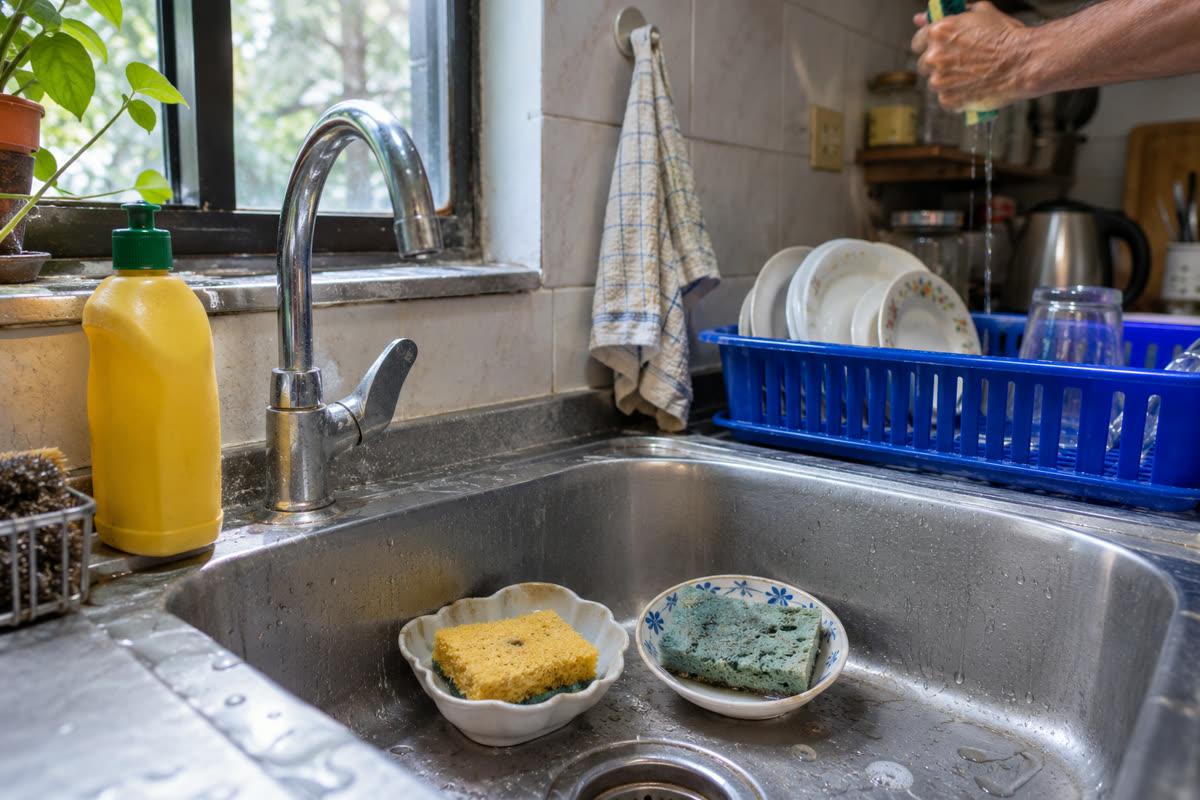
- Sponges: GIG suggests a dedicated gluten-free sponge or brush3, Beyond Celiac says to have separate sponges and dishrags for gluten-free cookware37 and the National Celiac Association suggests dedicated sponges, brushes and rags for hand-washing42; Coeliac UK says separate cloths or sponges are not needed4.
- Dish towels: GIG says the risk is minimal to none if shared towels are used only on dishes or hands that have been thoroughly washed, and otherwise suggests separate towels or paper towels5; the last step in Beyond Celiac's dish-cleaning list is to air dry or wipe with a clean towel that has not come into contact with gluten40.
- Dishwasher: GIG says a shared load is fine in a functional dishwasher that cleans thoroughly6, and Coeliac Australia lists washing all utensils and plates in the same dishwasher among the things it says can be done44; the one warewashing test we found used other machines7, 8.
Part of Cross-contact and the home kitchen, 19 guides
Key points
- GIG says gluten is a protein that heat and most cleaning sprays do not destroy, so it has to be physically removed by washing9.
- On sponges the charities disagree: GIG3, Beyond Celiac37 and the National Celiac Association42 suggest dedicated ones, while Coeliac UK says separate cloths or sponges are not needed4.
- For hand-washing, Beyond Celiac says to use fresh dish water and wash dishes that held gluten last38; Coeliac Australia lists washing all utensils and plates in the same washing-up water or dishwasher among the things it says can be done44.
- The one warewashing study we found used warewashing machines on test coupons, not household dishwashers7; machine washing removed the food soils more effectively than manual washing in that study11.
- GIG notes that others in the household who have less understanding of dietary needs may not be as vigilant about avoiding cross-contact as you are12, so whichever routine you choose, make sure everyone knows it.
What gets gluten off dishes: soap, hot water and scrubbing
GIG, the Gluten Intolerance Group, says most standard dish soaps remove gluten when used with hot water and proper scrubbing1. Coeliac UK, the UK celiac charity, says standard washing-up liquid or a dishwasher will remove gluten2.
Rinsing is a different thing. GIG writes that rinsing removes visible debris but leaves behind proteins, residue and invisible traces of gluten, while washing with hot soapy water lifts the residue off the surface13. It adds that gluten is not destroyed by heat or killed by most standard cleaning sprays and must be physically removed9, and it names a diluted bleach solution or a sanitizing spray applied after washing as what completes the process36. Beyond Celiac says dish soap with warm water works much more effectively than simply running dishes under water46.
Two studies of utensils and pots found little difference between cleaning methods14, 17. In one study, rinsing pots with water alone after gluten-containing pasta was cooked was as effective as scrubbing with soap and water at preventing detectable gluten transfer14; the authors list small sample size among the limits of their study15. In another study, gluten-free bread and pasta were prepared with kitchenware (a wooden spoon, colander, ladle and knife) that had been used for gluten-containing food16. The cleaning method did not change the result, and all samples contained under 10 mg/kg17.
Those results concern pots and utensils, not sponges, towels or dishwashers, so this guide does not build a routine on them. For more on what lab studies measured, see what studies measured in shared kitchens.
Sponges and brushes: the charities disagree
The charities do not agree on sponges. Each is quoted below.
| Charity | What it says |
|---|---|
| GIG (cohabitation article) | Shared sponges and dish rags should be replaced or laundered frequently because they can transfer gluten from one surface to another18. A dedicated gluten-free sponge or brush is an extra layer of protection, which GIG calls a small investment3. |
| GIG (7 tips for avoiding cross-contact) | Lists sink sponges among the kitchen items to give extra cleaning attention, or to buy a second set of and store separately19, 20. |
| Beyond Celiac | You should have separate sponges and dishrags to clean gluten-free cookware37. Its reason: gluten cannot be sanitized away, so remaining gluten on sponges or dishrags can be transferred to otherwise clean plates45. |
| National Celiac Association | When hand-washing, try to use dedicated gluten-free sponges, brushes and rags, because gluten can stick to them and be passed to dishes and surfaces42. |
| Coeliac UK | You do not need to use separate cloths or sponges4. |
GIG adds that dish soap dispensers and cleaning tool handles are easy-to-miss contact points that should be wiped down regularly21.
What the one sponge test measured
A published test of a sponge scourer is a study of wheat allergens, published in Japanese. Its authors report that in multiple trials wheat allergens were transferred from a bowl coated with 10 g of liquid batter to an unused bowl via sponge scrubbing, with a positive rate of approximately 80%10. The sponge still held residual batter after cleaning and rinsing22, and adding sponge-rinsing steps did not make complete removal of wheat allergen easy23.
Read it for what it tested: batter-coated bowls and wheat allergen, not a gluten level in parts per million from a home sink. Its authors conclude that sponges used on residual wheat should be dedicated in cooking facilities that prepare allergy-friendly foods24; the abstract does not describe a home kitchen10.
Both positions assume the washing itself is thorough. If you keep a dedicated sponge, store it where a housemate will not pick it up by mistake; GIG notes that others in the household who have less understanding of dietary needs may not be as vigilant about avoiding cross-contact as you are12.
Dish towels, cloths and pot holders
GIG answers a reader question on this. For dish towels, it says that if others in the household use kitchen towels only on dishes or hands that have been thoroughly washed, the risk is minimal to none; otherwise, separate towels or even paper towels are a good idea5.
For pot holders, GIG gives an example: if a pot holder is used on a gluten-containing cobbler that rises up to or over the top of the pan, the pot holder may touch the food, and if a bit of gluten is on it and it is later used the same way on a gluten-free cobbler, cross-contact could result25. GIG says that if sufficient care is taken that the pot holder does not come into contact with the food, there should be minimal to no risk, and that separate pot holders are a good idea and will not break the bank26.
Beyond Celiac's list of steps for cleaning dishes in shared kitchens ends with letting them air dry or wiping them with a clean towel that has not come into contact with gluten40. Coeliac UK says separate cloths or sponges are not needed4; its page does not mention dish towels by name41.
We found no published test of dish towels. A PubMed search on 2026-11-17 for allergen with dishcloth, dish cloth, kitchen towel or tea towel returned two records, neither about cleaning or drying dishes27. The towel advice above is the charities' own, not a measured result.
Hand washing: water and order
Beyond Celiac says to use fresh dish water when hand-washing, because particles of gluten in the water can be transferred to otherwise clean dishes when rinsing, and to save dishes that held gluten-containing foods for last38. Coeliac Australia takes a different line: it lists washing all utensils, plates and the like in the same washing-up water or dishwasher among the things it says can be done44.
The National Celiac Association says cleaning with soap and water or running through the dishwasher should be enough to get rid of gluten from any non-porous material43.
Dishwashers: what the charities say and what has been tested
GIG says that if you use a functional dishwasher that effectively removes food particles and cleans thoroughly, a shared load is fine6. Coeliac UK says that using a dishwasher will remove gluten2. Beyond Celiac's list of steps for cleaning dishes in shared kitchens includes, where possible, running them through the dishwasher39.
The one test, and what it did not use
A 2026 study in the Journal of Food Protection compared manual and mechanical washing. It contaminated stainless steel, polyethylene and ceramic coupons with foods that included wheat flour and batter28, then washed them by hand or in low- and high-temperature warewashing machines7. Residue was detected with gluten- or allergen-specific qualitative lateral flow devices29. Mechanical washing removed the food soils significantly more effectively than the manual treatment11, and tahini and almond butter were significantly harder to remove than the other foods30. Wood coupons were washed by hand only31.
The abstract describes warewashing machines used on test coupons, not household dishwashers loaded with plates, glasses and pots7, and it reports residue as detected or not, not as a gluten level in parts per million29. It cannot tell you whether a gluten-free plate comes out of a shared home load below any particular level.
A PubMed search on 2026-11-17 for gluten with dishwasher, dishwashing or warewashing returned one record, the study above8. The dishwasher advice in this guide therefore rests on the charities' statements and on that one test of other machines.
Pots, pans and tools that hold residue
GIG's cohabitation article names two items where washing may not be enough. Scratched or worn non-stick pans can trap gluten in the damaged coating and are much harder to clean thoroughly32. Cast iron is porous and nearly impossible to fully rid of gluten residue, and GIG strongly recommends a dedicated gluten-free cast iron pan if cast iron is regularly used in the household for gluten-containing foods33.
For wood, crevices and the clean-up after wheat flour, see what to clean after wheat flour lands in a gluten-free kitchen, and for a regular schedule, a weekly gluten-free kitchen routine.
Three routines, each taken from one charity
These columns are not our recommendation. Each follows what one charity wrote, so you can see the choice side by side.
| Step | Following Coeliac UK | Following GIG | Following Beyond Celiac |
|---|---|---|---|
| Washing | Clean pots, pans and utensils with hot soapy water34. | Standard dish soap with hot water and proper scrubbing1. | Dish soap with warm water, which it says works much more effectively than running dishes under water46; fresh dish water, and dishes that held gluten last38. |
| Sponge and cloth | No separate cloths or sponges needed4. | A dedicated gluten-free sponge or brush; shared sponges and dish rags replaced or laundered frequently3, 18. | Separate sponges and dishrags to clean gluten-free cookware37. |
| Dish towel | Page does not mention dish towels41. | Shared towel only on thoroughly washed dishes or hands; otherwise a separate or paper towel5. | Air dry, or a clean towel that has not come into contact with gluten40. |
| Dishwasher | A dishwasher will remove gluten2. | A shared load is fine in a functional dishwasher that cleans thoroughly6. | Where possible, clean by running through the dishwasher39. |
On storage and preparation, the US National Institute of Diabetes and Digestive and Kidney Diseases (NIDDK) lists storing and preparing gluten-free foods separately from other family members' foods that contain gluten as one way to prevent cross-contact at home35.
What has no published source
The sources cited here do not address the points below, so this guide gives no advice on them: where to put gluten-free items in a shared dishwasher; a replacement schedule for sponges or towels; baked-on food; and glasses, bottles or baby items.
Questions people ask
Can I put gluten-free dishes in the same dishwasher load as everyone else’s?
GIG says a shared load is fine in a functional dishwasher that effectively removes food particles and cleans thoroughly6. Coeliac UK says a dishwasher will remove gluten2, and Coeliac Australia lists washing plates and utensils in the same dishwasher among the things it says can be done44. We found no published test of a household dishwasher8.
Do I need a separate sponge for gluten-free dishes?
GIG suggests a dedicated gluten-free sponge or brush3, Beyond Celiac says to have separate sponges and dishrags for gluten-free cookware37, and the National Celiac Association suggests dedicated sponges, brushes and rags for hand-washing42; Coeliac UK says separate cloths or sponges are not needed4. In a test published in Japanese, wheat allergens were transferred from a batter-coated bowl to an unused one via sponge scrubbing, with a positive rate of approximately 80%10.
Do I need separate dish towels?
GIG says the risk is minimal to none if shared towels are used only on dishes or hands that have been thoroughly washed, and otherwise suggests separate towels or paper towels5. Beyond Celiac's dish-cleaning steps end with air drying or a clean towel that has not come into contact with gluten40.
Does hot water or a hot dishwasher cycle destroy gluten?
GIG says gluten is a protein that is not destroyed by heat, so it has to be physically removed9.
More in Cross-contact and the home kitchen
 What to clean after wheat flour lands in a gluten-free kitchenThe order of jobs after wheat flour reaches a gluten-free kitchen, what charities and studies say about each item, and what no source covers.
 Baking gluten-free in a home where someone else bakes with wheat flourA baking-day plan for a shared kitchen: order, counters, flour storage, tools and oven, and which timing rules have no published source.
 What studies measured in shared kitchens: pasta water, toasters, knives and spreadsWhat four experimental studies measured when gluten-free food met shared pots, toasters, knives and spreads: samples, results, and what went untested.
 Setting up a gluten-free kitchen: what to replace, wash or shareWalk each kitchen zone and decide, item by item, what to replace, what to wash and what a mixed household can keep sharing, with charity sources.
 Gluten-free with roommates, partners and family: a shared-kitchen agreementHow to split a shared kitchen when one person is gluten-free: what to keep separate, what to wash and share, and how to put the rules to housemates.
 Gluten cross-contact at home: where it happens and what to do about itHow gluten reaches gluten-free food at home, whether to separate, wash or ask for each route, and which rules have lab data behind them.
Related guides
 Toasters, colanders, cast iron, wood and air fryers: which can be cleanedWhich kitchen items the charities say to keep, wash or replace after going gluten-free, item by item, with what the studies we found measured.
 A weekly gluten-free kitchen routine: wipe, label, restock, re-checkA one-page weekly pass for a gluten-free kitchen: what to wipe, label, restock and do with leftovers, and where the charities and small studies differ.
Sources
- [1, 3, 9, 13, 18, 21, 32, 33, 36] Gluten Intolerance Group, Your Kitchen, Their Kitchen, Our Kitchen: Navigating Gluten-Free Cohabitation, checked Nov 17, 2026.
- [2, 4, 34, 41] Coeliac UK, Avoid Gluten Free Cross Contamination at Home, checked Nov 17, 2026.
Read on 2026-11-17: the page says “You do not need to use separate cloths or sponges”; the word “towel” does not appear on the page.
- [5, 12, 25, 26] Gluten Intolerance Group, FAQ: Should I be concerned about using the same dish/hand towels and pot holders as family members who handle gluten-containing food? (October 14, 2019), checked Nov 17, 2026.
- [6] Gluten Intolerance Group, Appliances: Risks of Cross-Contact, checked Nov 17, 2026.
- [7, 11, 28, 29, 30, 31] Journal of Food Protection (PubMed record), Effectiveness of Manual and Mechanical Warewashing Methods for Removing Allergen- and Gluten-Containing Foods from Food-Contact Surfaces (Kidd and colleagues, 2026), checked Nov 17, 2026.
- [8] PubMed, PubMed search: gluten with dishwasher, dishwashing or warewashing, checked Nov 17, 2026.
Read on 2026-11-17: the search returned one record, PMID 41448539, the 2026 warewashing study by Kidd and colleagues cited in this guide.
- [10, 22, 23, 24] Shokuhin Eiseigaku Zasshi (PubMed record), Secondary Contamination by Wheat Allergens across Cooking Bowls through the Use of Sponge Scourers (Hashimoto and colleagues, 2022), checked Nov 17, 2026.
- [14, 15] Gastroenterology (PubMed Central author manuscript), Preparation of Gluten-Free Foods Alongside Gluten-Containing Food May Not Always Be as Risky for Celiac Patients as Diet Guides Suggest (Weisbrod and colleagues), checked Nov 17, 2026.
- [16, 17] Journal of Food Protection (PubMed record), Cross-Contamination with Gluten by Using Kitchen Utensils: Fact or Fiction? (Studerus and colleagues, 2018), checked Nov 17, 2026.
- [19, 20] Gluten Intolerance Group, 7 Tips for Avoiding Gluten Cross-Contact at Home (updated January 8, 2021), checked Nov 17, 2026.
Read on 2026-11-17: the list under “Step 3. Clean carefully or keep separate.” names wooden utensils, cutting boards, nonstick pans, cast iron skillet, wooden rolling pins, food storage containers, waffle irons, cake pans and muffin tins, and sink sponges.
- [27] PubMed, PubMed search: allergen with dishcloth, dish cloth, kitchen towel or tea towel, checked Nov 17, 2026.
Read on 2026-11-17: the search returned two records, PMID 23724238 (a measurement of horse allergen in schools) and PMID 7573812 (birch-pollen antigenic activity of settled dust in homes). Neither is about cleaning or drying dishes.
- [35] National Institute of Diabetes and Digestive and Kidney Diseases (NIDDK), Eating, Diet, & Nutrition for Celiac Disease, checked Nov 17, 2026.
- [37, 38, 39, 40, 45, 46] Beyond Celiac, Cross-Contact, checked Nov 17, 2026.
- [42, 43] National Celiac Association, Dedicated Gluten-Free Kitchen, checked Nov 17, 2026.
- [44] Coeliac Australia, Managing Cross Contact at home, checked Nov 17, 2026.