What to clean after wheat flour lands in a gluten-free kitchen
Short answer
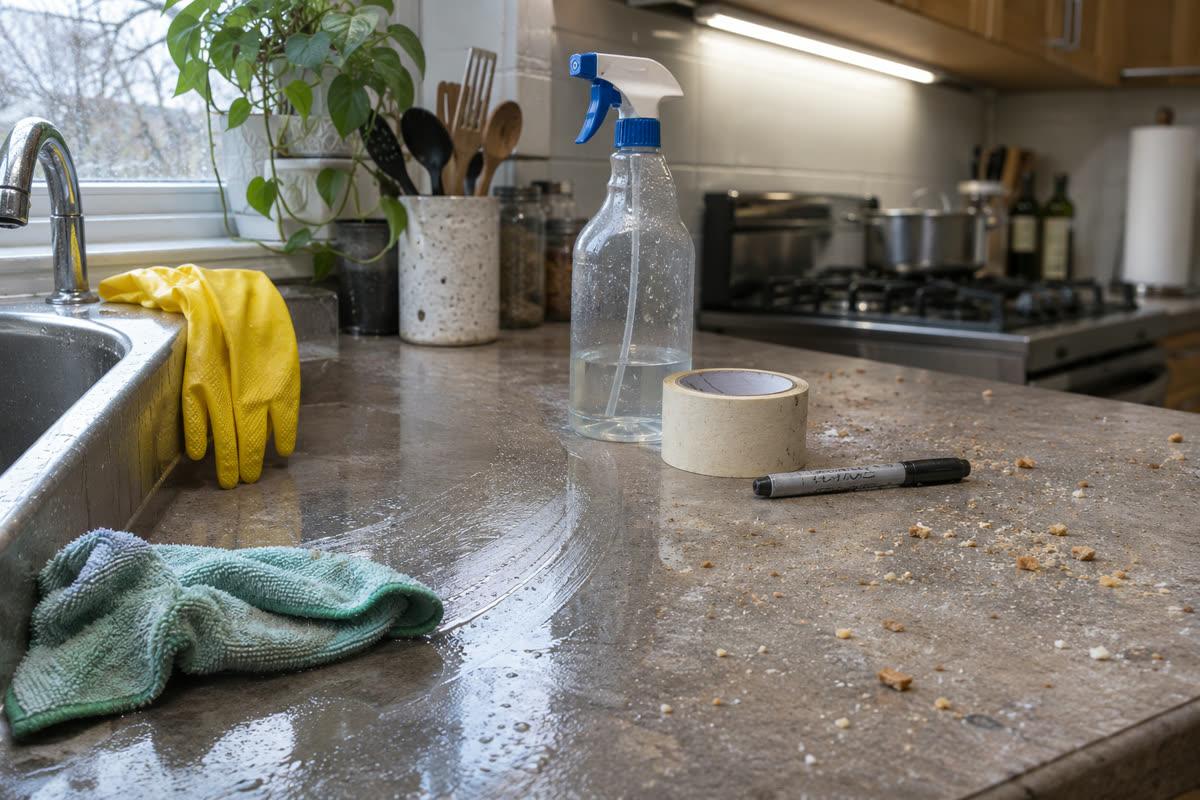
The charities we read split a floury kitchen into what washes and what may need replacing:
- Counters, pots and dishes: Coeliac UK says washing-up liquid or a dishwasher will remove gluten, and GIG says soap and water is sufficient for most items1, 2.
- Wood, scratched non-stick, pitted boards and mesh or crevice items: GIG says gluten can settle there, and lists inspecting, sanding or replacing3, 4, 28, 29.
- Appliances: GIG says to wash removable parts, wipe the rest, cover food in an oven and keep a separate air fryer5, 62, 6, 7.
- Sponges and towels: the charities differ, and the page gives each view8, 9, 90.
- Bleach: GIG says it only sanitizes gluten, and Beyond Celiac says it will not “kill” it87, 89. Steam and how long gluten lingers on a surface: we found no source11, 17.
Part of Cross-contact and the home kitchen, 19 guides
Key points
- Coeliac UK says standard washing-up liquid or a dishwasher will remove gluten1; GIG says thorough cleaning with soap and water is sufficient for most items, not all2.
- GIG says wood is porous and can trap gluten in grooves and knife marks, and that gluten can hide in cracks and scratches3, 12.
- In one study, kitchenware washed right after cooking wheat pasta or cutting bread gave gluten-free food under 20 mg/kg; the study used utensils, not flour dust on counters13, 14.
- GIG says high temperature does not burn gluten off, yet a second GIG page tells readers to heat a grill to burn off residue; the two pages disagree15, 16.
- GIG says bleach only sanitizes gluten and that scrubbing with soap and water can remove it87, 88; Beyond Celiac says bleach will not “kill” it89. We found no study that tests bleach or steam on gluten, and no source that states how long gluten stays on a surface10, 11, 17.
Where airborne flour goes
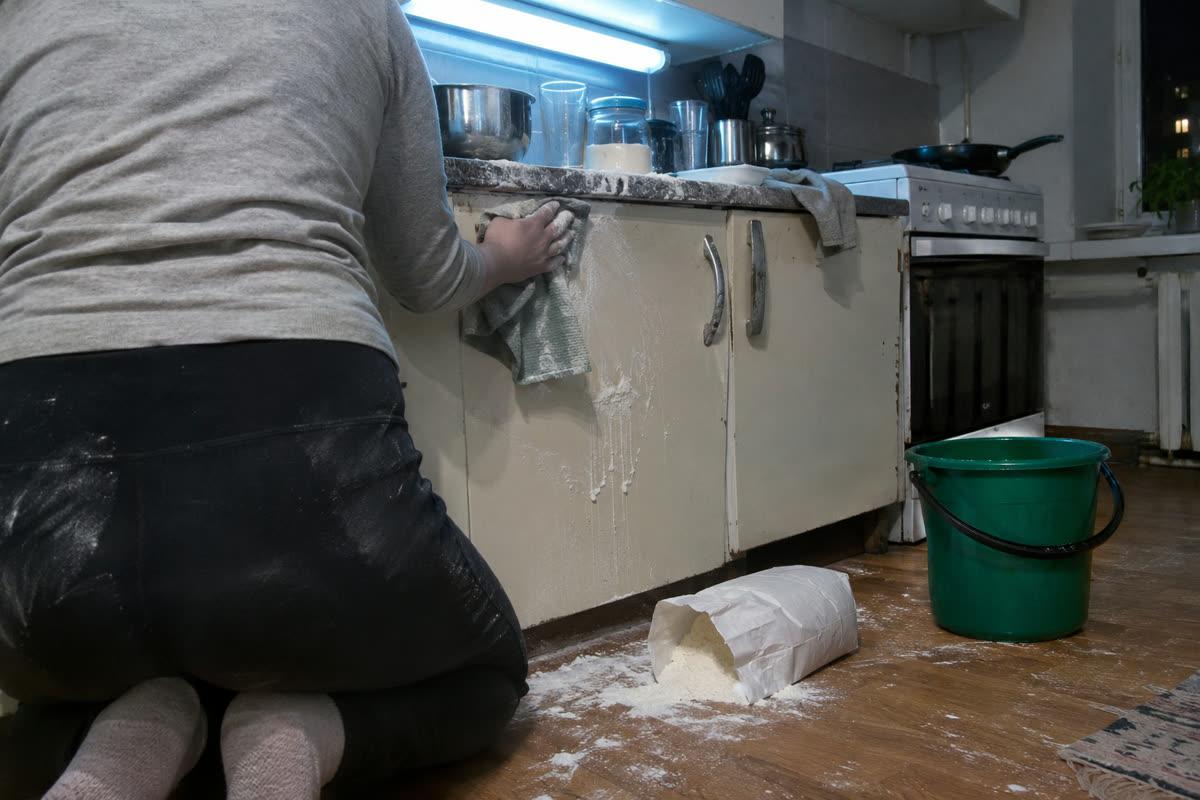
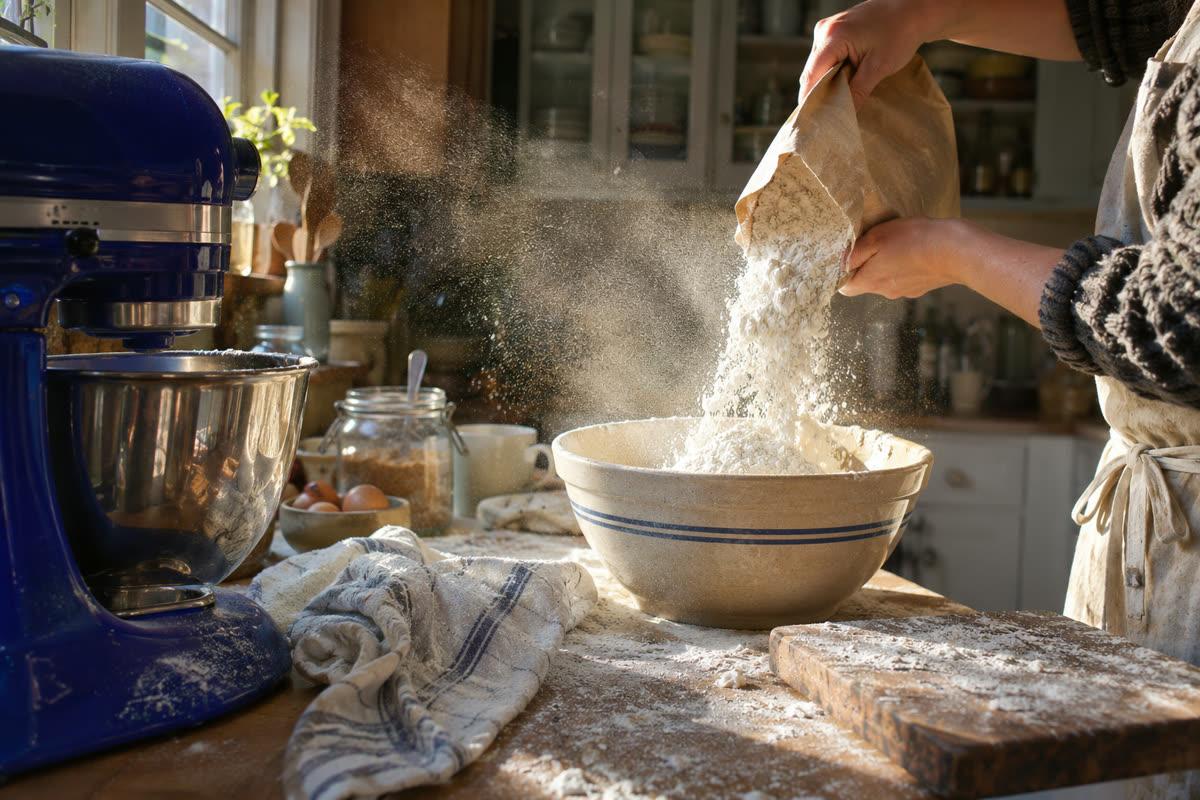
GIG says cross-contact can happen when cooking or baking at home, where gluten-containing flours may be airborne and settle on surfaces, utensils and gluten-free products18. Beyond Celiac says flour can stay airborne for 12-24 hours depending on ventilation and quantity of flour91. GIG describes cross-contact as gluten crumbs or particles getting into gluten-free food in amounts that could cause an adverse reaction19.
Counters, pots and dishes
For everyday washing the two charities give the same advice. Coeliac UK says to wipe down surfaces and clean pots, pans and cooking utensils with hot soapy water20, and that standard washing-up liquid or a dishwasher will remove gluten1. GIG says to wipe down any food prep or cooking surface after making dishes with gluten-containing ingredients21, and that thorough cleaning of equipment and utensils with soap and water is sufficient for most items2. GIG’s bleach FAQ adds that scrubbing with soap and water can remove gluten from surfaces such as a kitchen counter or cooking utensils88.
GIG says a shared dishwasher load is fine when the machine is functional and cleans thoroughly22.
What a study led by US government scientists found about washing
A study led by US Food and Drug Administration scientists soiled stainless steel, polyethylene and ceramic coupons with foods that included wheat flour and batter23. It washed them by hand (neutral detergent, rinse, then a 200 ppm quat sanitizer) or in warewashing machines24, 26, and read the results with qualitative lateral flow devices25. The machines were significantly more effective than hand washing at removing the food soils26. The setting was retail and food-service operations, not homes85, and the abstract does not break the result out for gluten alone, so read it as machine washing doing better than hand washing in that set-up, not as a household protocol.
GIG says a quick wipe is not always enough on items that have cracks and scratches27. Those items are the next section.
Wood, scratched items and things with crevices
GIG says wood is porous and can trap gluten in small grooves and knife marks3. For wooden boards and utensils, GIG’s March 2026 steps are:
- Inspect them. If they are deeply scratched or very old, GIG says to consider replacing them28.
- If they are in good shape, GIG says to sand them down lightly to remove the top layer29.
- Wash thoroughly with hot, soapy water30.
- Let them dry completely31.
- Re-oil with food-grade mineral oil to seal the surface32.
| Item | What GIG says |
|---|---|
| Cutting boards | If pitted or scratched, gluten could settle into crevices4. |
| Wooden utensils | Wood fibers could harbor gluten particles and enter your food with the next stir33. |
| Wooden rolling pins | Pushing flour into wood over the years could result in gluten transferring to gluten-free pastries and pies34. |
| Colanders, strainers and flour sifters | Starchy residue and tiny mesh make traces of gluten very difficult to remove35. Where sharing cannot be avoided, GIG says to clean the item thoroughly between every use36, 37. |
| Non-stick pans | Surfaces can get scratched and develop grooves where gluten could remain38. |
| Cast iron | GIG says the jury is still out on whether gluten clings to cast iron39, and that because it is usually washed without soap and is pitted, another pan may be worth buying40. |
| Pizza stones | Traditional stones are porous and could harbor gluten after non-gluten-free pizza41. |
| Muffin tins and cake pans | If buying a new set is not an option, GIG suggests cupcake liners and parchment paper42. |
Where to start if you cannot replace everything: GIG’s advice is to focus first on the highest-risk items, such as toasters and cutting boards43. Coeliac UK says you may want separate bread boards for gluten-free and gluten-containing bread44.
Open food and shared containers
Beyond Celiac says, in its steps for a full clean-out of a gluten-free kitchen’s fridge, to discard anything that may be contaminated, such as shared mayonnaise where someone could have double-dipped a knife used on bread92. The GIG spring-cleaning page does not say what to do with an open bag, jar or tub that flour has already reached17, and the other pages we read cover prevention. GIG says to put gluten-free packages above gluten-containing ones, keep them securely packaged45, and, in a fridge or pantry, to use a top shelf because crumbs or dust can fall46. GIG notes that flour and baking mixes could make dust47.
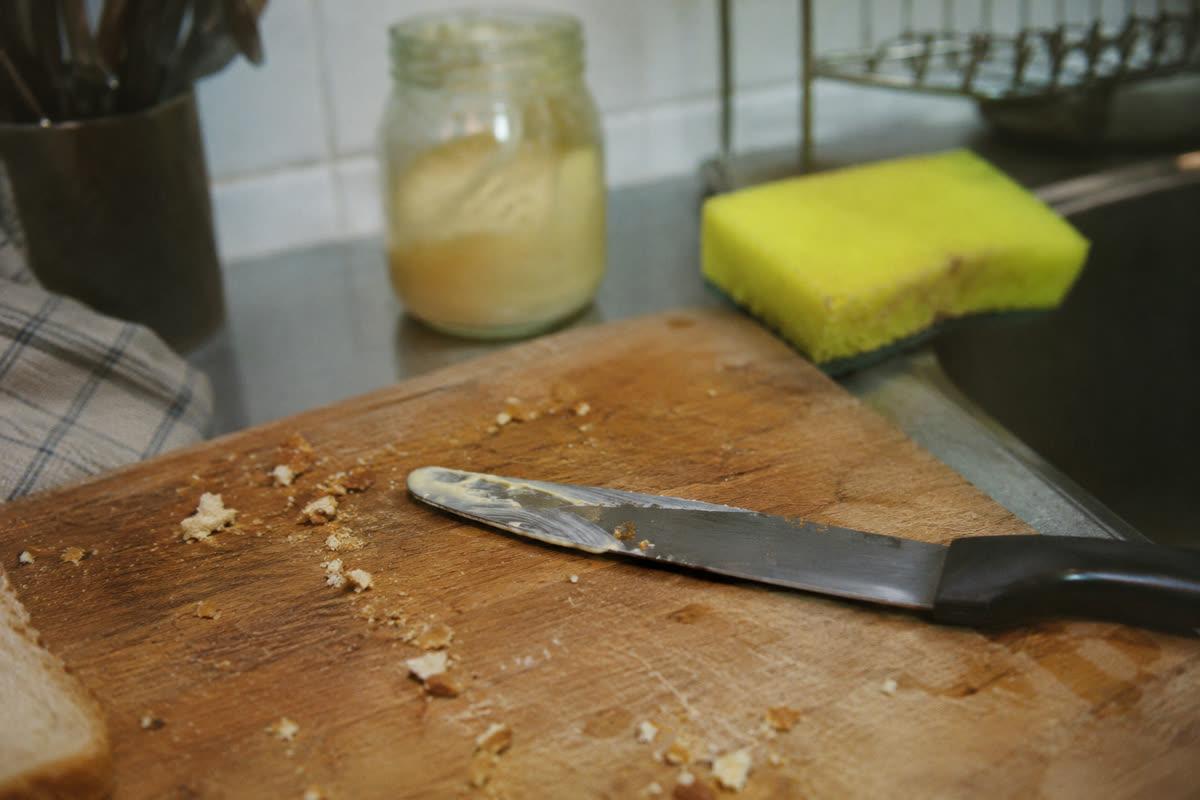
Shared spreads are the usual route for crumbs. GIG gives the example of a knife that spreads mayonnaise on wheat bread and is dipped back in the jar48. In one study that applied mayonnaise, jam and peanut butter with a knife used on gluten-containing bread, mayonnaise and peanut butter samples ended up above the 20 ppm gluten-free limit49, 50. Coeliac UK says to keep separate condiments or at least use clean cutlery for shared butters, jams and spreads51. GIG also suggests squeeze bottles, with a reminder to keep the tip off gluten-containing food52.
Our verdicts say whether each of these is gluten-free and name the sources we read: flour, bread, butter, cornstarch, baking powder and spices. They do not cover flour that landed on a jar in your kitchen.
Appliances
GIG’s appliance page is the most detailed source we found. The table gives its wording by appliance, with one study where a test exists.
| Appliance | What the sources say |
|---|---|
| Oven | GIG says to put gluten-free items on the higher rack so crumbs do not fall on them53. In a convection oven, wheat dust or food particles from earlier sessions may still be present and can be blown onto food, so GIG says to cover gluten-free food even when it is alone in the oven6, 54. |
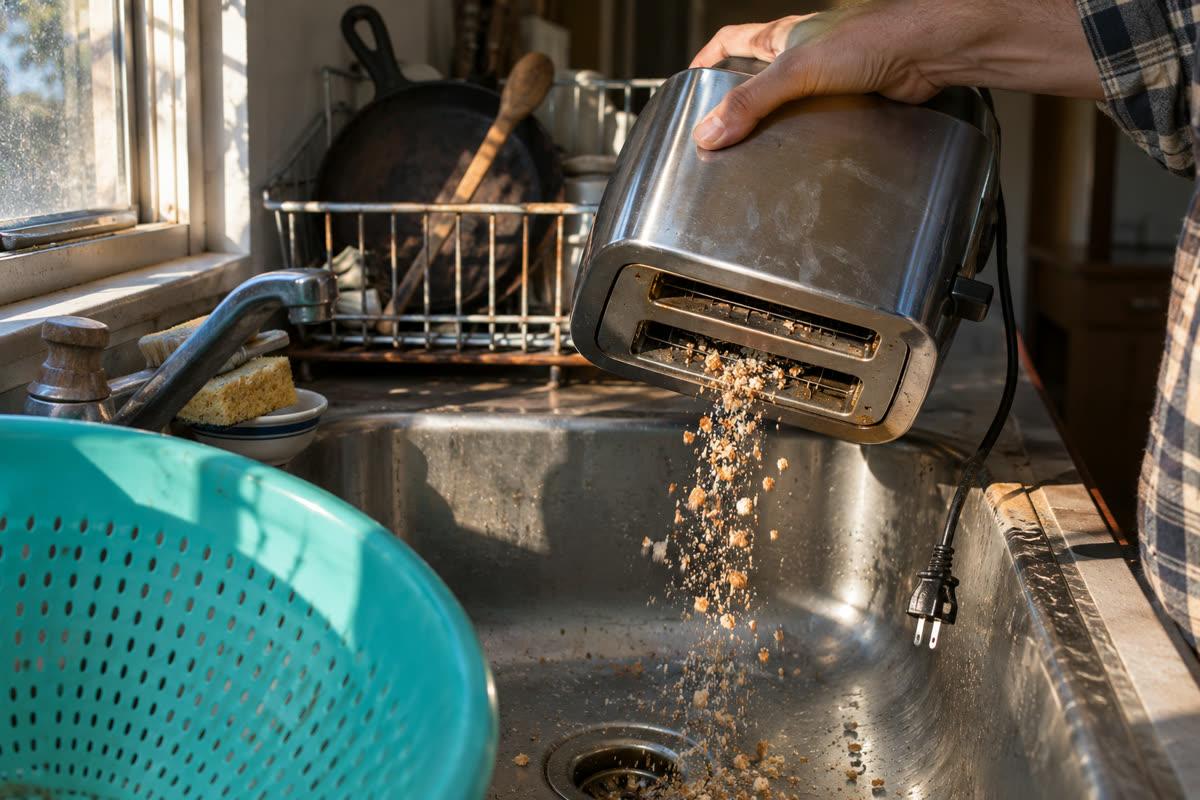
| Toaster | GIG says toaster bags or a new toaster for gluten-free toasting are options55, and calls toasters virtually impossible to clean thoroughly56. Coeliac UK says to use toaster bags or consider a separate toaster57. One research letter toasted gluten-free bread in shared toasters with visible gluten-containing crumbs86 and found no transfer above 20 ppm, without cleaning the toasters58, 59. |
| Microwave | GIG says to wipe it down after each use if it is shared with gluten-containing foods60. |
| Grill | GIG’s appliance page says gluten cannot be burned off by high temperature, and can be removed by thorough cleaning with soap, water and a metal grill scrubber15. Its March 2026 page says to scrub the grates with a grill brush and then heat the grill to burn off residue61, 16. |
| Air fryer | GIG says not to use the same air fryer for gluten-free and gluten-containing cooking7. |
| Stand mixer, blender, food processor | GIG says to wash every part that touches food after each use5, and to wipe down parts that cannot be washed before gluten-free use62. |
| Bread machine | GIG says to use a dedicated gluten-free machine63. |
| Waffle iron | Unless the plates come out for the dishwasher, GIG says another iron may be needed64. |
Two GIG pages give opposite advice on heat for grills15, 16. We cannot tell you which one is right, and neither page cites a test.
Sponges, cloths and towels
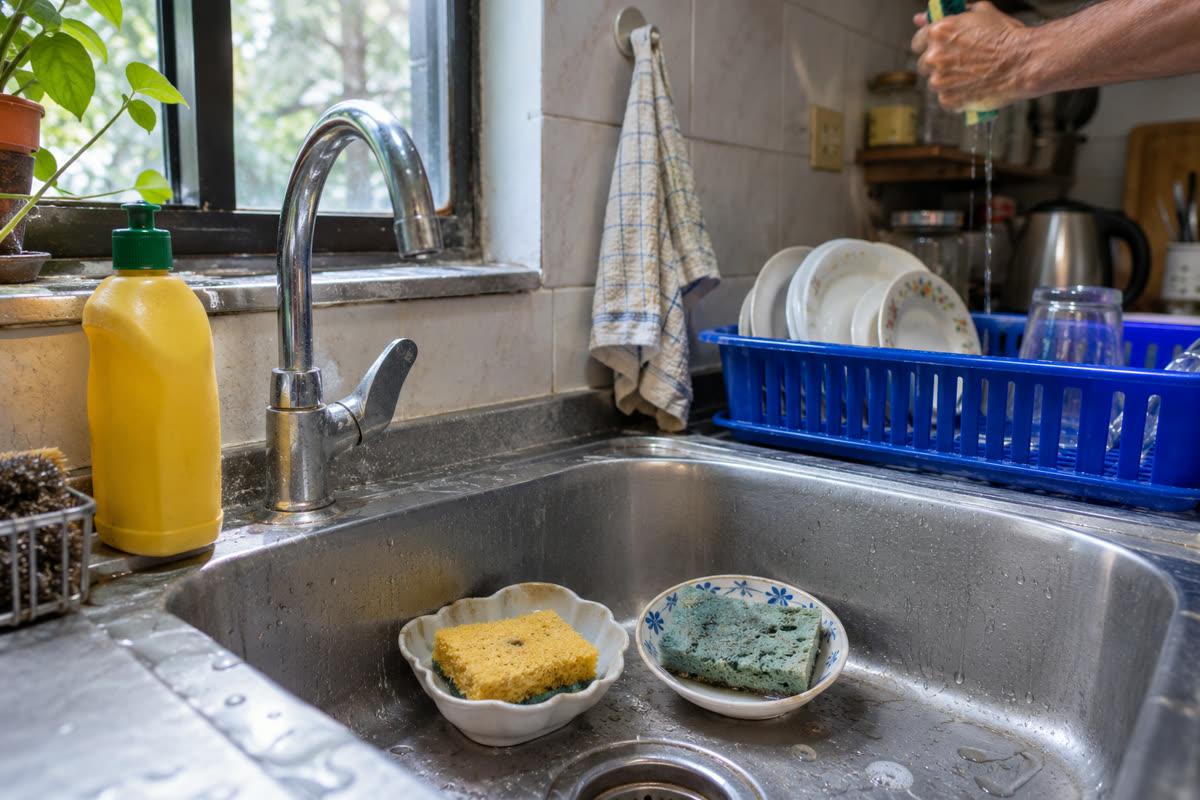
The charities differ here. Coeliac UK says you do not need separate cloths or sponges8. Beyond Celiac says you should have separate sponges and dishrags to clean gluten-free cookware90. GIG lists sink sponges among the items to clean carefully or keep separate9, and among the high-risk items for which replacement may be an option if they were heavily used with gluten65.
One Japanese study, which measured wheat allergens, scrubbed a bowl coated with liquid batter and then an unused bowl with the same sponge: wheat allergens moved to the second bowl in about 80% of trials66. Even with sponge rinsing added, complete removal of wheat allergen was difficult67. The authors concluded that sponges used on residual wheat should be dedicated in facilities that prepare allergy-friendly foods68.
For towels and pot holders, GIG says the risk from kitchen towels is minimal to none when they are used only on thoroughly washed dishes or hands, and otherwise separate towels, or even paper towels, are a good idea69. It also calls separate pot holders a good idea70, and suggests washing potholders before gluten-free cooking or labeling a separate one71.
What the cleaning studies tested, and what they did not
The test results below are narrower than the charity advice above. They are small studies with specific set-ups, and none of them tests flour dust spread over a kitchen.
| Study | What was tested | Result as reported |
|---|---|---|
| Studerus and colleagues, 2018 | Wooden spoon, colander, ladle and knife used for wheat foods, then for gluten-free bread and pasta13. | Gluten under 20 mg/kg in the samples14; all samples under 10 mg/kg whichever cleaning method was used72. The authors hypothesized that shared ladles pose a higher risk73. |
| Weisbrod and colleagues, 2019 | Pots after wheat pasta, a shared toaster and a knife after cupcakes74. | Rinsing pots with water alone was as effective as scrubbing with soap and water at preventing detectable gluten transfer75; all three knife washing methods removed gluten76. Cooking gluten-free pasta in shared water was the riskiest scenario77. |
| Kidd and colleagues, 2026 (FDA scientists) | Washing food-contact coupons, including wood, soiled with foods that included wheat flour23, 78. | Wood was tested with hand washing only78; machines beat hand washing on the materials where both were used26. |
| Parsons and colleagues, 2021 | A shared fryer, a shared toaster and a shared knife in spreads49. | Most results showed no significant cross-contact, but mayonnaise and peanut butter were above 20 ppm50. |
| Fuciños and colleagues, 2019 | An enzyme cleaning formulation in a food company with earlier gluten cross-contamination. | A preliminary validation in a food company, not a home79. |
| Wang and colleagues, 2010 | Cleaning steps on chicken-processing lines that used wheat batter. | Gliadin fell step by step after rinse, foam and sanitize, to not detected in a typical trial80. |
The Weisbrod letter’s authors say some kitchen activities may pose less risk than is commonly believed81, and name small sample size among its limits82. Between them these two studies used pasta, bread and cupcakes handled with utensils, pots and toasters13, 74, which is a different situation from flour dust over a counter. We do not use them to say a floury kitchen is fine. We cite them so you can see that much of the advice on this page, from GIG, is expert guidance and not a measurement.
Bleach, steam and drying time: what the sources say and what none covers
A common question is whether bleach or steam removes gluten. Charities speak to bleach; we found no test of either:
- Bleach: GIG’s FAQ answers “Does bleach kill gluten?” with “No, bleach only sanitizes gluten”87, and says scrubbing with soap and water can remove gluten from surfaces88. Beyond Celiac says gluten is not a virus or bacteria, so bleach or sanitizer will not “kill” it89. These are charity statements; a PubMed search for gluten with bleach or hypochlorite found no study of bleach as a kitchen cleaner for gluten10.
- Steam and hot water on surfaces: the PubMed search we ran returned no records11.
- Heat as a cleaner: GIG’s two pages disagree, as the appliances section shows15, 16. Beyond Celiac says gluten is a protein that cannot be “killed off” using heat or disinfecting agents like most bacteria can be93.
- How long gluten stays on a surface, or a drying time: the GIG spring-cleaning page gives no length of time17, and the Coeliac UK page does not mention it83. The one duration we found is for the air, not a surface: Beyond Celiac says flour can stay airborne for 12-24 hours depending on ventilation and quantity of flour91.
That leaves soap, water, a working dishwasher, replacement of the items the charities name, and covering or separating food. Those are what the charities and studies above describe; they are not guarantees.
After the clean-up
The NIDDK says to store and prepare gluten-free foods separately from family members’ foods that contain gluten, to prevent cross-contact84. For the longer setup, see setting up a gluten-free kitchen.
If you wonder whether a home test strip or pocket sensor can tell you anything about a cleaned surface or a bite of food, read what a home gluten test can and cannot tell you first.
Verdicts in this guide
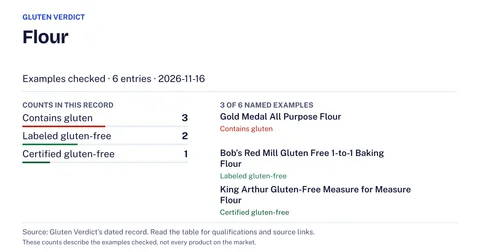 FlourContains glutenchecked Nov 16, 2026
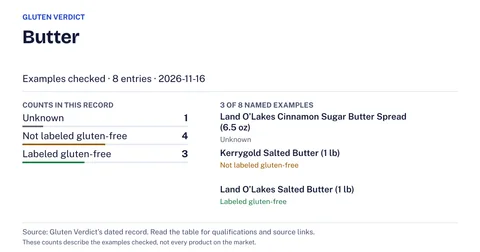 ButterNaturally gluten-freechecked Nov 16, 2026
 BreadContains glutenchecked Nov 16, 2026
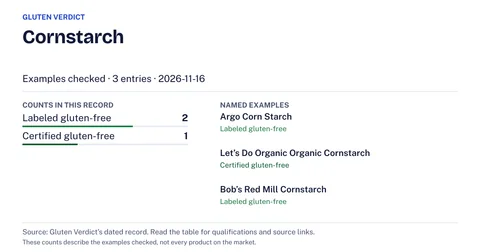 CornstarchNaturally gluten-freeBuy it labeled gluten-freechecked Nov 16, 2026
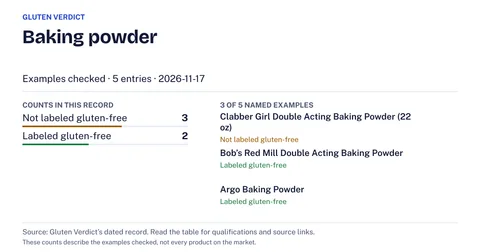 Baking powderDepends on the productchecked Nov 17, 2026
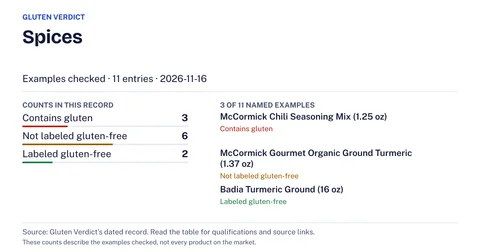 SpicesDepends on the product3 of 11 products we checked contain gluten: McCormick Chili Seasoning Mix (1.25 oz), Lawry’s Chili Spices & Seasonings Mix (1.48 oz), and McCormick Cheesy Taco Seasoning Mix (1.12 oz)checked Nov 16, 2026
Questions people ask
Does hot soapy water remove gluten from a kitchen surface?
Coeliac UK says to wipe surfaces and clean pots, pans and utensils with hot soapy water20. GIG says soap and water cleaning is sufficient for most items, and names wood, crevices and mesh as harder cases2, 3, 36.
Does heat burn gluten off a grill, pan or oven?
GIG’s appliances page says gluten cannot be burned off by high temperature15, but its March 2026 page tells readers to heat the grill to burn off residue16. We found no test that settles it.
What do the sources say about toasters?
GIG calls toasters virtually impossible to clean thoroughly56; Coeliac UK says toaster bags or a separate toaster57. One research letter found no transfer above 20 ppm from shared toasters that were not cleaned58, 59.
Can I keep using the same sponge?
Coeliac UK says separate cloths or sponges are not needed8. GIG lists sink sponges among items to clean carefully or keep separate9, and Beyond Celiac says to have separate sponges and dishrags for gluten-free cookware90. A Japanese study found wheat allergens moved between bowls through a sponge in about 80% of trials66.
More in Cross-contact and the home kitchen
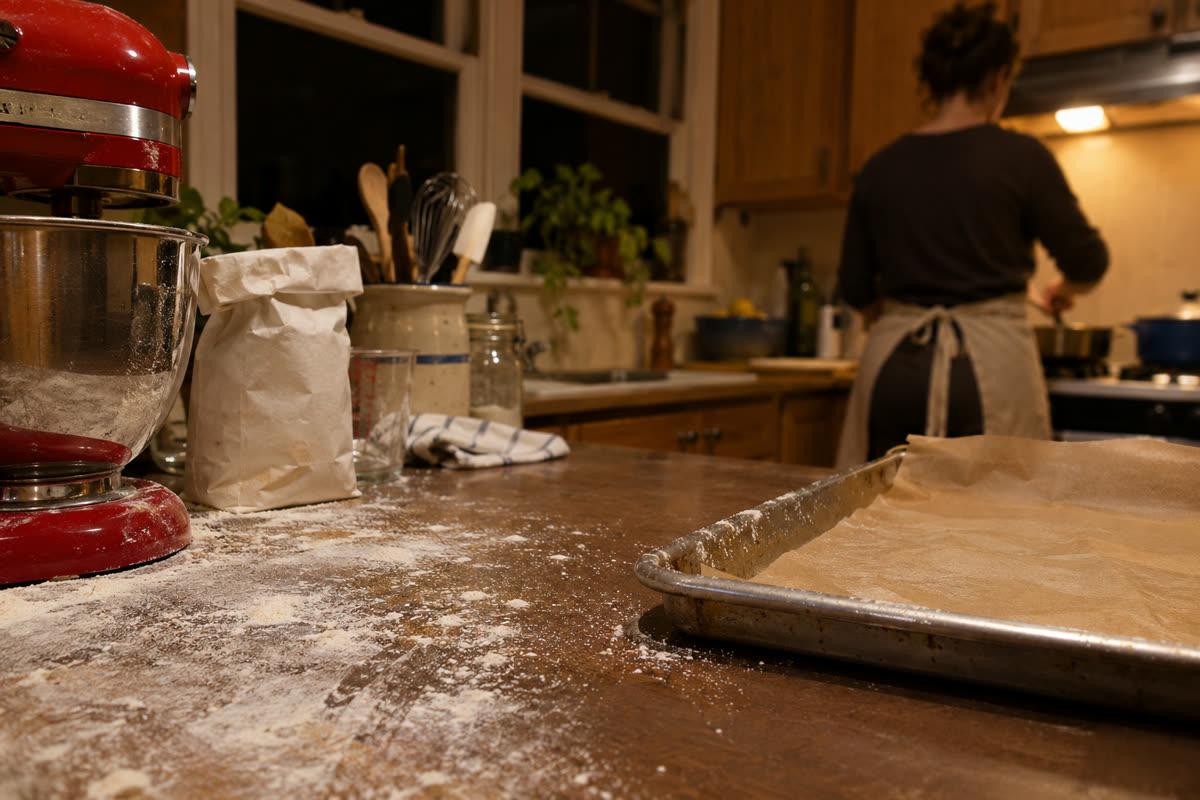 Baking gluten-free in a home where someone else bakes with wheat flourA baking-day plan for a shared kitchen: order, counters, flour storage, tools and oven, and which timing rules have no published source.
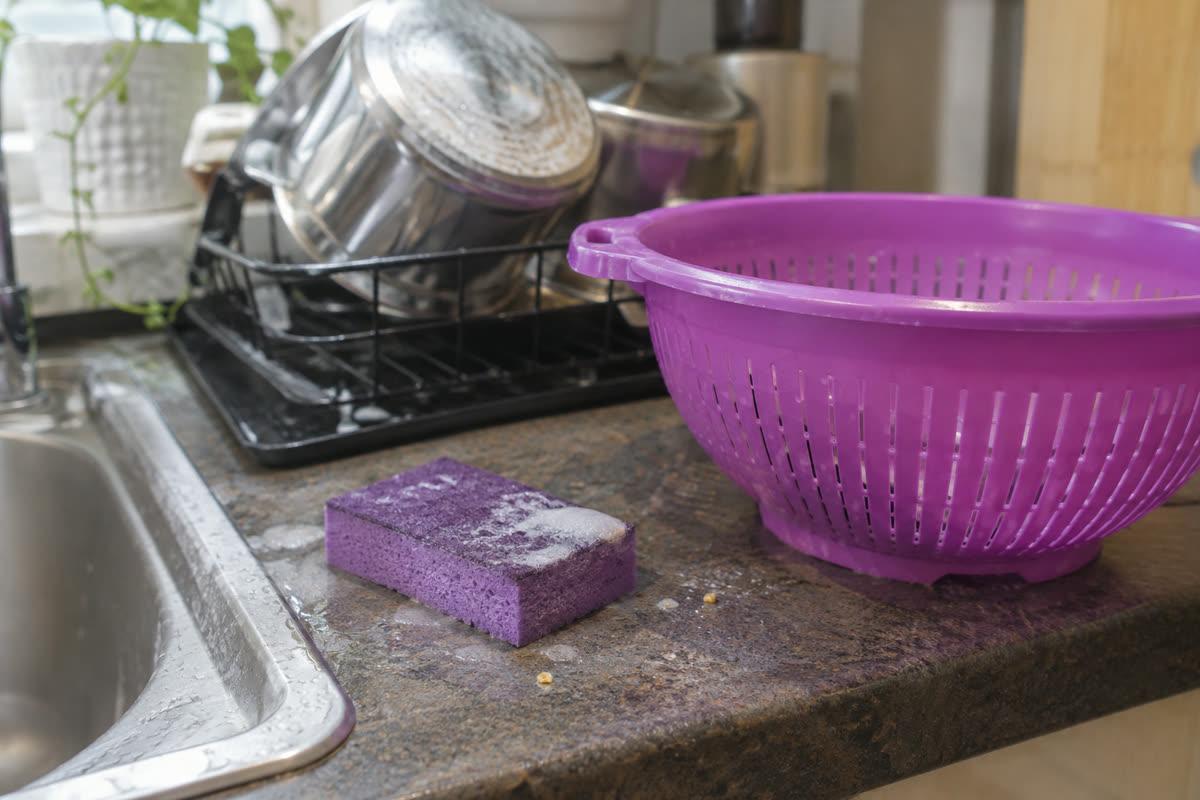 Setting up a gluten-free kitchen: what to replace, wash or shareWalk each kitchen zone and decide, item by item, what to replace, what to wash and what a mixed household can keep sharing, with charity sources.
 A weekly gluten-free kitchen routine: wipe, label, restock, re-checkA one-page weekly pass for a gluten-free kitchen: what to wipe, label, restock and do with leftovers, and where the charities and small studies differ.
 Gluten-free with roommates, partners and family: a shared-kitchen agreementHow to split a shared kitchen when one person is gluten-free: what to keep separate, what to wash and share, and how to put the rules to housemates.
 What studies measured in shared kitchens: pasta water, toasters, knives and spreadsWhat four experimental studies measured when gluten-free food met shared pots, toasters, knives and spreads: samples, results, and what went untested.
 Airborne flour and celiac disease: what the sources sayWhat charities and studies say about wheat flour dust in the air, what is only a hypothesis, and the wipe-down and cover steps the charities suggest.
Related guides
 Toasters, colanders, cast iron, wood and air fryers: which can be cleanedWhich kitchen items the charities say to keep, wash or replace after going gluten-free, item by item, with what the studies we found measured.
 Dishes, sponges, dishwashers and towels in a mixed householdWhat GIG, Beyond Celiac, Coeliac UK and published tests say about sponges, dish towels, hand washing and the dishwasher in a mixed home.
 Do home gluten tests work? What a strip or pocket sensor can and cannot showWhat a home gluten test strip or pocket sensor checks, how to read a maker's detection limit, and why a negative on one bite does not clear a meal.
 Sharing butter, jam and spreads with gluten eatersHow crumbs reach shared butter, jam and peanut butter, and what a second jar, squeeze bottle, knife rule or shelf each does and does not do.
Sources
- [1, 8, 20, 44, 51, 57, 83] Coeliac UK, Cross-contamination (cooking at home), checked Nov 17, 2026.
Read on 2026-11-17: the “Simple steps to avoid cross-contamination at home” list names washing-up liquid or a dishwasher, hot soapy water, cloths and sponges, fryers, condiments, bread boards and toasters; it does not mention bleach, steam or how long gluten stays on a surface.
- [2, 19, 21, 36, 37, 45, 47, 48] Gluten Intolerance Group, 25 Ways Cross-Contact Could Happen (And How to Avoid It), checked Nov 17, 2026.
- [3, 12, 16, 17, 27, 28, 29, 30, 31, 32, 43, 61, 65] Gluten Intolerance Group, Spring Cleaning Your Gluten-Free Kitchen (March 2026), checked Nov 17, 2026.
Read on 2026-11-17: the list under “Pantry Reset” names tossing expired products, wiping down shelves, checking labels and sealing open containers tightly; it does not say what to do with food that wheat flour has landed on, and the page gives no length of time that gluten stays on a surface and no mention of bleach or steam.
Read on 2026-11-17: the list under “Check High-Risk Items” names toasters, colanders, sieves, waffle makers, cast iron pans and sponges, and the sentence after it says replacement may be an option if they were heavily used with gluten in the past.
- [4, 33, 34, 35, 38, 39, 40, 41, 42, 71] Gluten Intolerance Group, The Tools to Replace in Your Gluten-Free Kitchen, checked Nov 17, 2026.
- [5, 6, 7, 15, 22, 53, 54, 55, 60, 62, 63, 64] Gluten Intolerance Group, Appliances: Risks of Cross-Contact, checked Nov 17, 2026.
- [9, 18, 46, 52, 56] Gluten Intolerance Group, 7 Tips for Avoiding Gluten Cross-Contact at Home, checked Nov 17, 2026.
Read on 2026-11-17: the list under Step 3, “Clean carefully or keep separate”, names wooden utensils, cutting boards, nonstick pans, cast iron skillets, wooden rolling pins, food storage containers, waffle irons, cake pans and muffin tins, and sink sponges.
- [10] PubMed, PubMed search: gluten with bleach or hypochlorite, checked Nov 17, 2026.
Read on 2026-11-17: the search returned eight records. None is a study of bleach as a kitchen cleaner for gluten; the closest is a 1974 paper whose title reads “Comparative studies on the sensitivity of gliadin and glutenin from gamma-irradiated wheat to sodium hypochlorite”.
- [11] PubMed, PubMed search: gluten with steam or hot water on surfaces, utensils or kitchens, checked Nov 17, 2026.
Read on 2026-11-17: the search returned no records.
- [13, 14, 72, 73] Studerus and colleagues, Journal of Food Protection (2018), Cross-Contamination with Gluten by Using Kitchen Utensils: Fact or Fiction?, checked Nov 17, 2026.
- [23, 24, 25, 26, 78, 85] Kidd and colleagues, Journal of Food Protection (2026), Effectiveness of Manual and Mechanical Warewashing Methods for Removing Allergen- and Gluten-Containing Foods from Food-Contact Surfaces Used in Retail and Food Service Operations, checked Nov 17, 2026.
- [49, 50] Parsons and colleagues, Clinical Nutrition (2021), Gluten cross-contact from common food practices and preparations, checked Nov 17, 2026.
- [58, 59, 74, 75, 76, 77, 81, 82, 86] Weisbrod and colleagues, Gastroenterology (2019), Preparation of Gluten-Free Foods Alongside Gluten-Containing Food May Not Always Be as Risky for Celiac Patients as Diet Guides Suggest, checked Nov 17, 2026.
- [66, 67, 68] Hashimoto and colleagues, Shokuhin Eiseigaku Zasshi (2022), Secondary Contamination by Wheat Allergens across Cooking Bowls through the Use of Sponge Scourers, checked Nov 17, 2026.
- [69, 70] Gluten Intolerance Group, FAQ: Should I be concerned about using the same dish/hand towels and pot holders as family members who handle gluten-containing food?, checked Nov 17, 2026.
- [79] Fuciños and colleagues, Food Research International (2019), Effectiveness of proteolytic enzymes to remove gluten residues and feasibility of incorporating them into cleaning products for industrial purposes, checked Nov 17, 2026.
- [80] Wang, Young and Karl, Journal of Food Science (2010), Evaluation of cleaning procedures for allergen control in a food industry environment, checked Nov 17, 2026.
- [84] National Institute of Diabetes and Digestive and Kidney Diseases (NIDDK), Eating, Diet, & Nutrition for Celiac Disease, checked Nov 17, 2026.
- [87, 88] Gluten Intolerance Group, Does bleach “kill” gluten? (FAQ), checked Nov 17, 2026.
- [89, 92] Beyond Celiac, Gluten-free kitchen setup after diagnosis (blog), checked Nov 17, 2026.
- [90, 91, 93] Beyond Celiac, Cross-Contact, checked Nov 17, 2026.