A weekly gluten-free kitchen routine: wipe, label, restock, re-check
Short answer
Run these four steps once a week, on top of wiping prep and cooking surfaces often and always after making dishes with gluten-containing ingredients, as GIG advises20:
- Wipe the shelves and wash shared counters, and replace or launder sponges and cloths3, 11, 12.
- Check that gluten-free food is labeled, sealed and stored on a higher shelf8, 9.
- Restock from your list, reading every label again, because ingredients can change3, 36.
- Refrigerate or freeze leftovers within 2 hours, in covered containers39, 40.
Part of Cross-contact and the home kitchen, 19 guides
Key points
- For someone with celiac disease, NIDDK advises storing and preparing gluten-free foods separately from other family members’ foods that contain gluten35.
- GIG says gluten is not destroyed by heat or killed by most standard cleaning sprays, so it must be physically removed10.
- The charities differ on details such as sponges and toasters13, 22, 14, 24.
- Two small studies found low gluten transfer from some shared kitchen items; the authors of one list its small sample size as a limitation and call the other a small study30, 32.
- Leftovers need to be refrigerated or frozen within 2 hours, according to FDA39.
Start from separate tools and loosen only on purpose
NIDDK’s advice for a household with celiac disease is to store and prepare gluten-free foods separately from family members’ foods that contain gluten35. The Gluten Intolerance Group (GIG) goes further for the tools that are hardest to clean: in its article on tools to replace, it recommends that when only some household members are going gluten-free, they get a separate set of the hard-to-clean items strictly for gluten-free food prep17. A different GIG article’s list of high-risk items names toasters, colanders, sieves, waffle makers, cast iron pans and sponges2.
Our default for a household that has not yet tested a looser setup is the stricter one: separate boards and utensils1, a separate toaster or toaster bags24, and a labeled zone8. The studies further down are small30, 32, so we treat their results as a reason to ask questions, not as permission to drop the routine.
| Item | Gluten Intolerance Group | Coeliac UK |
|---|---|---|
| Sponges and cloths | Replace or launder shared ones often, and consider a dedicated gluten-free sponge12, 13 | Separate cloths or sponges are not needed22 |
| Toaster | Toasters are at the top of the list of appliances to designate gluten-free only14 | Toaster bags, or consider a separate toaster24 |
| Shared jars and spreads | Buy double of items like peanut butter, jam, mustard and mayo, or split a family-size jar into two and label one18 | Separate condiments, or at least clean cutlery for shared butters, jams and spreads23 |
| Washing up | Hot soapy water for counters and prep areas before gluten-free cooking11 | Standard washing up liquid or a dishwasher will remove gluten21 |
Where the two differ, the stricter steps are a dedicated sponge and a dedicated toaster. Households that want to loosen a step can ask a registered dietitian; NIDDK says one can help you learn to avoid foods and drinks that contain gluten when you shop and prepare foods at home37.
The weekly pass, in order
Wiping after each meal is the daily habit; GIG says to wipe prep and cooking surfaces often and always after making dishes with gluten-containing ingredients20. The weekly pass is the slower check on top of that.
- Wipe down the shelves, pantry and fridge, and toss expired products3.
- Wash counters, tables and prep areas with hot soapy water and a clean cloth or paper towel11. GIG says gluten is a protein that is not destroyed by heat or killed by most standard cleaning sprays, so it must be physically removed10.
- Replace or launder shared sponges and dish rags12.
- Look over the hard-to-clean tools on GIG’s list: toasters, colanders, sieves, waffle makers, cast iron pans, sponges2. Anything that has been used with gluten and cannot be cleaned out goes on the replace list.
- If you bake in an oven that also cooks gluten-containing food, wipe the racks and interior, or use fresh foil or a clean baking sheet as a barrier15.
- Check labels and containers on the gluten-free shelves (next section).
- Restock from the list (below).
- Clear out leftovers (below).
GIG describes a yearly reset for households that have been gluten-free for years, because habits shift: new roommates, kids getting older, shared kitchens and busy routines can introduce new risks4, 5. For a household just starting out, GIG says not to replace everything overnight and to focus first on the highest-risk items, such as toasters and cutting boards6.
Labels and shelves
The weekly check is quick: is each gluten-free item where it belongs, closed, and marked?
- Color: GIG suggests one color for everything strictly gluten-free, such as cutting boards, mixing bowls, storage containers, tongs and spatulas7.
- Zones: label gluten-free foods and give them dedicated areas of the fridge and pantry8.
- Height and seals: GIG says to keep everything sealed and to store gluten-free products on higher shelves so crumbs do not fall into them9.
- Shared jars: see the table above for the two charities’ options18, 23. Our verdicts for peanut butter and butter record what we read and from whom; the jar in your hand has the final word.
Restocking staples from the list
Start from your list (gluten-free grocery list, with grocery shopping tips) and read each label again, even for items you buy every week: NIDDK advises reading labels for wheat, barley, rye and ingredients made from them36, and GIG notes that ingredients can change3. A “gluten-free” claim on an FDA-regulated food means the food meets FDA’s definition, including less than 20 parts per million of gluten38.
We have verdicts for several staples, and each records what we read: flour, bread, pasta, rice, oatmeal and cereal. GIG advises staying clear of a store’s bulk section, where gluten-containing ingredients can linger on scoops and bins19.
Put new items on the labeled shelves as soon as they come home, so they never sit in the wrong zone.
Leftovers: the 2-hour rule and keeping gluten-free food apart
FDA’s food-handling advice is that leftovers need to be refrigerated or frozen within 2 hours, and that dividing hot food into smaller containers helps it cool faster39. It also says to store refrigerated food in covered containers or sealed bags and to check leftovers daily for spoilage40.
For a gluten-free household, the gluten-free part is the same as for any other food: leftovers go into a sealed, labeled container, on a higher shelf in the gluten-free zone8, 9. The weekly pass is when anything unlabeled or past its day gets cleared out.
What small studies suggest, and what they do not settle
Weisbrod and colleagues wrote in 2020 that diet guides from professional societies, hospitals and advocacy organizations suggest dedicated toasters and have conflicting recommendations about dedicated utensils25. The table shows what the study reported for each scenario.
| Scenario | Reported result |
|---|---|
| Gluten-free pasta cooked in water used for gluten-containing pasta | The riskiest of the three; gluten above 20 ppm in all samples tested26 |
| Gluten-free bread toasted in shared toasters | Not associated with gluten transfer above 20 ppm; four samples with detectable gluten, at 5.1 to 8.3 ppm27 |
| Pots used for gluten-containing pasta, rinsed or scrubbed | Rinsing with water alone was as effective as scrubbing with soap and water at preventing detectable transfer28 |
| Knife used on a gluten-containing cupcake, then a gluten-free one | 28 of 30 samples had detectable gluten and 2 of 28 tested above 20 ppm; all three knife washing methods were effective29 |
A second small study, Studerus and colleagues in 2018, used a wooden spoon, colander, ladle and knife previously used with gluten-containing foods to prepare gluten-free bread and pasta41. Gluten was not detected in relevant and quantifiable amounts, below 20 mg/kg33. Its authors hypothesized that shared ladles pose a higher risk than shared wooden spoons, colanders or knives34.
Weisbrod and colleagues list their own limits: small sample size, subsampling of homogenized foods, and use of a sandwich ELISA rather than a competitive ELISA, which is able to detect hydrolyzed gluten30. They add that cross-contact varies between kitchens31. Weisbrod and colleagues describe the Studerus study as small32, and our routine does not rest on either one. See what the shared-kitchen studies found for the longer reading.
After a slip: use the checklist to find the gap
If someone in the house is glutened or crumbs turn up where they should not be, run the weekly pass early and look for the break: an unlabeled jar, a shared sponge, a toaster, a shared oven rack. GIG names this kind of drift (new roommates, shared kitchens, busy routines) as where new risks come in4. For a floury accident, our guide to cleaning a kitchen after wheat flour exposure covers what washes and what may need replacing.
This checklist covers the kitchen, not symptoms. NIDDK points to a registered dietitian for help with shopping and preparing food at home37.
One-page weekly checklist
Print or copy this list. Each line is the step above in short form.
- Shelves wiped, expired items tossed, open containers sealed3.
- Counters, tables and prep areas washed with hot soapy water11.
- Sponges and dish rags replaced or laundered12.
- Hard-to-clean tools checked; replace list updated2.
- Gluten-free food labeled, sealed and on the higher shelf8, 9.
- List written; labels re-read at the store; bulk bins skipped36, 19.
- Leftovers cleared or refrigerated within 2 hours, in covered containers39, 40, labeled and on the gluten-free shelf8.
Keep the list next to our grocery list so the restock and the label check happen in one trip.
Verdicts in this guide
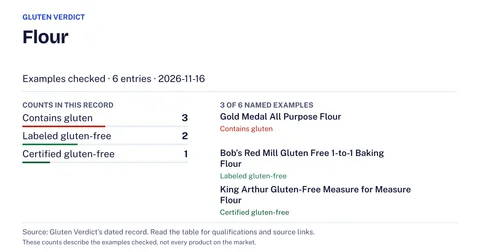 FlourContains glutenchecked Nov 16, 2026
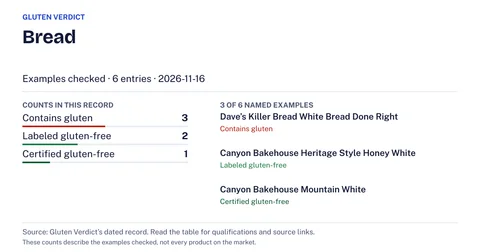 BreadContains glutenchecked Nov 16, 2026
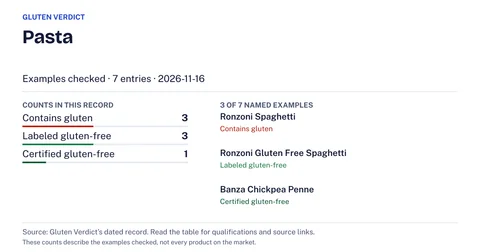 PastaContains glutenchecked Nov 16, 2026
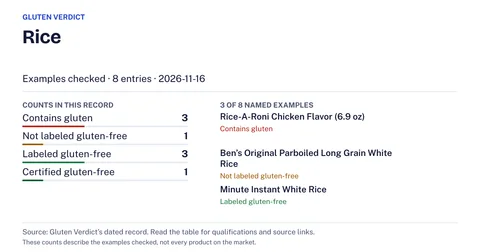 RiceNaturally gluten-free3 of 8 products we checked contain gluten: Rice-A-Roni Chicken Flavor (6.9 oz), Near East Original Rice Pilaf, and Ben’s Original Ready Rice Rice PilafBuy it labeled gluten-freechecked Nov 16, 2026
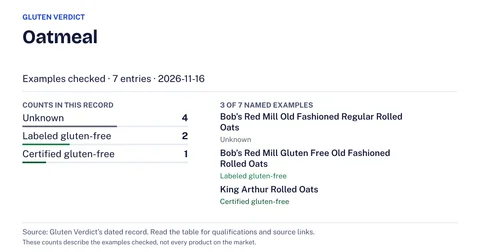 OatmealDepends on the productchecked Nov 16, 2026
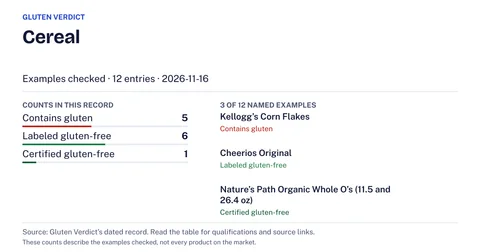 CerealDepends on the product5 of 12 products we checked contain glutenchecked Nov 16, 2026
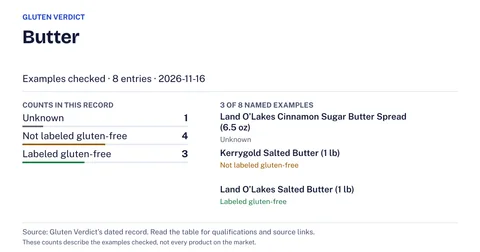 ButterNaturally gluten-freechecked Nov 16, 2026
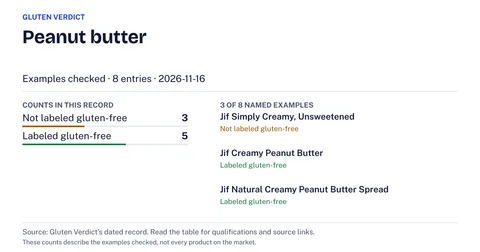 Peanut butterDepends on the productchecked Nov 16, 2026
Questions people ask
Does heat kill gluten?
No. GIG says gluten is a protein that is not destroyed by heat or killed by most standard cleaning sprays, so it must be physically removed10.
More in Cross-contact and the home kitchen
 What to clean after wheat flour lands in a gluten-free kitchenThe order of jobs after wheat flour reaches a gluten-free kitchen, what charities and studies say about each item, and what no source covers.
 Gluten-free with roommates, partners and family: a shared-kitchen agreementHow to split a shared kitchen when one person is gluten-free: what to keep separate, what to wash and share, and how to put the rules to housemates.
 Setting up a gluten-free kitchen: what to replace, wash or shareWalk each kitchen zone and decide, item by item, what to replace, what to wash and what a mixed household can keep sharing, with charity sources.
 Storing gluten-free food in a shared fridge, pantry and freezerWhere gluten-free food goes in a shared fridge, pantry and freezer, how to label it so everyone follows, and what the sources say and leave out.
 What studies measured in shared kitchens: pasta water, toasters, knives and spreadsWhat four experimental studies measured when gluten-free food met shared pots, toasters, knives and spreads: samples, results, and what went untested.
 Gluten cross-contact at home: where it happens and what to do about itHow gluten reaches gluten-free food at home, whether to separate, wash or ask for each route, and which rules have lab data behind them.
Related guides
 A gluten-free grocery list by aisle for US supermarketsAn aisle-by-aisle gluten-free grocery list for US stores: what needs no label, what needs a check, and what stays off the list.
 Starting a gluten-free diet: testing first, then labels, oats and the kitchenWhat NIH and the celiac charities say about starting a gluten-free diet: testing first, which foods to start with, a US label check, oats and the kitchen.
 Starting solids in a home with a celiac family member: kitchen routinesKitchen routines for a baby starting solids when someone at home has celiac disease: crumbs, spreads, towels, spills and hands, from charity guidance.
 When your partner has celiac disease: gluten-free home or split kitchenChoose between a gluten-free home and a split kitchen, and find what to say at restaurants and to family, with NIH and charity sources.
Sources
- [1, 2, 3, 4, 5, 6] Gluten Intolerance Group, Spring Cleaning Your Gluten-Free Kitchen (March 2026), checked Nov 17, 2026.
Read on 2026-11-17: the list under “Check High-Risk Items” names toasters, colanders, sieves, waffle makers, cast iron pans and sponges.
Read on 2026-11-17: the list under “Pantry Reset” names tossing expired products, wiping down the shelves, checking labels (“ingredients can change!”) and making sure open containers are sealed tightly.
- [7, 8, 9, 10, 11, 12, 13, 14, 15, 16] Gluten Intolerance Group, Your Kitchen, Their Kitchen, Our Kitchen: Navigating Gluten-Free Cohabitation, checked Nov 17, 2026.
- [17] Gluten Intolerance Group, The Tools to Replace in Your Gluten-Free Kitchen, checked Nov 17, 2026.
- [18, 19] Gluten Intolerance Group, 7 Tips for Avoiding Gluten Cross-Contact at Home, checked Nov 17, 2026.
- [20] Gluten Intolerance Group, 25 Ways Cross-Contact Could Happen (And How to Avoid It), checked Nov 17, 2026.
- [21, 22, 23, 24] Coeliac UK, Cross-contamination (cooking at home), checked Nov 17, 2026.
- [25, 26, 27, 28, 29, 30, 31, 32] Gastroenterology (PubMed Central author manuscript), Preparation of Gluten-Free Foods Alongside Gluten-Containing Food May Not Always Be as Risky for Celiac Patients as Diet Guides Suggest (Weisbrod and colleagues, 2020), checked Nov 17, 2026.
- [33, 34, 41] Journal of Food Protection (PubMed record), Cross-Contamination with Gluten by Using Kitchen Utensils: Fact or Fiction? (Studerus and colleagues, 2018), abstract, checked Nov 17, 2026.
- [35, 36, 37] National Institute of Diabetes and Digestive and Kidney Diseases (NIDDK), Eating, Diet, & Nutrition for Celiac Disease, checked Nov 17, 2026.
- [38] US Food and Drug Administration, Questions and Answers on the Gluten-Free Food Labeling Final Rule, checked Nov 17, 2026.
- [39, 40] US Food and Drug Administration, Refrigerator Thermometers: Cold Facts, checked Nov 17, 2026.