What happens when you stop eating gluten, condition by condition
Short answer
What a gluten-free diet does depends on why someone follows it. In short:
- Celiac disease: it is the treatment1, symptoms improve within days to weeks for many people, and NIDDK says it heals the small intestine in most people2; one adult follow-up study estimated confirmed recovery in 66% at 5 years3.
- Dermatitis herpetiformis: the rash may not go away until a person has followed the diet for 6 months to 2 years4.
- Wheat allergy: the Gluten Intolerance Group calls a wheat-free diet the only treatment5.
- No diagnosis: in one blinded trial of people with self-reported gluten sensitivity, fructans raised symptom scores more than gluten did6, and the Lancet review says fermentable carbohydrates and nocebo effects contribute considerably in many cases7.
- Before cutting gluten: NIDDK advises talking with a doctor about celiac testing first, because avoiding gluten can make the results inaccurate8.
Part of Gut science, healing and treatment research, 11 guides

Key points
- The diet is the treatment for celiac disease1, and the Gluten Intolerance Group calls a wheat-free diet the only treatment for wheat allergy5; for the general population NIDDK reports no evidence of better health or weight loss9.
- In celiac disease symptoms, antibodies and the lining recover on different clocks: days to weeks for many people's symptoms2, antibodies that typically return to normal10, and a lining that one adult study estimated was confirmed recovered in 66% at 5 years3.
- NIDDK says avoiding gluten before celiac testing can affect the results11, and the Gluten Intolerance Group and Coeliac UK say the same in their own words12, 13.
- In one blinded trial of people who felt better off gluten, gluten-specific effects appeared in only 8% of participants14; the Lancet review cites 16-30% across meta-analyses and says methods limit interpretation15, 16.
- Packaged gluten-free foods are not automatically lower in fat and sugar: NIDDK says some may be higher than the versions with gluten17.
Before you cut gluten: what the celiac tests need
NIDDK advises talking with a doctor about testing to diagnose celiac disease before beginning a gluten-free diet, because if gluten is avoided before testing, the test results may not be accurate8.
Doctors most often use blood tests and biopsies of the small intestine to diagnose or rule out celiac disease, and NIDDK says they do not recommend starting the diet first because it can affect the results11. Celiac disease is not diagnosed from symptoms alone, because some of its symptoms resemble those of other digestive disorders, such as irritable bowel syndrome or lactose intolerance18.
Two charities say much the same. The Gluten Intolerance Group says a patient must consume a gluten-containing diet for an accurate celiac disease diagnosis12. In the UK, Coeliac UK says that cutting gluten because you feel ill is very likely to cause an inaccurate result for both the blood test and the gut biopsy13.
If gluten has already been cut, Coeliac UK says it will need to be reintroduced to get the most accurate test results19. What that involves is a question for a clinician.
Find your situation
Each row says what the sources report, not what will happen to any one person. Which row applies is decided by testing and a clinician; NIDDK notes that celiac disease is not diagnosed from symptoms alone18.
| Situation | What the diet is for | What the sources report | How long, or how it is judged |
|---|---|---|---|
| Celiac disease | Treatment: doctors treat celiac disease by helping people follow a gluten-free diet, and NIDDK says it is needed for life1, 20. | Symptoms greatly improve for most people who stick to it, and for most it heals small-intestine damage2. About 20 percent have symptoms that continue or come back despite the diet21. | Symptoms: many people see improvement within days to weeks2. Antibodies: typically return to normal after treatment10. Lining: one adult study estimated confirmed recovery of 34% at 2 years and 66% at 5 years3. |
| Dermatitis herpetiformis (an itchy, blistering skin rash) | The same diet; in some cases a medicine such as dapsone is prescribed until the rash is under control with the diet alone22. | The rash may take some time to heal and may return if a person consumes small amounts of gluten23. | May not go away until a person has followed the diet for 6 months to 2 years4. |
| Wheat allergy | Avoiding any form of wheat25; the Gluten Intolerance Group calls a wheat-free diet the only treatment5. | An immune reaction to proteins in wheat24. A person with it does not have trouble tolerating gluten from non-wheat sources25. | Reactions happen within minutes to a few hours26. Children may outgrow it; adults usually have it for life5. |
| Non-celiac gluten sensitivity (NCGS) | People report symptoms linked to gluten- or wheat-based foods without celiac disease or wheat allergy27. | In blinded trials, gluten-specific effects were seen in only 8% of participants in one trial14, and fructans raised symptom scores more than gluten did in another, where gluten and placebo scores did not differ6, 46. | By ruling out celiac disease and wheat allergy first28; the Lancet review calls it a diagnosis of exclusion29. |
| No diagnosis, or a negative celiac test | NIDDK says a doctor may not recommend the diet to people without celiac disease or another gluten-related health problem9. | NIDDK: researchers have found no evidence that the diet promotes better health or weight loss for the general population9. Avoiding gluten without advice may leave the diet short of fiber, iron and calcium17. | Not applicable. The explanations that have a trial behind them are further down. |
Celiac disease: symptoms, antibodies and the lining run on different clocks
NIDDK reports that symptoms greatly improve for most people who stick to the diet, and that many see improvement within days to weeks2. Symptoms may return if a person consumes small amounts of gluten30. Depending on age at diagnosis, some symptoms, such as short height and tooth defects, may not improve31.
Symptoms are not the whole picture
The American College of Gastroenterology's 2023 guideline says most patients have an excellent clinical response to the diet32. NIDDK adds that in about 20 percent of people with celiac disease, symptoms continue or come back despite following it21, and lists small amounts of gluten, other health problems and refractory celiac disease as possible causes33. It also says people with celiac disease who have no symptoms can still develop complications over time if they do not get treatment31.
Antibodies
NIDDK says follow-up may include blood tests for antibodies, which are higher in untreated celiac disease but typically return to normal after treatment10.
The lining of the small intestine
NIDDK says that for most people the diet will heal damage in the small intestine2, and that in some cases doctors recommend additional biopsies to find out whether it has healed10.
One study at the Mayo Clinic looked at adults with biopsy-proven celiac disease who had a follow-up biopsy34. Its Kaplan-Meier estimates of confirmed recovery of the lining were 34% at 2 years and 66% at 5 years3. Most of those adults had some clinical response, but that was not a reliable marker of recovery of the lining35. This is one study at one clinic, not a rate for everyone.
Dermatitis herpetiformis: the skin runs on a slower clock
Dermatitis herpetiformis is an itchy, blistering skin rash that usually appears on the elbows, knees, buttocks, back or scalp36. NIDDK says about 2 to 3 percent of children and 10 to 20 percent of adults with untreated celiac disease have it36. Some people with celiac disease have the rash and no other symptoms23, and a doctor may order skin biopsies if a rash could be dermatitis herpetiformis37.
After a person starts the diet, the rash may take some time to heal and may return if a person consumes small amounts of gluten23. NIDDK says it may not go away until a person has followed the diet for 6 months to 2 years4, and that in some cases doctors prescribe a medicine such as dapsone until the rash is under control with the diet alone22.
Wheat allergy: avoiding wheat, not necessarily gluten
The Gluten Intolerance Group describes wheat allergy as an immune reaction to any of the hundreds of proteins in wheat24, one that happens very fast, within minutes to a few hours26. Symptoms can include itching, hives or anaphylaxis, a life-threatening reaction38.
The group says a person with a wheat allergy must avoid eating any form of wheat but does not have trouble tolerating gluten from non-wheat sources, and that a person can have a wheat allergy and also celiac disease or NCGS25.
A review of diagnosis and management says the main treatment is avoidance of wheat altogether, and that diagnosis of IgE-mediated wheat allergy rests on the medical history, specific IgE to wheat and oral food challenges39. The Gluten Intolerance Group adds that children allergic to wheat may outgrow it, while adults usually have it for life5.
Non-celiac gluten sensitivity: what blinded trials found
The Lancet's 2025 review defines NCGS as people who report intestinal and extraintestinal symptoms related to gluten-based or wheat-based foods in the absence of celiac disease or wheat allergy27. It says approximately 10% of adults worldwide self-report gluten or wheat sensitivity, and that meta-analyses suggest 16-30% of them have symptoms specifically triggered by gluten during controlled challenge studies15.
How NCGS is diagnosed is itself disputed. The Gluten Intolerance Group says it is diagnosed by ruling out celiac disease, wheat allergy and other causes, after which improvement on a gluten-free diet may be diagnostic28. The Lancet review says definitive diagnosis remains elusive for lack of biomarkers, among other reasons40.
| Trial | Who and what was tested | What it reported |
|---|---|---|
| Biesiekierski et al., 2011 | Patients with irritable bowel syndrome, celiac disease excluded, controlled on a gluten-free diet; gluten or placebo in a double-blind rechallenge41. | 13 of 19 patients in the gluten group reported that symptoms were not adequately controlled, against 6 of 15 on placebo42. |
| Biesiekierski et al., 2013 | A double-blind cross-over trial of 37 subjects with NCGS and irritable bowel syndrome, not celiac disease43. | Symptoms improved on reduced FODMAP intake and worsened to a similar degree with gluten or whey protein; gluten-specific effects in only 8% of participants14. |
| Skodje et al., 2018 | 59 people on a self-instituted gluten-free diet, celiac disease excluded44; 7-day challenges of gluten (5.7 g), fructans (2.1 g) or placebo in muesli bars45. | Scores were higher with fructans than with gluten6, and did not differ between gluten and placebo46. |
| Iven et al., 2025 | A randomised, single-blind crossover study of gluten or whey, and of gluten-containing or gluten-free muffins47, in people with NCGS and healthy controls48. | Symptoms that were not gluten-specific; the authors say nocebo effects may explain them49. Tension scores were higher after gluten than placebo in both groups68. |
The trials differ in who they enrolled and what they gave, and the Lancet review says methodological variability, including fermentable carbohydrates in challenge preparations, limits interpretation16. Their results are not uniform: the 2011 trial concluded that non-celiac gluten intolerance may exist, without clues to the mechanism50.
If you feel better without a diagnosis: explanations with a trial behind them
A gluten-free diet can change more than gluten: the Gluten Intolerance Group notes it could reduce fructan intake52. Three topics follow, each with a study behind it, though not always a study of gluten. None of them shows what caused any one person's change.
Fructans and other fermentable carbohydrates
The 2018 trial's authors note that foods with gluten often contain fructans, a type of fermentable carbohydrate51. The Gluten Intolerance Group names wheat among gluten-containing foods with fructans, and onion and watermelon among foods without gluten that may also contain them, and says a gluten-free diet could reduce fructan intake52. It adds that in certain cases a person may react to fructans or FODMAPs and not gluten53.
In that trial, mean overall symptom scores on the GSRS-IBS scale were 33.1 with gluten, 38.6 with fructans and 34.3 with placebo54. Thirteen participants had their highest score after gluten, 24 after fructans and 22 after placebo55. In the 2013 trial, symptoms improved on reduced FODMAP intake14.
Ultra-processed food: what the inpatient trial measured
The NIH inpatient trial by Hall and colleagues tested ultra-processed food, not gluten, in 20 weight-stable adults56, who ate ultra-processed or unprocessed diets for 2 weeks each57, with meals matched for presented calories, energy density, macronutrients, sugar, sodium and fiber58. Energy intake was greater on the ultra-processed diet59, and participants gained 0.9 kg on it and lost 0.9 kg on the unprocessed diet60.
With the meals matched on those measures, intake and weight still differed between the two diets59, 60. The trial did not test gluten or gluten-free products; NIDDK says some packaged gluten-free foods may be higher in fat and sugar than the same foods that contain gluten17.
Expectation
The Lancet review says current evidence suggests fermentable carbohydrates and nocebo effects contribute considerably to symptom generation in many cases7. In the 2025 crossover study, the symptoms seen in people with NCGS were not gluten-specific, and the authors say nocebo effects may explain them49.
NIDDK notes that more people without celiac disease have begun avoiding gluten believing it is healthier or could help them lose weight, and that researchers have found no evidence that it does either for the general population9.
What changes on the label when a maker swaps wheat for a gluten-free recipe
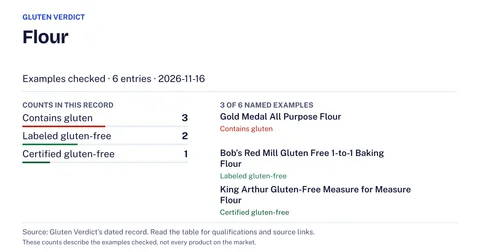
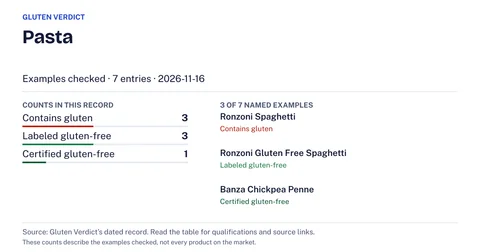
We read two same-maker pairs on 2026-11-17: a wheat product and the maker's gluten-free counterpart. The ingredient lists show what leaves and what comes in. Our verdicts for pasta and flour cover more brands, with the date each page was read.
| Pair | Wheat version lists | Gluten-free version lists | What changed |
|---|---|---|---|
| Jovial Foods spaghetti | Organic Durum Wheat Semolina. Contains wheat.61 | Organic brown rice flour, water62. The page is titled Organic Gluten Free Brown Rice Spaghetti63. | Durum wheat semolina out, brown rice flour in, and water now listed61, 62. |
| Bob's Red Mill flour | Whole Grain Hard Red Wheat. CONTAINS: Wheat.64 | Sweet White Rice Flour, Whole Grain Brown Rice Flour, Pearled White Sorghum Flour, Potato Starch, Tapioca Flour, Xanthan Gum.65 | One wheat ingredient out; a blend of rice, sorghum, potato and tapioca flours and starch in, plus xanthan gum64, 65. The maker says the blend replaces wheat flour cup for cup in non-yeast recipes66. |
The list is where to look. Our gluten scanner looks for these names in a photo of a label or in pasted text, and our guide to reading a US food label covers the claim, the Contains line and the may-contain lines. Recipes change, so the package in your hand has the final word.
Verdicts in this guide
Questions people ask
Does a gluten-free diet heal the gut?
In celiac disease, NIDDK says it will heal damage in the small intestine for most people2, though one Mayo Clinic study of adults estimated confirmed recovery of 34% at 2 years and 66% at 5 years3. In the 2013 trial of people with self-reported NCGS, there were no diet-specific changes in any biomarker it measured67.
Will I lose weight if I stop eating gluten?
NIDDK says researchers have found no evidence that a gluten-free diet promotes better health or weight loss for the general population9.
Why do I feel better off gluten if I do not have celiac disease?
In a 2018 trial of people who believed they were gluten sensitive, fructans raised symptom scores more than gluten did6. The Lancet review says fermentable carbohydrates and nocebo effects contribute considerably to symptoms in many cases7. Neither tells you what happened in your own case; that is a question for a clinician.
More in Gut science, healing and treatment research
 Can someone with celiac disease eat gluten again?What NIDDK, the ACG guideline and studies say about eating gluten again with celiac disease, why feeling well is not healing, and who runs a challenge.
 What gluten does in the gut: celiac disease, wheat allergy and gluten sensitivity comparedHow celiac disease, wheat allergy and non-celiac gluten sensitivity differ in the gut, and why testing comes before cutting out gluten.
 How long celiac healing takes: symptoms, antibodies and the gut liningWhat studies report on how long symptoms, blood antibodies and the intestinal lining take to recover on a gluten-free diet, and what to ask your care team.
 Leaky gut and gluten: what the studies measured, and in whomIs “gluten causes leaky gut” true? Sort the claims by evidence: cell and biopsy studies, trials in people, zonulin tests, and what to ask a test seller.
 How celiac disease damages the small intestine, step by stepThe steps from gluten to blunted villi in celiac disease: the genes, the immune response, how damage is graded and which test shows which step.
 The gut microbiome and celiac disease: what studies have measuredWhat studies have measured about gut bacteria in celiac disease, what probiotic trials found, and what guidelines say, so you can sort a claim.
All 11 guides in Gut science, healing and treatment research
Related guides
 Celiac disease vs gluten intolerance: three conditions, three diagnosesHow celiac disease, non-celiac gluten sensitivity and wheat allergy differ in mechanism, diagnosis and diet, with a source behind every point.
 Feeling worse after going gluten-free: what the sources say to check firstWhat NIDDK, Coeliac UK and clinical reviews say about symptoms that do not improve or get worse on a gluten-free diet, and which causes you can check.
 Gluten-free and low FODMAP: what to check when symptoms continueHow gluten and FODMAPs differ, what guidelines list for persistent symptoms on a gluten-free diet, and FODMAP ingredients to look for on labels.
 Celiac Blood Tests: What tTG-IgA, Total IgA, DGP and EMA Each CheckWhat tTG-IgA, total IgA, EMA and DGP check, why total IgA is drawn with tTG-IgA, when back-up tests are used, and why gluten stays in the diet first.
Sources
- [1, 2, 4, 10, 21, 22, 33] National Institute of Diabetes and Digestive and Kidney Diseases, Treatment for Celiac Disease, checked Nov 17, 2026.
- [3, 34, 35] American Journal of Gastroenterology (Mayo Clinic study, via PubMed Central), Mucosal recovery and mortality in adults with celiac disease after treatment with a gluten-free diet (Rubio-Tapia et al., 2010), checked Nov 17, 2026.
- [5, 12, 24, 25, 26, 28, 38] Gluten Intolerance Group, Celiac Disease, Non-Celiac Gluten Sensitivity or Wheat Allergy: What is the Difference?, checked Nov 17, 2026.
- [6, 44, 45, 46, 51, 54, 55] Gastroenterology (via PubMed), Fructan, rather than gluten, induces symptoms in self-reported non-celiac gluten sensitivity (Skodje et al., 2018), checked Nov 17, 2026.
- [7, 15, 16, 27, 29, 40] The Lancet (via PubMed), Non-coeliac gluten sensitivity (Biesiekierski et al., Lancet, 2025), checked Nov 17, 2026.
- [8, 9, 17, 20] National Institute of Diabetes and Digestive and Kidney Diseases, Eating, Diet, & Nutrition for Celiac Disease, checked Nov 17, 2026.
- [11, 18, 37] National Institute of Diabetes and Digestive and Kidney Diseases, Diagnosis of Celiac Disease, checked Nov 17, 2026.
- [13, 19] Coeliac UK, Getting diagnosed, checked Nov 17, 2026.
- [14, 43, 67] Gastroenterology (via PubMed), No effects of gluten in patients with self-reported non-celiac gluten sensitivity after dietary reduction of FODMAPs (Biesiekierski et al., 2013), checked Nov 17, 2026.
- [23, 30, 31, 36] National Institute of Diabetes and Digestive and Kidney Diseases, Symptoms & Causes of Celiac Disease, checked Nov 17, 2026.
- [32] American Journal of Gastroenterology (via PubMed), American College of Gastroenterology Guidelines Update: Diagnosis and Management of Celiac Disease (2023), abstract, checked Nov 17, 2026.
- [39] Journal of Asthma and Allergy (via PubMed), Wheat allergy: diagnosis and management (Cianferoni, 2016), checked Nov 17, 2026.
- [41, 42, 50] American Journal of Gastroenterology (via PubMed), Gluten causes gastrointestinal symptoms in subjects without celiac disease (Biesiekierski et al., 2011), checked Nov 17, 2026.
- [47, 48, 49, 68] United European Gastroenterology Journal (via PubMed), Impact of acute and sub-acute gluten exposure on gastrointestinal symptoms and psychological responses in non-coeliac gluten sensitivity (Iven et al., 2025), checked Nov 17, 2026.
- [52, 53] Gluten Intolerance Group, Could fructan cause a problem if someone has non-celiac gluten sensitivity (NCGS)?, checked Nov 17, 2026.
- [56, 57, 58, 59, 60] Cell Metabolism (via PubMed), Ultra-processed diets cause excess calorie intake and weight gain: an inpatient randomized controlled trial of ad libitum food intake (Hall et al., 2019), checked Nov 17, 2026.
- [61] Jovial Foods, Organic Durum Semolina Spaghetti, checked Nov 17, 2026.
- [62, 63] Jovial Foods, Organic Gluten Free Brown Rice Spaghetti, checked Nov 17, 2026.
- [64] Bob's Red Mill, Whole Wheat Flour, checked Nov 17, 2026.
- [65, 66] Bob's Red Mill, Gluten Free 1-to-1 Baking Flour, checked Nov 17, 2026.