Leaky gut and gluten: what the studies measured, and in whom
Short answer
Increased intestinal permeability is part of celiac disease1, but “leaky gut syndrome” is not currently accepted as a formal medical diagnosis2. To judge a claim that gluten causes it, check what the claim rests on:
- Cells, mouse intestine or biopsy tissue in a dish: gliadin increased permeability in these experiments, including in tissue from people without celiac disease3, 4.
- People with celiac disease: in one study, permeability was elevated in newly diagnosed disease and normal in most people after more than a year on a gluten-free diet5, 6.
- People without celiac disease: results differ, from higher small-bowel permeability on a gluten diet in one trial7 to no specific effect of gluten on blood markers in another8.
- Tests sold to the public: one review says no validated test exists for leaky gut syndrome9, and one study found commercial zonulin kits were not detecting zonulin10.
Part of Gut science, healing and treatment research, 11 guides

Key points
- Increased permeability is part of celiac disease1, and in one study it was normal in most people with celiac disease after more than a year on a gluten-free diet6.
- In one 2015 study, gliadin raised permeability in biopsy tissue from every group, including people without celiac disease; the tissue sat in a chamber, and each group had 5 or 6 people11.
- In people without celiac disease the findings differ with who was studied and what was measured12, 7, 8.
- A 2024 review says leaky gut syndrome is not currently accepted as a formal medical diagnosis and that no validated test exists for it2, 9.
- In one study, commercial zonulin kits were not detecting zonulin as prehaptoglobin-210.
What does “leaky gut” mean?
“Leaky gut” is a popular name for increased intestinal permeability: more material crossing the gut lining than usual. A 2019 review for clinicians in the journal Gut calls it “a simplistic term reflecting intestinal permeability”13.
Some permeability is normal. A 2024 review of leaky gut myths by Lacy and colleagues notes that all individuals have a baseline level of intestinal permeability14. What that review disputes is the syndrome: it says leaky gut syndrome is widely popularized in lay writing but is not currently accepted as a formal medical diagnosis2.
Gluten is a frequent suspect in that lay writing: the same review says gluten is often cited as a culprit15. Two questions follow, and they have different answers. Does gluten raise permeability, in whom, and by how much? And does a raised permeability amount to a diagnosis, or a cause of the symptoms people attribute to it?
How is gut permeability measured, and what can each method show?
No single measurement settles it. The 2019 Gut review says there is no current gold standard for tests of barrier function and that the available methods measure very different endpoints16. The 2024 review by Lacy and colleagues lists the methods used on people and tissue17.
| Method | What it does | Limits the sources name |
|---|---|---|
| Sugar probes swallowed, then measured in urine (for example lactulose and mannitol) | The most common indirect measure in people: probes cross the gut lining, enter the blood and are excreted in urine18. | Unknown normal values, no standard protocols and limited validation19. |
| Biopsy tissue kept in a chamber (ex vivo) | A sample taken at endoscopy is exposed to a test substance and its electrical resistance is tracked, as in the 2015 Hollon study20. | The tissue is not in a person who eats gluten20. The review by Lacy and colleagues groups this with other in vitro techniques whose clinical use is limited19. |
| Endoscopic imaging (confocal laser endomicroscopy) | One of the in vivo techniques the review by Lacy and colleagues lists17. | May not be as sensitive as once thought for evaluating food sensitivities21. |
| Blood zonulin kits | Direct-to-consumer blood panels have been marketed with an emphasis on measuring zonulin levels22. | In one study, commercial assays were not detecting zonulin as prehaptoglobin-210. |
| Stool tests | Sold online; the review by Lacy and colleagues says they allegedly measure markers related to permeability, including zonulin23. | Unregulated, with minimal evidence to support clinical use23. |
Because the methods measure different things, the kind of study and the method both matter when you read a claim16.
What happens to permeability in celiac disease?
The NIDDK describes celiac disease as a chronic digestive and immune disorder that damages the small intestine and is triggered by eating gluten24. A 2026 review in Gut says increased intestinal permeability is a central component of its pathophysiology1, and the 2019 Gut review says there is no controversy about barrier dysfunction in diseases that inflame and damage the intestine, celiac disease among them25.
Permeability also changes with treatment. In a prospective study of people with celiac disease (Duerksen and colleagues, 2005), permeability measured with lactulose and mannitol was elevated in newly diagnosed disease and in people on a gluten-free diet for less than a year5. In people on the diet for more than a year, it was normal in 80% at the first visit and 87% at the second; the study also found that trace gluten ingestion was associated with increased permeability at the second visit6. The authors conclude that permeability normalizes in the majority of people with celiac disease on a gluten-free diet26.
The NIDDK adds that for most people, following a gluten-free diet will heal damage in the small intestine and prevent more damage27.
These findings belong to people with celiac disease. The NIDDK says celiac disease can only occur in people who have certain genes28, and it separates celiac disease from gluten sensitivity, which does not damage the small intestine29.
What did the biopsy and cell studies test?
Hollon and colleagues (Nutrients, 2015) took duodenal biopsies from people with active celiac disease (6), celiac disease in remission (6), gluten sensitivity (6) and no celiac disease (5), mounted them in chambers and exposed them to gliadin or to plain medium11. They tracked the tissue’s electrical resistance for 120 minutes20. The gliadin was digested with pepsin and trypsin first30.
What it showed
- Tissue from every group, including people without celiac disease, showed a greater increase in permeability with gliadin than with medium alone11. The authors conclude that gliadin exposure increases intestinal permeability in all individuals3.
- The increase was greater in active celiac disease than in celiac disease in remission or in the non-celiac control group31.
What it did not test
- A person eating gluten. The tissue was in a chamber for 120 minutes20, and the authors say the short incubation may explain why they did not detect an inflammatory response32.
- Whether more permeability causes symptoms. Lacy and colleagues say increased permeability has not been proven to directly cause symptoms in all patients33.
- A clean comparison. The authors note that their gluten-sensitivity group went through an open, unblinded gluten challenge, so some may not have had true gluten sensitivity34, and that no one in the control group had tried a gluten-free diet35.
- A large sample: each group had 5 or 6 people11.
An earlier laboratory study (Lammers and colleagues, Gastroenterology, 2008) used cell lines, human biopsy specimens and mouse small intestine. Gliadin increased zonulin release and permeability in wild-type mouse small intestine but not in intestine from mice lacking the CXCR3 gene4. The paper also reports that CXCR3 expression in the gut lining was elevated in active celiac disease and returned to baseline on a gluten-free diet36.
Dish and mouse results come with a limit: Lacy and colleagues note that research in animal models has shown that isolated impairments in intestinal barrier function do not definitively lead to disease37.
What have studies in people without celiac disease found?
Three studies measured gluten and the gut lining in people with gluten sensitivity or irritable bowel syndrome, groups that do not have celiac disease; the first also included people with celiac disease for comparison38. They used different groups and methods, and their findings differ12, 7, 8.
| Study | Who and what was done | What it found |
|---|---|---|
| Sapone and colleagues, BMC Medicine, 2011 (comparison of groups) | People with celiac disease, people with gluten sensitivity and healthy gluten-tolerant people; permeability measured with a lactulose and mannitol probe38. | Gluten sensitivity was not associated with increased permeability; the authors report it was significantly reduced compared with controls12. |
| Vazquez-Roque and colleagues, Gastroenterology, 2013 (randomized trial) | 45 people with diarrhea-predominant irritable bowel syndrome, randomized to a gluten-containing or a gluten-free diet for 4 weeks39. | The gluten diet was associated with higher small-bowel permeability, greater in people carrying the HLA-DQ2 or DQ8 gene types; no significant difference in colonic permeability40. |
| Ajamian and colleagues, Molecular Nutrition & Food Research, 2021 (blinded challenge) | 33 people with irritable bowel syndrome who report gluten sensitivity; blood markers of epithelial injury and bacterial translocation measured during blinded gluten or placebo challenges on a low-FODMAP background41, 42. | No specific effect of gluten on epithelial integrity or symptoms in this group; reducing FODMAP intake reduced symptoms8. |
Each study asked a different question of a different group, so none of them settles the matter for people in general. The 2024 review by Lacy and colleagues adds that increased permeability or altered barrier function has not been proven to directly cause symptoms in all patients33.
Zonulin: the claim, the blood tests and the critique
Hollon and colleagues describe the model behind the zonulin story: intestinal exposure to gliadin leads to zonulin upregulation, the seals between gut cells come apart and permeability rises43. Consumer panels emphasize measuring zonulin22.
A 2019 study in PLoS One by Ajamian and colleagues checked what commercial zonulin kits detect. It reported that the kits were not detecting the actual protein as prehaptoglobin-210. The top matches for what they did detect were haptoglobin and complement C3 for one kit and complement C3 for the other44. The authors advise caution in using serum zonulin as a marker of mucosal barrier integrity until assay methodology improves45.
Lacy and colleagues reach a similar view: they say evidence suggests the assays are methodologically flawed and results do not correlate with disease states46.
A zonulin finding in children at risk of celiac disease
DaFonte and colleagues (Pediatrics, 2024) set out to determine whether permeability changes before celiac disease autoimmunity in at-risk children47. Children who developed autoimmunity had a significant increase in serum zonulin in the months before it appeared, compared with those who did not48. The authors list their own limits: all the children had a first-degree relative with celiac disease, so the findings cannot necessarily be extrapolated to the general population49, and commercially available assays do not measure all the proteins in the zonulin family50.
Why is “leaky gut syndrome” not a diagnosis?
Two reviews point to the same gaps:
- Not formally accepted: Lacy and colleagues say it is not currently accepted as a formal medical diagnosis2.
- Symptoms cannot identify it: the same review says it is impossible to discern this syndrome from others using symptoms alone51.
- No validated test: patients are frequently told blood work or stool studies can diagnose it, but no validated test currently exists9.
- Permeability changes for many reasons: the 2019 Gut review lists endurance exercise, non-steroidal anti-inflammatory drugs, pregnancy and surfactants such as bile acids and emulsifiers as increasing permeability52.
- A change is not always harmful: Lacy and colleagues write that changes in intestinal permeability are not always deleterious and the relationship with symptoms is unclear53.
- Fixing it is not proven to fix disease: the 2019 Gut review says it is still unproven that restoring barrier function can ameliorate clinical manifestations in gastrointestinal or systemic diseases54.
- Common complaints: Lacy and colleagues find minimal to no reliable evidence that leaky gut syndrome causes fibromyalgia, chronic fatigue syndrome, allergies, headache or brain fog55, and say all clinical studies to date gave correlative data without examining causation56.
Celiac disease is a different case. There, increased permeability is a central component of a disease the NIDDK describes as damaging the small intestine and triggered by gluten1, 24.
Sorting common claims by the evidence behind them
| Claim you may hear | What it rests on | What the sources say | Celiac disease |
|---|---|---|---|
| Gluten makes everyone’s gut leaky | Biopsy tissue and mouse intestine in a dish; trials and comparisons in people | Gliadin raised permeability in tissue from every group tested, including people without celiac disease11. In people: higher small-bowel permeability on a gluten diet in one trial7, none in gluten sensitivity in one comparison12, no specific effect on blood markers in one blinded challenge8. | Permeability is increased in celiac disease1. |
| Leaky gut causes fatigue, headaches and brain fog | Correlation | Lacy and colleagues: minimal to no reliable evidence of a causative role in conditions including chronic fatigue syndrome, headache and brain fog, and clinical studies to date gave correlative data55, 56. | The claim is about the syndrome, which is not an accepted diagnosis2; celiac disease is a chronic digestive and immune disorder24. |
| A zonulin blood test shows leaky gut | Commercial assays | One study found the kits were not detecting zonulin as prehaptoglobin-210; a review says results do not correlate with disease states46. | In one study of at-risk children, serum zonulin rose before celiac autoimmunity; the authors give limits48, 50. |
| A stool or blood panel can diagnose leaky gut | Direct-to-consumer panels | No validated test currently exists9; stool tests are unregulated with minimal evidence for clinical use23. | Not applicable: the panels discussed target leaky gut syndrome, not celiac disease22. |
| A gluten-free diet or supplements repair leaky gut | Diet and permeability research not run on a defined leaky gut disorder | Lacy and colleagues: dietary factors have not been studied specifically for treating a disorder associated with leaky gut syndrome57; the 2019 Gut review calls clinical benefit from restoring barrier function unproven54. | In one study, permeability was normal in most people with celiac disease after more than a year on the diet6; the NIDDK says the diet heals small-intestine damage for most people27. |
What to ask before paying for a permeability or sensitivity test
These questions come from what the sources above report. They are not medical advice.
- What does it measure? A zonulin level, a sugar-probe urine test and an endoscopic test measure different things16, and one study found commercial zonulin kits were not detecting zonulin as prehaptoglobin-210.
- Has it been validated, and against what? Lacy and colleagues report that no validated test exists to diagnose leaky gut syndrome9, and that even sugar-probe tests lack normal values and standard protocols19.
- Has the FDA reviewed it? The FDA says some direct-to-consumer tests are reviewed and others are not, and that tests for non-medical, general wellness or low-risk medical purposes are generally not reviewed before they are offered58. It also says that, as a matter of policy, it generally does not review some laboratory developed tests, which are created and performed in a single laboratory, if they are offered only when a health care provider prescribes them59. The FDA page does not name leaky gut or zonulin tests60, so ask the seller which category its test falls in.
- What evidence supports it, and where is it published? The FDA says direct-to-consumer tests have varying levels of evidence behind their claims61; Lacy and colleagues say stool tests have minimal evidence for clinical use23.
- What would a result change? Lacy and colleagues say that even a reliable measurement would be of unclear significance, because no standard of care exists for treating leaky gut syndrome62.
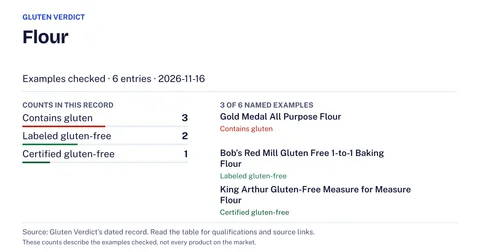
If the question behind your search is where gluten sits in everyday food, our verdicts show what the makers’ own pages said and when we read them: start with flour and soy sauce, or browse every verdict, A to Z.
Verdicts in this guide

Questions people ask
Does gluten cause leaky gut?
It depends on who and what was measured. In celiac disease, increased permeability is part of the disease1. In biopsy tissue from people without celiac disease, gliadin increased permeability in a dish3. In studies of people without celiac disease the findings differ7, 8.
Is leaky gut real?
Permeability can be measured18, and barrier dysfunction in diseases such as celiac disease is not controversial25. Leaky gut syndrome, though, is not currently accepted as a formal medical diagnosis2.
Does a gluten-free diet heal a leaky gut?
In one study of people with celiac disease, permeability was normal in most of those on a gluten-free diet for more than a year26. For leaky gut syndrome, Lacy and colleagues say a direct link between diet and treatment has not been established57.
More in Gut science, healing and treatment research
 What gluten does in the gut: celiac disease, wheat allergy and gluten sensitivity comparedHow celiac disease, wheat allergy and non-celiac gluten sensitivity differ in the gut, and why testing comes before cutting out gluten.
 How long celiac healing takes: symptoms, antibodies and the gut liningWhat studies report on how long symptoms, blood antibodies and the intestinal lining take to recover on a gluten-free diet, and what to ask your care team.
 What a mail-in gut microbiome or leaky-gut test can say about glutenWhat microbiome, stool and zonulin kits measure, what the NIDDK, a regulator and reviews say about them, and what to ask a seller before paying.
 The gut microbiome and celiac disease: what studies have measuredWhat studies have measured about gut bacteria in celiac disease, what probiotic trials found, and what guidelines say, so you can sort a claim.
 What happens when you stop eating gluten, condition by conditionWhat a gluten-free diet does in celiac disease, dermatitis herpetiformis, wheat allergy, gluten sensitivity and with no diagnosis, with the trials.
 How much gluten causes damage: what dose studies show and what 20 ppm meansWhat dose studies in celiac disease measured, how 20 ppm converts to milligrams for a real portion, and what FDA’s limit is and is not.
All 11 guides in Gut science, healing and treatment research
Related guides
 How celiac disease damages the small intestine, step by stepThe steps from gluten to blunted villi in celiac disease: the genes, the immune response, how damage is graded and which test shows which step.
 How to tell a host or relative you have celiac diseaseWhat to send a host before the meal, the cross-contact rule in one sentence, questions to ask about a dish, bringing your own, and how to pass on a dish.
 What to say to someone with celiac disease, and what to skipSentences to use, and ones to skip, when you cook for, eat out with or work beside someone with celiac disease, each tied to the fact behind it.
 When your partner has celiac disease: gluten-free home or split kitchenChoose between a gluten-free home and a split kitchen, and find what to say at restaurants and to family, with NIH and charity sources.
Sources
- [1] Gut (BMJ), via PubMed, Coeliac disease and the intestinal barrier: mechanisms of disruption and strategies for restoration (Damianos et al., 2026), checked Nov 17, 2026.
- [2, 9, 14, 15, 17, 19, 21, 22, 23, 33, 37, 46, 51, 53, 55, 56, 57, 62] Gastroenterology & Hepatology (N Y), via PubMed Central, Leaky gut syndrome: myths and management (Lacy et al., 2024), checked Nov 17, 2026.
- [3, 11, 20, 30, 31, 32, 34, 35, 43] Nutrients, via PubMed Central, Effect of gliadin on permeability of intestinal biopsy explants from celiac disease patients and patients with non-celiac gluten sensitivity (Hollon et al., 2015), checked Nov 17, 2026.
- [4, 36] Gastroenterology, via PubMed Central, Gliadin induces an increase in intestinal permeability and zonulin release by binding to the chemokine receptor CXCR3 (Lammers et al., 2008), checked Nov 17, 2026.
- [5, 6, 26] Digestive Diseases and Sciences, via PubMed, Intestinal permeability in long-term follow-up of patients with celiac disease on a gluten-free diet (Duerksen et al., 2005), checked Nov 17, 2026.
- [7, 39, 40] Gastroenterology, via PubMed Central, A controlled trial of gluten-free diet in patients with irritable bowel syndrome-diarrhea: effects on bowel frequency and intestinal function (Vazquez-Roque et al., 2013), checked Nov 17, 2026.
- [8, 41, 42] Molecular Nutrition & Food Research, via PubMed, Effect of gluten ingestion and FODMAP restriction on intestinal epithelial integrity in patients with irritable bowel syndrome and self-reported non-coeliac gluten sensitivity (Ajamian et al., 2021), checked Nov 17, 2026.
- [10, 44, 45] PLoS One, via PubMed Central, Serum zonulin as a marker of intestinal mucosal barrier function: may not be what it seems (Ajamian et al., 2019), checked Nov 17, 2026.
- [12, 38] BMC Medicine, via PubMed Central, Divergence of gut permeability and mucosal immune gene expression in two gluten-associated conditions: celiac disease and gluten sensitivity (Sapone et al., 2011), checked Nov 17, 2026.
- [13, 16, 18, 25, 52, 54] Gut (BMJ), via PubMed Central, Leaky gut: mechanisms, measurement and clinical implications in humans (Camilleri, 2019), checked Nov 17, 2026.
- [24, 28, 29] National Institute of Diabetes and Digestive and Kidney Diseases, Definition & Facts for Celiac Disease, checked Nov 17, 2026.
- [27] National Institute of Diabetes and Digestive and Kidney Diseases, Treatment for Celiac Disease, checked Nov 17, 2026.
- [47, 48, 49, 50] Pediatrics, via PubMed Central, Zonulin as a biomarker for the development of celiac disease (DaFonte et al., 2024), checked Nov 17, 2026.
- [58, 59, 60, 61] US Food and Drug Administration, Direct-to-Consumer Tests, checked Nov 17, 2026.
Read on 2026-11-17: the page on direct-to-consumer tests describes genetic tests and tests of proteins, toxins and the microbiome in general terms; the words “leaky gut”, “zonulin” and “permeability” do not appear on the page.