How much gluten causes damage: what dose studies show and what 20 ppm means
Short answer
No single gluten threshold has been shown to apply to everyone with celiac disease: a systematic review found no evidence to suggest a single definitive threshold1, and a dose-response meta-analysis estimated that the risk of relapse rises with the daily dose2. The 20 parts per million in FDA’s rule is the limit for a gluten-free claim, and FDA says it chose that figure partly because tests validated for lower levels were not available when the rule was written3, 25.
Part of Gut science, healing and treatment research, 11 guides
Key points
- In the Catassi trial, 49 adults took a capsule of 0, 10 or 50 mg of gluten a day for 90 days; the change in the villous height to crypt depth ratio was -20% in the 50 mg group and -1% in the 10 mg group, with an interval from -18% to 68%4, 5.
- A systematic review of 13 studies found that some patients tolerated an average of 34-36 mg of gluten per day while others who consumed about 10 mg per day developed mucosal abnormalities6.
- A 2023 meta-analysis of 7 records estimated relapse risk rising with the dose2, and its authors list substantial limitations in the studies behind it7, 8.
- 20 ppm means 20 mg of gluten per kg of food, so the milligrams a day that adds up to depends on how much of the food is eaten9.
- FDA says tests validated for levels below 20 ppm were not available when it wrote the rule3.
What a dose study can and cannot show
A dose study gives people with celiac disease a measured amount of gluten and looks for a change. The authors of the Catassi trial began from a gap: it was not known whether trace amounts of gluten are harmful to treated patients10. They checked for change in three ways: clinical, serologic and histologic evaluations of the small intestine11.
FDA describes the damage in celiac disease as damage to the lining of the small intestine that prevents absorption of vital nutrients12. The Catassi trial’s histologic evaluation was of the small intestine11.
The studies differ in ways that matter when comparing them. The authors of the 2023 meta-analysis note that the included studies used different ways to judge relapse, including patient-reported symptoms that are subjective and blood markers that are not sensitive enough13, and that they differ in sample size, amount of gluten and length of challenge14. The authors also write that, for ethical reasons, such studies usually limit the challenge to short times, usually less than 3 months15.
The Catassi trial: 0, 10 or 50 milligrams a day for 90 days
The trial was multicenter, double-blind, placebo-controlled and randomized. It enrolled 49 adults with biopsy-proven celiac disease who had been on a gluten-free diet for at least 2 years, kept their background gluten intake under 5 mg a day, and took a daily capsule of 0, 10 or 50 mg of gluten for 90 days4.
| Daily capsule | People | Change in Vh/Cd (95% CI) |
|---|---|---|
| 0 mg (placebo) | 13 | +9% (3% to 15%)5 |
| 10 mg | 13 | -1% (-18% to 68%)5 |
| 50 mg | 13 | -20% (-22% to -13%)5 |
No significant differences in the intraepithelial lymphocyte count were found between the three groups, and one patient challenged with 10 mg developed a clinical relapse5. The interval reported for the 10 mg group runs from -18% to 68%, so that group’s result does not point clearly in either direction.
The authors concluded that the ingestion of contaminating gluten should be kept lower than 50 mg a day in the treatment of celiac disease16. That is the authors’ conclusion from one trial of adults over 90 days, not a figure from a regulator.
What a review of 13 studies found
Akobeng and Thomas reviewed 13 studies: three randomized controlled, one cohort, two crossover and seven cross-sectional6. The daily amount of tolerable gluten varied widely between them. Some patients tolerated an average of 34-36 mg of gluten per day, while others who consumed about 10 mg per day developed mucosal abnormalities6.
Studies of gluten-free products with different degrees of gluten contamination were also inconsistent17. The review’s conclusion was that the amount of tolerable gluten varies among people with celiac disease; there is no evidence to suggest a single definitive threshold, and a daily intake under 10 mg is unlikely to cause significant histological abnormalities1.
What the 2023 dose-response meta-analysis estimated
A 2023 meta-analysis in Nutrients pooled studies that tested different gluten amounts and judged relapse from clinical, serologic and/or histologic evidence. It screened 440 papers and used 7 records in the dose-response analysis7. Relapse is a wider test than damage to the lining alone7.
| Daily gluten | Relative risk (95% CI) | Authors’ estimate |
|---|---|---|
| 6 mg | 1.002 (1.001 to 1.004)2 | 0.2%2 |
| 10 mg | 1.004 (1.002 to 1.006)38 | 0.4%38 |
| 40 mg | 1.018 (1.009 to 1.02)38 | 1.8%18 |
| 150 mg | 1.07 (1.03 to 1.10)2 | 7%2 |
| 881 mg | 1.50 (1.23 to 1.82)2 | 50%2 |
| 1276 mg | 1.80 (1.36 to 2.38)2 | 80%2 |
| 1505 mg | 2.00 (1.43 to 2.78)2 | relative risk of 2.002 |
The authors describe a dose-response curve with an initial slight increase in risk at lower doses and a steeper rise at over 1.5 g a day19. They add that relapse might happen even with a very low dose of gluten, that the duration of exposure matters, and that the literature has substantial limitations, including data from just a few countries that differ in the amount of gluten and the length of the challenge8.
The meta-analysis estimates a rising risk across doses. It does not name a dose below which relapse cannot happen; its authors write that relapse might happen even with a very low dose8.
From parts per million to milligrams a day
A limit of 20 ppm means 20 mg of gluten in each kilogram of food9. The Gluten Intolerance Group puts it as 20 weight units of gluten per million weight units of the food20. To turn a label into a dose, multiply by the weight eaten.
| Food eaten in a day | Gluten it contains |
|---|---|
| 30 g | 0.6 mg |
| 100 g | 2 mg |
| 250 g | 5 mg |
| 500 g | 10 mg |
| 1 kg | 20 mg |
| 2.5 kg | 50 mg |
Set against the Catassi trial, the 10 mg capsule matches the 500 g row and the 50 mg capsule the 2.5 kg row. Those are our conversions, not figures from the trial. The conversion also leaves out two things the studies include: the Catassi participants kept background intake under 5 mg a day4, and the more products with some gluten a person eats in a day, the more gluten is ingested21.
A food at the limit is the ceiling for a gluten-free claim. A gluten-free claim requires the unavoidable gluten to be below 20 ppm9; FDA says the goal for any food labeled gluten-free is to contain no gluten or the lowest amount possible under 20 ppm22; and the Gluten Intolerance Group says most gluten-free products do not have gluten levels anywhere near the thresholds it discusses (20 ppm and, for GFCO-certified products, 10 ppm)23. We give no figure for a crumb, because none of the sources cited here measures one.
Why FDA chose 20 ppm, and what the rule covers
FDA’s rule defines gluten as the proteins that naturally occur in a gluten-containing grain and that may cause adverse health effects in persons with celiac disease24. Foods labeled gluten-free must have any unavoidable gluten below 20 ppm9.
FDA explains the figure in two parts. When the rule was written it used an approach built on analytical methods, because it relies on scientifically validated methods to enforce the rule25. Methods validated for levels below 20 ppm were not available then; FDA adds that some celiac disease researchers and some epidemiological evidence suggest that most people with celiac disease can tolerate variable trace amounts, including levels under 20 ppm, without adverse health effects3. FDA’s consumer page calls 20 ppm the lowest level that can be reliably detected with validated methods26.
So the number is a labeling limit that FDA ties to what validated methods can detect and enforce, with some evidence on tolerance cited in addition25, 3. It is not itself a study result. FDA also hosts a report on thresholds that summarizes what was known about dose-response relationships for gluten27.
When FDA checks a food by analysis, the rule says it uses a method that can reliably quantify 20 ppm gluten across raw and cooked or baked products28. In an analysis FDA released in 2017 of 702 samples from more than 250 products labeled gluten-free, only one product did not comply29. That result speaks to compliance with the limit, not to the level each product carried.
What the 20 ppm limit does not settle
- Several products in a day. The more products with some gluten a person eats, the more gluten is ingested21.
- Cross-contact and oats are inside the limit, not outside it, but the limit says nothing about how a given package was handled. FDA uses “cross-contact” for the unavoidable presence of gluten in a food due to contact with a gluten-containing food30, and oats labeled gluten-free must contain less than 20 ppm31. See our verdict for oatmeal.
- Fermented and hydrolyzed foods. FDA is aware that sandwich ELISA methods do not adequately detect gluten in them32, and its examples of fermented foods include beer33. For such foods a maker must keep records showing adequate assurance instead34. See beer and soy sauce.
- Wheat starch. The rule treats an ingredient derived from a gluten-containing grain and processed to remove gluten, such as wheat starch, as a problem when its use results in 20 ppm or more gluten in the food35.
- Meat, poultry, certain egg products and most alcohol. The rule does not apply to foods whose labeling USDA or TTB regulates; FDA says USDA generally regulates the labeling of meats, poultry and certain egg products, and TTB that of most alcoholic beverages36.
Where individual sensitivity enters
The sources frame the question differently. The systematic review found that the amount of tolerable gluten varies among people with celiac disease1. In the Catassi trial one patient challenged with 10 mg developed a clinical relapse5. The meta-analysis authors write that relapse might happen even with a very low dose8.
On the other side, FDA says some researchers and some epidemiological evidence suggest most people with celiac disease can tolerate trace amounts, including levels under 20 ppm3. Both statements are attributed to their authors here; neither is a rule for any one person. What a particular trace means for a particular person is a question for that person’s own doctor or dietitian.
What this means when you read a label
A gluten-free claim on an FDA-regulated food means any unavoidable gluten is below 20 ppm9. FDA says the rule does not prohibit a maker from stating truthful and non-misleading information, including the maximum amount of gluten the food may contain37.
Our guides on how to read food labels and may-contain wheat labels cover the other lines on a package, and cross-contamination covers how gluten gets into food. For specific foods, each verdict, such as bread, shows what the maker’s pages said on the date we read them.
Verdicts in this guide
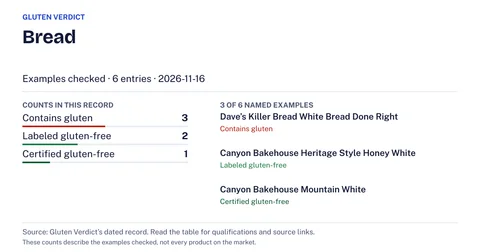 BreadContains glutenchecked Nov 16, 2026
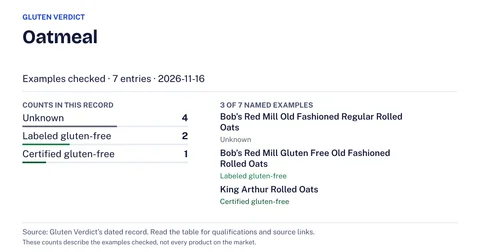 OatmealDepends on the productchecked Nov 16, 2026
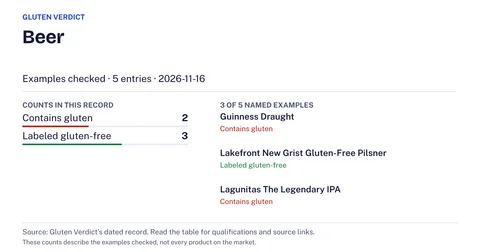 BeerDepends on the product2 of 5 products we checked contain gluten: Guinness Draught and Lagunitas The Legendary IPAchecked Nov 16, 2026
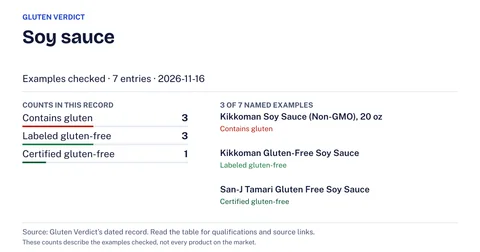 Soy sauceDepends on the product3 of 7 products we checked contain gluten: Kikkoman Soy Sauce (Non-GMO), 20 oz; San-J Organic Shoyu Soy Sauce; and Lee Kum Kee Premium Soy Sauce (No Preservatives Added)checked Nov 16, 2026
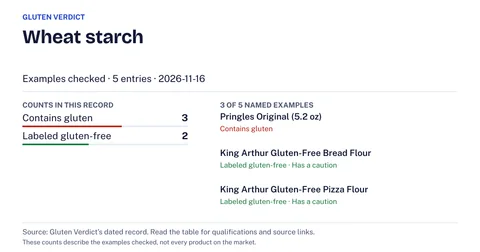 Wheat starchDepends on the product3 of 5 products we checked contain gluten: Pringles Original (5.2 oz), Jiffy Corn Muffin Mix, and Chex Mix Bold Garlic and Herbchecked Nov 16, 2026
Questions people ask
Is 20 ppm the same as 20 mg of gluten a day?
No. 20 ppm is a concentration: 20 mg of gluten per kg of food9. How many milligrams that adds up to in a day depends on how much of the food is eaten; by our arithmetic, 100 g of a food at exactly 20 ppm holds 2 mg.
Does any amount of gluten cause damage?
The systematic review found no evidence to suggest a single definitive threshold1, and the meta-analysis authors write that relapse might happen even with a very low dose8. The Catassi trial reported a change in Vh/Cd of -20% (-22% to -13%) at 50 mg a day and -1% (-18% to 68%) at 10 mg5.
Why did FDA not choose zero?
FDA says validated tests for levels below 20 ppm were not available when it wrote the rule3.
More in Gut science, healing and treatment research
 Can someone with celiac disease eat gluten again?What NIDDK, the ACG guideline and studies say about eating gluten again with celiac disease, why feeling well is not healing, and who runs a challenge.
 What gluten does in the gut: celiac disease, wheat allergy and gluten sensitivity comparedHow celiac disease, wheat allergy and non-celiac gluten sensitivity differ in the gut, and why testing comes before cutting out gluten.
 How long celiac healing takes: symptoms, antibodies and the gut liningWhat studies report on how long symptoms, blood antibodies and the intestinal lining take to recover on a gluten-free diet, and what to ask your care team.
 How celiac disease damages the small intestine, step by stepThe steps from gluten to blunted villi in celiac disease: the genes, the immune response, how damage is graded and which test shows which step.
 Leaky gut and gluten: what the studies measured, and in whomIs “gluten causes leaky gut” true? Sort the claims by evidence: cell and biopsy studies, trials in people, zonulin tests, and what to ask a test seller.
 The gut microbiome and celiac disease: what studies have measuredWhat studies have measured about gut bacteria in celiac disease, what probiotic trials found, and what guidelines say, so you can sort a claim.
All 11 guides in Gut science, healing and treatment research
Related guides
 How to read a US food label for glutenWhere gluten shows up on a US food label: the gluten-free claim, the Contains line, the ingredient list and may-contain lines, and what each means.
 What “may contain wheat” and “made in a facility with wheat” mean on a US labelHow to read “may contain wheat”, shared-facility and shared-equipment lines on US labels, with and without a gluten-free claim, and what to check next.
 Gluten cross-contact at home: where it happens and what to do about itHow gluten reaches gluten-free food at home, whether to separate, wash or ask for each route, and which rules have lab data behind them.
 If you think you were glutened: what the celiac organizations say to doWhat the celiac charities, FDA and NIDDK say to do after accidental gluten exposure, when to contact a clinician, and how to trace the cause.
Sources
- [1, 6, 17] PubMed (Alimentary Pharmacology & Therapeutics), Systematic review: tolerable amount of gluten for people with coeliac disease (Akobeng and Thomas, 2008), checked Nov 17, 2026.
- [2, 7, 8, 13, 14, 15, 18, 19, 38] Nutrients (MDPI), via PubMed Central, Systematic Review and Dose-Response Meta-Analysis on the Relationship between Different Gluten Doses and Risk of Coeliac Disease Relapse (2023), checked Nov 17, 2026.
- [3, 22, 25, 30, 31, 32, 33, 36, 37] US Food and Drug Administration, Questions and Answers on the Gluten-Free Food Labeling Final Rule, checked Nov 17, 2026.
- [4, 5, 10, 11, 16] PubMed (American Journal of Clinical Nutrition), Gluten dose trial in celiac disease (Catassi et al., 2007), checked Nov 17, 2026.
- [9, 24, 28, 34, 35] US eCFR, 21 CFR 101.91 Gluten-free labeling of food, checked Nov 17, 2026.
- [12, 26, 29] US Food and Drug Administration, Gluten and Food Labeling, checked Nov 17, 2026.
- [20] Gluten Intolerance Group, What does 20 ppm of gluten mean? (GIG FAQ), checked Nov 17, 2026.
- [21, 23] Gluten Intolerance Group, Could gluten build up over several products at 20 ppm? (GIG FAQ), checked Nov 17, 2026.
- [27] US Food and Drug Administration, Approaches to Establish Thresholds for Major Food Allergens and for Gluten in Food, checked Nov 17, 2026.