Gluten-free at college: disability services, meal plans and dining halls
Short answer
Ask the college’s disability services office for accommodations, with a doctor’s letter, as early as you can1, 2. The college works out with each student what to grant, and the Justice Department says each school should evaluate its own meal plan3, 4.
- Find the office’s procedure and follow it; the student has to start the request5, 6.
- Bring documentation from a doctor; a high school IEP or 504 plan is generally not sufficient on its own7, 8.
- Meet with the office and ask for dining, meal-plan and housing changes in writing; expect an interactive process without your parents3.
- On the meal plan, Lesley University agreed to consider exemptions, but that agreement binds Lesley only9, 10.
- If the college stalls: its grievance procedure, then OCR or the Justice Department11, 12, 13.
Part of Kids, school, college and family, 21 guides

Key points
- At college the student has to ask: the school does not identify or assess the student’s needs5.
- A doctor’s letter is the usual documentation, and a high school 504 plan is generally not enough2, 8.
- The Lesley University agreement is an example, not a rule: it binds Lesley10, and the Justice Department says each school should evaluate its own plan4.
- The Foundation’s 24 recommendations rest on a panel’s expert consensus, informed by the literature, disability law and precedent14.
- If the college stalls: grievance procedure, then OCR or the Justice Department11, 12, 13.
Which laws cover a college, and what do they ask of it?
The US Department of Education’s Office for Civil Rights (OCR) enforces Section 504 of the Rehabilitation Act and Title II of the Americans with Disabilities Act (ADA). OCR’s pamphlet for students says practically every postsecondary school in the United States is subject to one or both of these laws15.
College is not high school. Unlike a high school, a postsecondary school is not required to provide a free appropriate public education; it is instead required to provide appropriate academic adjustments so that it does not discriminate on the basis of disability16. That changes who starts the process: the student has to tell the school about the disability and the need, and the college is not required to identify the student or assess the student’s needs5. The K-12 side is covered in our 504 plan guide.
Another part of the ADA also appears in this area. The Justice Department’s 2012 agreement with Lesley University, a private nonprofit university, describes it as a public accommodation subject to Title III of the ADA17. The Department’s own question-and-answer page says some people with food allergies have a disability under the ADA, and that this would include people with celiac disease and others who have autoimmune responses to certain foods18. The Celiac Disease Foundation’s 2026 paper states the same for celiac disease19.
A law covering a college does not decide what it must provide for you. What the college grants is worked out with each student through an interactive process, which the steps below follow3.
What the Lesley University agreement says, and who it binds
On December 20, 2012, the Justice Department entered into an agreement with Lesley University in Cambridge, Massachusetts, covering students with celiac disease and other food allergies20. Lesley had required all students living on campus to take its meal plan21. The Department’s Q&A says the agreement requires Lesley to consider exempting students who cannot, because of disability, take full advantage of the plan9.
The Q&A lists what Lesley agreed to, among other things:
- Gluten-free and allergen-free options in its dining hall food lines, in addition to standard meals22
- Pre-ordering of allergen-free meals for students with known allergies22
- Notices about food allergies and identification of foods that contain specific allergens22
- Training for food service and university staff22
- A dedicated space in the main dining hall to store and prepare gluten-free and allergen-free foods22
- Work to keep vendors that accept students’ prepaid meal cards and also offer food without allergens22
The process it describes
The agreement is a useful picture of what a request can look like. Disability Services meets the student individually and works with the student in an interactive process23. After that process the university gives the student a written letter setting out the specific plan24. A student who disagrees can ask for a review by the university’s ADA and Section 504 coordinator25. A meal-plan exemption is named as one possible modification, not a certain one: the agreement says the university may allow it, depending on the individual circumstances26.
Who it binds
The agreement binds Lesley University and its successors, assigns, agents, employees and contractors10, and it was to remain in effect for three years from its effective date27. It states that it is not an admission by the university that it violated the ADA28. Beyond Celiac puts the effect on other colleges plainly: the case did not establish a law that all colleges and universities must follow, but it gives other schools guidelines29. The Justice Department says many aspects of the agreement will serve as a model, and that each school should evaluate its own food service plan4.
So cite Lesley as an example when you ask your college for something, and do not present it as a rule that applies to your college. We read the agreement and the Department’s Q&A on 2026-11-17.
What documentation to bring, and when to ask
OCR advises asking as early as possible, because some adjustments take longer to provide than others1. A college may set reasonable standards for documentation, some require more than others, and it may ask for documentation prepared by a medical doctor or another qualified diagnostician7.
For celiac disease, Beyond Celiac’s college toolkit says many schools require students to register with the Office of Disability Services before they are eligible for special dietary accommodations, and that students will most likely need a physician’s note2. It adds that the doctor should be contacted well in advance of any deadlines30. The Celiac Disease Foundation’s handbook says the medical letter should include:
- The student’s full name and date of birth31
- A clear statement of the diagnosis, with the date of diagnosis if available31
- A description of celiac disease as a chronic autoimmune disorder requiring strict, lifelong adherence to a gluten-free diet31
- A statement that celiac disease qualifies as a disability under the ADA31
- How the condition may affect the student in an academic setting31
- The provider’s name, title, specialty, practice, contact information, signature and date31
The Foundation also posts a sample physician letter32. Check whether your college wants its own form as well33. If you plan to ask for anything beyond food, such as a single room, a car on campus or kitchen access, Beyond Celiac says to have the doctor mention it in the letter34.
Two points from OCR for families coming from a school with a plan. A high school IEP or 504 plan is generally not sufficient documentation on its own8, and neither the high school nor the college is required to conduct or pay for a new evaluation35.
How to make the request, step by step
- Find the college’s procedure. A postsecondary school may require reasonable procedures, and the student is responsible for knowing and following them6. The Foundation’s handbook treats the Office of Disability Services as the usual place where medical documentation is collected and reviewed, though another office may handle it36.
- Get the doctor’s letter described above, with time to spare30.
- Send the letter and the forms by the deadline37. Name the dining, meal-plan and housing requests you want in the request itself: the handbook says documentation can be used to determine accommodations for dining, housing and academics38.
- Meet with the office. OCR tells students to expect an interactive process, and not to expect the college to invite parents into it or to write an IEP3.
- Ask for the result in writing. At Lesley the university gave students a written letter with the specific plan24. The Foundation’s handbook describes an official accommodation letter that shows instructors the approved accommodations without disclosing the diagnosis unless the student chooses to share it39.
- Keep copies of the medical documentation, the accommodation letters and the emails40.
Telling the college is voluntary, but to receive an adjustment you have to identify yourself as having a disability41.
Questions to ask dining staff
Start with whoever runs the food. Beyond Celiac calls the school’s food service director a great place to start42. Gluten Intolerance Group (GIG) suggests asking a dining hall manager or food service dietitian how gluten-free food is prepared, what is offered and when, how foods are labeled and what prevents cross-contact43. GIG says that while a few colleges have dedicated gluten-free dining halls, most do not44, so what you ask about is usually a station, a pre-order option or the way the main line is run.
| Ask about | What the sources say |
|---|---|
| A dedicated section or station | Beyond Celiac’s list for a food service director includes whether any dining hall has a gluten-free section and whether the kitchens have a dedicated section for gluten-free preparation45. GIG notes that unless it is a dedicated gluten-free station, cross-contact is always a risk46. |
| Ingredients and labels | Beyond Celiac’s list includes whether the ingredients of dishes can be shared and whether symbols mark gluten-free dishes45. GIG suggests asking to see the original packaging of dishes made from packaged foods such as soups, stews and dressings47. |
| Cross-contact on the line | GIG suggests checking whether serving platters or utensils are shared between gluten-containing and gluten-free items, and avoiding those items if so48. Beyond Celiac’s questions to ask before you eat include whether fries were cooked with the onion rings or chicken fingers or in a separate fryer, and whether the server will change gloves45. |
| Condiments | GIG says not to use condiments from communal containers, because of the risk of gluten from serving utensils or crumbs49. |
| Pre-ordered meals | Lesley agreed to let students with known allergies pre-order allergen-free meals22. The Foundation’s panel lists pre-ordered or custom meals among its dining recommendations50. |
| A named contact | The panel lists direct communication with dietitians, dining managers and the lead chef for support and to resolve issues51. |
| Who runs the dining hall | The Foundation’s paper says the obligation to accommodate applies regardless of how dining services are structured52. |
Tell the staff you have a medical condition that requires gluten-free food, so they take it seriously53. Go outside the busiest times when you can, since staff then have more time for your questions54, and thank them; GIG advises it55. Our eating out guide covers the same questions for restaurants.
Meal plan: stay on it, change it or ask for an exemption
Two things are on the record. At Lesley, the Justice Department’s agreement requires the university to consider exempting students who cannot, because of disability, take full advantage of the meal plan9. The Foundation’s panel lists an exemption from mandatory meal plans, when medically necessary, among its dining recommendations50, and its handbook adds that students should keep access to campus dining halls whatever their exemption status56.
Neither makes an exemption automatic. The Justice Department says each school should evaluate its own plan4, and the Foundation’s recommendations rest on a panel’s expert consensus (see the last section). Plan on asking for it, with the doctor’s letter, rather than assuming it.
Questions to settle with the college, in writing, before choosing:
- What can the dining hall provide if you stay on the plan: a gluten-free station, pre-ordered meals, ingredient lists, trained staff? Lesley’s list is a reference point for what to ask22.
- If you are exempted, do you keep access to the dining halls? The handbook says students should56.
- What does each option cost, and does the housing contract or any other rule tie you to the plan? Ask for figures from the college; none of the pages we read give prices.
- Where would you cook, and is a kitchen or appliance part of the housing request? The next section and our dorm guide cover this.
- Is the outcome written into your accommodation letter?24
Kitchen access and housing
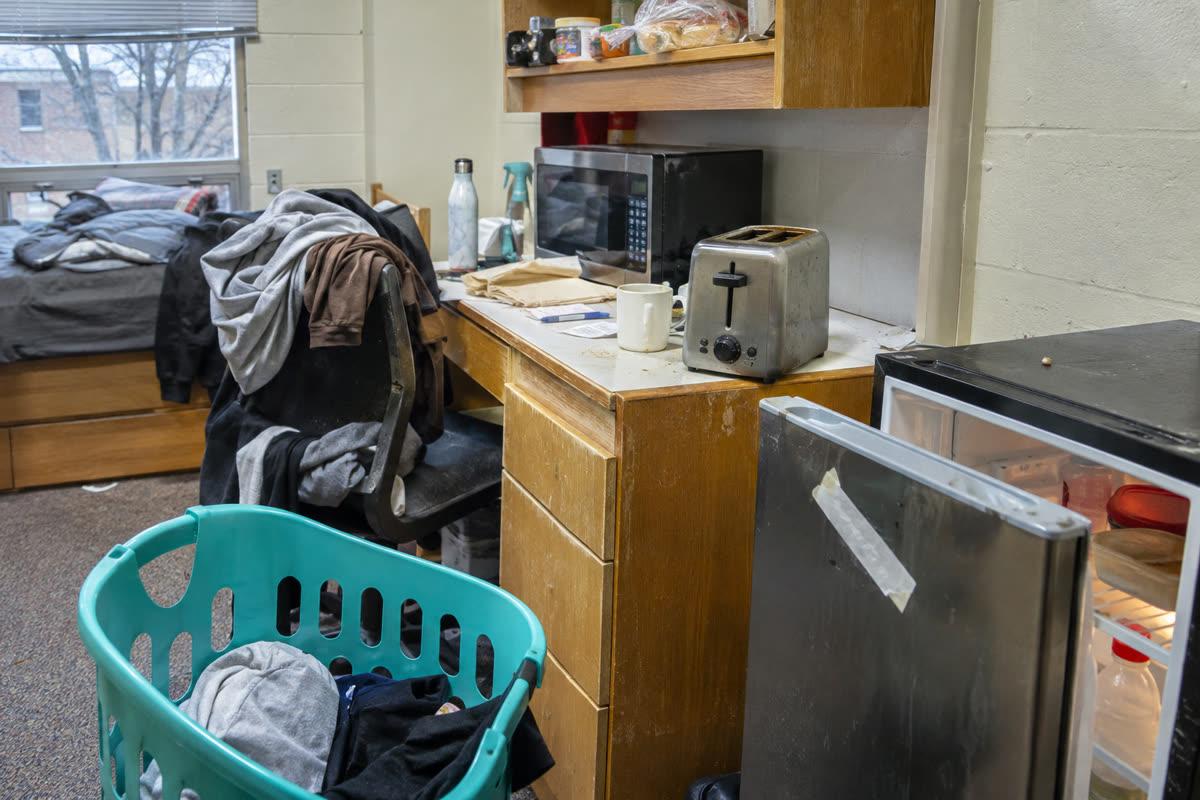
Housing requests go through the same process. The Foundation’s panel lists six housing accommodations: priority housing, roommate considerations, dining proximity, bathroom access, kitchen appliances and transportation flexibility51. Beyond Celiac lists requests students make: a single room, a car on campus, access to a community kitchen, bringing a microwave, fridge, toaster or hot plate to prepare gluten-free meals in the dorm, and a dorm with a community kitchen or close to a gluten-free dining hall57. For the fridge, microwave, toaster and roommate rules, see gluten-free in a college dorm. If a semester abroad is planned, see study abroad.
Questions to ask on a campus visit
A student GIG interviewed suggests visiting the dining halls and asking staff to walk you through the options and their kitchen practices58. If you cannot visit, she suggests emailing the Head of Dining, or an equivalent role59, and not judging the dining options from the college website alone, which may be outdated or inaccurate60.
- Who is my contact in disability services, and who is my contact in dining?51
- Which dining halls have a gluten-free section, and are other students eating gluten-free on campus?45
- Can I pre-order meals, and how are ingredients and allergens shown at the point of service and online?51
- How do you prevent cross-contact in the kitchen, and are dishes marked with symbols?45
- Is dining run by the college or a contractor, and who decides on accommodations?52
- What would a meal-plan exemption involve, and what would it cost? (Ask for the figures in writing.)
Ask the same questions at every college on your list, so the answers can be compared. We do not rank colleges; no source we read supports a ranking.
The first weeks
Reach out to dining staff before classes start; GIG says they will have people to help you find your way around the space and to provide more options61. A student GIG interviewed says it helped to have met the Head of Dining before her first year62, and three years in he was still her main dining contact63.
Use the arrangements early, with ordinary meals, so you find out what works. If the result is not what you expected, tell the school as soon as you know; OCR warns that waiting until the course or activity is over may be too late64. Ask whether your accommodations renew every year, and set a reminder for a mid-year check-in with the office65.
If the college refuses or stalls
- Go to the college’s coordinator. OCR says practically every postsecondary school must have a person, frequently called the Section 504 Coordinator, ADA Coordinator or Disability Services Coordinator, who coordinates compliance66. The school must also have grievance procedures, which are not the same as high school due process11.
- Use the Foundation’s ladder. Its paper recommends first working with disability services to revise the plan, supported where needed by documentation from a treating physician or registered dietitian67. If barriers persist, students may turn to patient advocacy organizations or, as a last resort, a disability rights attorney who specializes in postsecondary access68.
- File a complaint. If you are dissatisfied with the grievance outcome, or want an alternative to it, OCR says you may file a complaint against the school with OCR or in a court12. Ask OCR about any filing time limit; we did not read its complaint procedure.
- Or contact the Justice Department. ADA.gov accepts an ADA complaint online or by mail13. It says it cannot investigate every complaint69, that its review can take up to three months70, and that the ADA Information Line is 800-514-0301 (voice) or 1-833-610-1264 (TTY)71.
This page reports what the agencies say and is not legal advice.
What the Celiac Disease Foundation’s 2026 national recommendations say
The Foundation announced the recommendations on March 3, 202672, from a panel of 40 stakeholders: physicians, registered dietitians, disability rights experts, foodservice leaders, university administrators, students and parents73. The paper is in Nutrients74. The panel adopted 24 accommodations across four domains75.
| Domain | Count | Accommodations named |
|---|---|---|
| Academics | 5 | Extended time, modified coursework, gluten-free class environments, leave without penalty, remote access51 |
| Housing | 6 | Priority housing, roommate considerations, dining proximity, bathroom access, kitchen appliances, transportation flexibility51 |
| Dining | 7 | Reliable gluten-free meals, staff training, ingredient transparency, direct communication, custom meals, meal plan exemption, dedicated gluten-free zones51 |
| Campus life | 6 | Athletic support, study abroad inclusion, social event access, mental health support, emergency planning, internship and employment flexibility51 |
These are a panel’s recommendations. The paper says that, given few interventional or comparative studies, the recommendations rest on expert consensus informed by the literature, disability law and institutional precedent, and that each needed at least 90% approval from the panel14. It also says accommodations should be individualized, because not every one is necessary or appropriate for every student76, and the Foundation says implementation remains inconsistent across institutions77. The paper names a Justice Department settlement with Rider University and a public settlement of a lawsuit against the University of Maryland alongside Lesley78; we have not read those documents.
Questions people ask
Does a college have to let me out of the meal plan?
Not by any rule we found. The Justice Department’s agreement requires Lesley University to consider exemptions for students who cannot, because of disability, take full advantage of the plan9, but it binds Lesley10, and the Department says each school should evaluate its own plan4.
Is my high school 504 plan enough for the college?
OCR says an IEP or Section 504 plan is generally not sufficient documentation at the college level8.
Do I have to tell the college I have celiac disease?
OCR says disclosure is voluntary, but a student who wants an adjustment has to identify themselves as having a disability41.
Can a parent take part in the meetings?
OCR says not to expect a postsecondary school to invite parents into the process3.
Who pays for a new medical evaluation if the college wants one?
OCR says neither the high school nor the postsecondary school is required to conduct or pay for a new evaluation35.
What if I have gluten sensitivity rather than celiac disease?
The Foundation’s paper says its recommendations may also be relevant to students with other conditions that require a gluten-free diet, such as non-celiac gluten sensitivity, which can typically be accommodated with documentation from a treating clinician79.
More in Kids, school, college and family
 Gluten-free in a college dorm: the fridge, microwave, toaster and roommate rulesHow to set up a shared dorm room or kitchen for gluten-free living: fridge, microwave, toaster, sponges, a roommate script and how to ask for housing help.
 A 504 plan and school meal rules for celiac disease: what to ask for and where to complainMeal substitution or a 504 plan for a child with celiac disease: what each rule says, what the medical statement must hold, and where to complain.
 Pediatric celiac clinic visits: what to bring and what to askWhat to bring to a child’s celiac follow-up and the questions for the gastroenterologist and dietitian, drawn from the Celiac Disease Foundation checklist.
 Celiac disease in teenagers: friends, eating out and taking over their own careWhat research and celiac charities say about teenagers with celiac disease: telling friends, eating out, taking over care and clinic follow-up.
 A gluten-free care plan for daycare and preschoolWrite a one-page gluten-free care plan for daycare or preschool, ask the right questions on a tour, and see which government rule covers each program.
 A gluten-free child who refuses food: what to track and when to ask the doctorHow to tell ordinary picky eating from a pattern to raise with your child’s doctor or dietitian, what ARFID is, and a one-week log to bring.
Related guides
 Eating out with celiac disease: what to check, ask and watch forPlan a restaurant meal with celiac disease: what to check before you go, the questions to ask in order, how to read the answers, and what studies measured.
 A gluten-free meal plan as a shopping template, by meal slotA weekly gluten-free shopping template: staples for each meal slot, the check each packaged item needs, and a ledger of when you last read each label.
 College meal plans and gluten-free food: accommodations, waivers and the costHow a student with celiac disease asks a college for a changed meal plan or a waiver: the disability office, documents, dining questions, cost.
 Gluten-free dining at national park lodges: what to ask and what to packHow national park lodge dining works on a gluten-free diet: what each operator's own page says, what to send before you arrive, and what to pack.
Sources
- [1, 3, 5, 6, 7, 8, 11, 12, 15, 16, 35, 41, 64, 66] US Department of Education, Office for Civil Rights, Students with Disabilities Preparing for Postsecondary Education (September 2011), checked Nov 17, 2026.
- [2, 30, 34, 37, 57] Beyond Celiac, Beyond Celiac College Toolkit, checked Nov 17, 2026.
Read on 2026-11-17: the list under “Additional Accommodations Some students request accommodations beyond special dietary ones, including:” names a single room to avoid a roommate who brings gluten into the room; having a car on campus to drive to stores and medical appointments; access to a community kitchen; the ability to bring a microwave, fridge, toaster, hot plate, etc. to prepare gluten-free meals in the dorm; academic accommodations in case of glutening; and a dorm with a community kitchen or close to a gluten-free dining hall.
- [4, 9, 18, 20, 21, 22] US Department of Justice (ADA.gov archive), Questions and Answers about the Lesley University Agreement and Potential Implications for Individuals with Food Allergies (January 2013), checked Nov 17, 2026.
Read on 2026-11-17: the list headed “Among other things, Lesley University agreed to:” names gluten-free and allergen-free food options in its dining hall food lines in addition to its standard meal options; pre-ordering of allergen-free meals for students with known allergies; notices concerning food allergies and identification of foods containing specific allergens; training of food service and university staff on food allergy-related issues; a dedicated space in its main dining hall to store and prepare gluten-free and allergen-free foods; and work to retain vendors that accept students’ prepaid meal cards and also offer food without allergens.
- [10, 17, 23, 24, 25, 26, 27, 28] US Department of Justice, Settlement Agreement Between the United States of America and Lesley University (2012), checked Nov 17, 2026.
- [13, 69, 70, 71] ADA.gov, US Department of Justice, File a Complaint, checked Nov 17, 2026.
Read on 2026-11-17: under “Filing an ADA Complaint with the Department of Justice, Civil Rights Division” the page gives two options, headed “Online” (submit a report on the Department of Justice’s Civil Rights Division website) and “Mail” (send the paper ADA Complaint Form, or a letter with the same information, to the Civil Rights Division at 950 Pennsylvania Avenue, NW, Washington, DC 20530).
- [14, 19, 50, 51, 52, 67, 68, 74, 75, 76, 78, 79] Weisbrod and colleagues, Nutrients, Accommodating Celiac Disease in Higher Education: Evidence-Informed National Recommendations (Nutrients, 2026), checked Nov 17, 2026.
Read on 2026-11-17: Table 1, “Summary of 24 Recommended Accommodations,” lists Academic A1 to A5 (Extended Time, Modified Coursework, Gluten-Free Class Environments, Leave Without Penalty, Remote Access); Housing H1 to H6 (Priority Housing, Roommate Considerations, Dining Proximity, Bathroom Access, Kitchen Appliances, Transportation Flexibility); Dining D1 to D7 (Reliable GF Meals, Staff Training, Ingredient Transparency, Direct Communication, Custom Meals, Meal Plan Exemption, Dedicated GF Zones); and Campus Life C1 to C6 (Athletic Support, Study Abroad Inclusion, Social Event Access, Mental Health Support, Emergency Planning, Internship and Employment Flexibility). Its description of D3 is “Clear labeling and access to full ingredient lists and allergen information”; of D4, “Students have access to dietitians, dining managers, and lead chef for support and issue resolution”; of D5, “Option for pre-ordered or customized meals prepared in cross-contact–free environments”; and of D1, “GF meals available during all dining hours, including weekends and holidays.”
Read on 2026-11-17: the page’s citation line reads “Nutrients. 2026 Jan 16;18(2):294. doi: 10.3390/nu18020294”.
- [29, 42, 45, 53] Beyond Celiac, Information for College Students, checked Nov 17, 2026.
Read on 2026-11-17: the list under “Some questions to consider asking your foodservice director include:” names where the best place to go for gluten-free food is, whether any dining hall has a gluten-free section for students, whether other students are eating gluten-free on campus, whether the ingredients of dishes served can be shared, whether the kitchens have a dedicated section for gluten-free food preparation, how cross-contact is prevented in the kitchen, and whether symbols indicate which dishes are gluten-free or can be made gluten-free. The list under “Ask these questions before you eat:” includes asking for the ingredients of a sauce, whether French fries were cooked with the onion rings or chicken fingers or in a separate fryer, whether a spoonful of rice can be served from a fresh batch after pasta fell into it, and whether the server will change gloves before preparing a gluten-free sandwich.
- [31, 33, 36, 38, 39, 40, 56, 65] Celiac Disease Foundation, National Recommendations for Supporting Students with Celiac Disease in Higher Education (handbook), checked Nov 17, 2026.
Read on 2026-11-17: the list under “To support a college student seeking accommodations for celiac disease, the medical letter should include the following components:” names student identification (full name and date of birth); diagnosis (a clear statement confirming the diagnosis, with the date of diagnosis if available); a description of celiac disease as a chronic autoimmune disorder requiring strict, lifelong adherence to a gluten-free diet; an ADA qualification statement; functional impact in an academic setting; and provider information (printed name, title and specialty, institution or practice name, contact information, signature and date).
- [32] Celiac Disease Foundation, Resources for College Students, checked Nov 17, 2026.
- [43, 44, 47, 48, 49, 54, 55] Gluten Intolerance Group, College Dining Halls, checked Nov 17, 2026.
- [46, 61] Gluten Intolerance Group, Dorms, Dining Halls, and Gluten-Free Living, checked Nov 17, 2026.
- [58, 59, 60, 62, 63] Gluten Intolerance Group, Guide to a Gluten-Free College Experience, checked Nov 17, 2026.
- [72, 73, 77] Celiac Disease Foundation, Celiac Disease Foundation Publishes First-Ever Evidence-Informed National Recommendations to Support College Students with Celiac Disease (March 3, 2026), checked Nov 17, 2026.
Read on 2026-11-17: the release is dated 3/3/2026 on the page.