A gluten-free care plan for daycare and preschool
Short answer
Write a one-page plan for whoever feeds your child and ask the center to follow it. Which federal rule reaches the program depends on whether it is government-run, private or home-based, or takes federal money1, 2, 3.
- What your child eats, with supplied snacks stored apart from food that contains gluten4.
- Who prepares your child’s food: first, or with fresh gloves5.
- Hands and tables washed with soap and water before eating6.
- No feeding by other children, mouthed toys or dropped food7, 8.
- Wheat craft materials replaced or kept away from food9, 10.
- Staff check with you before guessing11.
Part of Kids, school, college and family, 21 guides

Key points
- Many toddlers cannot say they feel ill, so GIG says staff should check with parents instead of taking a risk11, 12.
- In one study with 30 participants aged 2 to 18, paper mâché, cooked pasta tables and a baking project moved gluten far above 20 ppm; Play-Doh and dry pasta gave few transfers above it13, 10.
- ADA.gov says even small, home-based child care centers are covered by title III, except those run by religious entities2, 14.
- Section 504’s preschool rule reaches programs that receive federal financial assistance3, 15.
- ADA.gov’s child care page is informal guidance with no legally binding effect, so quote the regulation too16.
What goes on a one-page care plan
A plan the staff will use is short. Print it, hand it to the person in charge and to whoever serves your child’s food, and keep a copy. Coeliac UK, a charity in the UK, advises meeting the person in charge and the relevant catering staff before the child starts, and telling them the child has celiac disease and needs a strict gluten-free diet17.
| Plan line | What to write | Where the line comes from |
|---|---|---|
| Diet | Celiac disease; strict gluten-free diet; the foods you will supply. | Coeliac UK suggests telling staff the child has coeliac disease and needs a strict gluten free diet17. |
| Storage | Snacks you supply stay in their own container, away from food that contains gluten. | Coeliac UK says to inform staff that supplied snacks should be stored separately4. |
| Preparation | Staff prepare or hand over your child’s food first, or change gloves before touching it. | GIG says to prepare it before others, or at the very least to change gloves5. |
| Sharing and the floor | Other children do not feed your child or put hands on the food; mouthed toys and dropped food stay away from your child. | GIG describes each of these7, 8. |
| Hands and tables | Hands and tables washed with soap and water before eating. | In one study soap and water was consistently the most effective method for removing gluten, although other methods did as well in certain scenarios6. |
| Crafts and sunscreen | Wheat craft materials replaced or kept away from food; sunscreen checked. | GIG lists the supplies and the sunscreen point9, 18. |
| Who calls whom | If a food is unclear, staff call you before giving it. | GIG says to check with parents instead of taking a risk11. |
Questions to ask when you tour
Ask them in this order; each answer goes into the plan.
- Who prepares and serves snacks, and is my child’s food prepared first or handled with fresh gloves?5
- Where is the food I bring kept, and who can reach it?4
- Do children wash with soap and water before eating, or use sanitizer or wipes?6, 19
- How are tables cleaned before a meal, and with what?
- Which craft and sensory materials do you use: play dough, paste, paper mâché, pasta tables, baking?9, 10
- What happens when a child offers food, picks up something dropped, or puts a shared toy in their mouth?7, 8
- How are birthday treats and parent-supplied party food handled, and will you tell me ahead?20
- Does the program take part in USDA’s Child and Adult Care Food Program, or receive other federal money?21, 3
- Who calls me, and how fast, when staff are unsure about a food?11
- Will every shift, including substitutes, see the plan?
Snack and meal service: who prepares, who serves, where it is kept
At this age the adults carry the plan, because the child cannot. GIG notes that toddler speech has limitations, that many kids will not be able to articulate that they feel ill, and that they will not think twice about telling you about a leftover cracker eaten off the snack table12. Its advice to staff is to check with the parents of children on a gluten-free diet instead of taking a risk11.
Order matters at the counter. GIG says a worker touching one child’s sandwich before a gluten-free child’s meal can be enough for cross-contact, so it asks for the gluten-free child’s food to be prepared before the others’, or at least for gloves to be changed5. NIDDK defines cross-contact as foods or products that contain gluten coming into contact with gluten-free foods22.
If you supply the food
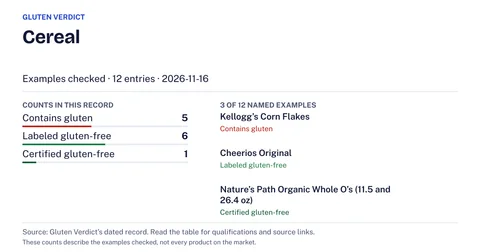
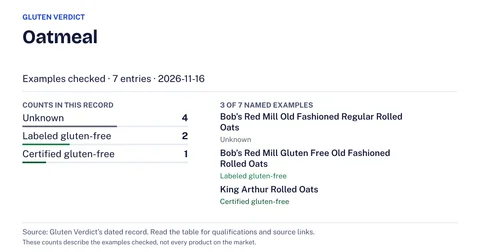
Coeliac UK points out that a supplied snack also keeps a child from feeling different at snack time, and says staff should store it apart from food that contains gluten4. For packaged foods, NIDDK says the FDA requires foods that carry a “gluten-free” or equivalent claim on the label to contain less than 20 parts per million of gluten23; our guide to reading a US food label shows where to look. Snack-table staples vary by product: our verdicts for bread, cereal and oatmeal show which of the products we checked carry a gluten-free claim and which show none.
If the program serves meals through USDA
The meal-pattern section of the Child and Adult Care Food Program (CACFP) rules says institutions and facilities must make meal modifications, including substitutions, for participants with a disability whose disability restricts their diet, at no additional cost, and the request must relate to the disability24, 21. A modified meal that does not meet the meal pattern is reimbursed only with a written medical statement signed by a State licensed healthcare professional, and the rule says that by October 1, 2025 a statement from a registered dietitian must also be accepted25. In the same paragraph, a parent may supply one or more components of the reimbursable meal as long as the program provides at least one required component26.
Whether your child’s celiac disease meets the rule’s test is for the program and its State agency to decide on your child’s facts; this page does not decide it. Our 504 plan guide walks through the same medical-statement rule for school meals.
Hands, tables and toys: eating risk versus touch risk
Gluten has to be eaten to cause symptoms, Coeliac UK says, which is why paints, crayons and glues are a problem mainly when a child eats them; and young children often put things in their mouth27. GIG says medical research to date does not show that gluten applied to the skin causes a reaction related to celiac disease, and that the main concern with a topical product is when it gets into the mouth28. So the questions for the center are about what reaches the mouth: hands, tables and shared toys.
Washing
One study put gluten on the hands of 30 participants aged 2 to 18 through classroom activities, then assigned each to soap and water, water alone or a wet wipe, and measured gluten on bread rubbed on their hands and on tables13, 29, 30. Its authors report that soap and water was consistently the most effective method, although other methods were as effective in certain scenarios6.
GIG’s 2026 article says commercial wet wipes, wet cloths with some detergent and soap and water remove food proteins, while hand sanitizer and dry towels are often found to leave residue behind19. A 2026 narrative review in the journal Nutrients goes further, reporting that standard alcohol hand sanitizers show negligible mechanical or chemical efficacy against inert gliadin proteins31. For the plan, that points to one line: soap and water before every meal and snack, with wet wipes when there is no sink.
Sharing, mouths and the floor
GIG asks staff to make sure other children do not feed your child or put their hands in your child’s mouth or on the food7, and to watch for toys or instruments that have been in another child’s mouth and snacks that fell on the ground8. Coeliac UK adds that young children often swap food, so staff need to stay vigilant32.
Sunscreen
GIG’s 2020 childcare page says sunscreen sticks to skin and can be ingested from hands and face, and asks parents to check the gluten-free status of their sunscreens and workers to apply it to gluten-free children before others18. GIG’s later page puts the same point in terms of the mouth: the concern is a topical reaching it28.
Art and sensory play
GIG’s childcare page lists craft supplies that contain wheat unless the package says otherwise: playdough, finger paint, paper mache, craft paste, macaroni, bird seed and sunscreen9. The page is from 2020 and says “unless otherwise stated on package”, so the center should read the package of each product it uses.
The 2020 study above measured gluten moving from classroom materials onto gluten-free bread. Paper mâché, cooked pasta in sensory tables and a baking project gave transfer far above 20 ppm; Play-Doh and dry pasta gave few transfers above it10. The authors note that gluten is used in schools, particularly in early childhood, art and home-economics classrooms33. Coeliac UK says play dough is not always gluten free34 and advises gluten-free pasta or supervision when preschoolers make art with dried pasta35.
So the question for the center is which materials are on the calendar, not whether crafts are allowed. For the high-risk materials, the study’s authors conclude that schools should provide gluten-free supplies and have a robust strategy to prevent gluten cross-contact with food36. Which brands of play dough, paste and paint contain wheat belongs in a guide that cites the makers; this one does not name any.
Birthday treats and parent-brought food
Ask the center how birthdays are handled before the first one happens. For events where you know what food will be served, GIG says it can be beneficial to bring your own food similar to what everyone else is having, and that it is always worth asking ahead of time20. The same article suggests, for events with baked goods, making a large batch at home and freezing the portions individually37.
Put the center’s answer in the plan: who tells you about a party, where the treat you supplied is kept, and who hands it over.
Public, private and home care: which rule covers which
The Justice Department’s ADA page on child care centers is the starting point, and the regulations it rests on are on eCFR. Read the table as a map of where to look, not as legal advice.
| Type of program | What the government pages say | Source |
|---|---|---|
| Run by a government agency (Head Start, summer programs, extended school day programs) | Must comply with title II of the ADA1. | ADA.gov, child care Q&A |
| Private center | Must comply with title III as a public accommodation1. The regulation’s list of public accommodations includes a day care center38 and a nursery or other private place of education39. | ADA.gov; 28 CFR 36.104 |
| Home-based center | ADA.gov says even small, home-based centers that may not have to follow some State laws are covered by title III2. | ADA.gov, child care Q&A |
| Run by a religious entity | Activities controlled by religious organizations are not covered by title III14. | ADA.gov, child care Q&A |
| Any preschool or day care program that receives federal financial assistance | The Section 504 rules for preschool education programs apply to recipients of federal financial assistance3, and a recipient that provides preschool education or day care may not exclude qualified handicapped persons on the basis of handicap15. (The regulation uses the older word “handicap”.) | 34 CFR 104.31 and 104.38 |
| A program in USDA’s CACFP | Institutions and facilities must make meal modifications for a participant whose disability restricts the diet24. | 7 CFR 226.20 |
What a private center covered by title III has to do, in the regulation’s words: make reasonable modifications in policies, practices or procedures when they are necessary to give people with disabilities access, unless it can demonstrate that the modification would fundamentally alter the nature of the service40. ADA.gov adds that a center cannot just assume a child’s disabilities are too severe and must make an individualized assessment of whether it can meet the child’s needs without fundamentally altering its program41. It also says centers accepting new children are not required to accept a child whose necessary care would fundamentally alter the program42.
Whether a given child’s celiac disease counts as a disability is decided on that child’s facts. The title III regulation’s definition (28 CFR 36.105) lists eating among the major life activities and the digestive system among the major bodily functions43, and ADA.gov’s own example for a different condition, diabetes, says providers should obtain written authorization from the child’s parents or guardians and physician and follow their directions44; that page does not mention celiac disease50. ADA.gov also states that its guidance has no legally binding effect16, so quote the regulation as well as the page.
State licensing rules for child care are a separate layer that this guide does not cover; ADA.gov notes that small, home-based centers may not have to follow some State laws2. Your state’s child care licensing office is the place to ask.
If staff push back
- Put the plan and your request in writing and keep a copy. Written statements are what the rules above refer to: the CACFP rule asks for a written medical statement25, and ADA.gov’s diabetes example asks for written authorization44.
- Ask what the center can do and, for anything it will not do, why. A covered center has to make reasonable modifications unless doing so would fundamentally alter the program45.
- If the program takes part in CACFP, ask for its procedure for requesting meal modifications: the rule says it must make sure parents have notice of that procedure46.
- Call the ADA Information Line, where specialists answer general and technical questions on weekdays47.
- To file a complaint: ADA.gov’s complaint page lists a public school or other state or local government program, and a private business that serves the public, among those a complaint can name, and sends issues other than employment, air travel and housing to the Department of Justice’s Civil Rights Division48. The Department says it first investigates and tries to resolve complaints through informal or formal settlements49.
This is a guide to what the agencies’ own pages say, not legal advice. For a Section 504 or school-meal complaint, our 504 plan guide lists the school-side steps.
Moving on to kindergarten
Our 504 plan guide covers the two federal routes at school, a meal modification under USDA’s school meal rules and a Section 504 plan, and the school plan guide for teachers shows what staff see. Your daycare plan is a good first draft for either: storage, hands, craft materials and who calls whom carry over unchanged.
Verdicts in this guide

Questions people ask
Can a daycare refuse a child with celiac disease?
ADA.gov says that for a child with a disability, a child care center cannot just assume the child’s disabilities are too severe and must make an individualized assessment41. It also says centers are not required to accept a child whose necessary care would fundamentally alter the program42. Whether your child’s celiac disease counts as a disability is decided on your child’s facts.
Can I bring my child’s food to daycare?
In the USDA CACFP rule’s paragraph on meal modifications for disability, a parent may supply one or more components of the reimbursable meal as long as the program provides at least one required component26. Coeliac UK, a UK charity, advises providing snacks and asking staff to store them separately4. Ask your center for its own policy and put it in the plan.
Is hand sanitizer enough before snack?
GIG says hand sanitizer is often found to leave residue behind, and names soap and water and wet wipes as working for removing food proteins19. In one study soap and water was consistently the most effective method6.
More in Kids, school, college and family
 A care sheet for the babysitter or grandparent of a child with celiac diseaseA one-page care sheet for a babysitter or grandparent: the checked foods, the kitchen cross-contact points, what to do after an exposure, and whom to call.
 Your child has celiac disease: a first-week plan for the kitchen, labels, school and talking to your childThe first week after a child’s celiac diagnosis, in order: the diet plan, first labels, kitchen, two school routes, talking to your child and follow-up.
 Going gluten-free as a family: choose the household rule, then fix the kitchenAll gluten-free, shared with rules or split: what NIDDK, the charities and one small study say, plus rules for siblings and visiting relatives.
 A 504 plan and school meal rules for celiac disease: what to ask for and where to complainMeal substitution or a 504 plan for a child with celiac disease: what each rule says, what the medical statement must hold, and where to complain.
 A gluten-free child who refuses food: what to track and when to ask the doctorHow to tell ordinary picky eating from a pattern to raise with your child’s doctor or dietitian, what ARFID is, and a one-week log to bring.
 Teaching a child to read gluten-free labels, one skill at a timeFour label skills to teach a gluten-free child in order, a cupboard practice game, and the questions an adult still answers.
Related guides
 Play-Doh, paste and art supplies: what the makers say about wheatWhat Hasbro and Crayola say about wheat in dough and craft supplies, what one school study measured, and what to ask the teacher.
 A gluten-free kid at a birthday party: the host text, the cake knife and the snack tableA parent’s plan for a celiac child at a party or sleepover: the host text, own food, cake and snack-table cross-contact, and hand washing.
 Introducing gluten to a baby when celiac runs in the familyWhat two randomized trials, pooled reviews and pediatric societies found on timing the first gluten, and when family testing is discussed.
 Talking to your child’s teacher about celiac disease: a script, a one-page sheet and the classroom questionsA two-minute script, a one-page sheet, a template email and the classroom questions about snacks, crafts and trips, drawn from US celiac charity guidance.
Sources
- [1, 2, 14, 16, 41, 42, 44, 45, 47, 49, 50] ADA.gov, US Department of Justice, Commonly Asked Questions about Child Care Centers and the Americans with Disabilities Act, checked Nov 17, 2026.
Read on 2026-11-17: no mention of celiac disease or gluten on the page; its allergy question (Q19) names severe allergies to bee stings or certain foods, and its diabetes question (Q20) is the one that asks for written authorization.
- [3] Electronic Code of Federal Regulations, 34 CFR 104.31, Application of this subpart, checked Nov 17, 2026.
- [4, 17, 27, 32, 34, 35] Coeliac UK, Nursery, Playgroup and School (UK charity), checked Nov 17, 2026.
- [5, 7, 8, 9, 11, 12, 18] Gluten Intolerance Group, Pre-School, Childcare, and Gluten Risks (published January 17, 2020), checked Nov 17, 2026.
Read on 2026-11-17: the list headed “Craft Supplies That Contain Wheat (Unless otherwise stated on package)” names playdough, finger paint, paper mache, craft paste, macaroni, bird seed and sunscreen.
- [6, 10, 13, 29, 30, 33, 36] PubMed, US National Library of Medicine, Weisbrod et al. 2020, Gluten cross-contact in the school environment (abstract), checked Nov 17, 2026.
- [15] Electronic Code of Federal Regulations, 34 CFR 104.38, Preschool and adult education, checked Nov 17, 2026.
- [19, 20, 37] Gluten Intolerance Group, Navigating School Parties and Community Events This Fall, checked Nov 17, 2026.
- [21, 24, 25, 26, 46] Electronic Code of Federal Regulations, 7 CFR 226.20, Requirements for meals (Child and Adult Care Food Program), checked Nov 17, 2026.
Read on 2026-11-17: the meal-pattern tables in this section are headed “Child and Adult Care Food Program Breakfast”, “Child and Adult Care Food Program Lunch and Supper” and “Child and Adult Care Food Program Snack”.
- [22, 23] National Institute of Diabetes and Digestive and Kidney Diseases, Eating, Diet, & Nutrition for Celiac Disease, checked Nov 17, 2026.
- [28] Gluten Intolerance Group, 25 Ways Cross-Contact Could Happen and How to Avoid It, checked Nov 17, 2026.
- [31] PubMed, US National Library of Medicine, Mpakosi et al. 2026, Celiac disease management in school environments (abstract), checked Nov 17, 2026.
- [38, 39] Electronic Code of Federal Regulations, 28 CFR 36.104, Definitions, checked Nov 17, 2026.
- [40] Electronic Code of Federal Regulations, 28 CFR 36.302, Modifications in policies, practices, or procedures, checked Nov 17, 2026.
- [43] Electronic Code of Federal Regulations, 28 CFR 36.105, Definition of “disability”, checked Nov 17, 2026.
Read on 2026-11-17: the definition lists “eating” among the major life activities and “digestive” among the body systems and the major bodily functions.
- [48] ADA.gov, US Department of Justice, File a Complaint, checked Nov 17, 2026.
Read on 2026-11-17: the list headed “Who You Can File a Complaint Against” names a state or local government (for example a public school or other state or local government program) and a private business that serves the public (for example a restaurant, doctor’s office, shop or hotel); under “Where and How to File Your Complaint”, “Other Issues” are filed with the Department of Justice, Civil Rights Division, online or by mail.