Gluten-free in the hospital: meals, medicines and prep products to ask about
Short answer
The Gluten Intolerance Group (GIG) and Coeliac UK, both charities, advise telling the care team before the day, asking for the hospital dietitian and checking each medicine by its label or with the pharmacist1, 2, 3, 8. No source we read says whether bowel-prep, IV or injectable products contain gluten14, 15. Steps for a planned stay:
- Ask your doctor for a written diet order, and call the departments that apply, including pharmacy and nutrition services, before you are admitted4, 1.
- Ask who verifies and approves the gluten-free foods, and ask to see the dietitian early, because dietitians typically handle meal orders (Coeliac UK, describing UK hospitals)5, 2.
- Ask for an allergy wristband and a note on your chart, so hospital staff can see the diet6, 7.
- For each medicine, read the ingredient list in the “inactive ingredients” or “Description” section, or ask the pharmacist and the maker3, 8.
- Bring gluten-free snacks if the ward allows them, in case the hospital’s catering has gaps9, 10.
Part of Explaining celiac and everyday social life, 15 guides

Key points
- A written diet order, an allergy wristband, a chart note and calls to each department before admission are steps in the Gluten Intolerance Group’s hospital checklist4, 6, 7, 1.
- FDA says most orally administered drug products contain no gluten or virtually none; the ingredient list is the thing to read11, 3.
- “Made with no gluten-containing ingredients” is a separate statement from a “gluten-free” claim: FDA says not to assume such a food meets its gluten-free rule12.
- FDA’s draft guidance on gluten in drugs is about oral products. It says gluten is not believed to harm people with celiac disease through other routes, and neither FDA page we read names IV fluids, injections, bowel prep or contrast agents13, 14, 15.
- Coeliac UK advises that prescribed medications be taken or stopped only under medical advice, and to talk to a doctor or pharmacist about any concern with a medicine16.
What to do before a planned admission
The aim is to put the diet on record in several places before the day. The Gluten Intolerance Group (GIG) lists these steps in an educational bulletin that covers day surgery as well as longer stays17.
- Get the diet in writing. GIG suggests a written physician’s order for a gluten-free diet from your regular doctor or GI doctor4. It also suggests asking the doctor to include the word “allergy” and to list “wheat, barley, rye and oats and their derivatives” on the order, which helps kitchen staff, most of whom will not have medical backgrounds but are trained to accommodate food allergies18.
- Call each department that applies. GIG’s list is pre-op, surgery, medical/surgery, pharmacy, nutrition services (the dietitian) and rehabilitation, and it suggests making an appointment to speak with someone in each before admission1.
- Tell the nurses. GIG’s reasoning is that you will most likely see nursing staff more often than doctors, and making nurses aware of your dietary restrictions helps get the message across to other hospital personnel19.
- Ask for an allergy wristband. GIG says you may need to ask out loud for a wristband that states your need to avoid gluten as an “allergy”6.
- Ask for a chart note. GIG suggests a prominent note on your chart reading “Celiac Disease: All foods and medications must be verified gluten-free”7.
For a planned stay, Coeliac UK, a UK charity, says speaking with the ward sister or dietitian ahead of time can help the hospital get ready, and that some hospitals need extra time to order in gluten free bread and crackers20. That page describes UK hospitals, so ask your own hospital how much notice it needs.
These are charities’ checklists, not a hospital’s own policy. Ask your hospital which of them it follows.
Meals: the dietitian, the menu and the tray
Ask for the dietitian
GIG’s advice is to identify the person who can verify which foods the hospital serves are gluten-free and how they are prepared in the kitchen, and to find out who is responsible for approving the “gluten-free” foods5. Coeliac UK says to ask to see a dietitian early in an admission, as dietitians typically handle meal orders2.
GIG adds that not all dietary staff are familiar with what a gluten-free diet entails, so you should speak directly with the head dietitian21. If the visit is an emergency, GIG says to contact the hospital’s Registered Dietitian as soon as you are settled22.
Questions for the menu and the kitchen
- Is there a gluten-free menu, and how does meal ordering work? GIG also suggests asking what the kitchen does to prevent cross-contact of gluten-free foods with crumbs or particles from gluten-containing items23.
- Will gluten free snacks be provided, and do you need to see a dietitian to plan your meals? Those are Coeliac UK’s suggested questions9.
- Who flags the diet? A UK article on the British Dietetic Association’s website, by two NHS dietitians, says patients need to be screened on admission for food hypersensitivity and flagged, such as on medical records, beds and handovers24.
Why the kitchen question matters: NIDDK defines cross-contact as foods or products that contain gluten coming into contact with gluten-free foods25, and says it can occur at any time, including when foods are prepared or served26.
Checking the tray when it arrives
Even when a hospital marks meals as gluten free, Coeliac UK says to ask about cross-contamination risks27, and to double check with staff if you are unsure whether a meal meets gluten free requirements28.
Wording on packaged items matters. FDA says that unless the label of a food carrying a statement such as “made with no gluten-containing ingredients” also bears a “gluten-free” claim, consumers should not assume the food meets all of FDA’s requirements for the claim12. The same article makes a similar point about hospital food: foods with no gluten-containing ingredients may be available, but not all can be classified as gluten-free because they were not tested to contain no more than 20ppm gluten29. How to read food labels covers the claim, the Contains line and the ingredient list.
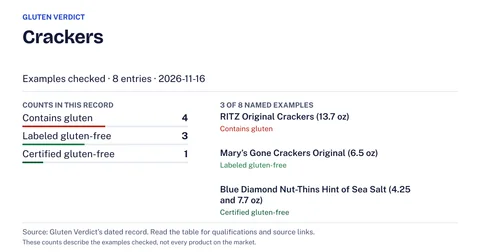
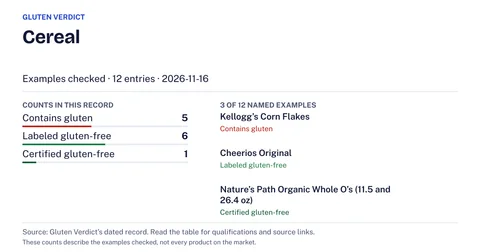
Our verdict pages cover packaged items you may be offered or bring, with the sources we read for each: bread, crackers and cereal.
Medicines: how to ask the pharmacist
FDA says the majority of orally administered drug products either contain no gluten or virtually no gluten11. GIG says the majority of drug manufacturers do not clearly label their products or packaging with information about gluten content30, and that anyone with doubts about a medication should consult the pharmacist and/or check with the manufacturer8.
| Where | What it gives you |
|---|---|
| Drug Facts label, nonprescription products | FDA says ingredients are listed in the “inactive ingredients” section3. |
| Labeling, prescription products | FDA says ingredients will generally be listed in the “Description” section3. |
| DailyMed | FDA says you can look up labeling for more than 90,000 prescription and nonprescription products there31, and that the label you read should match the product you want information about32. DailyMed’s help page shows its search can look by inactive ingredient33. |
| The pharmacist or the maker | GIG’s advice for doubts about a medication8. FDA encourages manufacturers to have accurate information on the sources of their ingredients so they can answer questions from the public and health care providers34. |
In hospital, the question to put to the pharmacist is which product, from which maker, the ward is giving you and whether its ingredient list includes wheat. DailyMed’s help page notes that the same drug may be produced by many different manufacturers or have different dosages35, so the drug’s name alone does not identify the product.
FDA’s own reading, for oral drug products: if the list of ingredients does not mention wheat gluten or wheat flour, the product should not contain gluten in an amount that would harm a typical (non-refractory) individual with celiac disease36.
GIG says to ask about your medication and supplements, and, if bringing your own is not allowed, to request that each one provided to you is checked and verified to be free of gluten37. GIG also suggests keeping your list of current medications, with the names and addresses of your health care providers, with your hospital papers38.
Coeliac UK’s advice is that prescribed medications should only be taken or stopped under medical advice, and that anyone with a concern about the medicines they take should talk to their doctor or pharmacist16.
Bowel prep and imaging products
The sources we read do not say whether any bowel-preparation product or imaging contrast agent contains gluten. FDA’s Medications and Gluten page and its draft guidance on gluten in drug products do not name them14, 15. A gluten status for a particular prep or contrast product therefore has to come from that product’s own label, its maker or the pharmacist.
- Ask the office that gave you the instructions for the exact product name and maker, and ask the pharmacist about that product. Pharmacy is one of the departments GIG says to call before admission1.
- Look the product up as in the table above: the label sections3, or DailyMed, checking that the label matches your product31, 32.
Any food or drink your procedure instructions allow is still food, so read its label as usual: how to read food labels.
IV fluids and injections
FDA’s 2017 draft guidance on gluten in drug products is about products taken by mouth or applied in or near the mouth. It says gluten is not believed to harm individuals with celiac disease through routes of exposure other than oral or enteral ingestion13. It is a draft, and FDA states that its guidance documents in general do not establish legally enforceable responsibilities39.
Neither FDA page we read names IV fluids or injectable medicines14, 15. GIG’s suggested chart note asks that all foods and medications be verified gluten-free7. Whether that applies to an IV bag or an injection in your case is a question for the pharmacist and the treating team. Ask it once, before the day, and ask that the answer be written on your chart.
If you cannot speak up: a family member’s role
GIG says that if you are too ill to contact the dietitian on an emergency visit, a family member or caregiver who understands your gluten-free diet should do it22. Coeliac UK likewise says to speak up yourself or ask a family member, friend or caregiver to help communicate your needs40, and suggests that person bring a gluten free checklist, kitchen poster or template letter to help inform staff41.
What a helper can carry, based on the checklists above:
Food from home and a fallback
GIG suggests asking whether you can bring gluten-free food from home, and says you might be able to request a small fridge for your room or access to a shared refrigerator on the floor42. If you may bring food, GIG lists gluten-free crackers, energy bars, condiments and a box of cereal as easy to store in hospital rooms10, and says to mark all your food with your full name and room number43.
Coeliac UK also suggests packing some gluten free snacks in case there are any gaps in the hospital’s catering9. In a UK article on the British Dietetic Association’s website, two NHS dietitians say many hospitals do not have sufficient mechanisms to ensure staff are always aware of the needs of people with celiac disease44. That is the case for a fallback. Check each packaged item’s label first: how to read food labels.
After the stay
New prescriptions at discharge are new products to look up: the label sections and DailyMed work the same way as before the stay3, 31. NIDDK says your doctor or a registered dietitian can guide you on what to eat and drink to maintain a balanced diet45.
If a problem with a medicine comes up, FDA’s Medications and Gluten page links to MedWatch, FDA’s adverse event reporting program46.
Verdicts in this guide

Questions people ask
Who orders gluten-free meals in a hospital?
Coeliac UK says dietitians typically handle meal orders in UK hospitals2. GIG says to find out who is responsible for approving the gluten-free foods at your hospital5.
Is “no gluten-containing ingredients” the same as gluten-free?
Not by itself. FDA says that unless the label also bears a “gluten-free” claim, consumers should not assume the food meets its requirements for the claim12.
Do IV fluids contain gluten?
We found no page that says. FDA’s draft guidance covers oral products and says gluten is not believed to harm people with celiac disease through other routes13; neither FDA page names IV fluids14, 15. Ask the pharmacist.
Can I bring my own food to the hospital?
GIG says to ask, and that you might be able to request a small fridge or shared refrigerator42.
Should I stop a medicine that might contain gluten?
Coeliac UK says prescribed medications should only be taken or stopped under medical advice16.
More in Explaining celiac and everyday social life
 When gluten-free eating wears you down: fewer decisions, same rulesEase gluten-free burnout with routines: check each product once, set a standing plan for eating out, and know which rules stay fixed.
 Gluten-free at work: catered lunches, client dinners, the office kitchen and business tripsWhat to ask a caterer, say to a server, label in the office fridge and carry on a business trip, from GIG, NIDDK, FDA and a chain's own allergen page.
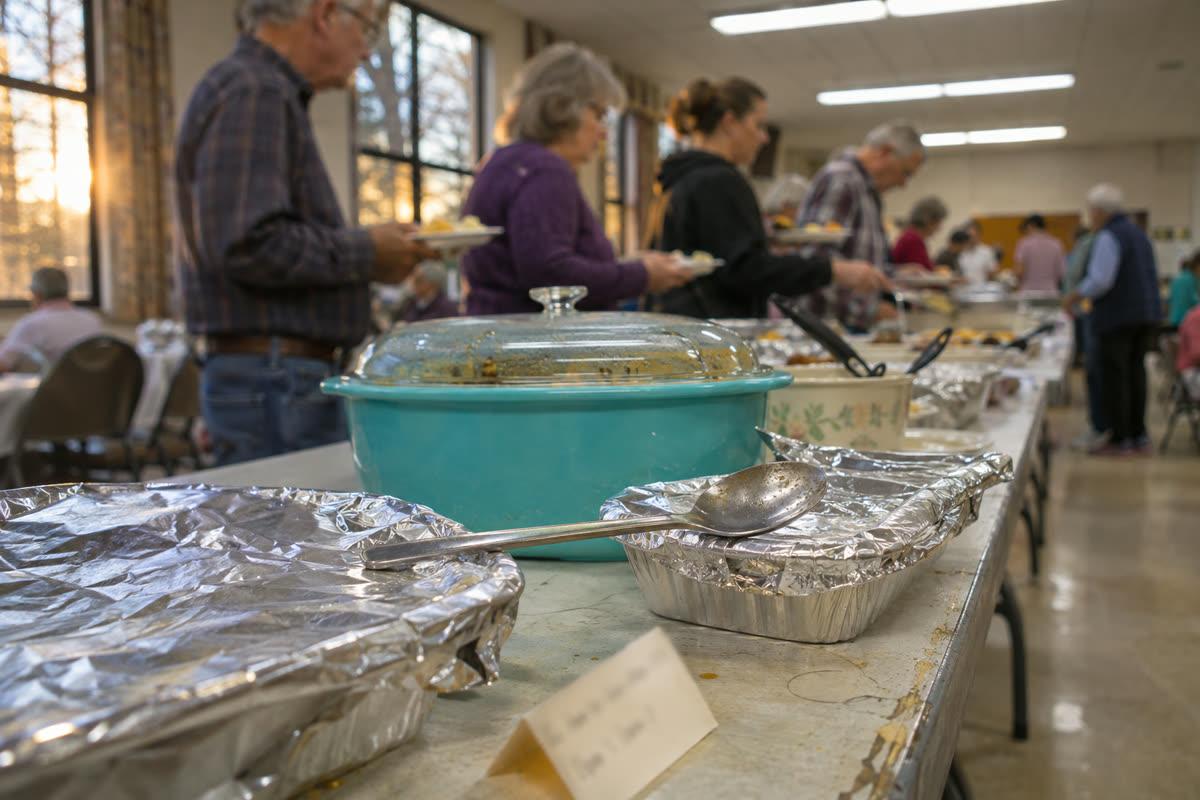 Gluten-free at church suppers, clubs and volunteer events: what to ask before the dayWhat to ask organizers, what to bring and how to handle the serving line at a church supper, club meal or volunteer shift, plus a note to hand over.
 Gluten-free meals in a nursing home or assisted living: the rules and what to askWhich meal rules cover a nursing home or assisted living, what to ask on a tour, how to get a gluten-free diet into the care plan, and where to complain.
 When your partner has celiac disease: gluten-free home or split kitchenChoose between a gluten-free home and a split kitchen, and find what to say at restaurants and to family, with NIH and charity sources.
 What to say to someone with celiac disease, and what to skipSentences to use, and ones to skip, when you cook for, eat out with or work beside someone with celiac disease, each tied to the fact behind it.
Related guides
 Medical ID for celiac disease: what to carry and what to tell paramedics or an ERWhere to keep celiac medical ID information (phone, bracelet, wallet card), what to list, and what to say to paramedics, with a fill-in card.
 Gluten in medications: what the label, DailyMed and a pharmacist can showFDA’s gluten-free food rule does not cover drugs. Use the ingredient list, DailyMed, the maker and a pharmacist, and know what each can show.
 How to check a medicine for gluten, from the bottle to the makerFind your exact medicine by NDC in DailyMed, read its inactive ingredients, compare refills, and ask the maker about starch names the label leaves open.
 Finding a dietitian who knows celiac disease: credentials, directories and questionsWhat RD and RDN mean, which celiac-related credentials and directories exist, and what to ask a dietitian at your first visit after a celiac diagnosis.
Sources
- [1, 4, 5, 6, 7, 10, 17, 18, 19, 21, 22, 23, 37, 38, 42, 43] Gluten Intolerance Group, Educational bulletin on a gluten-free hospital stay (published April 2022), checked Nov 17, 2026.
- [2, 9, 20, 27, 28, 40, 41] Coeliac UK, Gluten Free Hospital Stay Guidance UK, checked Nov 17, 2026.
- [3, 11, 14, 31, 32, 34, 36, 46] US Food and Drug Administration, Medications and Gluten, checked Nov 17, 2026.
Read on 2026-11-17: the page does not mention bowel-preparation products, imaging contrast agents, intravenous fluids or injectable medicines.
Read on 2026-11-17: the list headed “Related Information” on the page includes a link headed “Report a problem to MedWatch”.
- [8, 30] Gluten Intolerance Group, Medications and the Gluten-Free Diet (educational bulletin), checked Nov 17, 2026.
- [12] US Food and Drug Administration, Questions and Answers on the Gluten-Free Food Labeling Final Rule, checked Nov 17, 2026.
- [13, 15, 39] US Food and Drug Administration, Gluten in Drug Products and Associated Labeling Recommendations (draft guidance, December 2017), checked Nov 17, 2026.
Read on 2026-11-17: the text of the draft guidance does not mention bowel-preparation products, imaging contrast agents, intravenous fluids or injectable medicines.
- [16] Coeliac UK, Medication and coeliac disease, checked Nov 17, 2026.
- [24, 29, 44] British Dietetic Association, Hospital meals and coeliac inpatients (article on the British Dietetic Association website), checked Nov 17, 2026.
- [25, 26, 45] National Institute of Diabetes and Digestive and Kidney Diseases (NIDDK), Eating, Diet, & Nutrition for Celiac Disease, checked Nov 17, 2026.
- [33, 35] US National Library of Medicine, DailyMed help: search and NDC codes, checked Nov 17, 2026.
Read on 2026-11-17: the table headed “Current types of information that can be searched” lists drug name, class, ingredient, inactive ingredient and the unique ingredient codes, among others.