What to say to someone with celiac disease, and what to skip
Short answer
Treat it as a medical condition, ask what they need, and let their answer outrank any general rule. Four things cover most situations:
- Treat it as a medical condition, not a diet choice: NIDDK describes celiac disease as a chronic digestive and immune disorder triggered by gluten1.
- Ask the person what a meal has to avoid; GIG says they can usually share options, brands and tips for keeping food away from gluten8.
- Read the label with them, because “gluten-free” is a voluntary claim and FDA says people with celiac disease should read and scrutinize labels42, 41.
- Expect questions about preparation, because cross-contact can happen when food is grown, processed, stored, prepared or served37.
Part of Explaining celiac and everyday social life, 15 guides

Key points
- NIDDK describes celiac disease as a chronic digestive and immune disorder triggered by gluten, and separates it from a wheat allergy1, 3.
- Ask the person what a meal has to avoid: GIG says they can usually share options, brands and tips8.
- GIG says even a crumb from shared butter or a cutting board can trigger symptoms in someone with celiac disease14.
- If a guest brings their own dish or skips yours, GIG says it is about their health, not about you16.
- FDA’s gluten-free claim is voluntary and requires any unavoidable gluten to be under 20 ppm; FDA says people with celiac disease should read and scrutinize labels42, 44, 41.
What to know about celiac disease before you say anything
NIDDK, part of the US National Institutes of Health, describes celiac disease as a chronic digestive and immune disorder that damages the small intestine and is triggered by eating foods containing gluten1. Coeliac UK, a UK charity, calls it an autoimmune disease and says it is not a food allergy or an intolerance4.
GIG notes that some people think going gluten-free is a fad rather than a medical necessity7. A good opening line treats it as a medical need: “I know this is a medical thing for you, so I’ll go by what you tell me.”
Someone who avoids gluten may have a different condition. NIDDK separates celiac disease from gluten sensitivity or wheat intolerance2 and from a wheat allergy3. If you are not sure which one your friend has, ask.
Start with a question, not advice
GIG’s advice to friends and family is to ask the person: they can usually share options, specific brands and tips for keeping food away from gluten8. It also says to be patient when someone who avoids gluten asks you or others a lot of questions9.
One question opens most of what follows: “What does a meal have to avoid for you, and what would you like me to do about the kitchen?” Ask it before you shop, book or order, not after.
If you slip, GIG’s advice is to go easy on yourself and keep at it12.
Cooking for them
GIG calls offering gluten-free options the most supportive thing a host can do11. It also suggests cooking together: let them choose the meal and pick the recipes, and offer to buy the gluten-free ingredients13.
Then read the labels yourself. FDA says consumers with celiac disease should read and scrutinize labels to avoid gluten ingredients41, and that “gluten-free” is a voluntary claim a maker can use when a food meets the requirements42. Try: “I’ll bring the packages along so we can read them together.”
| Item | Why it needs a look | Our verdict |
|---|---|---|
| Soy sauce | FDA says that in general, soy sauce made from soybeans and wheat, or any other gluten-containing grain, may not bear a “gluten-free” claim48. | Soy sauce |
| Flour | FDA gives wheat flour as its example of an ingredient derived from a gluten-containing grain that has not been processed to remove gluten49. | Flour |
| Bread | NIDDK lists bread among the foods in which gluten is common1. | Bread |
| Butter | GIG says even a crumb from shared butter can trigger symptoms in someone with celiac disease14. | Butter |
Contact is the other half. NIDDK defines cross-contact as foods that contain gluten coming into contact with gluten-free foods36, and says it can occur when foods are grown, processed, stored, prepared or served37. For a host, GIG’s steps are separate cutting boards, utensils and serving dishes for the gluten-free food17 and no shared utensils between gluten-containing and gluten-free foods24. Our kitchen setup guide goes through a home kitchen.
Your own kitchen is part of the question. GIG says there is a higher risk of cross-contact for gluten-free food in the same space, especially if you bake with gluten-containing flour in your kitchen, and to be understanding if a guest brings their own food23. Try: “I’m glad to cook, but tell me whether my kitchen works for you, and I won’t take it personally if you bring your own.”
A restaurant night
Offer a choice, not a verdict. NIDDK’s steps for eating out start before the meal, with an online search for restaurants that offer a gluten-free menu39. At the restaurant, it says to tell the server about celiac disease and ask about ingredients, how food is prepared and whether a gluten-free menu is available38. GIG suggests friends do a little research and suggest places that clearly label their menus or offer gluten-free dishes18.
A “gluten-free” line on a menu is a different case from a package label. FDA says its regulation applies to packaged foods, and it recommends that restaurants making a “gluten-free” claim on their menus be consistent with its definition43.
If your friend feels awkward asking detailed questions, GIG suggests offering to speak up for them15. In one account GIG quotes, a parent said “we need gluten-free” rather than “he needs”, so her son did not feel singled out10. These are questions from GIG’s list for the server:
- Is there a dedicated fryer for gluten-free foods?31
- Does this contain flour or roux? GIG notes that the flour in a roux is often wheat flour32
- Can my meal be cooked in a separate pan from gluten foods?33
Our french fries verdict shows how the fryer question plays out. Our verdicts for Panera and Chipotle show each chain’s own wording and the date we read it. For the full routine, see our eating-out guide.
Family meals, and what to tell the other relatives
GIG notes that many people think gluten-free simply means leaving out the bread, so a little context goes a long way19. You can give that context before the day: “[Name] eats strictly gluten-free for a medical reason, so I’m keeping the serving spoons separate.”
- Separate serving utensils for the gluten-free dishes, or serve the gluten-free dish first, before anything else touches the table20.
- At a buffet, keep the gluten-free items together at one end of the table25.
- Let the gluten-free guest serve first, so utensils from gluten-containing dishes do not get moved around and shared before their food26.
GIG says a host cannot control what other guests do at a potluck or buffet, and that hosts sometimes listen with every good intention but do not fully understand how cross contact happens21. That is a reason to ask the guest what would help, not a reason to stop trying.
When someone at the table says “a little won’t hurt”, GIG’s guide for people who need to eat gluten-free suggests they stay calm and repeat what they need: even a small amount can make them sick22. You can back them up: “They’ve told us even a little matters, so let’s keep the spoons separate.”
At the office: lunches, catering and the shared kitchen
GIG’s workplace article calls the breakroom a shared space full of potential risk for cross-contact27. A colleague can help in three places. Ask before you move their food or rearrange the fridge.
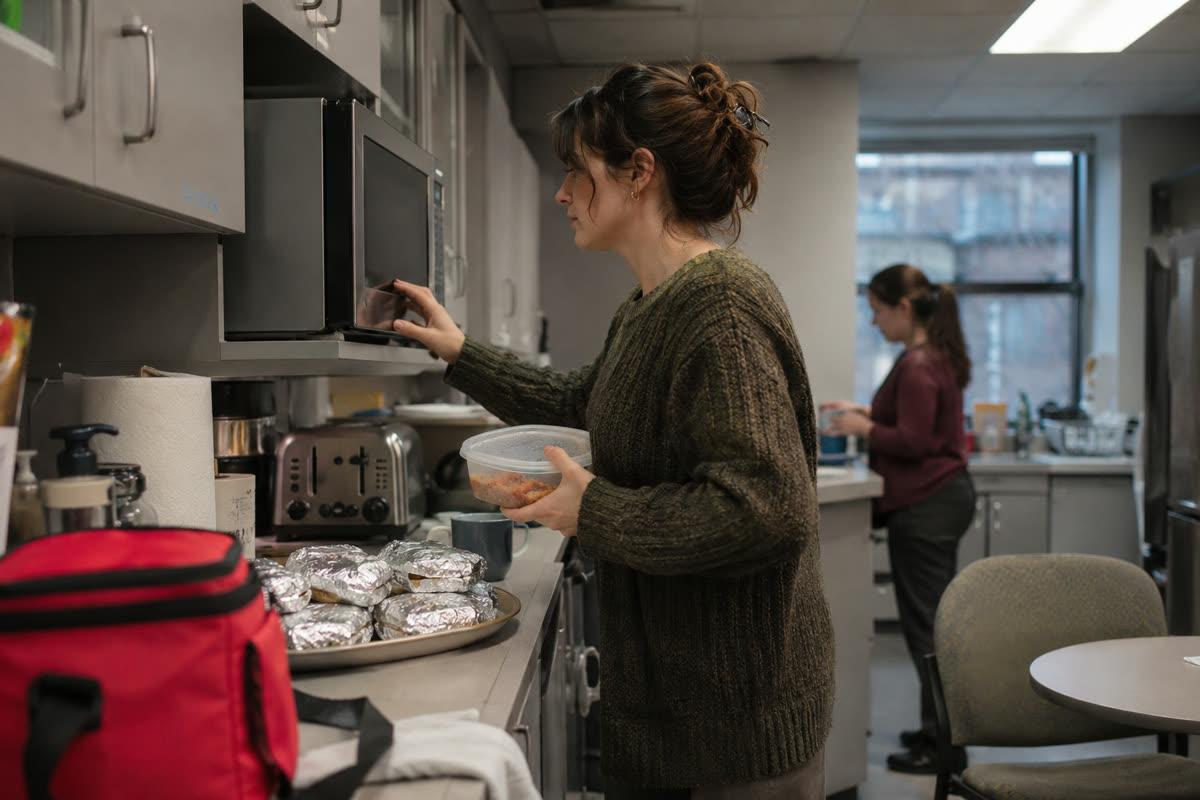
- Lunch orders: GIG says to check that foods are individually wrapped and to ask that gluten-free items be packaged separately from the other orders28. Try: “I’m ordering for the team. Can I ask them to pack yours separately?”
- Catered meetings: GIG suggests requesting a gluten-free option early, such as a prepared and packaged salad without dressing29. Try: “I’m booking the catering today. What should I ask for?”
- Parties: GIG says that when a party is being planned, you can request a gluten-free option or offer to bring one30. Try: “Before I order the cake, what would work for you?”
Sentences that sound kind and land badly
Each row pairs a sentence that tends to go wrong with the fact behind it and a replacement.
| Instead of | Why it lands badly | Try |
|---|---|---|
| “Isn’t that just a fad diet?” | GIG’s sample reply from a person with celiac disease is that not eating gluten is medically prescribed35. | “I didn’t realize it was medical. What should I know?” |
| “Can’t you cheat now and then? A little won’t hurt.” | Coeliac UK says even very small amounts of gluten can be damaging to people with coeliac disease5. | “Tell me what I should do about the sauce and the spoons.” |
| “It’s only a crumb.” | GIG says even a crumb from shared butter or a cutting board can trigger symptoms in someone with celiac disease14. | “I’ll use a clean board and a fresh knife for yours.” |
| “Isn’t it just an allergy?” | Coeliac UK calls it an autoimmune disease, not an allergy4; NIDDK separates it from a wheat allergy3. | “I know it’s not an allergy. What does it mean for dinner?” |
| “You look fine to me.” | Coeliac UK says you do not need gut symptoms to have coeliac disease6. | “I’m glad you’re up for dinner. What do you need from me?” |
| “I made it gluten-free, so it’s fine.” | Cross-contact can happen when food is prepared or served37, and GIG lists separate utensils among a host’s steps24. | “Here is what I used and how I cooked it. Want to check the packages?” |
| “You didn’t even try my cookies.” | GIG says a skipped dish or a dish brought from home is about their health, not about you16. | “Thanks for telling me. I’ll plan the next one around your list.” |
Why “under 20 ppm” on a US label is a limit, not a promise of zero
On a US package, FDA’s rule says any unavoidable presence of gluten in a food labeled gluten-free must be less than 20 parts per million (ppm)44. GIG pictures 20 ppm as one teaspoon in approximately 65 gallons of water34.
FDA says the goal for a food labeled gluten-free is to contain no gluten or the lowest amount possible under 20 ppm45. It chose 20 ppm because methods validated to detect lower levels were not available when the rule was written46. FDA adds that some celiac disease researchers and some epidemiological evidence suggest that most individuals with celiac disease can tolerate variable trace amounts, including levels under 20 ppm47, and NIDDK says that amount is too small to cause problems in most people with celiac disease40. Coeliac UK, for its part, says even very small amounts of gluten can be damaging to people with coeliac disease5.
The FDA and NIDDK statements are about most people, not every person, so the person’s own rule is the one to follow. Ask: “Do you stick to packages labeled gluten-free, or are there brands you trust?”
What to look up here before you cook or order
Our verdict pages show what a maker’s or restaurant’s own pages said on the date we read them. Start with every verdict, A to Z, the gluten scanner for a label photo or pasted ingredients, or the guides to reading a food label and hidden sources of gluten. The package in your hand is the thing to read before you cook.
Verdicts in this guide
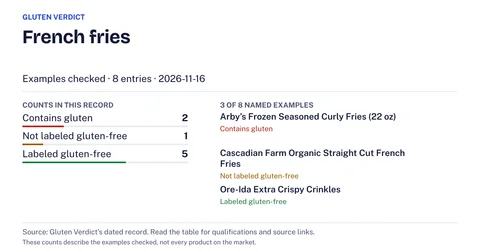 French friesDepends on the product2 of 8 products we checked contain gluten: Arby’s Frozen Seasoned Curly Fries (22 oz) and Checkers Frozen Crispy Seasoned Fries (28 oz)checked Nov 16, 2026
 Soy sauceDepends on the product3 of 7 products we checked contain gluten: Kikkoman Soy Sauce (Non-GMO), 20 oz; San-J Organic Shoyu Soy Sauce; and Lee Kum Kee Premium Soy Sauce (No Preservatives Added)checked Nov 16, 2026
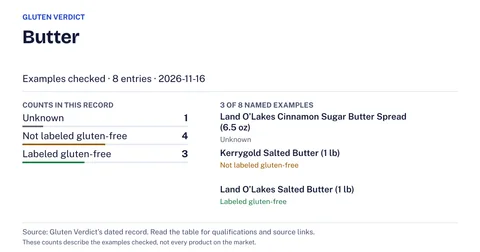 ButterNaturally gluten-freechecked Nov 16, 2026
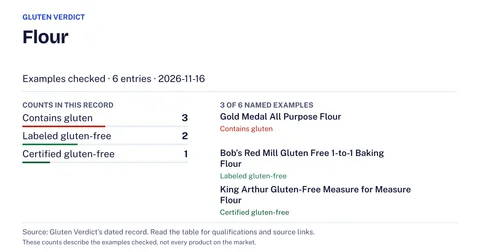 FlourContains glutenchecked Nov 16, 2026
 BreadContains glutenchecked Nov 16, 2026
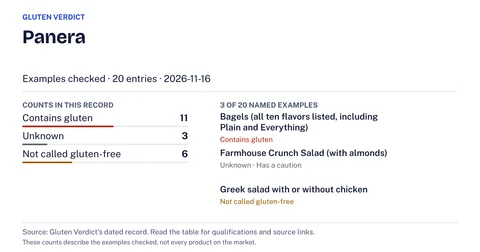 PaneraDepends on the order11 of 20 menu items we checked contain glutenPanera Bread · checked Nov 16, 2026
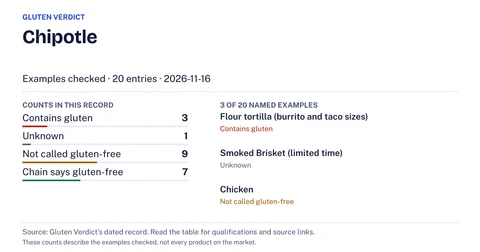 ChipotleDepends on the order3 of 20 menu items we checked contain gluten: Flour tortilla (burrito and taco sizes), Burrito, and QuesadillaChipotle Mexican Grill · checked Nov 16, 2026
Questions people ask
Is celiac disease an allergy?
No. NIDDK separates celiac disease from a wheat allergy, a type of food allergy3, and Coeliac UK calls it an autoimmune disease, not an allergy or an intolerance4.
Can I cook for someone with celiac disease in my own kitchen?
Ask them. GIG says there is a higher risk of cross-contact for gluten-free food in the same space, especially if you bake with gluten-containing flour in your kitchen, and to be understanding if a guest brings their own food23.
Does a person with celiac disease eat only foods labeled “gluten-free”?
FDA’s answer to a similar question is “Not necessarily”: it says consumers with celiac disease should read and scrutinize labels to avoid gluten ingredients41, and that the claim is voluntary42. Ask the person what they follow.
What if I get something wrong?
GIG’s advice is to go easy on yourself if you don’t always get it right, and keep at it12.
More in Explaining celiac and everyday social life
 How to explain celiac disease to friends and familyA three-sentence explanation of celiac disease, then sourced replies to the usual questions: allergy, fad, how strict, and what to cook.
 Gluten-free at work: catered lunches, client dinners, the office kitchen and business tripsWhat to ask a caterer, say to a server, label in the office fridge and carry on a business trip, from GIG, NIDDK, FDA and a chain's own allergen page.
 How to tell a host or relative you have celiac diseaseWhat to send a host before the meal, the cross-contact rule in one sentence, questions to ask about a dish, bringing your own, and how to pass on a dish.
 When your partner has celiac disease: gluten-free home or split kitchenChoose between a gluten-free home and a split kitchen, and find what to say at restaurants and to family, with NIH and charity sources.
 When a relative says a little gluten won’t hurt: what to say, and what to let goOne-line replies for the relative who scrapes off croutons or says one bite is fine, each with its source, plus what to push back on and what to let go.
 When gluten-free eating wears you down: fewer decisions, same rulesEase gluten-free burnout with routines: check each product once, set a standing plan for eating out, and know which rules stay fixed.
Related guides
 How to cook dinner for a guest with celiac diseaseA host's plan for one dinner: what to ask the guest, a menu with few risk points, which labels to read, the cooking order, clean tools and serving.
 Gluten cross-contact at home: where it happens and what to do about itHow gluten reaches gluten-free food at home, whether to separate, wash or ask for each route, and which rules have lab data behind them.
 Eating out with celiac disease: what to check, ask and watch forPlan a restaurant meal with celiac disease: what to check before you go, the questions to ask in order, how to read the answers, and what studies measured.
 Setting up a gluten-free kitchen: what to replace, wash or shareWalk each kitchen zone and decide, item by item, what to replace, what to wash and what a mixed household can keep sharing, with charity sources.
Sources
- [1, 2, 3] NIDDK (National Institutes of Health), Definition & Facts for Celiac Disease, checked Nov 17, 2026.
- [4, 5, 6] Coeliac UK, Common Coeliac Disease Myths Debunked, checked Nov 17, 2026.
- [7] Gluten Intolerance Group, Setting Healthy Boundaries When You’re Living Gluten-Free, checked Nov 17, 2026.
- [8, 9, 10, 11, 12, 13] Gluten Intolerance Group, Supporting & Encouraging Gluten-Free Loved Ones, checked Nov 17, 2026.
- [14, 15, 16, 17, 18] Gluten Intolerance Group, I Heart My Gluten-Free Friends & Family, checked Nov 17, 2026.
- [19, 20, 21, 22] Gluten Intolerance Group, A Seat at the Table: Talking to Family About Your Gluten-Free Needs, checked Nov 17, 2026.
- [23, 24, 25, 26] Gluten Intolerance Group, Tips for Entertaining Your Gluten-Free Family and Friends This Holiday Season, checked Nov 17, 2026.
- [27, 28, 29, 30] Gluten Intolerance Group, The Gluten-Free Office and Workplace, checked Nov 17, 2026.
- [31, 32, 33] Gluten Intolerance Group, Gluten-Free FAQ: Questions to ask in a restaurant, checked Nov 17, 2026.
- [34] Gluten Intolerance Group, Gluten-Free FAQ: What is 20 ppm in terms I can understand?, checked Nov 17, 2026.
- [35] Gluten Intolerance Group, Talking to Friends & Family About Living Gluten-Free, checked Nov 17, 2026.
- [36, 37, 38, 39, 40] NIDDK (National Institutes of Health), Eating, Diet, & Nutrition for Celiac Disease, checked Nov 17, 2026.
- [41, 42, 43, 44, 45, 46, 47, 48, 49] US Food and Drug Administration, Questions and Answers on the Gluten-Free Food Labeling Final Rule, checked Nov 17, 2026.