When your partner has celiac disease: gluten-free home or split kitchen
Short answer
There are two setups in use: a gluten-free home, or a shared kitchen with separate storage and cleaning rules. NIDDK’s advice is to store and prepare gluten-free foods separately from other family members’ foods that contain gluten4, and the Gluten Intolerance Group calls a fully gluten-free home an option that is not for every household31. Settle it with your partner, and with their doctor or dietitian for the diet itself3.
Part of Explaining celiac and everyday social life, 15 guides

Key points
- The Celiac Disease Foundation names a strict gluten-free diet for life as the only treatment, so settle the kitchen rules with that in mind1.
- A fully gluten-free home is optional, and GIG says it is not for every household31.
- GIG’s shared-kitchen rules cover storage, appliances such as toasters that are hard to clean, and washing with hot soapy water, since gluten is not destroyed by heat or most cleaning sprays and has to be physically removed22, 19, 26, 25.
- At a restaurant, ask how the food is prepared and ask to talk with the chef9.
- A survey of partners found burden common59, and NIDDK says people diagnosed with celiac disease, or their child, may find support groups helpful as they adjust6.
First weeks: ask your partner what they need
Celiac disease is a chronic digestive and immune disorder that damages the small intestine2, and the treatment the Celiac Disease Foundation names is lifelong adherence to a strict gluten-free diet1. Because the diet is lifelong, the kitchen rules are worth settling with care rather than in a rush.
Before you clear a cupboard, ask your partner what they want and what their doctor or dietitian has said. NIDDK says a doctor or registered dietitian can guide the diet3, and the Gluten Intolerance Group (GIG) advises talking with everyone in the household and laying out a plan together38.
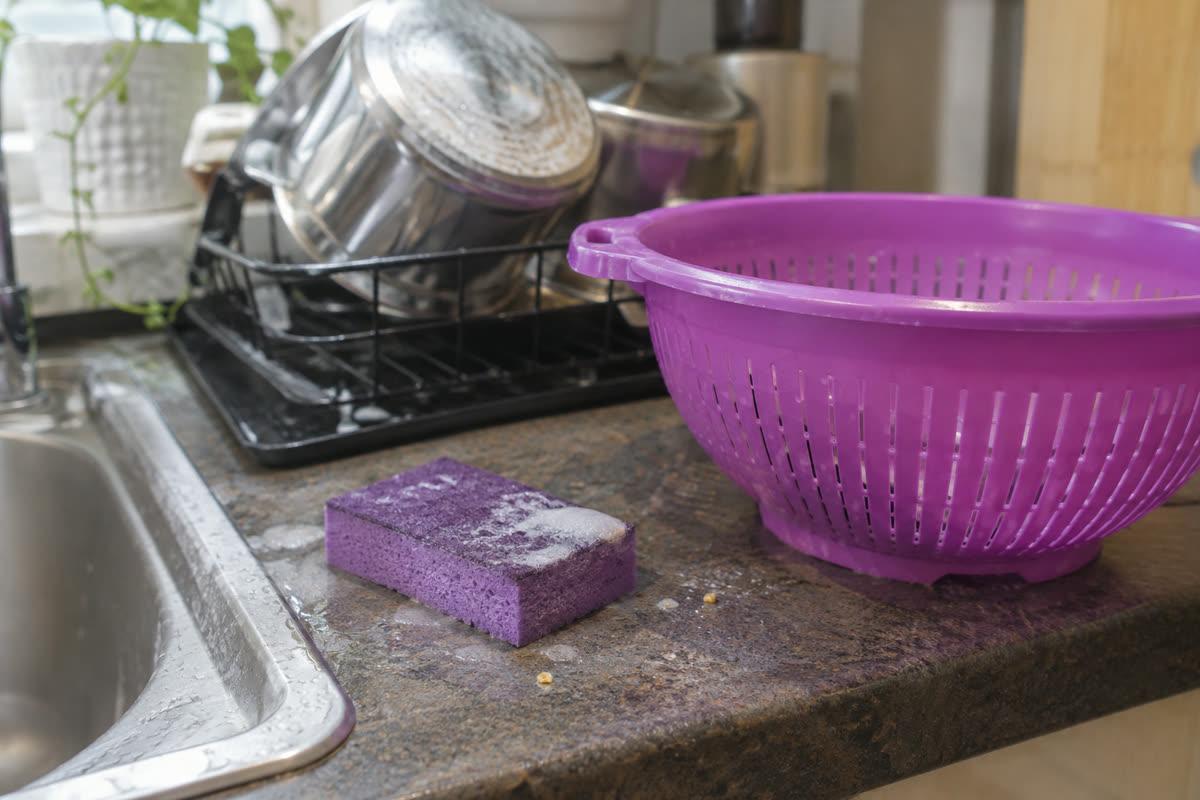
It helps to know what cross-contact looks like at home. GIG names a knife used on regular peanut butter, a shared cutting board and a colander that once drained wheat pasta as things that can leave behind enough traces to make someone with celiac disease seriously ill16. GIG also tells anyone supporting a gluten-free person to be patient when that person asks a lot of questions42, and to go easy on themselves when they get something wrong43.
Gluten-free home or split kitchen?
There are two main setups to weigh, and each has a cost. This is what the sources say about each.
| Gluten-free home | Split kitchen | |
|---|---|---|
| What it is | No gluten food in the house. GIG notes that some families choose to go entirely gluten-free31. | Gluten foods and gluten-free foods share the home. NIDDK’s advice is to store and prepare gluten-free foods separately from other family members’ foods that contain gluten4. |
| What the sources warn about | GIG says it is not for every household and may not always be healthy for family members without celiac disease or another condition that needs the diet, because gluten-free diets can lack nutrients31. NIDDK says packaged gluten-free foods tend to cost more5. | GIG says cross-contact can happen in a mixed household32, and that not every household can own two sets of pots and pans or a second oven, so cleaning shared items properly is essential24. |
A variation on the first is gluten-free at home with gluten foods eaten away from home. It is a choice for the two of you to make together.
Five questions to settle it
- What does your partner want, and what has their doctor or dietitian said? It is their diet and their health, so start there.
- How much gluten food do you eat at home? GIG tells households to note the type and number of gluten-containing items being made in the kitchen36. Toast every morning and weekend baking put more gluten in the kitchen than an occasional bowl of pasta.
- Who else eats here? GIG notes that younger children, others in the household or visitors who have less understanding of dietary needs may not be as vigilant about avoiding cross-contact as the person with celiac disease is36.
- Which duplicates would you need? The table in the next section lists the ones GIG names, from the toaster to the colander.
- Will you both keep it up? Try one setup for a few weeks, then sit down and change what is not working. If you bake with wheat flour, read our guide to cleaning a kitchen after wheat flour exposure.
If you share a kitchen: the rules in one table
This is the short version, drawn from what GIG says about shared kitchens. Our guide to setting up a gluten-free kitchen goes item by item, gluten cross-contact at home covers the routes, and what lab studies measured in shared kitchens shows which rules have measurements behind them.
| Where | What GIG says |
|---|---|
| Storage | Keep gluten-free products sealed and on higher shelves so crumbs do not fall into them22. Assign one color to everything strictly gluten-free, and make sure the whole household knows what it means18. |
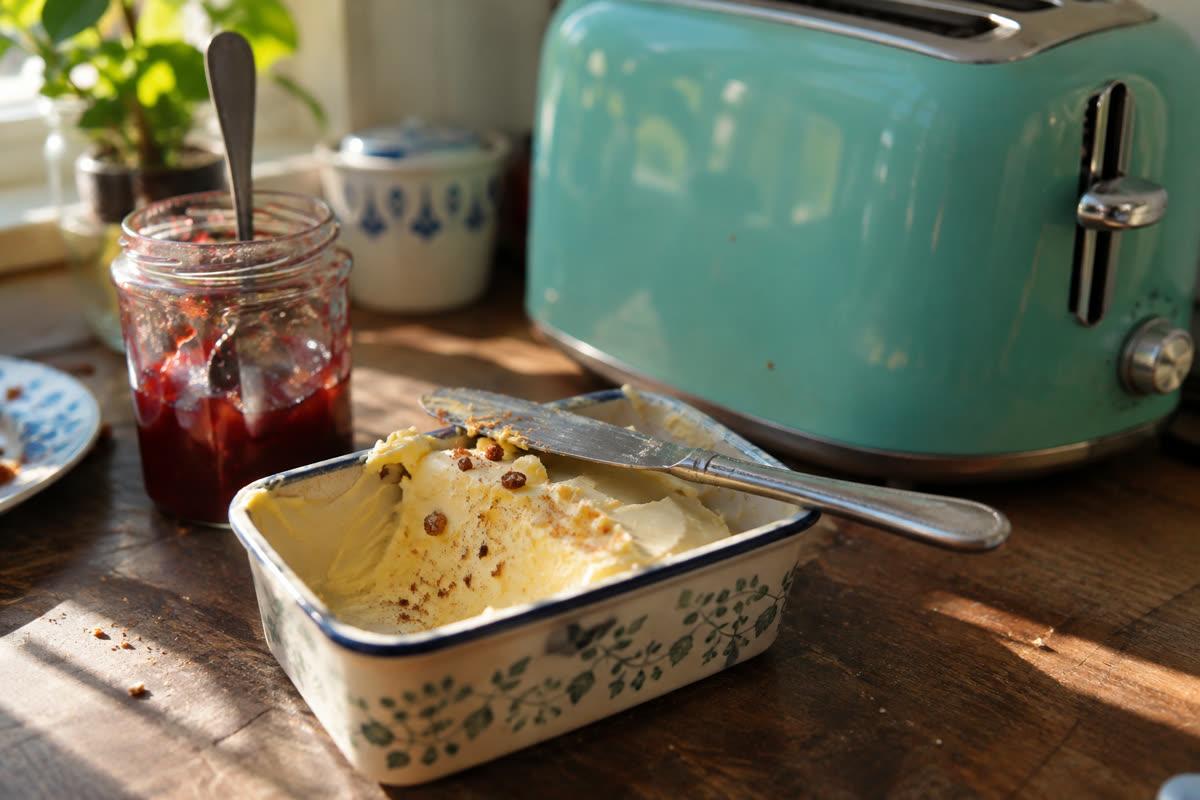
| Spreads and condiments | If you share one, make sure housemates understand why double dipping is not an option23. See sharing butter, jam and spreads and our butter verdict. |
| Toaster, air fryer, blender | At the top of GIG’s list of appliances to designate gluten-free only19, because their grooves and vents trap crumbs20. If a second one is not an option yet, GIG suggests a toaster bag as a temporary measure21. |
| Colanders, sifters, waffle irons | Not shared between gluten-free and gluten use if possible; if they are shared, clean thoroughly between every use33. |
| Pots, pans and cast iron | Worn non-stick pans can trap gluten, and cast iron is porous and nearly impossible to fully rid of residue, so GIG suggests a separate gluten-free pan28. |
| Counters | Wash with hot soapy water and a clean cloth or paper towel before any gluten-free meal preparation26. |
| How to clean | Gluten is not destroyed by heat or killed by most standard cleaning sprays, so it has to be physically removed25. |
| Sponges and towels | Replace or launder shared sponges and dish rags often27. Kitchen towels used only on thoroughly washed dishes or hands carry minimal to no risk, GIG says; otherwise use separate towels or paper towels37. |
| Oven | Wipe down the racks and interior, use a fresh sheet of foil, or put the dish on a clean baking sheet29. |
Rules only hold if both of you keep them. GIG’s summary is that the person with celiac disease has higher needs than the people they live with, but it is still the same kitchen and the same team, and the household should sit down and talk about how to make the shared space work for everyone30. Agree who does which job, such as wiping the counter, checking labels or putting the gluten-free items away.
Cooking and shopping: labels and the foods that surprise people
On foods FDA regulates, any food carrying the label “gluten-free,” “no gluten,” “free of gluten” or “without gluten” must contain less than 20 parts per million of gluten11. The claim is voluntary, so a food that is gluten-free by nature may not carry it12. NIDDK says gluten may be found in candy, condiments, hot dogs and sausages, ice cream, salad dressing and soups7. For the person with celiac disease, NIDDK suggests contacting the maker, or visiting its website, if possible, when it is not clear whether a food contains gluten8. Our guide to reading a US food label for gluten shows where to look.
| Food | What the sources say |
|---|---|
| Soy sauce | FDA says that in general, soy sauce made from soybeans and wheat, or any other gluten-containing grain, may not bear a “gluten-free” claim15. Our verdict page shows the bottles we read. |
| Pasta | The colander that once drained wheat pasta is one of GIG’s examples of what can leave traces16. Our verdict page covers the pasta products we read. |
| Bread | Toast is the everyday case: see the toaster row above. Our verdict page covers the breads we read. |
| Flour | Our verdict page covers wheat flour and the gluten-free flours and blends we read. |
| French fries | At a restaurant, GIG suggests asking whether fries are cooked in a dedicated fryer or share oil with breaded items50. Our verdict page covers frozen fries. |
| Butter | The double-dipped knife is the route GIG warns about for any shared condiment23. |
Cooking together can be a good way to learn. GIG suggests letting the person with celiac disease choose the meal and pick the recipes44.
Restaurants as a pair: who asks, and what to say
Agree before you leave who will do the talking, and whether your partner wants you to speak for them. NIDDK’s advice to the person with celiac disease is to tell the server, ask about ingredients, how food is prepared and whether a gluten-free menu exists, and ask to talk with the chef for more detail9.
GIG’s restaurant article is written for parents and caregivers of a child or dependent, but its questions work for a couple. It says busy servers respond best to short, direct explanations49. Questions it lists:
- “Are the french fries cooked in a dedicated fryer, or do they share oil with breaded items?”50
- “Is the GF pasta boiled in fresh water, or in the same water used for regular pasta?”51
- “Is this item cooked on a clean section of the grill/flat-top, separate from breaded foods?”52
GIG also lists red flags, among them confirmation that gluten-free food shares cooking oil or grill space with heavily breaded items, and kitchen staff refusing or hesitating to check the ingredient labels on packaged sauces or mixes53.
One small habit from a GIG article: a mother said “we need” instead of “he needs” when asking a restaurant about gluten-free food, so her son did not feel singled out41. Whether to do the same is your partner’s call.
A restaurant’s “gluten-free” line is not a manufacturer’s label. FDA says its definition applies to food manufacturers that voluntarily label FDA-regulated foods, and that restaurants’ use of the term should be consistent with it13; state and local governments play an important role in overseeing restaurants14. Our guide to eating out with celiac disease goes deeper.
Family and friends: speaking up for your partner
Ask your partner first how much they want you to say. GIG’s 2026 article, written for people with celiac disease, says a teen or someone still living at home can ask a parent or trusted adult to have the conversation with them or for them, and that the same approach works for gatherings with a partner’s family, friends or roommates46.
For the conversation itself, GIG advises letting the host know about the dietary needs once the invitation arrives, and explaining what cross-contact is and why it matters45. It also says it never hurts to come prepared with a dish, a snack or a small meal of your own47. A line you could adapt: “We’d love to come. [Name] has celiac disease, so we’d like to talk through the menu and how it will be served. Can we help?”
Educating relatives is part of backing your partner. GIG says advocating means educating others as well as standing up for someone39, and that doing so helps build a broader support system40. Expect to repeat yourself: GIG notes that people may not fully understand however many times it is explained48.
A comparison some relatives find easier than a lecture is GIG’s: cross-contact is like a strong perfume that lingers in a room after the wearer has left, even though you cannot see it17.
When a relative says a little will not hurt, see when a relative says a little gluten won’t hurt and what to say to someone with celiac disease.
Your own meals and your own gluten
Your own diet is yours to settle with your partner. What the sources address is how gluten foods are stored, cooked and cleaned up after, so the decision is mostly about your habits at home. Two questions come up often.
Kissing
A 2026 study in Gastroenterology tested gluten transfer in couples where one partner had celiac disease. The partner without it ate a gluten load, then either waited 5 minutes before kissing or drank 4 oz of water and kissed straight away55. Only 2 of the 20 gluten exposures tested above 20 ppm in the saliva of the partner with celiac disease, and none did after the water56. The amount detected in the saliva of the partners with celiac disease varied from under 5 ppm to 153.9 ppm65. The authors concluded that there was not an increased risk of significant gluten transfer when kissing57. It is one study, and our guide to dating with celiac disease covers it with the earlier advice. GIG’s 2021 advice, which predates the study, was a mouth routine for the partner who ate gluten: gluten-free toothpaste, mouthwash and floss54.
Lip products, toothpaste and other products
NIDDK lists lip balms and lipsticks and toothpastes among products that can contain gluten10. GIG says medical research does not show that applying gluten to the skin causes a reaction related to celiac disease34, and that the main concern is a topical getting into the mouth35. That makes the labels on anything near your mouth worth checking if you kiss.
When it gets hard for both of you
Researchers have looked at partners. A survey of 94 patient and partner pairs58 concluded that partner burden is common in celiac disease, with more than one-third of partners experiencing mild-to-moderate burden59. The Celiac Disease Foundation reported on a Columbia University study in which the more severe a patient’s symptoms, the more burden the caregiver felt, and stress was also higher when the caregiver was already dissatisfied in the relationship60.
A Swedish registry study looked at what it called high-risk caregivers: parents of people diagnosed at 19 or younger and spouses of people diagnosed as adults62. Compared with control caregivers, it reported an 8% statistically significant risk increase for anxiety and depression combined63, and its authors concluded that caregivers may be at increased risk of severe burden64. These are findings about groups. They do not say how any one household will feel.
The Foundation’s item adds that healthcare providers should involve caregiving partners in treatment and management planning decisions61. NIDDK says people with celiac disease may find support groups helpful as they learn about and adjust to a gluten-free lifestyle6; our guide to celiac support groups sets out what the national groups say they offer.
Verdicts in this guide
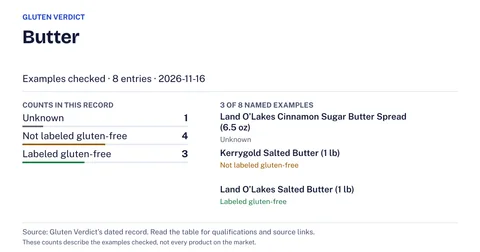 ButterNaturally gluten-freechecked Nov 16, 2026
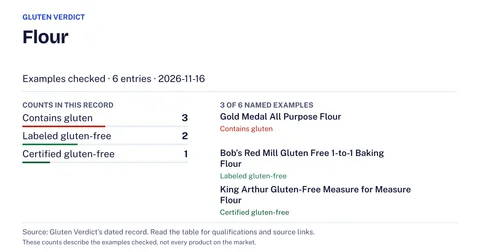 FlourContains glutenchecked Nov 16, 2026
 BreadContains glutenchecked Nov 16, 2026
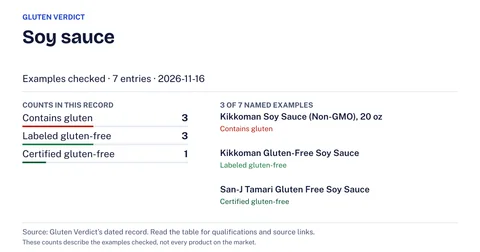 Soy sauceDepends on the product3 of 7 products we checked contain gluten: Kikkoman Soy Sauce (Non-GMO), 20 oz; San-J Organic Shoyu Soy Sauce; and Lee Kum Kee Premium Soy Sauce (No Preservatives Added)checked Nov 16, 2026
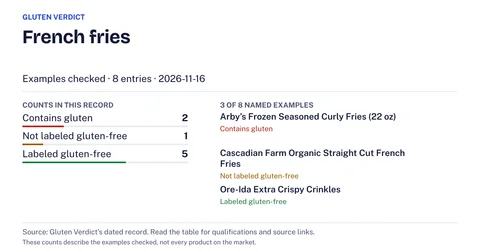 French friesDepends on the product2 of 8 products we checked contain gluten: Arby’s Frozen Seasoned Curly Fries (22 oz) and Checkers Frozen Crispy Seasoned Fries (28 oz)checked Nov 16, 2026
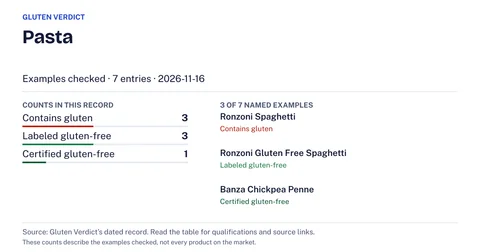 PastaContains glutenchecked Nov 16, 2026
Questions people ask
Does the partner of someone with celiac disease have to stop eating gluten?
NIDDK’s advice is to store and prepare gluten-free foods separately from other family members’ foods that contain gluten4, and GIG describes going entirely gluten-free as an option that is not for every household31. The choice is one for you and your partner to make, with their doctor or dietitian for the diet itself3.
Can I kiss my partner after eating gluten?
One 2026 study of couples found only 2 of 20 gluten exposures above 20 ppm in the saliva of the partner with celiac disease, and none after the partner who ate gluten drank 4 oz of water56. The authors concluded there was not an increased risk of significant gluten transfer when kissing57. It is a single study.
More in Explaining celiac and everyday social life
 How to explain celiac disease to friends and familyA three-sentence explanation of celiac disease, then sourced replies to the usual questions: allergy, fad, how strict, and what to cook.
 What to say to someone with celiac disease, and what to skipSentences to use, and ones to skip, when you cook for, eat out with or work beside someone with celiac disease, each tied to the fact behind it.
 How to tell a host or relative you have celiac diseaseWhat to send a host before the meal, the cross-contact rule in one sentence, questions to ask about a dish, bringing your own, and how to pass on a dish.
 When gluten-free eating wears you down: fewer decisions, same rulesEase gluten-free burnout with routines: check each product once, set a standing plan for eating out, and know which rules stay fixed.
 When a relative says a little gluten won’t hurt: what to say, and what to let goOne-line replies for the relative who scrapes off croutons or says one bite is fine, each with its source, plus what to push back on and what to let go.
 Gluten-free meals in a nursing home or assisted living: the rules and what to askWhich meal rules cover a nursing home or assisted living, what to ask on a tour, how to get a gluten-free diet into the care plan, and where to complain.
Related guides
 Gluten-free with roommates, partners and family: a shared-kitchen agreementHow to split a shared kitchen when one person is gluten-free: what to keep separate, what to wash and share, and how to put the rules to housemates.
 Setting up a gluten-free kitchen: what to replace, wash or shareWalk each kitchen zone and decide, item by item, what to replace, what to wash and what a mixed household can keep sharing, with charity sources.
 Gluten cross-contact at home: where it happens and what to do about itHow gluten reaches gluten-free food at home, whether to separate, wash or ask for each route, and which rules have lab data behind them.
 Eating out with celiac disease: what to check, ask and watch forPlan a restaurant meal with celiac disease: what to check before you go, the questions to ask in order, how to read the answers, and what studies measured.
Sources
- [1] Celiac Disease Foundation, What is Celiac Disease?, checked Nov 17, 2026.
- [2, 10] NIDDK (National Institutes of Health), Definition & Facts for Celiac Disease, checked Nov 17, 2026.
- [3, 4, 5, 6, 7, 8, 9] NIDDK (National Institutes of Health), Eating, Diet, & Nutrition for Celiac Disease, checked Nov 17, 2026.
- [11, 12, 13, 14] US Food and Drug Administration, Gluten and Food Labeling, checked Nov 17, 2026.
- [15] US Food and Drug Administration, Questions and Answers on the Gluten-Free Food Labeling Final Rule, checked Nov 17, 2026.
- [16, 17, 18, 19, 20, 21, 22, 23, 24, 25, 26, 27, 28, 29, 30] Gluten Intolerance Group, Your Kitchen, Their Kitchen, Our Kitchen: Navigating Gluten-Free Cohabitation (August 3, 2026), checked Nov 17, 2026.
- [31, 32, 33, 34, 35] Gluten Intolerance Group, 25 Ways Cross-Contact Could Happen and How to Avoid It, checked Nov 17, 2026.
- [36, 37] Gluten Intolerance Group, Should I be concerned about using the same dish/hand towels and pot holders as family members in my household who handle gluten-containing food?, checked Nov 17, 2026.
- [38, 39, 40, 41, 42, 43, 44] Gluten Intolerance Group, Supporting and encouraging gluten-free loved ones (May 20, 2021), checked Nov 17, 2026.
- [45, 46, 47] Gluten Intolerance Group, A Seat at the Table: Talking to Family About Your Gluten-Free Needs (November 3, 2026), checked Nov 17, 2026.
- [48] Gluten Intolerance Group, Talking to Friends & Family About Living Gluten-Free (January 15, 2020), checked Nov 17, 2026.
- [49, 50, 51, 52, 53] Gluten Intolerance Group, Questions to Ask When Eating Out (September 8, 2026), checked Nov 17, 2026.
- [54] Gluten Intolerance Group, 7 Things to Know About Kissing Gluten-Free (February 12, 2021), checked Nov 17, 2026.
- [55, 56, 57, 65] Gastroenterology (PubMed), A Prospective Study of Gluten Transfer Through Kissing in Celiac-Discordant Couples (2026), checked Nov 17, 2026.
- [58, 59] Digestive Diseases and Sciences (PubMed), Partner Burden: A Common Entity in Celiac Disease (2016), checked Nov 17, 2026.
- [60, 61] Celiac Disease Foundation, Study Shows That Partner Burden in Celiac Disease Can Strain Long-Term Relationships, checked Nov 17, 2026.
- [62, 63, 64] Digestive and Liver Disease (PubMed), Anxiety and depression in caregivers of individuals with celiac disease: a population-based study (2017), checked Nov 17, 2026.