Gluten-free at church suppers, clubs and volunteer events: what to ask before the day
Short answer
Tell the person who runs the meal before the day, ask what will be served and how it is prepared, and bring food you can eat so the last-minute decision is already made1, 2, 4. Whether to rely on an organizer’s reply is your call, so our suggestion is to keep your own dish in the plan.
- Let the host or organizer know you have celiac disease and find out whether gluten-free food will be available1.
- Ask what will be served, whether separate utensils are used and how the food is prepared3, 2.
- If the answer is thin or unsure, bring gluten-free food of your own4, 5.
- In the line, ask to go first, or to make your plate before others begin, which cuts the risk of crumbs and gluten-covered serving spoons6, 7.
Part of Explaining celiac and everyday social life, 15 guides
Key points
- The advice in this guide comes from NIDDK, FDA, celiac charities and one study in school classrooms, on hosts, parties and community events. None of the sources we read is about congregations or volunteer kitchens specifically.
- NIDDK says cross-contact can occur at any time, including when foods are prepared or served8; GIG says that if the same spoon, fork, tongs or scoop serves both gluten-containing and gluten-free food, cross-contact is inevitable9.
- A “gluten-free” label on a manufacturer’s package means less than 20 parts per million of gluten under FDA’s rule10, 11; a card on a homemade dish is only the cook’s own description.
- In one classroom study, soap and water was consistently the most effective method for removing gluten from hands and tables12.
Who to tell, and what to say
NIDDK’s advice for social gatherings is to let the host know you have celiac disease and find out whether gluten-free food will be available1. At a church supper, a club dinner or a volunteer day, the “host” is whoever decides what is served and who prepares it: the person running the meal, the one signing people up for dishes, or whoever places the catering order.
Gluten Intolerance Group (GIG) suggests, when you are eating at the home of someone unfamiliar with your need for gluten-free food, communicating about your dietary needs in advance13, and, if you believe the host would be receptive and especially expect to interact with them again, graciously informing them of those needs14. The Celiac Disease Foundation adds that you should not expect a party host to know what celiac disease is, and should explain politely what you can and cannot eat15.
A guest article on the National Celiac Association’s site includes a point worth borrowing for a group meal: the conversation is an opening to explain cross-contact concerns, such as shared serving spoons or cutting boards, in a kind way16. NIDDK names wheat, barley and rye as grains that contain gluten60, so those are the words to use if the person asks what to avoid. Our guide to telling hosts has wording for that first conversation.
Communion is a separate question, with its own answers in each tradition. It has its own communion guide; this page is about the shared meals around it.
Questions to ask before the day
GIG’s advice for a party is to ask what food will be served before you go3, and to ask about ingredients, whether separate utensils were used, and how the food was prepared2. For a group meal, turn that into a short list you can send in one message:
- What is being served, and is it a potluck, a catered meal or cooked by a few volunteers?
- Who prepares it, and can I ask them about ingredients directly?
- Will each dish have its own serving spoon, and is there a way to serve me first?
- If someone is cooking on a grill or in a fryer, is it shared with breaded or bun-based foods?
- Would it help if I bring a dish for the table, and is there a sign-up sheet?
The fryer and grill questions come from GIG’s tailgate-party list of cross-contact risks: a grill can be used to warm or toast buns, leaving gluten-containing crumbs17, and when gluten-free food is fried in the same oil as breaded food the risk of cross-contact is high18. GIG’s holiday-buffet advice for catered food is to ask whether items are cooked in a shared fryer or on shared equipment, which it calls the most common places for hidden gluten19.
If the meal is catered, the Celiac Disease Foundation suggests calling ahead to see whether you can request a gluten-free meal or gluten-free options20. A volunteer ordering for the group can ask the caterer the same questions.
Potlucks: what to bring
NIDDK’s advice is that if gluten-free food is not available, or you are unsure, you bring gluten-free food4. The Celiac Disease Foundation’s holiday and social-eating advice is to “come prepared”: if you are going to someone else’s house for a get-together and are unsure of the menu, bring a dish or two you are sure you can eat5. Its dining advice also says to always bring a back-up snack21.
GIG says that at an event where you do not know the host very well, you may wish to bring your own gluten-free food22. Bring something that works as a meal for you, not only a side. When the event uses a sign-up sheet, GIG suggests volunteering a dish and leaving yourself room to pick one you make well and enjoy23, 24. Where families bring their own meals, GIG lists foods that hold well in a crockpot, such as chili, soups, stews and rice-based dishes25. If the event usually has baked goods, GIG suggests making a large batch of something at home and freezing it individually26.
Eating beforehand is another fallback. GIG’s tips for teens say that having a meal or snack before the event helps you avoid temptations that could make you feel sick later27.
Dishes to ask about at a shared table
We do not rate anyone’s dish. This table shows what GIG and the Celiac Disease Foundation say to watch for, with our verdict pages for the foods themselves. GIG’s tailgate list says to avoid the foods on it unless the packaging shows the product is labeled gluten-free or, preferably, GFCO-certified28.
| At the table | What the sources say | Our verdict page |
|---|---|---|
| Buns, sandwich bread, rolls | GIG’s tailgate-party list of gluten-containing foods includes burger and hot dog buns and sandwich bread28. | Bread, hot dogs |
| Pretzels, crackers, cookies | On the same GIG list: soft and hard pretzels, cookies and crackers28. | Pretzels, crackers, cookies |
| Pasta salad, macaroni and cheese | GIG lists pasta salads and macaroni and cheese28. | Pasta, mac and cheese |
| Gravy and sauces | The Celiac Disease Foundation tells diners to watch for hidden gluten in gravies, sauces, spices and drinks29. | Gravy |
| Chips and dips | GIG describes chip bowls and shared dips as places gluten gets carried over by hands and double-dipping30, 31. | Chips |
The serving line
GIG says shared chip bowls, dips, serving utensils and buffet tables can all introduce gluten into otherwise gluten-free foods32. Its tailgate guide names the same pattern: hands moving from a gluten-containing snack bowl to a gluten-free one can leave crumbs behind30, and one spoon, fork, tongs or scoop used for both kinds of food means cross-contact9.
You can ask an organizer for any of these changes, taken from GIG guidance for hosts and guests and from a guest article on the National Celiac Association’s site:
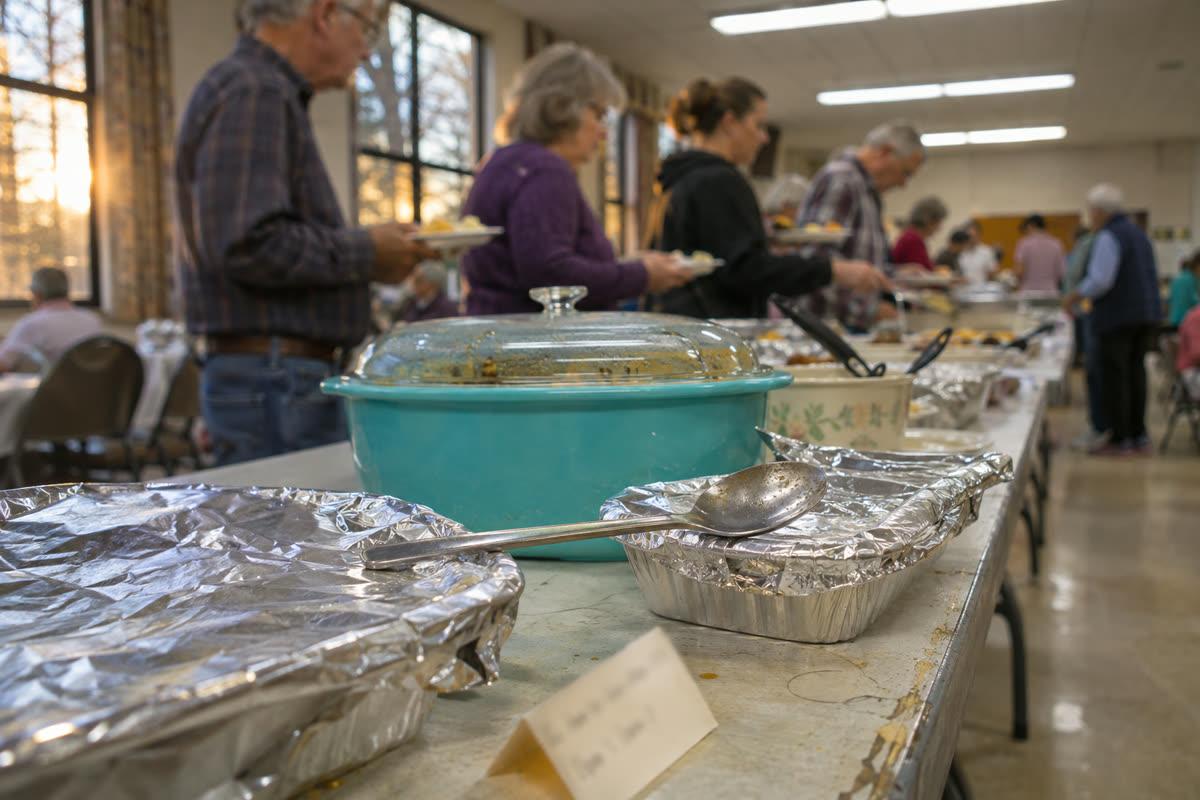
- Serve yourself first. A guest article on the National Celiac Association’s site suggests slipping into line first to cut down on crumbs and gluten-covered serving spoons, or asking the host beforehand if you can make your plate before others begin6, 7.
- Give each dish its own spoon. GIG calls using the same serving utensil in both types of food one of the most common ways gluten gets into gluten-free food33.
- Put gluten-free dishes on a separate table, with their own serving utensils, plates, eating utensils and napkins34, 35.
- Use cards. GIG suggests a card with an ingredient list next to self-serve dishes, and asking people to label the food they bring36, 37. GIG also says that even with clear rules, someone is bound to forget38, so treat the cards as a help, not a fix on their own.
GIG says any buffet-style display introduces new opportunities for cross-contact39. For a buffet or food-court setting outside a group event, see our buffets, food courts and food trucks guide.
If you are unsure about a dish, the Celiac Disease Foundation’s dining and holiday advice includes not being afraid to send things back or to ask questions about cross-contact40. GIG’s holiday advice is blunter: it is always acceptable to say no thank you41.
When someone buys food for the group
For a packaged food, FDA’s “gluten-free” claim is voluntary, and the rule defines what it means on a food label42. Foods with the label “gluten-free”, “no gluten”, “free of gluten” or “without gluten” must contain less than 20 parts per million of gluten10. A food with no claim may still be gluten-free: FDA notes the claim is not required, so it may not appear even if the food is gluten-free43.
FDA’s definition was set for food manufacturers that voluntarily label FDA-regulated foods11. Our reading: a card on a homemade casserole is the cook’s own description, not a manufacturer’s label, so ask how it was made. If a volunteer bought a product and is unsure, NIDDK suggests not eating foods you are unsure about and contacting the maker or checking its website44.
Some packages carry a certification logo. FDA says it does not endorse, accredit or recommend any particular third-party certification program45. GIG’s article says GFCO-certified food meets a threshold of 10 parts per million of gluten or less46. Our label guide covers the rest of what a label can tell you.
Youth groups, retreats and overnight events
For events where food is hard to predict, GIG’s community-events article recommends carrying your own: certified gluten-free bars as a compact option47 and gluten-free noodle cups, which need only hot water that is often easy to find48. If the menu is known, GIG suggests bringing your own version of what others are having49, and says it is always worth asking ahead50.
For teens, GIG’s tips are to bring snacks with enough to share51 and to eat before you go27. A retreat is longer than a supper, so ask the organizers early which meals are cooked on site, whether there is a fridge and microwave you can use, and who in the kitchen you can talk to.
For cooking over a shared grill or toasting bread, Coeliac New Zealand, a New Zealand charity, suggests packing your own barbecue or taking tinfoil or your own tray and making sure separate tongs are used52. It also suggests a clean grill, pan or toaster bag for gluten-free toast53. GIG’s tailgate guide warns that grills used to warm or toast buns can leave gluten-containing crumbs17.
Volunteering in the kitchen
None of the sources we read is about adults working in a church or club kitchen, so there is no tested protocol to give you. What we found is general cross-contact advice and one classroom study.
GIG says colanders, sifters and waffle irons are harder to clean and should not be shared between gluten-free and other use if possible54, and that soap and water is enough for most cooking equipment55. If a shared kitchen has such items, ask before you cook your own dish in it.
On hands, one study measured gluten transfer in school classrooms with children aged 2 to 18, 30 participants in all56. After a baking project, gluten transfer was far greater than the 20 ppm threshold set by Codex Alimentarius, measured on gluten-free bread slices rubbed on hands and tables, and soap and water was consistently the most effective way to remove gluten, although other methods worked as well in some scenarios57, 12. It was a school study, so treat it as a pointer. GIG also says wet wipes or soap and water remove food proteins, while hand sanitizer and dry towels often leave residue58.
Our own suggestion, not a source’s: if you are asked to help serve or bake, say what you can do without handling gluten-containing food, such as setting tables, greeting people or running the sign-up sheet, and wash your hands before you eat.
A note to hand an organizer
Copy this, change the details, and send it a week ahead.
Hello, I have celiac disease, so I cannot eat wheat, barley or rye. I would like to take part in the meal and I will bring a dish I can eat, so there is no need for you to make anything special. Could you tell me what will be served and who is preparing it? If it is possible, I would be grateful for a clean serving spoon for each dish, and to serve myself before the line forms. Thank you for helping.
Why each line is there: asking what is served and how it is prepared follows GIG’s party advice2; serving first follows the National Celiac Association article6 and separate spoons follow GIG33; bringing your own dish follows NIDDK and the Celiac Disease Foundation4, 5. NIDDK says cross-contact can occur at any time, including when food is prepared or served, which is why the note mentions spoons and the line and not only ingredients8.
Verdicts in this guide
 BreadContains glutenchecked Nov 16, 2026
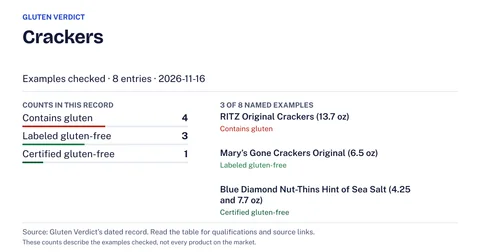 CrackersDepends on the product4 of 8 products we checked contain glutenchecked Nov 16, 2026
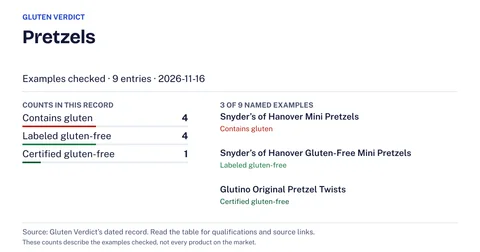 PretzelsDepends on the product4 of 9 products we checked contain glutenchecked Nov 16, 2026
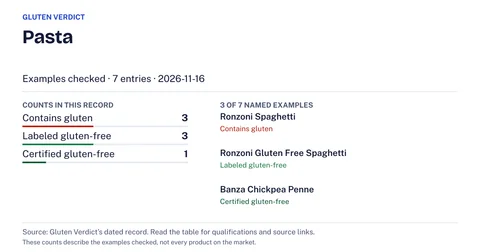 PastaContains glutenchecked Nov 16, 2026
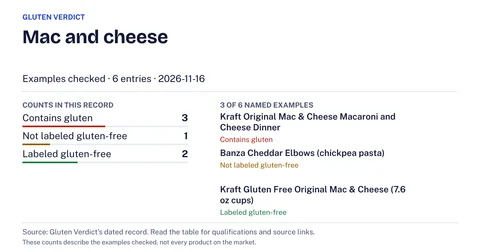 Mac and cheeseContains glutenchecked Nov 16, 2026
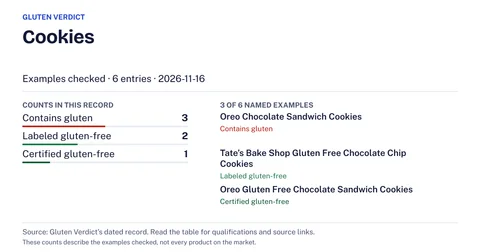 CookiesContains glutenchecked Nov 16, 2026
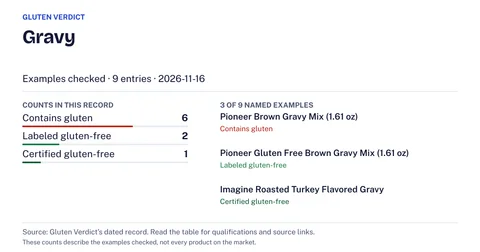 GravyDepends on the product6 of 9 products we checked contain glutenchecked Nov 16, 2026
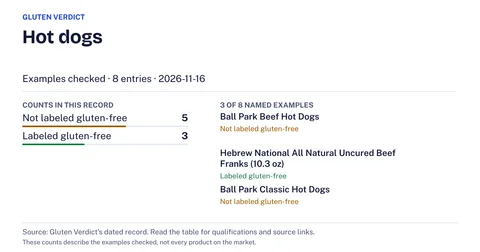 Hot dogsDepends on the productchecked Nov 16, 2026
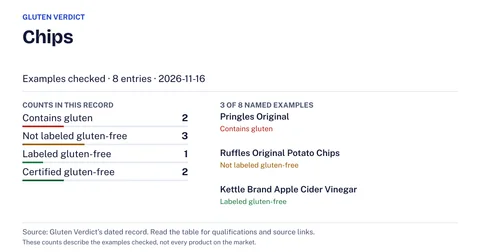 ChipsDepends on the product2 of 8 products we checked contain gluten: Pringles Original and Pringles Salt & Vinegarchecked Nov 16, 2026
Questions people ask
What if the organizer says “everything is gluten-free”?
Ask how it was prepared. GIG’s party advice is to ask about ingredients, separate utensils and preparation2, and NIDDK says to avoid eating foods you are not sure about44.
Does a gluten-free label mean there is no gluten at all?
No. Under FDA’s rule, a food labeled gluten-free must contain less than 20 parts per million of gluten10.
More in Explaining celiac and everyday social life
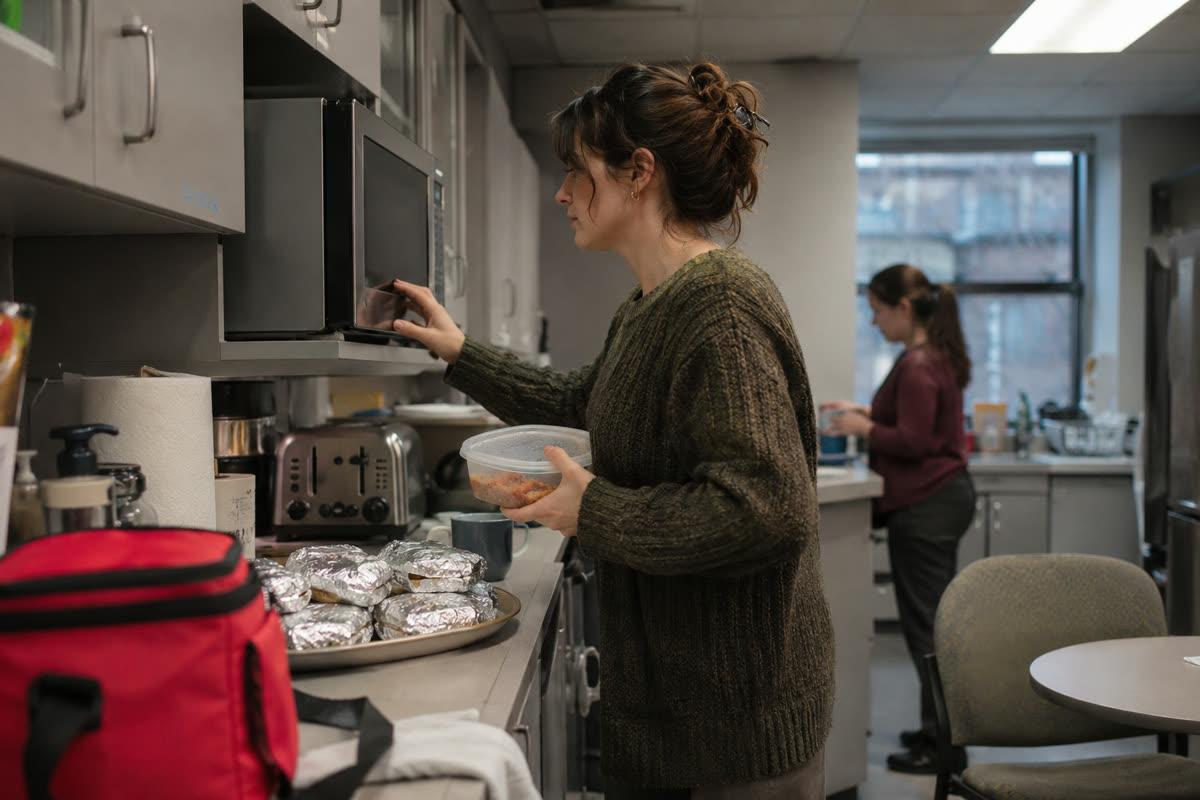 Gluten-free at work: catered lunches, client dinners, the office kitchen and business tripsWhat to ask a caterer, say to a server, label in the office fridge and carry on a business trip, from GIG, NIDDK, FDA and a chain's own allergen page.
 When gluten-free eating wears you down: fewer decisions, same rulesEase gluten-free burnout with routines: check each product once, set a standing plan for eating out, and know which rules stay fixed.
 Gluten-free in the hospital: meals, medicines and prep products to ask aboutHow to ask for a gluten-free tray, question the pharmacist about medicines and prep products, and bring a fallback before a planned stay or procedure.
 When your partner has celiac disease: gluten-free home or split kitchenChoose between a gluten-free home and a split kitchen, and find what to say at restaurants and to family, with NIH and charity sources.
 Gluten-free meals in a nursing home or assisted living: the rules and what to askWhich meal rules cover a nursing home or assisted living, what to ask on a tour, how to get a gluten-free diet into the care plan, and where to complain.
 Celiac awareness dates, events and groups for the people around someone with celiac diseaseWhich celiac awareness dates exist, one way to take part from a charity’s own page, and how to judge a support group or online community.
Related guides
 Receiving Communion With Celiac Disease: What Each Church Says in Its Own DocumentsWhat Catholic, United Methodist, Lutheran and Episcopal documents say about low-gluten hosts, the cup and a separate chalice, and how to ask your clergy.
 How to tell a host or relative you have celiac diseaseWhat to send a host before the meal, the cross-contact rule in one sentence, questions to ask about a dish, bringing your own, and how to pass on a dish.
 How to cook dinner for a guest with celiac diseaseA host's plan for one dinner: what to ask the guest, a menu with few risk points, which labels to read, the cooking order, clean tools and serving.
 Gluten-free at a holiday dinner, potluck or cookout as a guestHow a guest with celiac disease can message the host, bring a dish, serve first at a buffet and decide when to eat only their own food.
Sources
- [1, 4, 8, 44, 60] National Institute of Diabetes and Digestive and Kidney Diseases (NIDDK), Eating, Diet, & Nutrition for Celiac Disease, checked Nov 17, 2026.
- [2, 3, 32, 59] Gluten Intolerance Group, Going out Gluten free: Dates, Parties and Everything in Between, checked Nov 17, 2026.
- [5, 15, 20, 21, 29, 40] Celiac Disease Foundation, Dining and Social Eating, checked Nov 17, 2026.
- [6, 7, 16] National Celiac Association, A Seat at the Table: Navigating Thanksgiving as a GF Guest, checked Nov 17, 2026.
- [9, 17, 18, 28, 30, 31] Gluten Intolerance Group, Gluten-Free Tailgate Parties, checked Nov 17, 2026.
Read on 2026-11-17: under the heading “Gluten-Containing Foods”, the page says to avoid the foods in its list unless the packaging shows the product is labeled gluten-free or, preferably, GFCO-certified. The list names buns for burgers and hot dogs; soft and hard pretzels; sandwich bread and other bread products; breaded fried chicken and other fried foods; pasta salads and macaroni and cheese; cookies and crackers; snack mixes; some barbeque sauces; and some sauces, dressings, and dips.
- [10, 11, 42, 43, 45] US Food and Drug Administration, Gluten and Food Labeling, checked Nov 17, 2026.
- [12, 56, 57] PubMed (US National Library of Medicine), Weisbrod and colleagues: A Quantitative Assessment of Gluten Cross-contact in the School Environment for Children With Celiac Disease (2020), checked Nov 17, 2026.
- [13, 14, 22, 33, 39, 46, 54, 55] Gluten Intolerance Group, 25 Ways Cross-Contact Could Happen (And How to Avoid It), checked Nov 17, 2026.
- [19, 41] Gluten Intolerance Group, Taking The Stress Out Of The Holiday Buffets - Parties, checked Nov 17, 2026.
- [23, 24, 25, 26, 47, 48, 49, 50, 58] Gluten Intolerance Group, Navigating School Parties and Community Events this Fall, checked Nov 17, 2026.
- [27, 51] Gluten Intolerance Group, Supporting Gluten-Free Kids at Parties: What Teens and Parents Need to Know, checked Nov 17, 2026.
- [34, 35, 36, 37, 38] Gluten Intolerance Group, Gluten-Free Entertaining (hosting advice), checked Nov 17, 2026.
- [52, 53] Coeliac New Zealand, Tackling Cross Contamination, checked Nov 17, 2026.