When gluten-free eating wears you down: fewer decisions, same rules
Short answer
Gluten Intolerance Group (GIG) describes burnout as the effort of managing a chronic condition outrunning your energy, and decision fatigue is one of its signs1, 2. Settle each repeated choice once and keep the rules fixed:
- Keep a list of products you have read, each with the date you read it, so no product is decided twice.
- Make one standing plan for each place you eat: call ahead, say what you need, check the fryer and utensils3, 4, 5.
- Repeat a few meals and lean on naturally gluten-free foods and certified products on tired days6, 7, 8.
- Hand off the searching, not the check: let a friend find the places and you ask the questions9.
- Keep the rules: in the US, FDA says a “gluten-free” claim means under 20 parts per million of gluten, and a food with no claim still gets its ingredient list read10, 11.
Part of Explaining celiac and everyday social life, 15 guides
Key points
- GIG lists decision fatigue, resentment, social isolation and carelessness as signs of gluten-free burnout2, 12, 13, 14.
- A qualitative evidence synthesis of 15 studies reports that coeliac disease creates a multifaceted burden with practical, social, economic and psychological aspects15, 16.
- Routines cut decisions, not standards: the 20 ppm claim rule and reading unlabeled foods stay the same10, 11.
- GIG, NIDDK and the 2025 review name a therapist, a registered dietitian or support groups as places to take the load17, 18, 19.
What is wearing you down?
GIG’s 2026 burnout article puts it this way: “burnout happens when the emotional and mental energy required to manage a chronic condition outpaces your internal battery”1. It lists four signs: decision fatigue, resentment or anger, social isolation, and apathy or carelessness2, 12, 13, 14. “Burnout” here is GIG’s everyday word for that pattern, written by a charity for its readers.
Research on adults with coeliac disease describes the same load in other words. A qualitative evidence synthesis in Quality of Life Research pooled 17 articles from 15 qualitative studies with 371 adults; most of the studies were from Europe15. A 2025 meta-synthesis of six studies of 198 patients in the UK and Australia reached a similar finding: the diet was a constant responsibility that dominated thoughts20, 21.
Find your own drain in this table, then settle it once. The middle column is what the sources say; the last is what this guide builds.
| What drains you | What the sources say | Settle it once with |
|---|---|---|
| Deciding what to eat | Feeling overwhelmed by simple tasks such as choosing dinner or a restaurant is GIG’s first sign2. | A few repeat meals; a list of products you have already read |
| Reading and researching foods | The review found everyday tasks and pre-planning, such as food preparation, sourcing and researching foods, cooking and shopping22. | A dated list of checked products and the printable grocery list |
| Asking and explaining | The same review names the repeated need to disclose the condition, educate others and watch what others do around food23. | A standing plan for each place you eat |
| Missing out | GIG describes staying home or skipping gatherings to avoid the awkwardness of advocating for dietary needs13. | Handing the searching to friends; speaking to the host ahead |
| Vigilance at home | In a shared household, GIG calls the constant vigilance against cross-contact exhausting24. | A one-time kitchen set-up |
GIG’s article is advice from a charity, not a clinical source1. Where this guide reports what the reviews found, the scope is theirs: adults with coeliac disease, in studies mostly from Europe, the UK and Australia15, 20.
Read each product once, then keep the result
Reading labels is the check you repeat most. The aim is to do it once per product and write down the answer.
Our verdict pages are built as that kind of list: each one shows the sources we read and the date we checked them. Six common aisles show how much the answer varies. Our verdicts mark cereal, chips, crackers and soy sauce as depending on the product, and bread and pasta as containing gluten in their usual form, so one word on a shelf never settles a whole aisle.
The printable grocery list puts the checked staples, labeled products and a label card of ingredient names on paper, each line dated, free and without an email. The guide on how to read food labels explains the words themselves.
Use the scanner for the first pass
Our gluten scanner reads an ingredient list that you scan or paste and points to the words that name wheat, barley, rye, malt or oats, so you do not have to hunt for them by eye. It reads words only: it cannot see cross-contact, and it cannot tell you whether a food meets the gluten-free claim rule. Treat its result as a shortcut to the list, not as a replacement for it.
What a claim, a missing claim and a logo each give you
- A “gluten-free”, “no gluten”, “free of gluten” or “without gluten” label has to mean less than 20 parts per million of gluten on FDA-regulated foods10. In a 2017 analysis of 702 samples from more than 250 products labeled gluten-free, FDA reported that only one did not comply25.
- A claim is optional, so a missing one does not mean gluten is present: FDA says it may not appear even on a food that is gluten-free26. FDA also says people with celiac disease should read and scrutinize labels to avoid gluten ingredients11. NIDDK adds that if a label does not say what is in a product, you can ask the maker for an ingredient list and should not assume it is gluten-free27.
- For foods that are naturally gluten-free but at higher risk of cross-contact, such as products made from grains, legumes and seeds, FDA says a claim sets the expectation that any gluten is under 20 ppm28.
- Coeliac NZ members suggest that learning to read the ingredients and process, rather than relying on a front-of-pack claim, can save money and widen options29.
- A certification logo covers a product: GFCO says it certifies physical products carrying its mark, not brands or facilities30. FDA says it does not endorse or recommend any particular certification program31.
A standing order for the places you eat
Asking and explaining is the part many people find hardest to repeat. Decide the routine for each kind of place once, so that each meal out starts from a plan and not from a blank page.
| Place | What the charities suggest | Your standing step |
|---|---|---|
| A restaurant you go to often | Coeliac UK’s tips: call ahead and ask to speak to a manager or a chef3; explain your dietary restrictions to staff when you arrive4; double check that the fryer and utensils used are specific to gluten free options5. | Save the restaurant, the person you spoke to and what was agreed in one note, then reuse it |
| A new restaurant | GIG says calling in advance can reduce worry when you are dining somewhere new32. | One call, using the same questions each time |
| A friend’s home or a social event | GIG suggests speaking with the host in advance, and where appropriate asking for a special plate or bringing your own food33. | A short message to the host a few days before |
| A group outing | GIG suggests asking friends to find a few gluten-free friendly options so you can pick from their list9. | Let them search; you still ask your questions at the table |
Writing your explanation down once, in words that work for you, saves repeating it from scratch; Coeliac UK’s own advice is simply to explain your dietary restrictions to a member of staff on arrival4.
Set up the kitchen once
For shared households, GIG suggests setting strict physical boundaries: color-coded cutting boards, dedicated squeeze bottles for condiments and reusable toaster bags24.
Coeliac UK, a UK charity, gives a short home list that also tells you what you can skip. Its tips include hot soapy water for surfaces, pots and pans, a separate toaster or toaster bags, clean oil or a separate fryer for gluten free foods, and separate knives or spoons for butter and jam; it says you do not need separate cloths or sponges34.
Meals that need little vetting
On tired days the fewest decisions come from meals you already know. GIG suggests picking two simple, low-effort breakfasts and dinners and rotating them for a week or two6. Coeliac UK notes that many foods are naturally gluten free, such as meat, fish, fruit and vegetables, with potatoes, rice and lentils to base meals on7.
For packaged shortcuts, GIG points to the GFCO logo on prepared meals and snacks8. GFCO is GIG’s own certification program35, so read that as a charity recommending its own program. The certification is per product30, so a logo on one box does not by itself cover a different flavor from the same brand. Our verdicts for pasta and bread show which gluten-free versions we have read.
When to check again
A list saves effort only while it stays accurate. Look again in these cases:
- The package looks different, or the flavor, size or variety is not the one you read.
- The date on your list, or on our verdict, is old. Every verdict shows the date we checked it.
- The product has no claim and you have not read this ingredient list.
Our chips verdict shows why the second line matters: the answer there depends on the brand and flavor.
What the charities and the reviews say about the emotional side
GIG’s piece on mental well-being says people who seem to move through feelings of loss about a chronic condition, rather than staying stuck in them, are the ones who talk about it36. It says a support group of people who deal with the same thing can be most helpful for some people, and that for many a therapist provides a consistent, recurring check-in17. The burnout article also points readers to local and virtual peer support groups37.
The reviews report the same pattern from patients’ own accounts. In the Quality of Life Research synthesis, participants felt isolated or overwhelmed by the burden of the disease38; its authors conclude that adaptation involves ongoing learning, that psychological acceptance helps adjustment, and that psychosocial assessment and support could improve quality of life after diagnosis39. In the 2025 meta-synthesis, support eased the dietary burden40, and the authors note that face-to-face support services such as support groups were found to have a positive impact on quality of life19.
For the food side, NIDDK says a registered dietitian will teach you how to avoid gluten while following a healthy diet18. This guide does not give medical advice. Questions about your own health, mood or nutrition belong with your care team. For more on the people and groups, see our guide to celiac support groups and organizations.
What not to loosen
Fewer decisions is the goal. These stay as they are:
- The meaning of the claim: FDA-regulated foods labeled gluten-free must contain less than 20 ppm of gluten10.
- Reading foods that carry no claim: FDA says to read and scrutinize labels11, and NIDDK says to ask the maker if a label does not say what is in a product27.
- Kitchen steps from Coeliac UK’s list: the separate toaster or toaster bags, and the clean oil or separate fryer34.
- A warning light: GIG names the temptation to ignore cross-contact risks because you are too tired to care as a sign of burnout14. If that is you, cut the workload from the sections above and leave the rules alone.
- Symptoms that continue: NIDDK says symptoms may be caused by consuming small amounts of gluten, other health problems, or refractory celiac disease42. If they continue or come back on a gluten-free diet, it says to keep a food journal and talk with a doctor and a registered dietitian41.
Verdicts in this guide
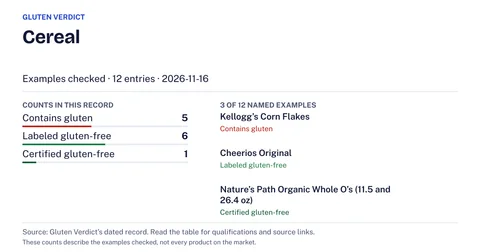 CerealDepends on the product5 of 12 products we checked contain glutenchecked Nov 16, 2026
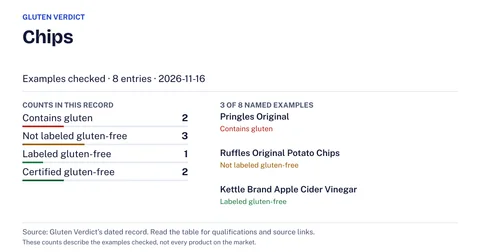 ChipsDepends on the product2 of 8 products we checked contain gluten: Pringles Original and Pringles Salt & Vinegarchecked Nov 16, 2026
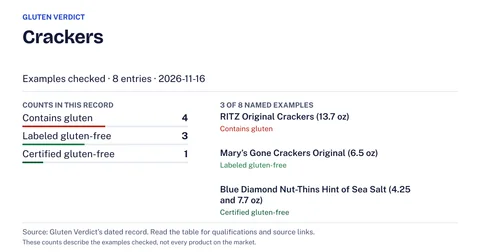 CrackersDepends on the product4 of 8 products we checked contain glutenchecked Nov 16, 2026
 PastaContains glutenchecked Nov 16, 2026
 BreadContains glutenchecked Nov 16, 2026
 Soy sauceDepends on the product3 of 7 products we checked contain gluten: Kikkoman Soy Sauce (Non-GMO), 20 oz; San-J Organic Shoyu Soy Sauce; and Lee Kum Kee Premium Soy Sauce (No Preservatives Added)checked Nov 16, 2026
Questions people ask
Can I eat the same few meals on repeat?
GIG suggests two simple breakfasts and dinners on a rotating schedule for a week or two when you are burned out6. NIDDK says a registered dietitian teaches how to avoid gluten while following a healthy diet18; whether a limited rotation suits you over time is a question for your care team.
If a product has the GFCO logo, can I stop reading the label?
GIG, which runs GFCO35, says it certifies products to 10 ppm or less and suggests leaning on the logo when you are burned out8. GFCO certifies products rather than brands or facilities30, and FDA does not endorse any certification program31. We would keep reading the box when the product, flavor or package is not the one you checked.
Does a “gluten-free” claim mean I can stop checking?
The claim has to meet FDA’s rule of less than 20 ppm10. The claim is optional, and foods without it still need their ingredient list read26, 11.
Is it common to feel isolated or overwhelmed by the diet?
In a synthesis of qualitative studies, participants felt isolated or overwhelmed by the burden of the disease38. These are accounts from the studies, not a measure of how common it is.
More in Explaining celiac and everyday social life
 Gluten-free in the hospital: meals, medicines and prep products to ask aboutHow to ask for a gluten-free tray, question the pharmacist about medicines and prep products, and bring a fallback before a planned stay or procedure.
 When your partner has celiac disease: gluten-free home or split kitchenChoose between a gluten-free home and a split kitchen, and find what to say at restaurants and to family, with NIH and charity sources.
 Gluten-free at work: catered lunches, client dinners, the office kitchen and business tripsWhat to ask a caterer, say to a server, label in the office fridge and carry on a business trip, from GIG, NIDDK, FDA and a chain's own allergen page.
 Gluten-free at church suppers, clubs and volunteer events: what to ask before the dayWhat to ask organizers, what to bring and how to handle the serving line at a church supper, club meal or volunteer shift, plus a note to hand over.
 Gluten-free meals in a nursing home or assisted living: the rules and what to askWhich meal rules cover a nursing home or assisted living, what to ask on a tour, how to get a gluten-free diet into the care plan, and where to complain.
 When a relative says a little gluten won’t hurt: what to say, and what to let goOne-line replies for the relative who scrapes off croutons or says one bite is fine, each with its source, plus what to push back on and what to let go.
Related guides
 Celiac awareness dates, events and groups for the people around someone with celiac diseaseWhich celiac awareness dates exist, one way to take part from a charity’s own page, and how to judge a support group or online community.
 Grieving foods after a celiac diagnosis: what people describe and where to get helpSadness or anger about food after a celiac diagnosis: what charities and research report, small steps the sources name, and when to call a provider or 988.
 Finding a dietitian who knows celiac disease: credentials, directories and questionsWhat RD and RDN mean, which celiac-related credentials and directories exist, and what to ask a dietitian at your first visit after a celiac diagnosis.
 A gluten-free grocery list by aisle for US supermarketsAn aisle-by-aisle gluten-free grocery list for US stores: what needs no label, what needs a check, and what stays off the list.
Sources
- [1, 2, 6, 8, 9, 12, 13, 14, 24, 37] Gluten Intolerance Group, Gluten-Free Burnout is Real: 4 Ways to Lighten the Load, checked Nov 17, 2026.
- [3, 4, 5] Coeliac UK, Hints and tips for eating out, checked Nov 17, 2026.
- [7, 34] Coeliac UK, Hints and tips for cooking at home, checked Nov 17, 2026.
Read on 2026-11-17: the list headed “Top Tips:” names wiping down surfaces with hot soapy water; cleaning pots and pans with soap and hot water; that washing up liquids are fine to use; that you do not need separate cloths or sponges; that you may want separate bread boards; using a separate toaster or toaster bags; using clean oil or a separate fryer for gluten free foods; and using different butter knives or dishes and jam spoons to keep breadcrumbs out of condiments.
- [10, 25, 26, 31] US Food and Drug Administration, Gluten and Food Labeling, checked Nov 17, 2026.
- [11, 28] US Food and Drug Administration, Questions and Answers on the Gluten-Free Food Labeling Final Rule, checked Nov 17, 2026.
- [15, 16, 22, 23, 38, 39] Quality of Life Research (via PubMed Central), The psychosocial experiences of adults diagnosed with coeliac disease: a qualitative evidence synthesis (Rose et al., 2024), checked Nov 17, 2026.
- [17, 36] Gluten Intolerance Group, How To Take Care of Yourself Mentally, checked Nov 17, 2026.
- [18, 27, 41, 42] National Institute of Diabetes and Digestive and Kidney Diseases (NIDDK), Treatment for Celiac Disease, checked Nov 17, 2026.
- [19, 20, 21, 40] Journal of Human Nutrition and Dietetics (via PubMed Central), A Meta-Synthesis Exploring Daily Experiences of Adults With Coeliac Disease in Adhering to a Gluten-Free Diet (Kowalczuk and Moor, 2025), checked Nov 17, 2026.
- [29] Coeliac New Zealand, Challenges, benefits and coping strategies, checked Nov 17, 2026.
- [30, 35] Gluten Intolerance Group, How Does GFCO Certify Gluten-Free Food?, checked Nov 17, 2026.
- [32, 33] Gluten Intolerance Group, Managing the Stress of Getting “Glutened”, checked Nov 17, 2026.