Gluten-free meals in a nursing home or assisted living: the rules and what to ask
Short answer
A nursing home that takes part in Medicare or Medicaid must serve food that accommodates resident allergies, intolerances and preferences, and an attending physician prescribes a therapeutic diet1, 2, 3. Assisted living is licensed and regulated by each state, and state rules on meals and therapeutic diets vary4, 5. The federal food rule for nursing homes does not name gluten or celiac disease, so ask how the kitchen will carry out the diet6.
Part of Explaining celiac and everyday social life, 15 guides

Key points
- A Medicare- or Medicaid-participating nursing home must offer food that accommodates allergies, intolerances and preferences2; therapeutic diets are prescribed by the attending physician3.
- Assisted living is regulated at the state level, and state rules on therapeutic diets vary4, 5. GIG cautions that assisted living is not required to follow or enforce a doctor’s diet prescription7.
- The federal food rule does not use the words gluten or celiac, so kitchen practices (for example shared toasters and fryers) have to be asked about and written down6.
- In a nursing home a complaint can go to the grievance official, the State Survey Agency or the long-term care ombudsman8, 9, 10; the ombudsman program also covers assisted living11.
Which rules cover the home you are looking at?
Start by finding out what kind of home it is. The federal food rules apply to nursing homes that take part in Medicare or Medicaid: 42 CFR part 483 sets what an institution must meet to qualify as a Skilled Nursing Facility in Medicare and as a nursing facility in Medicaid1. Medicare’s own guide says every nursing home listed on its Care Compare site is Medicare-certified and has passed certain inspections12.
| Nursing home | Assisted living | |
|---|---|---|
| Rule-maker | Federal rules for facilities that take part in Medicare or Medicaid1 | Licensed and regulated at the state level, according to HHS’s 2015 compendium4 |
| Special diets | Therapeutic diets must be prescribed by the attending physician3 | Varies: the compendium says state regulations vary on meals, snacks and therapeutic diets5, and that several states require providers to furnish therapeutic and modified diets, which it also calls special diets when ordered by a physician13 |
| Where a complaint can go | The facility’s grievance official, the State Survey Agency, the State Long-Term Care Ombudsman program8, 9, 10 | The ombudsman program also advocates for people in assisted living facilities11 |
GIG’s caution and the state rules can both be true. GIG says senior living facilities, including assisted living facilities, are not required to follow or enforce a doctor’s diet prescription7; the 2015 HHS compendium says several states require providers to furnish therapeutic and modified diets13. Read your state’s current rule instead of relying on either summary.
What the federal nursing home food rule says
Section 483.60 opens with a duty to give each resident a diet that meets “daily nutritional and special dietary needs, taking into consideration the preferences of each resident”14. The parts that matter for a gluten-free diet:
- The food each resident receives includes “Food that accommodates resident allergies, intolerances, and preferences”2.
- A resident who chooses not to eat the food first served, or who asks for a different meal, must be offered “Appealing options of similar nutritive value”15.
- Therapeutic diets must be prescribed by the attending physician, who may delegate that task to a registered or licensed dietitian to the extent State law allows3.
- The staffing rule includes a qualified dietitian or other clinically qualified nutrition professional, full-time, part-time or on a consultant basis16.
- A member of the Food and Nutrition Services staff must take part in the interdisciplinary team17.
What the rule leaves out matters as much. Read on 2026-11-17, the section does not use the words gluten, celiac, cross-contact, toaster or fryer6. It does not say how a kitchen must keep a gluten-free meal apart from other food6, so that detail has to come from your questions and from the care plan.
Getting the diet onto the order, the care plan and the tray
- Ask who writes the diet order. Therapeutic diets are prescribed by the attending physician, or by a dietitian the physician delegates to where State law allows3. The rule does not say whether a gluten-free diet counts as a therapeutic diet6, so ask the facility how it will record one.
- Ask to take part in the care plan. A resident has the right to take part in developing the person-centered plan of care, to request meetings and to request revisions18. The care-plan team includes the attending physician, a member of the food and nutrition services staff and, to the extent practicable, the resident and the resident’s representatives19.
- Name the kitchen practices in the plan. The rule sets no practices, so ask that the plan record the ones that matter to the resident, such as the toaster, fryer and serving questions GIG suggests asking20. This is our suggestion, not a requirement.
- Ask for the nutrition side too. GIG says to make sure facility staff know how to include foods that offset vitamins and minerals that may be missing when gluten-containing grains are avoided21.
- Ask how the plan will be reviewed. The comprehensive care plan must be reviewed and revised by the interdisciplinary team after each assessment22.
On cost, the rule says a facility may not charge for special foods and meals, including medically prescribed dietary supplements, ordered by the resident’s physician, physician assistant, nurse practitioner or clinical nurse specialist23. Ask the facility, before admission, whether it treats a gluten-free diet as one of those.
Questions to ask on the tour
Medicare’s nursing home guide gives a dining list for any visit, including how the home accommodates special dietary needs24. It also suggests naming your specific needs: “Will the nursing home provide care for my specific needs?”25 Say celiac disease by name. The questions below come from the Gluten Intolerance Group (GIG); they are suggestions, not rules.
| Ask | Why it is on the list |
|---|---|
| How do you prevent cross-contact at prep and serving, and how are shared fryers, grills and toasters handled for gluten-free orders? | GIG lists these as questions to ask20. It says shared equipment, buffet-style serving and thickened liquids can all introduce gluten without anyone meaning to26. |
| Who reviews ingredient labels when a product or supplier changes? | Also on GIG’s list20. |
| How does the diet get passed between shifts, and what is the backup when a gluten-free meal is not available? | GIG’s questions, because the person who took the breakfast order may not be the one plating dinner27. |
| How are buffets and self-serve handled? | GIG says buffets and salad bars are higher risk for cross-contact and suggests asking for an individual gluten-free plate28. |
| Are gluten-free foods stored apart and labeled? | GIG suggests asking whether gluten-containing foods are stored separately from gluten-free foods in refrigerators, freezers and cupboards29. |
| How are staff trained, and how is the training repeated? | GIG suggests asking how well-versed staff are at reading packaged food labels30, and says training works best as part of onboarding and refreshed regularly31. |
| Does the kitchen already handle other special diets well, and has it been through GFFS validation? | GIG calls a kitchen that handles diabetic or low-sodium diets with confidence a great sign, and suggests asking about its own Gluten-Free Food Service (GFFS) validation32, 33. |
| Can the menu show which dishes are gluten-free, and is there a photo and restriction list in the kitchen? | GIG’s GFFS program manager suggests color-coded or dedicated gluten-free menus and a photo of each resident in the kitchen with a list of dietary restrictions34. |
Where gluten can hide in a group kitchen
GIG’s list of items most worth a second glance at the label in a kitchen cooking for a crowd35:
- Soy sauce and marinades36; see our verdict on soy sauce.
- Gravies and sauces thickened with regular flour36; see gravy.
- Soups, broths and bouillon cubes36.
- Malt-based products, including malt vinegar and some cereals36; see malt vinegar.
- Seasoning blends, thickened liquids for residents with swallowing difficulties, and deli meats and processed proteins36.
For packaged food the kitchen buys, FDA’s rule says a food labeled “gluten-free” must contain less than 20 parts per million of gluten37; our guide to how to read food labels covers the rest of the label. For an everyday staple, see our verdict on bread.
Food from family, supplements and medicines
A nursing home must have a policy on the use and storage of foods that family and other visitors bring to residents38. Ask for the policy, and ask Medicare’s question too: “Is there a policy about bringing in outside food and drink?”39 The food-sources part of the same section says it does not preclude residents from consuming foods the facility did not procure40.
For assisted living, GIG says it is important to know the facility’s policy on residents’ requests for gluten-free menu items and how it monitors food that guests bring in41.
Supplements and medicines are a separate check. GIG says that if the facility uses dietary supplements to help residents meet nutritional needs, you should verify that they are gluten-free42. The NIDDK says medicines are rare sources of gluten43; questions about a particular medicine belong with the pharmacist and the physician.
Assisted living: find your state’s rules and read the contract
HHS’s Office of the Assistant Secretary for Planning and Evaluation (ASPE) says residential care settings are licensed and regulated at the state level, and all states have at least one category of residential care4. Its compendium of state rules is the 2015 edition4, so use it as a map of what to look for, then confirm in your state’s current licensing rule. It reports that state regulations vary on meals, snacks and therapeutic diets5, and that all but six states require providers to furnish three daily meals44.
GIG’s warnings fit that picture. It says there may be limited options for gluten-free food in an assisted living facility, and that not all staff know about the gluten-free diet45. It also says residents can typically choose what they will eat and whether to follow a gluten-free diet, and that the level of monitoring will vary by facility7.
What to get in writing before moving in
If meals keep going wrong
Escalate in steps. The first three are federal nursing home rights; the last applies to nursing homes and assisted living.
- Ask for a care plan review. The plan must be reviewed and revised by the interdisciplinary team after each assessment22, and a resident may request meetings and revisions18. Medicare’s guide suggests asking on the tour how concerns are reported and whether you will be told how they are resolved46.
- File a grievance with the facility. A nursing home resident has the right to voice grievances without discrimination or reprisal47. The facility must give a copy of its grievance policy on request48, and the policy covers filing orally or in writing and anonymously49. A Grievance Official oversees the process and tracks each grievance through to its conclusion8.
- Go outside the facility. The grievance policy must give contact information for independent entities, that is, the pertinent State agency, Quality Improvement Organization, State Survey Agency and State Long-Term Care Ombudsman program10. The facility must post a list of State agencies and advocacy groups, such as the Office of the State Long-Term Care Ombudsman program50, and a statement that a resident may file a complaint with the State Survey Agency about any suspected violation of state or federal nursing facility regulations9.
- Call the long-term care ombudsman. The program advocates for people living in nursing homes and residential care communities such as assisted living, and every state is required to have one11. Medicare’s guide points to the ombudsman in your state for free, personalized help51. The Administration for Community Living’s Eldercare Locator connects you to services for older adults and their families52.
This page covers rights and questions, not treatment. If a resident becomes ill after a meal, that is a matter for their physician.
Verdicts in this guide
 BreadContains glutenchecked Nov 16, 2026
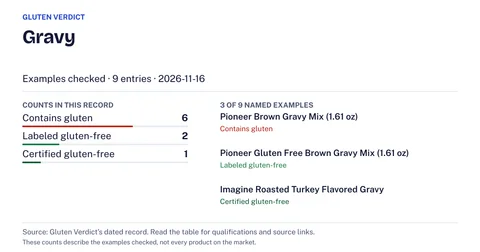 GravyDepends on the product6 of 9 products we checked contain glutenchecked Nov 16, 2026
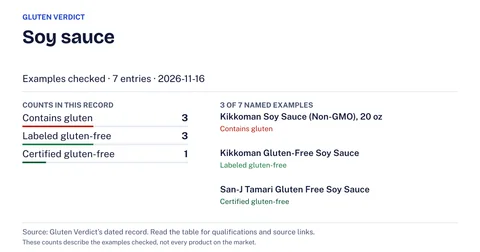 Soy sauceDepends on the product3 of 7 products we checked contain gluten: Kikkoman Soy Sauce (Non-GMO), 20 oz; San-J Organic Shoyu Soy Sauce; and Lee Kum Kee Premium Soy Sauce (No Preservatives Added)checked Nov 16, 2026
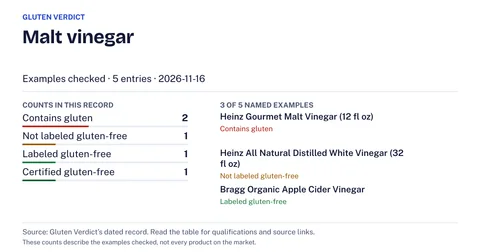 Malt vinegarContains glutenchecked Nov 16, 2026
Questions people ask
Does a nursing home have to serve gluten-free meals?
The federal rule requires food that accommodates resident allergies, intolerances and preferences2, and therapeutic diets prescribed by the attending physician3. The section does not use the word gluten6, so what that means for a kitchen is something to settle with the facility and the physician.
Does an assisted living facility have to follow a doctor’s gluten-free order?
It depends on the state. HHS’s 2015 compendium says state regulations vary on therapeutic diets5, and GIG says senior living facilities, including assisted living facilities, are not required to follow or enforce a doctor’s diet prescription7.
Can a nursing home charge extra for special meals?
The rule says a facility may not charge for special foods and meals, including medically prescribed dietary supplements, ordered by the resident’s physician, physician assistant, nurse practitioner or clinical nurse specialist23. Ask the facility whether a gluten-free diet is handled that way.
Who can help if the facility will not cooperate?
The long-term care ombudsman program advocates for residents of nursing homes and residential care communities11. Medicare’s guide points to the ombudsman in your state for free help51. In a nursing home you can also file a grievance with the facility or a complaint with the State Survey Agency47, 9.
More in Explaining celiac and everyday social life
 When your partner has celiac disease: gluten-free home or split kitchenChoose between a gluten-free home and a split kitchen, and find what to say at restaurants and to family, with NIH and charity sources.
 When gluten-free eating wears you down: fewer decisions, same rulesEase gluten-free burnout with routines: check each product once, set a standing plan for eating out, and know which rules stay fixed.
 How to tell a host or relative you have celiac diseaseWhat to send a host before the meal, the cross-contact rule in one sentence, questions to ask about a dish, bringing your own, and how to pass on a dish.
 How to explain celiac disease to friends and familyA three-sentence explanation of celiac disease, then sourced replies to the usual questions: allergy, fad, how strict, and what to cook.
 What to say to someone with celiac disease, and what to skipSentences to use, and ones to skip, when you cook for, eat out with or work beside someone with celiac disease, each tied to the fact behind it.
 Gluten-free at church suppers, clubs and volunteer events: what to ask before the dayWhat to ask organizers, what to bring and how to handle the serving line at a church supper, club meal or volunteer shift, plus a note to hand over.
Related guides
 Gluten-free in the hospital: meals, medicines and prep products to ask aboutHow to ask for a gluten-free tray, question the pharmacist about medicines and prep products, and bring a fallback before a planned stay or procedure.
 Medical ID for celiac disease: what to carry and what to tell paramedics or an ERWhere to keep celiac medical ID information (phone, bracelet, wallet card), what to list, and what to say to paramedics, with a fill-in card.
 Finding a dietitian who knows celiac disease: credentials, directories and questionsWhat RD and RDN mean, which celiac-related credentials and directories exist, and what to ask a dietitian at your first visit after a celiac diagnosis.
 How to read a US food label for glutenWhere gluten shows up on a US food label: the gluten-free claim, the Contains line, the ingredient list and may-contain lines, and what each means.
Sources
- [1] Electronic Code of Federal Regulations, 42 CFR 483.1 Basis and scope, checked Nov 17, 2026.
- [2, 3, 6, 14, 15, 16, 17, 38, 40] Electronic Code of Federal Regulations, 42 CFR 483.60 Food and nutrition services, checked Nov 17, 2026.
Read 42 CFR 483.60 on 2026-11-17 (eCFR text current to 2026-11-13): the section does not use the words gluten, celiac, cross-contact, toaster or fryer.
- [4] US Department of Health and Human Services, ASPE, Compendium of Residential Care and Assisted Living Regulations and Policy: 2015 Edition, checked Nov 17, 2026.
- [5, 13, 44] US Department of Health and Human Services, ASPE, Compendium of Residential Care and Assisted Living Regulations and Policy: 2015 Edition (PDF), checked Nov 17, 2026.
- [7, 21, 28, 29, 30, 34, 41, 42] Gluten Intolerance Group, Senior Care: Gluten-Free Living for Our Elders, checked Nov 17, 2026.
- [8, 9, 10, 18, 23, 47, 48, 49, 50] Electronic Code of Federal Regulations, 42 CFR 483.10 Resident rights, checked Nov 17, 2026.
- [11] National Ombudsman Resource Center, Home page: the Long-Term Care Ombudsman program, checked Nov 17, 2026.
- [12, 24, 25, 39, 46, 51] Medicare.gov, Your Guide to Choosing a Nursing Home, checked Nov 17, 2026.
- [19, 22] Electronic Code of Federal Regulations, 42 CFR 483.21 Comprehensive person-centered care planning, checked Nov 17, 2026.
- [20, 26, 27, 31, 32, 33, 35, 36] Gluten Intolerance Group, Gluten-Free and Golden: A Guide for Seniors and the People Who Love Them, checked Nov 17, 2026.
Read on 2026-11-17: the list headed “Hidden Gluten” (after “Keep an eye out for:”) names soy sauce and marinades; gravies and sauces thickened with regular flour; soups, broths, and bouillon cubes; malt-based products, including malt vinegar and some cereals; seasoning blends; thickened liquids for residents with swallowing difficulties; and deli meats and processed proteins.
- [37] US Food and Drug Administration, Gluten and Food Labeling, checked Nov 17, 2026.
- [43] National Institute of Diabetes and Digestive and Kidney Diseases, Treatment for Celiac Disease, checked Nov 17, 2026.
- [45] Gluten Intolerance Group, Living Gluten-Free for Older Adults, checked Nov 17, 2026.
- [52] US Administration for Community Living, Eldercare Locator, checked Nov 17, 2026.