Gluten-free at work: catered lunches, client dinners, the office kitchen and business trips
Short answer
Ask early, ask how each dish is prepared, and keep a backup of your own: the Gluten Intolerance Group (GIG) describes asking early and keeping a backup for catered meetings and shared office space1, 3, and NIDDK describes asking how food is prepared at restaurants2. FDA’s gluten-free definition was established for food manufacturers; for restaurants it says labeling should be consistent with that definition, so ask the kitchen what is behind a menu label4, 21.
Part of Explaining celiac and everyday social life, 15 guides
Key points
- GIG’s advice for a meeting you know will be catered is to request a gluten-free option early1.
- FDA’s gluten-free definition was established for food manufacturers; for restaurants FDA says gluten-free labeling should be consistent with it, and that state and local governments play an important role in oversight4, 21, 5.
- GIG calls toasters virtually impossible to thoroughly clean, which matters for a shared office or hotel toaster6.
- Chipotle’s own allergen page says individual foods may come into contact during preparation, which its chart does not reflect7.
- GIG suggests keeping well-packaged gluten-free options in the office fridge, cupboard or desk for the day nobody planned for you3.
Catered lunches: when to ask and what to ask
The earlier you ask, the more the caterer or office manager can do. GIG’s advice, when you know a meeting will be catered, is to request a gluten-free option early; its example is a prepared and packaged salad without dressing1.
Three questions cover most of what you need from a caterer. They are our selection and adaptation from question lists that GIG and NIDDK wrote for restaurants, not a rule from either one:
- Can I see an ingredient or allergen list for each dish? Asking to see a gluten-free menu or allergen list heads GIG’s list of questions for a restaurant8.
- How will my meal be prepared? NIDDK advises asking about food ingredients and how food is prepared, and asking to talk with the chef for more detail2. GIG’s list adds whether the grill is shared with gluten foods and how it is cleaned, and whether a meal can be cooked in a separate pan9, 10.
- Can my meal be wrapped and packaged separately? For an order shared with co-workers, GIG says to check that foods are individually wrapped and to ask that the gluten-free order be packaged apart from the others in a bag or box11.
If the spread is already out, GIG suggests getting to the table first, before any cross-contact has occurred between the items12. If you had no advance notice, GIG says that is a good time to have well-packaged gluten-free options in the office fridge, cupboard or desk3.
If the team lunch is pizza, note that in one crowd-sourced study of restaurant food labeled gluten-free (described under client dinners), gluten-free labeled pizza and pasta were the items most likely to test positive for gluten13. That is one reason to ask the three questions rather than rely on a label alone.
Team meals and client dinners
When you have a say in the venue, NIDDK’s advice is to search online for restaurants that offer a gluten-free menu14. GIG’s dining tips add calling the restaurant the day before or earlier the same day and speaking to the chef15, and timing the meal before or after the busiest mealtime so staff have more time to help16.
When someone else picks the place, NIDDK’s advice for social gatherings is to let the host know you have celiac disease and find out whether gluten-free foods will be available17. For a client dinner the host is whoever booked the table, so that is who to ask.
What to say at the table
GIG offers this opening line for a server: “Hi, I need your help with my menu selection. I am on a medically restricted diet and am unable to eat wheat, rye, barley, and foods made with these grains. I have some questions for you or the chef.”18
Then ask what NIDDK lists: the ingredients, how the food is prepared, and whether a gluten-free menu is available2. On fried foods, GIG’s advice is to avoid items cooked in oil that is used for both breaded and non-breaded foods19. When the plate arrives, GIG says to double-check with the server that it is the special meal you ordered and that your instructions were followed20.
What a gluten-free label on a menu does and does not mean
FDA says its gluten-free definition was established for food manufacturers that voluntarily label FDA-regulated foods4. For restaurants, FDA says gluten-free labeling should be consistent with the federal definition21, and that state and local governments play an important role in oversight5.
One study of crowd-sourced results found gluten in 32% of the foods that were labeled gluten-free: 5,624 tests by 804 users of a portable gluten detector22. The tests were those users opted to share23, and the authors note the device may detect gluten at levels below 20 parts per million, with exposure of unknown clinical significance24. It is one study of self-selected tests, so read it as a reason to ask the kitchen, not as a rate for any one restaurant.
The office kitchen: fridge, cupboard, dishes, toaster and snack machine
GIG’s workplace article goes through the shared spaces one by one. The table sets out what GIG says for each; the toaster row comes from GIG’s cross-contact page.
| Shared space | What GIG says |
|---|---|
| Fridge | Store gluten-free items on the top shelf, well-packaged or sealed, and clearly labeled25. |
| Cupboard | Ask whether you can dedicate one cupboard or specific upper shelves to gluten-free food or utensils26. |
| Dishes and utensils | Wash thoroughly with soap and water, or check with your office manager whether the company can supply extras of anything difficult to clean27. |
| Tables and counters | Wipe down surfaces where you prepare or lay out a meal, to keep residual crumbs from gluten-containing foods out of your food28. |
| Toaster | GIG calls toasters virtually impossible to thoroughly clean, in its advice for shared households and for travel, and suggests toaster bags as a barrier6. |
| Vending machine or snack box | Snacks are typically individually wrapped, which helps prevent cross-contact in the machine; the challenge is reading the label to verify a snack before you pay29. GIG suggests asking the vending company for ingredient information and requesting labeled or certified gluten-free snacks30. |
Crumbs are the common thread. GIG notes that even a crumb of gluten-containing bread can be enough to cause problems for people with celiac disease or gluten sensitivity31, and it lists washing hands with soap and water before preparing and eating food as a way to help prevent cross-contact32. NIDDK defines cross-contact as foods that contain gluten coming into contact with gluten-free foods33.
For office parties, GIG says to request a gluten-free option or offer to bring one if you know a party is planned, and to fall back on your personal stash if it is impromptu34.
A desk stash: what to keep and how to read the package
Start from the US label rule. FDA says foods that carry “gluten-free,” “no gluten,” “free of gluten” or “without gluten” on the label must contain less than 20 parts per million of gluten35. The claim itself is voluntary36, and a food with no claim can still be gluten-free, because the claim is not required to be on the package37. With no claim on the package, the ingredient list and the maker are what you have.
NIDDK’s advice is not to eat a food if you are not sure whether it contains gluten, and, if possible, to contact the company that makes it or visit its website38. Our guide to reading a food label for gluten covers the rest of the package.
GIG’s workplace article suggests keeping gluten-free bread in the office fridge for a sandwich of your own39, and gluten-free crackers in the break room or at your desk40.
Our verdicts for crackers, bread, chips and coffee show what the sources we read said, makers’ own pages among them, with the date. Recipes change, so the package in your hand has the final word.
Business travel: flights, hotels and meals on the road
GIG’s 2019 travel bulletin starts with research: look up restaurants that offer gluten-free options along the way and at your destination41. Its 2026 travel article suggests carrying small, compact, shelf-stable snacks with you at all times42.
For a hotel stay, the 2019 bulletin lists snack and simple-meal items to keep on hand and says some of them suit a hotel equipped with a microwave43. GIG also names toasters among the appliances that are hard to clean thoroughly in a shared household or when traveling6, which is worth remembering at a hotel breakfast bar.
On flights, the 2019 bulletin says most airlines require special meals to be pre-ordered 24 to 72 hours in advance44. Our guide to airline special meals links each airline’s own page, and flying gluten-free covers what to pack. For client dinners on the road, the steps under client dinners above apply.
Chain restaurants: Chipotle's allergen page and our Panera verdict
Chipotle’s Allergens & Special Diet page carries an allergen chart and adds that individual foods may come into contact with one another during preparation, which the chart does not reflect7. On gluten, the page says not to eat its flour tortillas if you avoid gluten, and that if you are highly sensitive you can ask staff to change gloves by telling them at the start of your order45. It also says items containing corn, including corn tortillas (chips and crispy corn tortillas) and corn salsa, may have trace amounts of gluten from potentially co-mingling with gluten-containing grains in the field46.
Our Chipotle and Panera verdicts record what each chain’s own pages said when we read them, with the date. Neither verdict rests on a catering page, so for a catered tray from either chain, ask its catering team what allergen information it can give.
How much to tell colleagues and your manager
GIG’s workplace article begins with your manager47 and with being clear about your need to avoid gluten48. It says that once a manager acknowledges changes can be made, you can find out how to help inform and educate co-workers49.
GIG’s summary of what minimizes cross-contact at the office is letting your manager and co-workers know your dietary restrictions, helping educate them about what constitutes gluten-free, setting up the right environment, and setting up alternatives in advance in case accommodations aren’t made50.
How much detail you give is your call. Our guides on telling a host or relative and eating out have wording you can adapt.
When an informal ask is not enough
The asks above are informal ones, of the kind GIG’s article describes. For a formal request, the US Equal Employment Opportunity Commission pulls together disability-related materials for employees and employers51. Whether celiac disease qualifies in your situation is a legal question this guide does not answer; our guides on workplace accommodations and the ADA cover the formal route.
Verdicts in this guide
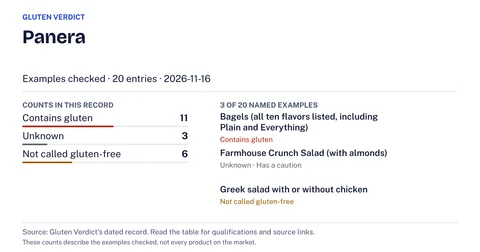 PaneraDepends on the order11 of 20 menu items we checked contain glutenPanera Bread · checked Nov 16, 2026
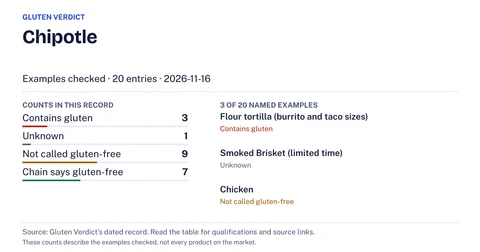 ChipotleDepends on the order3 of 20 menu items we checked contain gluten: Flour tortilla (burrito and taco sizes), Burrito, and QuesadillaChipotle Mexican Grill · checked Nov 16, 2026
 BreadContains glutenchecked Nov 16, 2026
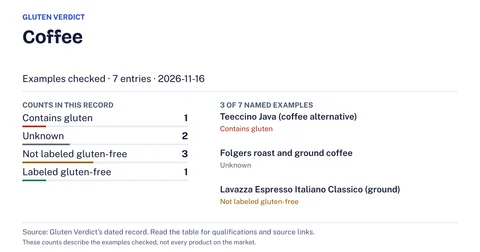 CoffeeDepends on the product1 of 7 products we checked contains gluten: Teeccino Java (coffee alternative)checked Nov 16, 2026
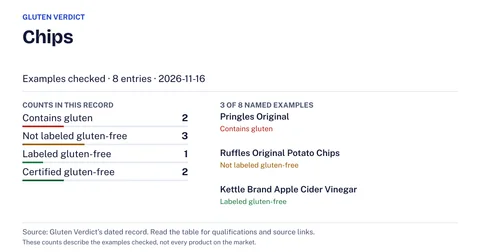 ChipsDepends on the product2 of 8 products we checked contain gluten: Pringles Original and Pringles Salt & Vinegarchecked Nov 16, 2026
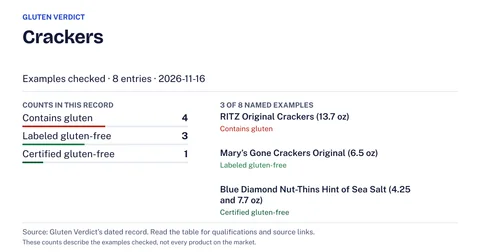 CrackersDepends on the product4 of 8 products we checked contain glutenchecked Nov 16, 2026
Questions people ask
What does FDA say about gluten-free labeling in restaurants?
FDA says its gluten-free definition was established for food manufacturers that voluntarily label FDA-regulated foods4. For restaurants, it says labeling should be consistent with the federal definition and that state and local governments play an important role in oversight21, 5.
Does Chipotle's allergen chart reflect cross-contact?
No. Chipotle’s page says individual foods may come into contact with one another during preparation, which is not reflected on its chart7.
Does a food have to say gluten-free to be gluten-free?
No. FDA says the claim is not required to be on a food package, so it may not appear even if the food is gluten-free37.
More in Explaining celiac and everyday social life
 What to say to someone with celiac disease, and what to skipSentences to use, and ones to skip, when you cook for, eat out with or work beside someone with celiac disease, each tied to the fact behind it.
 When gluten-free eating wears you down: fewer decisions, same rulesEase gluten-free burnout with routines: check each product once, set a standing plan for eating out, and know which rules stay fixed.
 Gluten-free at church suppers, clubs and volunteer events: what to ask before the dayWhat to ask organizers, what to bring and how to handle the serving line at a church supper, club meal or volunteer shift, plus a note to hand over.
 Gluten-free in the hospital: meals, medicines and prep products to ask aboutHow to ask for a gluten-free tray, question the pharmacist about medicines and prep products, and bring a fallback before a planned stay or procedure.
 Asking an employer for celiac-related accommodations: what the ADA, EEOC and JAN sayHow to ask an employer for a celiac-related accommodation: what the ADA, EEOC and JAN say, what a request contains, and the EEOC charge deadline.
 How to tell a host or relative you have celiac diseaseWhat to send a host before the meal, the cross-contact rule in one sentence, questions to ask about a dish, bringing your own, and how to pass on a dish.
Related guides
 Eating out with celiac disease: what to check, ask and watch forPlan a restaurant meal with celiac disease: what to check before you go, the questions to ask in order, how to read the answers, and what studies measured.
 A gluten-free grocery list by aisle for US supermarketsAn aisle-by-aisle gluten-free grocery list for US stores: what needs no label, what needs a check, and what stays off the list.
 Gluten-free on a budget: what costs extra and what does notSort a gluten-free shopping list into plain foods, foods that need a statement and packaged substitutes, then compare costs and check each claim.
 How to read a US food label for glutenWhere gluten shows up on a US food label: the gluten-free claim, the Contains line, the ingredient list and may-contain lines, and what each means.
Sources
- [1, 3, 11, 12, 25, 26, 27, 28, 29, 30, 34, 39, 40, 47, 48, 49, 50] Gluten Intolerance Group, The Gluten-Free Office and Workplace, checked Nov 17, 2026.
- [2, 14, 17, 33, 38] NIDDK (National Institutes of Health), Eating, Diet, & Nutrition for Celiac Disease, checked Nov 17, 2026.
- [4, 5, 21, 35, 36, 37] US Food and Drug Administration, Gluten and Food Labeling, checked Nov 17, 2026.
- [6] Gluten Intolerance Group, Cross-contact, checked Nov 17, 2026.
- [7, 45, 46] Chipotle Mexican Grill, Allergens & Special Diet, checked Nov 17, 2026.
- [8, 9, 10] Gluten Intolerance Group, What are some of the most important questions to ask the wait staff or management of a food service or restaurant?, checked Nov 17, 2026.
- [13, 22, 23, 24] PubMed Central (Am J Gastroenterol 2019), Detection of Gluten in Gluten-Free Labeled Restaurant Food: Analysis of Crowd-Sourced Data (Lerner and colleagues; PMID 30920417), checked Nov 17, 2026.
- [15, 16, 18, 19, 20] Gluten Intolerance Group, Restaurant Dining: Seven Tips for Staying Gluten-Free (educational bulletin), checked Nov 17, 2026.
- [31, 32] Gluten Intolerance Group, I am very strict about eating gluten-free at home and work, but I still feel like I am getting gluten in my system. What can I do?, checked Nov 17, 2026.
- [41, 43, 44] Gluten Intolerance Group, Traveling Gluten-Free (educational bulletin, 2019), checked Nov 17, 2026.
- [42] Gluten Intolerance Group, Traveling Gluten-Free with Confidence, checked Nov 17, 2026.
- [51] US Equal Employment Opportunity Commission, EEOC Disability-Related Resources, checked Nov 17, 2026.