Gluten-free in Japan: soy sauce, miso, barley tea and the allergen box
Short answer
Japan’s mandatory allergen label covers wheat but not barley or rye1, 2, and it does not apply to restaurant food, food sold loose or alcohol3, 4, 5. So check three routes yourself, then read the whole Japanese ingredient list:
- Soy sauce (shoyu): the Consumer Affairs Agency’s definition of one type starts from soybeans plus a roughly equal amount of 麦, a grain, and even tamari-type sauce may use a small amount6, 7. The Gluten Intolerance Group says shoyu contains wheat unless otherwise noted8.
- Miso: its koji can be grown on rice, barley, wheat or soybeans, so the ingredient list decides9, 10.
- Barley tea (mugicha): GIG says it is commonly served alongside water in restaurants and is a tea to avoid11, and a maker’s page can show no allergen at all12.
- Packaged food: read the whole list for 小麦, 大麦 and ライ麦, because wheat is a mandatory item but the handbook says barley and rye are not covered1, 2.
- Gluten-free limit
- The Consumer Affairs Agency’s allergen handbook says Western “gluten-free” labelling and Japan’s allergen labelling follow different standards16, and it states no gluten-free limit49. For rice-flour products, the ministry’s voluntary Non-Gluten guideline19 uses 1 ppm or less17
- Set by
- Food Labeling Standards (食品表示基準), under which labelling of nine allergen items including wheat is mandatory1
Part of Travel: Asia and the Middle East, 12 guides

Key points
- Wheat is one of nine items Japan’s Food Labeling Standards make mandatory; the handbook’s entry for wheat says barley and rye are not covered1, 2.
- A plain “may contain” statement is not allowed in Japan; makers who cannot rule out contamination are encouraged to name what their factory also produces13, 14. A missing line is therefore not information by itself.
- Wheat-allergen labelling is required at several ppm of wheat total protein, in the agency’s 2016 leaflet15, and the agency says this standard differs from Western gluten-free labelling16.
- “Non-Gluten” (1 ppm or less) is a ministry term for rice flour and products made mainly from it, under a voluntary guideline17, 18, 19.
- Soy sauce is made by fermentation20, and the authors of one portable-sensor study point to testing limits for fermented gluten21.
Why rice is not the whole story
The Gluten Intolerance Group (GIG) describes the staples of Japanese cuisine as white rice, soybeans, fish and seafood22. It then lists ingredients in Japanese cooking and food products that “need to be avoided” by someone eating gluten-free23:
- Soy sauce (shoyu), which GIG says contains wheat unless otherwise noted8. Route one below.
- Miso made with barley, which GIG says must be avoided24. Route two below.
- Barley tea (mugicha), a tea to avoid on GIG’s list11. Route three below.
- Udon, somen and ramen noodles, which GIG says are made with wheat flour25, and soba, which GIG says can be a mixture of buckwheat and wheat26. Our verdicts: udon, ramen and soba noodles.
- Tempura and karaage, which GIG says are not traditionally gluten-free27. Our verdict: tempura.
This guide names no restaurants and rates no cities, and it writes no Japanese sentences of its own. Every Japanese word in it comes from an agency or maker page that we opened on the date shown beside each source.
Route one: soy sauce (shoyu) and tamari
Japan defines soy sauce by type, and the definitions say which grain goes into the koji. In the Consumer Affairs Agency’s (CAA) 2025 slides on the soy sauce labelling rules, the first type listed, こいくちしょうゆ, starts from soybeans plus a roughly equal amount of 麦6. Tamari, たまりしょうゆ, starts from soybeans alone or soybeans with a small amount of 麦7.
麦 is a grain word. In the raw-material list of the Japanese Agricultural Standard for soy sauce (the 2015 text, the version we could open), the list of permitted raw materials includes 小麦, 大麦 and 裸麦28, which we read as wheat, barley and hull-less barley. So the grain in a soy sauce can be wheat or barley.
That is why a bottle sold as tamari still needs its own ingredient-list read: the definition allows a small amount of 麦7, and GIG’s label-reading list says tamari is “often but not always GF”29. Our verdicts compare US bottles: soy sauce and teriyaki sauce. For the sauce served with sushi, see our sushi verdict.
The standard also defines soy sauce made by adding 発酵分解調味液, a seasoning liquid it describes as wheat gluten that has been fermented and broken down30. We found no source that says how that appears on a retail label, so the ingredient list is the place to look.
Route two: miso and the grain in its koji
Hikari Miso, a miso maker, says the issue is that koji can be grown on rice, barley, wheat or soybeans9. Soybeans and rice are naturally gluten-free, but some miso pastes are made with barley or wheat koji, which contain gluten31. Its advice is that a simple check of the ingredient label will tell you whether the miso includes those grains10. GIG’s advice for miso made with barley is that it must be avoided24.
Hikari’s own Barley Miso page shows what a barley miso looks like on paper: the ingredient list reads “Water, Organic Barley, Organic Soybeans, Salt, Yeast, Koji Culture.”32 and the page adds a “Contains: Soybeans, Barley” line33. That line is Hikari’s own statement. In Japan, the handbook’s entry for wheat says barley is not covered2, so a barley miso can name barley in the ingredient list and have nothing about it in the allergen box. Read the grain inside the list, not only the box. Our verdict: miso.
Miso soup served in a restaurant falls outside the allergen labelling4, so the question to ask is which miso the kitchen uses.
Route three: barley tea and other barley drinks
GIG says barley tea, mugicha, is very popular in summer as an iced tea and is commonly served alongside water in restaurants, and that for someone eating gluten-free it is a tea to avoid11. GIG’s alternative is green tea, ocha34. Plain green tea is not automatic either, because what a maker adds decides it; see our green tea verdict.
A maker’s page shows how little a pack may say. Ito En’s Japanese page for a lemon barley tea in tea bags lists 大麦 first among its ingredients, and its アレルギー物質 (allergen) field shows なし, meaning none12. That fits the handbook’s statement that barley is not covered2: the tea is barley, and the allergen field is empty.
Drinks with alcohol are not covered by the allergen rules. The handbook lists alcoholic drinks, including alcohol used in making foods, among the things the allergen labelling does not cover5, so do not expect a grain entry in an allergen box on a bottle. For how labels work for beer and other drinks, see our gluten-free alcohol guide.
Reading the allergen box on a Japanese pack
The allergen rules cover processed foods and additives that contain an allergen and are in a container or package35. The handbook lists what falls outside them: food sold without a container or package, such as loose or by weight3; food served where it is eaten on the premises or delivered, such as restaurant food4; and alcoholic drinks5.
What the box lists
- Nine items are mandatory, in the handbook’s order: えび, カシューナッツ, かに, くるみ, 小麦, そば, 卵, 乳 and 落花生1. The agency’s English sheet names eight of them: shrimp, crab, walnut, wheat, buckwheat, egg, dairy products and peanut36. Barley and rye are on neither of the sheet’s lists36, and the handbook’s entry for wheat says they are not covered2.
- The allergen can be declared in brackets after the ingredient, for example 醤油(大豆・小麦を含む)37, or, as an exception, together in one bracket at the end of the ingredient list as (一部に…を含む)38.
- The same allergen may be left off a second ingredient: the handbook’s dressing example declares 小麦 on the yeast extract and leaves it off the soy sauce39. So the wheat in a soy sauce may be declared elsewhere in the list; read the whole box.
- A trace of an allergen can trigger the label: the handbook describes labelling as needed when an item’s total protein content in an ingredient is at a set level, given as several micrograms per gram or more40. The agency’s leaflet puts the same idea as several ppm of wheat total protein15.
What a missing line does not tell you
Japan does not allow a simple “may contain” statement13. The handbook encourages makers who cannot rule out contamination to add a factory notice naming what the factory also produces14. A pack with no such notice is therefore not evidence either way.
The label has to be in Japanese: the handbook says an allergen label in a foreign language does not meet the law without a Japanese one41. On an imported pack, read the Japanese text. For the same job on US labels, see the wheat, barley and rye names on ingredient lists.
Where barley can sit in an ingredient list
Malt is one place barley can sit. The handbook notes, in a model label for a chocolate confection, that malt extract is mostly barley malt, and only rarely wheat malt42. Since barley is outside the mandatory list2, a barley malt extract can appear in an ingredient list with no entry in the box. Our verdict: malt extract.
Since barley is not covered2, the ingredient list is where it would be named in sauces, soups and drinks. Look for 大麦 there, and for 麦 in names of seasonings you are not sure of, because the soy sauce definitions use that grain word6.
What “gluten-free” and “Non-Gluten” mean in Japan
The CAA says that Western “gluten-free” labelling and Japan’s allergy labelling follow different standards16, 43. Its leaflet sets them side by side: for EU and US labelling, “gluten-free” is allowed with gluten at 20 ppm or less44; in Japan, wheat allergy labelling is required at several ppm of wheat total protein15. The leaflet also says that stressing “gluten-free” on a food that contains a wheat allergen may raise problems under the misleading-representation law, 景品表示法45.
A claim on a pack is not the same as the contents. The handbook’s incident reports include a bread sold as made only of rice flour that turned out to contain wheat gluten46; the maker had not recognised gluten as a wheat ingredient47.
Japan has its own term, “Non-Gluten” (ノングルテン). The Ministry of Agriculture, Forestry and Fisheries (MAFF) set it up in contrast to the Western 20 ppm “gluten-free”48. A product using it states that its gluten is 1 ppm or less17. It applies to rice flour and to processed products that use that flour as the main ingredient and contain no other rice flour, no gluten and no wheat of the kind labelling requires18, under a guideline meant to encourage makers’ voluntary action19.
| Statement | Where it comes from | What the sources say |
|---|---|---|
| 小麦を含む (in the allergen box) | Food Labeling Standards, CAA | Wheat is one of nine mandatory items1; barley and rye are not covered2. |
| グルテンフリー | Western countries’ labelling term16 | The handbook mentions it once, to say Western gluten-free labelling and Japan’s allergen labelling differ16, and states no gluten-free limit49. |
| ノングルテン (Non-Gluten) | MAFF guideline, voluntary19 | 1 ppm or less, for rice flour and products made mainly from it17, 18. |
Words to point at on a label or a menu
No agency document we read supplies a Japanese sentence a diner could hand over to say they have celiac disease, and we do not write one ourselves. What the sources do supply are the grain words as the agencies print them. Use the table to read an ingredient list or to point at a word; for a full sentence, take a card from a celiac society or ask a Japanese speaker.
| Japanese | English | Where it comes from |
|---|---|---|
| 小麦 | wheat | The CAA English sheet lists wheat as a mandatory item36; the handbook’s Japanese list names 小麦1. |
| 大麦 | barley | The handbook’s entry for wheat says 大麦 and ライ麦 are not covered2. MAFF’s page gives the Codex definition of gluten in Japanese, naming 小麦、ライ麦、大麦、オーツ麦50. |
| ライ麦 | rye | Same sources as 大麦2, 50. |
| そば | buckwheat | A mandatory item; the English sheet gives buckwheat36. GIG says soba can be a mixture of buckwheat and wheat26. |
| 麦茶 | barley tea | Part of the product name on Ito En’s page for a tea whose ingredient is 大麦12; GIG calls the drink mugicha11. |
The English for 大麦 and ライ麦 is our match, not a translation any source prints: the Japanese lists name the grains in the order wheat, rye, barley50, which is the order of FDA’s English list51. Check it with a Japanese speaker before you rely on it.
Shared grills, fryers and boards are not covered by the labelling, because restaurant food falls outside it4. That question has to be asked, and we have found no agency or society source for how to word it in Japanese, so this guide gives none.
What a pocket sensor can and cannot tell you
A 2021 study in Frontiers in Nutrition tested a portable gluten sensor developed by Nima Labs52 on 119 samples ranging from 2 to 101,888 mg/kg of gluten53, with ELISA, a laboratory method, as the reference54. The sensor’s detection rate for samples at 20 mg/kg or more was 90%55. Samples between 2 and 20 mg/kg could test either positive or negative56, and the authors point to testing limitations for partially hydrolyzed, fractionated or fermented gluten21.
Soy sauce is made by fermentation20. A 2017 paper on a laboratory method for fermented-hydrolyzed foods tested 15 soy sauces among its samples57 and says the method’s insight into the extent of proteolysis is essential for accurate gluten quantification in such foods58. The 2021 authors name fermented gluten as a testing limitation21, so read a sensor result on a soy sauce with that limit in mind.
Verdicts in this guide
 Soy sauceDepends on the product3 of 7 products we checked contain gluten: Kikkoman Soy Sauce (Non-GMO), 20 oz; San-J Organic Shoyu Soy Sauce; and Lee Kum Kee Premium Soy Sauce (No Preservatives Added)checked Nov 16, 2026
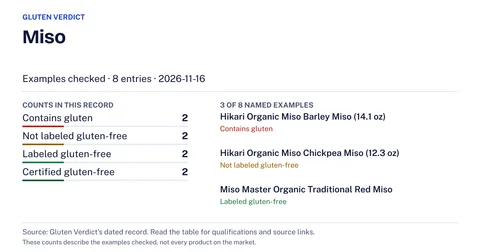 MisoDepends on the product2 of 8 products we checked contain gluten: Hikari Organic Miso Barley Miso (14.1 oz) and Hikari Miso Soup Akadashi (12 servings, 7.0 oz)checked Nov 16, 2026
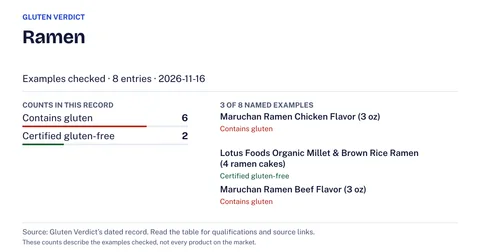 RamenContains glutenchecked Nov 16, 2026
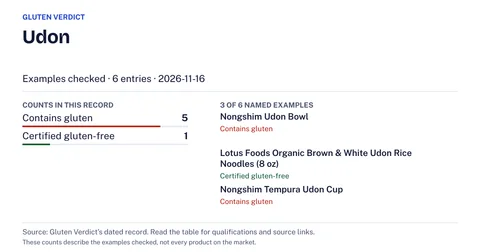 UdonContains glutenchecked Nov 16, 2026
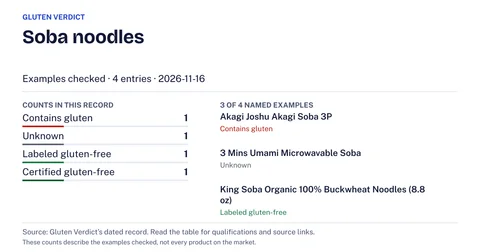 Soba noodlesDepends on the product1 of 4 products we checked contains gluten: Akagi Joshu Akagi Soba 3Pchecked Nov 16, 2026
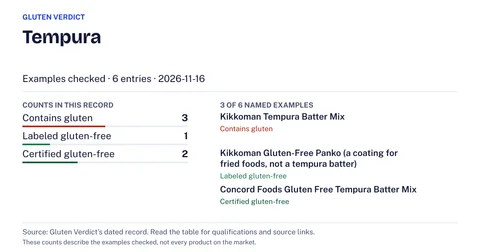 TempuraDepends on the product3 of 6 products we checked contain gluten: Kikkoman Tempura Batter Mix, Kikkoman Tempura Dipping Sauce, and Nongshim Tempura Udon Cupchecked Nov 16, 2026
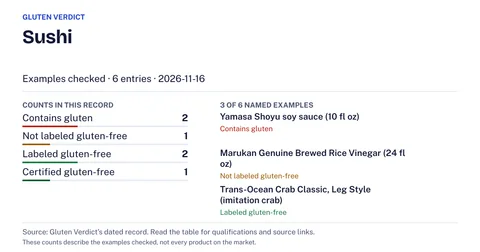 SushiDepends on the product2 of 6 products we checked contain gluten: Yamasa Shoyu soy sauce (10 fl oz) and Lee Kum Kee Less Sodium Soy Saucechecked Nov 16, 2026
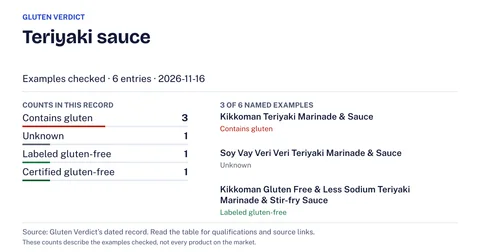 Teriyaki sauceDepends on the product3 of 6 products we checked contain gluten: Kikkoman Teriyaki Marinade & Sauce, Kikkoman Teriyaki Marinade & Stir-fry Sauce – Roasted Garlic, and Kikkoman Teriyaki BBQ Sauce – Originalchecked Nov 16, 2026
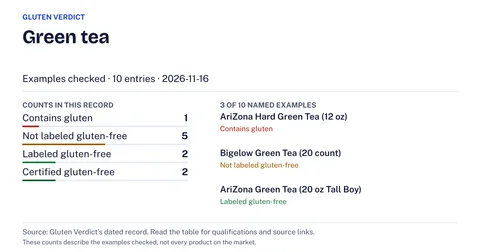 Green teaDepends on the product1 of 10 products we checked contains gluten: AriZona Hard Green Tea (12 oz)checked Nov 16, 2026
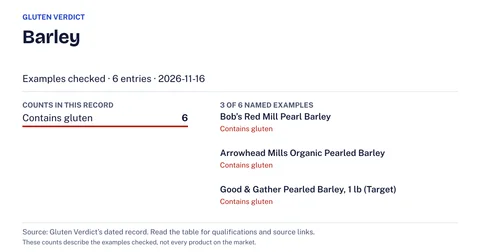 BarleyContains glutenchecked Nov 16, 2026
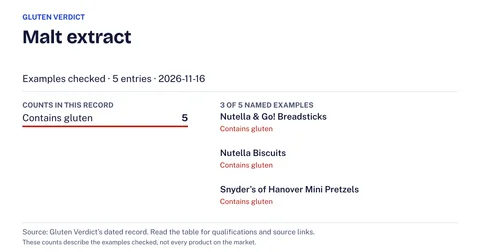 Malt extractContains glutenchecked Nov 16, 2026
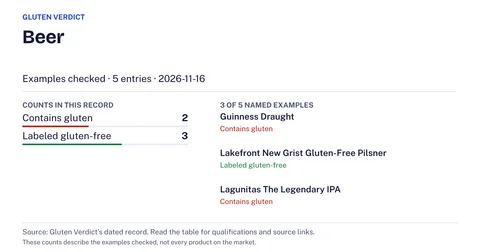 BeerDepends on the product2 of 5 products we checked contain gluten: Guinness Draught and Lagunitas The Legendary IPAchecked Nov 16, 2026
Questions people ask
Is Japanese soy sauce gluten-free?
Not by default. The type definitions start from soybeans plus a roughly equal amount of 麦, and even the tamari definition allows a small amount of it6, 7. GIG says shoyu contains wheat unless otherwise noted8.
Does a Japanese allergen box list barley or rye?
Not as an item. The nine mandatory items include wheat but not barley or rye1, and the handbook’s entry for wheat says 大麦 and ライ麦 are not covered2.
Is “Non-Gluten” the same as “gluten-free”?
No. It is a Japanese term, set up in contrast to the Western 20 ppm “gluten-free”48, that means 1 ppm or less17, and it applies to rice flour and products made mainly from it18.
Does a pack without a “may contain” line mean no cross-contact?
No. A plain “may contain” statement is not allowed in Japan13, and makers are encouraged to use a factory notice instead14.
Does the allergen law cover restaurant food?
No. The handbook lists food served where it is eaten, such as restaurant food and delivery, among the things outside the allergen labelling4.
More in Travel: Asia and the Middle East
 What “gluten-free” means on a pack in Asia, country by countryWhat a gluten-free claim requires in six Asian countries, what Japan, Hong Kong, Taiwan and China print instead, and how to read a pack in hand.
 Gluten-free in South Korea: where wheat and barley turn up at a Korean tableWhere wheat and barley turn up in Korean food: marinades, ganjang, doenjang, gochujang, noodles, barley tea, and what a Korean label says.
 Gluten-free in Vietnam, the Philippines, Malaysia, Indonesia and Taiwan: sauces, noodles and label rulesWhere wheat enters a Southeast and East Asian meal, what four regulators print about gluten cereals, and the one country whose rule we could not read.
 Gluten-free in Singapore: hawker noodles, soya sauce and the new label ruleWhich Singapore hawker noodles are rice and which wheat, where soya and oyster sauce come in, and what the Food Agency's gluten-free label means.
 Gluten-free in Hong Kong: dim sum wrappers, noodles, sauces and the packet labelSort Hong Kong dim sum, noodle-shop and sauce choices by wrapper, noodle and ingredient, and read what a Hong Kong packet must name.
 Gluten-free in China: wheat staples, sauces, hot pot and the label rulesWhere wheat sits in Chinese staples, sauces and hot-pot bases, what China’s label standard requires, and the Chinese words it prints for wheat and gluten.
Related guides
 Ordering sushi and Japanese food when you avoid glutenWhich sushi, ramen and hibachi items carry wheat, what to ask about soy sauce, imitation crab, tempura and shared fryers, and a first-visit order.
 Miso, gochujang and other fermented pastes: where barley and wheat are usedHow to pick a miso or gochujang jar: read the koji grain, the full ingredient list and the maker’s gluten-free statement.
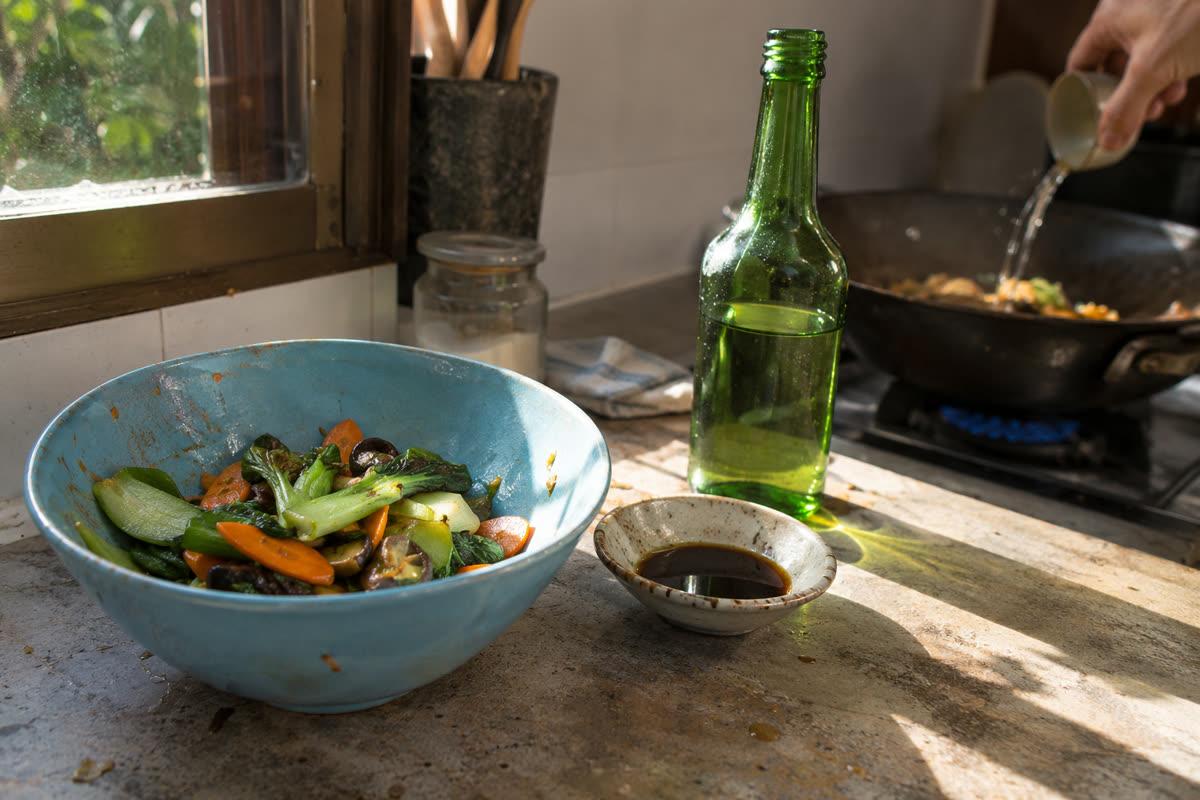 What to use instead of soy sauce when you eat gluten-freeTamari, gluten-free soy sauce, coconut aminos and liquid aminos: what each maker says, how to confirm it on the bottle, and what changes when you cook.
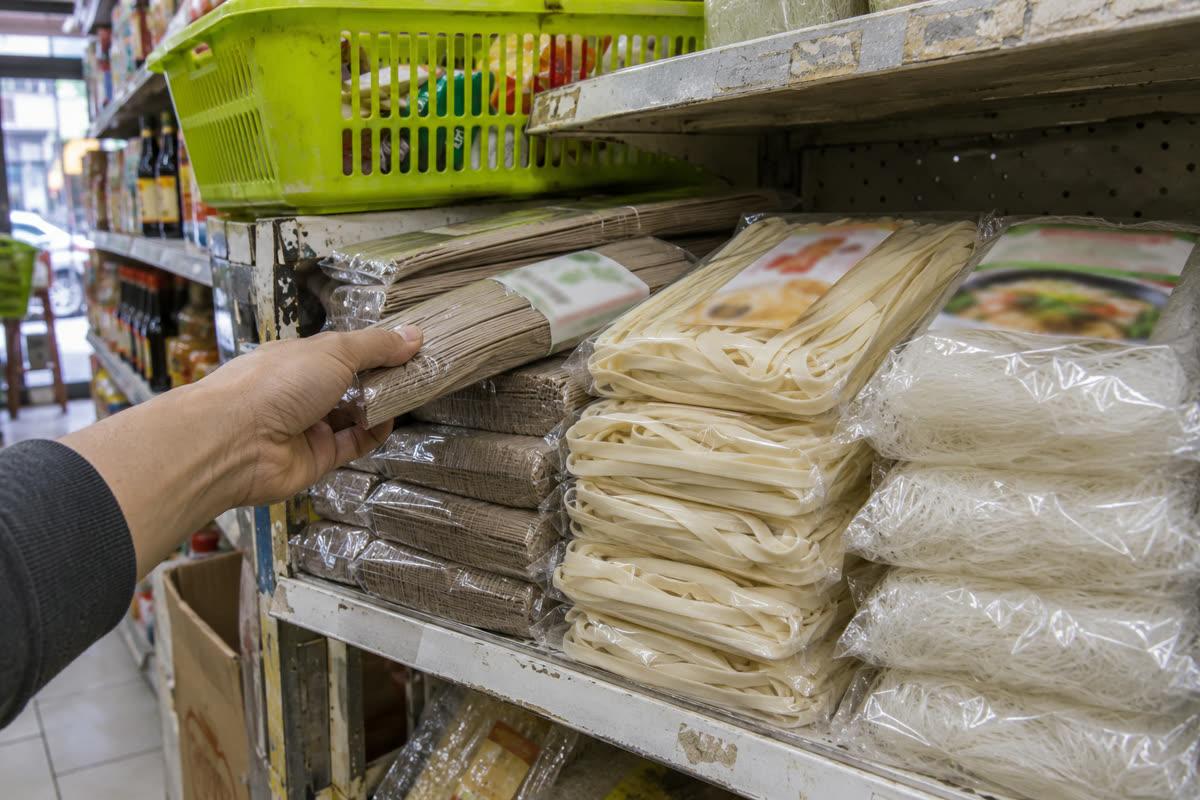 Soba vs udon vs rice noodles: which noodle holds wheatUdon is wheat, soba can be a buckwheat and wheat mix, and rice noodles are rice. How to read a package and ask about the broth and dipping sauce.
Sources
- [1, 2, 3, 4, 5, 13, 14, 16, 35, 37, 38, 39, 40, 41, 42, 46, 47, 49, 59] Japan Consumer Affairs Agency (消費者庁), Food allergy labelling handbook for processed foods (加工食品の食物アレルギー表示ハンドブック), April 2026, checked Nov 17, 2026.
Read on 2026-11-17: the handbook’s only mention of グルテンフリー is the note quoted for the standards difference (in its section on responses by makers); the text states no gluten-free limit.
Read on 2026-11-17: the table “Food allergy labelling items in other countries” (諸外国での食物アレルギー表示対象品目) has a row for wheat and cereals. Japan’s column names 小麦 only. Its footnote 2 lists the grains behind the cereal entry for Codex (小麦、ライ麦、大麦、えん麦 and crossbred strains) and for the EU and Switzerland (小麦、ライ麦、大麦、えん麦 or their crossbred strains).
- [6, 7] Japan Consumer Affairs Agency (消費者庁), Soy sauce: review of the item-by-item labelling rules (しょうゆに関する個別品目ごとの表示ルール), March 2025, checked Nov 17, 2026.
- [8, 11, 22, 23, 24, 25, 26, 27, 34] Gluten Intolerance Group, Japanese Cuisine When You’re Eating Gluten-Free, checked Nov 17, 2026.
- [9, 10, 31] Hikari Miso, Is Miso Gluten-Free? (updated May 25, 2026), checked Nov 17, 2026.
- [12] Ito En (伊藤園), 檸檬麦茶 ティーバッグ 20袋 (lemon barley tea bags, product page), checked Nov 17, 2026.
Read on 2026-11-17: Ito En’s Japanese product page for 檸檬麦茶 ティーバッグ 20袋 lists 大麦(日本、アメリカ、カナダ)、乾燥レモンピール、レモンマートル under 原材料 and shows なし in its アレルギー物質 field.
- [15, 43, 44, 45] Japan Consumer Affairs Agency (消費者庁), Leaflet: EU and US “gluten-free” labelling differs from Japan’s allergy labelling (created May 2016), checked Nov 17, 2026.
- [17, 18, 19, 48, 50] Japan Ministry of Agriculture, Forestry and Fisheries (農林水産省), Third-party certification of Non-Gluten rice flour and process-control JAS (米粉のノングルテンの第三者認証と製造工程管理JAS), checked Nov 17, 2026.
- [20, 28, 30] Japan Ministry of Agriculture, Forestry and Fisheries (農林水産省), Japanese Agricultural Standard for soy sauce (しょうゆの日本農林規格), text as amended 3 December 2015, checked Nov 17, 2026.
- [21, 52, 53, 54, 55, 56] Frontiers in Nutrition (PubMed 34355010), A Portable Gluten Sensor for Celiac Disease Patients May Not Always Be Reliable Depending on the Food and the User (2021), checked Nov 17, 2026.
- [29] Gluten Intolerance Group, Advanced Label-Reading Tips, checked Nov 17, 2026.
- [32, 33] Hikari Miso, Organic Miso, Barley Miso, 14.1 oz, checked Nov 17, 2026.
- [36] Japan Consumer Affairs Agency (消費者庁), Allergen labelling: specified ingredients and items recommended for labelling (English sheet), checked Nov 17, 2026.
Read on 2026-11-17: the row “Specified ingredients” (labelling is mandatory) names shrimp, crab, walnut, wheat, buckwheat, egg, dairy products and peanut. The sheet names eight items; the April 2026 handbook names nine. Barley and rye are on neither list.
- [51] US Food and Drug Administration, Questions and Answers on the Gluten-Free Food Labeling Final Rule, checked Nov 17, 2026.
- [57, 58] Analytical and Bioanalytical Chemistry (PubMed 29116352), A multiplex competitive ELISA for the detection and characterization of gluten in fermented-hydrolyzed foods (2017), checked Nov 17, 2026.