Maltodextrin, dextrin and glucose syrup made from wheat: what the label rules say
Short answer
In the US, maltodextrin, dextrin and glucose syrup are mostly made from corn1, 2, 3. The National Celiac Association says a wheat source has to be declared on foods FDA regulates4, though FDA exempts a derived ingredient that contains no protein from the allergen14. Work through these checks in order:
- Look beside the ingredient and in the Contains line for “wheat”: on an FDA-regulated food a wheat source has to be declared in one of those two places5, 4.
- Know what the charities say: Gluten Intolerance Group and the National Celiac Association both treat maltodextrin as gluten-free even when it is made from wheat6, 7; the National Celiac Association says the same of glucose syrup8.
- Treat dextrin separately: the National Celiac Association says it depends on the starting material, and wheat dextrin should be avoided unless the product is labeled gluten free2, 9.
- If wheat is named and the product also says “gluten-free”, FDA requires an asterisked statement that the wheat has been processed10.
- For dextrin in USDA-regulated foods and medications, the National Celiac Association says the allergen law does not cover them and to check with the maker about its starting material12; FDA says its gluten-free rule does not apply to USDA-labeled foods11.
Part of Hidden gluten in ingredients, sauces and processed foods, 21 guides
Key points
- US allergen law names wheat31 and reaches an ingredient that contains protein derived from a named food, with listed exceptions13; FDA says an ingredient derived from an allergen is outside the labeling requirement when it contains no protein derived from that allergen14.
- For glucose syrup, Gluten Intolerance Group points to purification15 and the National Celiac Association to refining and an enzymatic process16; FDA’s gluten-free Q&A says hydrolysis is not considered a process to remove gluten17, and neither FDA page we read names these three ingredients18, 19.
- Dextrin is the one the National Celiac Association does not clear by name: it depends on the starting material, unlike its position on maltodextrin2, 20.
- The EU lists wheat based glucose syrups and wheat based maltodextrins as exceptions in Annex II’s gluten-cereal entry, so read a pack by its own country’s rule21.
What these names mean and what they are made from
The charities describe these ingredients as made from starch, and the starch can come from more than one plant22, 23. Maltodextrin sounds like barley malt, but the National Celiac Association says it does not contain barley24. The word that does matter is “malt” on its own: Gluten Intolerance Group says “malt” in an ingredients list means the product is not gluten-free25, and FDA says malt extract and malt syrup come from barley that has not been processed to remove gluten26. See malt on food labels and our malt extract verdict.
| Name on the label | What it is, and what it can be made from | Usual US source |
|---|---|---|
| Maltodextrin | A partially hydrolyzed starch used as a thickener1. It can be made from corn, potato, rice or wheat, says Gluten Intolerance Group22. | Almost always corn1 |
| Dextrin | A carbohydrate hydrolyzed from starches; it may or may not be gluten free depending on the starting material2. | Most dextrin is derived from corn in the United States2 |
| Glucose syrup and dextrose | A starch hydrolysate27. Gluten Intolerance Group lists corn, potatoes, barley, cassava and wheat as common sources23. Dextrose is another word for glucose28. | Cornstarch is the most common source in the US; wheat starch is more commonly used in Europe3 |
| Maltose | A type of sugar22. Gluten Intolerance Group says it can be derived from barley malt29. | Barley malt is one source Gluten Intolerance Group names29 |
Wheat starch is a different ingredient and is not covered by the charity positions below: Gluten Intolerance Group says whether it is gluten-free depends on how extensively it is processed30. See our wheat starch verdict.
What US label law requires when the source is wheat
US allergen law names wheat among the major food allergens; no other gluten grain is on its list31. Its definition also reaches an ingredient that contains protein derived from one of those foods, with listed exceptions13.
FDA says the food source of a major allergen must be declared either in the ingredient list or in a “Contains” statement printed right after or next to it5. The National Celiac Association applies that to these ingredients: wheat-made maltodextrin has to be declared in parentheses after the ingredient or in a Contains statement on FDA-regulated foods4, and wheat-derived dextrin has to be disclosed and labeled under the same law on FDA-regulated foods32.
FDA also says an ingredient derived from a major allergen is not subject to the allergen labeling requirements when it does not contain a protein derived from that allergen14.
FDA’s allergen guidance does not name maltodextrin, dextrin or glucose syrup18, so for a particular product the maker’s own answer is what confirms the source.
What FDA’s gluten-free rule says
Under 21 CFR 101.91, a food labeled gluten-free cannot contain an ingredient derived from a gluten grain and processed to remove gluten (the rule’s example is wheat starch) if using it brings the food to 20 parts per million of gluten or more33.
When a label names wheat and also says gluten-free, the word “wheat” has to be followed by an asterisk that points to the statement “The wheat has been processed to allow this food to meet the Food and Drug Administration (FDA) requirements for gluten-free foods.” Without it the food is deemed misbranded10.
Where FDA’s wording and the charities’ wording differ
FDA defines a hydrolyzed food as one whose chemical components are broken into smaller compounds by reaction with water34. It says hydrolysis is not considered a process to remove gluten, and gives hydrolyzed soy protein and hydrolyzed wheat protein as examples17. For hydrolyzed or fermented products made from gluten grains, FDA says a gluten-free claim is not permitted unless the grains were processed to remove gluten and the ingredient resulted in less than 20 ppm of gluten in the food before hydrolysis or fermentation35. When no scientifically valid test method is available because the food is hydrolyzed, the maker of a food that carries the claim must keep records demonstrating adequate assurance36.
The charities describe maltodextrin, dextrin and glucose syrup as products of hydrolysis37, 2, 27, and for glucose syrup explain the lack of gluten by purification or refining and an enzymatic process15, 16. FDA’s pages we read do not say whether these starch ingredients count as hydrolyzed foods under its rule18, 19. We report the two positions side by side and do not settle between them.
What the charities say about the gluten left after processing
| Ingredient | Gluten Intolerance Group | National Celiac Association |
|---|---|---|
| Maltodextrin | The finished product has “no gluten proteins, even when derived from gluten-containing grains”37; “so highly processed that it is gluten-free”6. | Considered gluten free regardless of the starting material; “highly unlikely” to bring an otherwise gluten-free food to 20 ppm or more7. |
| Glucose syrup and dextrose | A highly purified sugar fraction processed to remove all proteins15; no protein remains in glucose from wheat38. | Lists glucose syrup among ingredients considered gluten free even when derived from wheat8; says the enzymatic process leaves it under 20 parts per million of gluten16. |
| Dextrin | Its article on deli meats lists wheat-derived dextrin among additives that could contain gluten39. | May or may not be gluten free; wheat dextrin should be avoided unless the product is labeled gluten free2, 9. Not to be confused with maltodextrin20. |
Neither charity page gives a gluten test result for maltodextrin made from wheat40, 41. Gluten Intolerance Group says it can vouch only for GFCO-certified products as thoroughly tested and at 10 ppm or less42. For maltose, it says maltose from barley malt can be considered gluten-free because the malt has been processed to remove gluten and the resulting maltose meets gluten-free standards29; the US allergen list names wheat and not barley31, so a barley-malt source would not be required to appear in a Contains line.
One clinical study
A 2008 randomized, double-blind, placebo-controlled study followed 90 people with celiac disease in remission who consumed glucose syrups, maltodextrins or placebo for 24 weeks43. The authors reported that daily ingestion of wheat-based starch hydrolysates, glucose syrups and maltodextrins had no deleterious effect on small-bowel mucosal villous architecture or inflammation compared with placebo44. It is a single study, and its abstract names glucose syrups, dextrose and maltodextrins, not dextrin43.
The National Celiac Association adds that many food allergy specialists and organizations recommend avoiding glucose syrup made from wheat for a wheat allergy, which is different from celiac disease45.
How to read the label, step by step
- Find the ingredient: maltodextrin, dextrin, glucose syrup, dextrose or maltose.
- Look beside it and in the Contains line for “wheat”. On an FDA-regulated food a wheat source has to be declared in one of those two places5, 4.
- Read the rest of the list. A Contains line that names no wheat says nothing about barley or rye31, FDA says malt extract and malt syrup come from barley26, and Gluten Intolerance Group says malt usually comes from barley25. How real products read is in our maltodextrin, dextrin, glucose syrup and high fructose corn syrup verdicts.
- Check for a gluten-free claim. If wheat is named and the claim is there too, the asterisk statement has to be there as well10.
- Check who regulates the label. Meats, poultry and medicines sit outside the points above; the section “Where the allergen rule may not reach” below has what FDA and the charities say.
- If the source is still unclear, ask the maker (next section). Our gluten scanner shows which words in an ingredient list you scan or paste name wheat, barley, rye, malt or oats.
Where the allergen rule may not reach
FDA says its gluten-free rule does not apply to foods whose labeling USDA regulates, which generally means meats, poultry and certain egg products11. For foods under USDA and for medications, the National Celiac Association says to check with the manufacturer where a dextrin’s starting material is from12.
Gluten Intolerance Group makes the same point about sliced deli meats: they may contain wheat-derived dextrin or modified food starch as thickeners, and some of those additives come from gluten grains39. Because deli meats are regulated by USDA and not FDA, it says to contact the manufacturer with questions46. See our modified food starch verdict.
What to ask the maker
Our guide to what to ask a manufacturer covers the whole call. For these ingredients, ask:
- What plant is the maltodextrin, dextrin or glucose syrup in this product made from: corn, potato, rice, wheat or barley?
- Is it the same source in every batch and at every plant that makes this product?
- Is the product labeled gluten-free, and is it under FDA or USDA labeling rules?
- If it is a medicine or supplement, is the source named on the label or only on a request?
Ask for the answer in writing and note the date, and read the package again at each purchase.
Other countries: the EU lists these as exceptions
This guide is about US labels. The EU rule works differently. Regulation (EU) No 1169/2011 requires the name of a substance listed in its Annex II to be emphasised in the ingredient list through a typeset such as the font, style or background colour47. In Annex II’s entry for cereals containing gluten, the exceptions include wheat based glucose syrups including dextrose, wheat based maltodextrins and glucose syrups based on barley21.
The regulation’s footnote on the exceptions for wheat based glucose syrups and maltodextrins reads: “And the products thereof, in so far as the process that they have undergone is not likely to increase the level of allergenicity assessed by the Authority for the relevant product from which they originated.”48 So the entry lists wheat based glucose syrups and maltodextrins as exceptions, subject to that footnote’s condition. The National Celiac Association notes that wheat starch is more commonly used for glucose syrup in Europe3. Our guide on which gluten grains an allergen line must name, by country compares countries; we have not read the UK, Canadian or other national rules for this page.
Verdicts in this guide
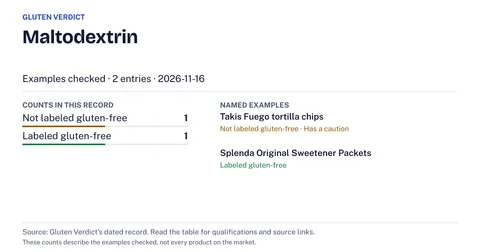 MaltodextrinNaturally gluten-freechecked Nov 16, 2026
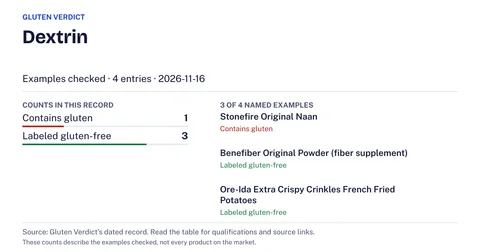 DextrinDepends on the product1 of 4 products we checked contains gluten: Stonefire Original Naanchecked Nov 16, 2026
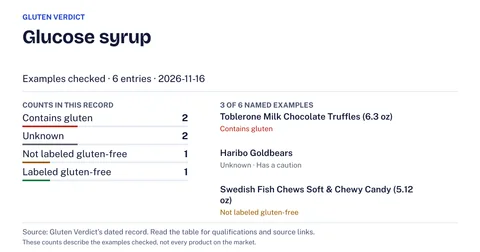 Glucose syrupNaturally gluten-free2 of 6 products we checked contain gluten: Toblerone Milk Chocolate Truffles (6.3 oz) and Darrell Lea Original Black Licorice (7 oz)checked Nov 16, 2026
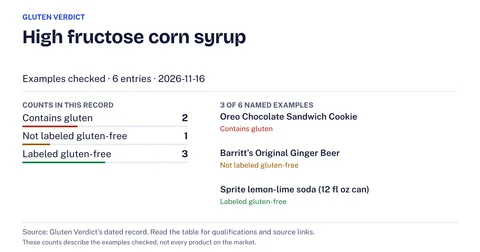 High fructose corn syrupNaturally gluten-free2 of 6 products we checked contain gluten: Oreo Chocolate Sandwich Cookie and Ritz Original Crackerschecked Nov 16, 2026
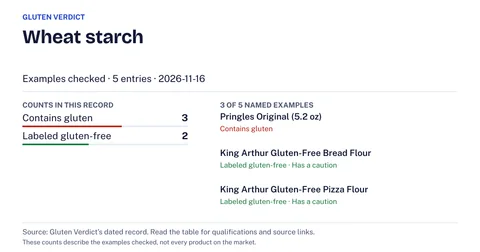 Wheat starchDepends on the product3 of 5 products we checked contain gluten: Pringles Original (5.2 oz), Jiffy Corn Muffin Mix, and Chex Mix Bold Garlic and Herbchecked Nov 16, 2026
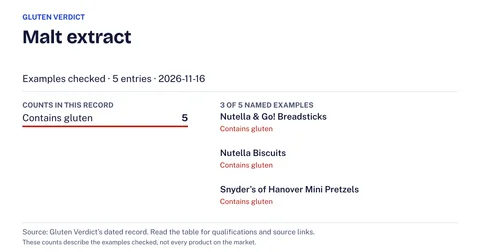 Malt extractContains glutenchecked Nov 16, 2026
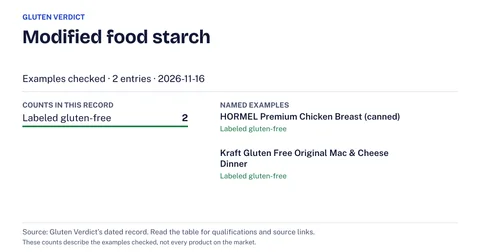 Modified food starchDepends on the productchecked Nov 16, 2026
Questions people ask
Is maltodextrin made from barley malt?
The National Celiac Association says it can sound like it would be made from barley malt, but it does not contain barley24. It says maltodextrin can be made from wheat but is almost always derived from corn in the United States1.
If maltodextrin is made from wheat, will a US label say so?
On foods FDA regulates, the National Celiac Association says it has to be declared, in parentheses after the ingredient or in a Contains statement4. For USDA-regulated foods and medications it says to check with the manufacturer12.
Is dextrin the same as maltodextrin?
No. The National Celiac Association says dextrin is not to be confused with maltodextrin, and treats dextrin as depending on its starting material20, 2.
Is dextrose the same as glucose?
The National Celiac Association says dextrose is simply another word for glucose28.
Does a gluten-free label cover wheat-made maltodextrin?
On an FDA-regulated food, a gluten-free claim means the rule’s ingredient and 20 ppm conditions apply33, and if wheat is named the asterisk statement has to appear10.
Does wheat-made glucose syrup matter for a wheat allergy?
The National Celiac Association says many food allergy specialists and organizations recommend avoiding glucose syrup made from wheat for a wheat allergy, which is different from celiac disease45.
More in Hidden gluten in ingredients, sauces and processed foods
 Wheat, barley and rye on an ingredient list: the names to look forLook up wheat, barley and rye names on a US ingredient list, from durum to malt, and sort each as contains gluten, depends on the maker, or lookalike.
 Malt on a food label: which forms are barley and what to checkWhat malt extract, syrup, flavoring and vinegar on a US label mean for gluten, why the Contains line misses barley, and what to check first.
 Where wheat, barley and rye hide in processed food: 15 places to checkFifteen processed foods where wheat, barley or rye turn up, the label step that catches each, and what US allergen law does and does not flag.
 Gravy, jarred pasta sauce and cheese sauce: where flour and starch thicken the potHow to read a gravy packet, gravy jar, cheese sauce or pasta sauce for wheat flour, wheat gluten and starch, with maker pages read on 2026-11-17.
 Hydrolyzed protein, yeast extract and wheat starch on a US food labelWhich grain is behind hydrolyzed protein, yeast extract and wheat starch, what a US label must name, and what to ask the maker.
 Gluten-free snack bars: reading oats and barley malt on the wrapperRead a snack-bar wrapper in four steps (gluten-free claim, malt, oats, Contains line), with a Clif and a KIND bar worked through.
All 21 guides in Hidden gluten in ingredients, sauces and processed foods
Related guides
 Natural flavors, caramel color and modified food starch: which can carry glutenWhich additives on a US label can come from a gluten grain, which sources describe as gluten free, and what the maker has to disclose.
 How to read a US food label for glutenWhere gluten shows up on a US food label: the gluten-free claim, the Contains line, the ingredient list and may-contain lines, and what each means.
 A gluten-free label that lists wheat or wheat starch: what it meansHow a US pack can say gluten-free and still list wheat starch or “wheat”, the statement FDA requires, and what to ask the maker.
 Reading the label of a flavored syrup, sauce or cookie topping for glutenHow to read coffee and bar syrup, sauce and cookie-topping labels for gluten, and what Torani, Monin and DaVinci Gourmet say on their own pages.
Sources
- [1, 4, 24, 40] National Celiac Association, Maltodextrin (reviewed September 22, 2025), checked Nov 17, 2026.
Read on 2026-11-17: the page gives no gluten test result and no parts-per-million figure for maltodextrin made from wheat.
- [2, 9, 12, 20, 32] National Celiac Association, Is dextrin gluten free? (reviewed March 25, 2026), checked Nov 17, 2026.
- [3, 8, 16, 45] National Celiac Association, Glucose syrup from wheat in a gluten-free product (revised September 2, 2026), checked Nov 17, 2026.
Read on 2026-11-17: the list headed “The following are considered gluten free even when derived from wheat:” names citric acid, distilled alcohols, distilled vinegar and glucose syrup.
- [5, 14, 18] US Food and Drug Administration, Questions and Answers Regarding Food Allergens, Including the Food Allergen Labeling Requirements (Edition 5), checked Nov 17, 2026.
Read on 2026-11-17: the text of the guidance names none of maltodextrin, dextrin, glucose syrup or dextrose.
- [6] Gluten Intolerance Group, Are maltose and maltodextrin gluten-free? (GIG FAQ, October 14, 2019), checked Nov 17, 2026.
- [7, 27, 28] National Celiac Association, Ingredients People Question (reviewed August 2022), checked Nov 17, 2026.
- [10, 33, 36] Electronic Code of Federal Regulations, 21 CFR 101.91 Gluten-free labeling of food, checked Nov 17, 2026.
- [11, 17, 19, 26, 34, 35] US Food and Drug Administration, Questions and Answers on the Gluten-Free Food Labeling Final Rule, checked Nov 17, 2026.
Read on 2026-11-17: the page names malt extract and malt syrup, and has no sentence on maltodextrin, dextrin, glucose syrup or dextrose.
- [13, 31] US Food and Drug Administration, Food Allergen Labeling and Consumer Protection Act of 2004 (FALCPA), checked Nov 17, 2026.
- [15, 22, 23, 25, 29, 30, 37, 41, 42] Gluten Intolerance Group, Are Maltose, Maltodextrin, Glucose Syrup, Yeast Extracts, and Wheat Starch Gluten-Free? (2021), checked Nov 17, 2026.
Read on 2026-11-17: the section on maltose and maltodextrin gives no gluten test result and no parts-per-million figure for maltodextrin made from wheat.
- [21, 47, 48] European Union (EUR-Lex), Regulation (EU) No 1169/2011 on food information to consumers (consolidated text of 1 April 2025), checked Nov 17, 2026.
Read on 2026-11-17: in Annex II, point 1 (“Cereals containing gluten … and products thereof, except:”) the exceptions listed are wheat based glucose syrups including dextrose; wheat based maltodextrins; glucose syrups based on barley; and cereals used for making alcoholic distillates including ethyl alcohol of agricultural origin.
- [38] Gluten Intolerance Group, Glucose from wheat or corn (GIG FAQ, October 14, 2019), checked Nov 17, 2026.
- [39, 46] Gluten Intolerance Group, 43 Foods Where Gluten May Be Hidden (updated August 2021), checked Nov 17, 2026.
- [43, 44] PubMed (Alimentary Pharmacology & Therapeutics, 2008), Clinical trial: gluten microchallenge with wheat-based starch hydrolysates in coeliac disease patients, checked Nov 17, 2026.