Malt on a food label: which forms are barley and what to check
Short answer
“Malt” on a US label usually comes from barley, a gluten grain1, and FDA says malt extract, malt syrup and similar malt-derived ingredients cannot be used in a food with a gluten-free claim2. The major allergen list behind a Contains line names wheat, not barley, so read the whole ingredient list3, 4. Maltose and maltodextrin are separate ingredients30, and Gluten Intolerance Group says both are gluten-free5.
Part of Hidden gluten in ingredients, sauces and processed foods, 21 guides
Key points
- FDA says “malt extract” and “malt syrup” are interchangeable terms, that “barley malt” and “barley malt extract” are used too6, and that malt extract and malt syrup are derived from barley that has not been processed to remove gluten7.
- FDA says malt vinegar cannot be used in a food that bears a gluten-free claim8.
- Barley is not on the major allergen list, so a Contains line can leave malt unflagged: WK Kellogg Co says its malt cereals “do not list wheat as an allergen”3, 4.
- Gluten Intolerance Group says that on a product that is not certified or labeled gluten-free, the plain word “vinegar” could refer to malt vinegar9.
What malt is, and why it points to barley
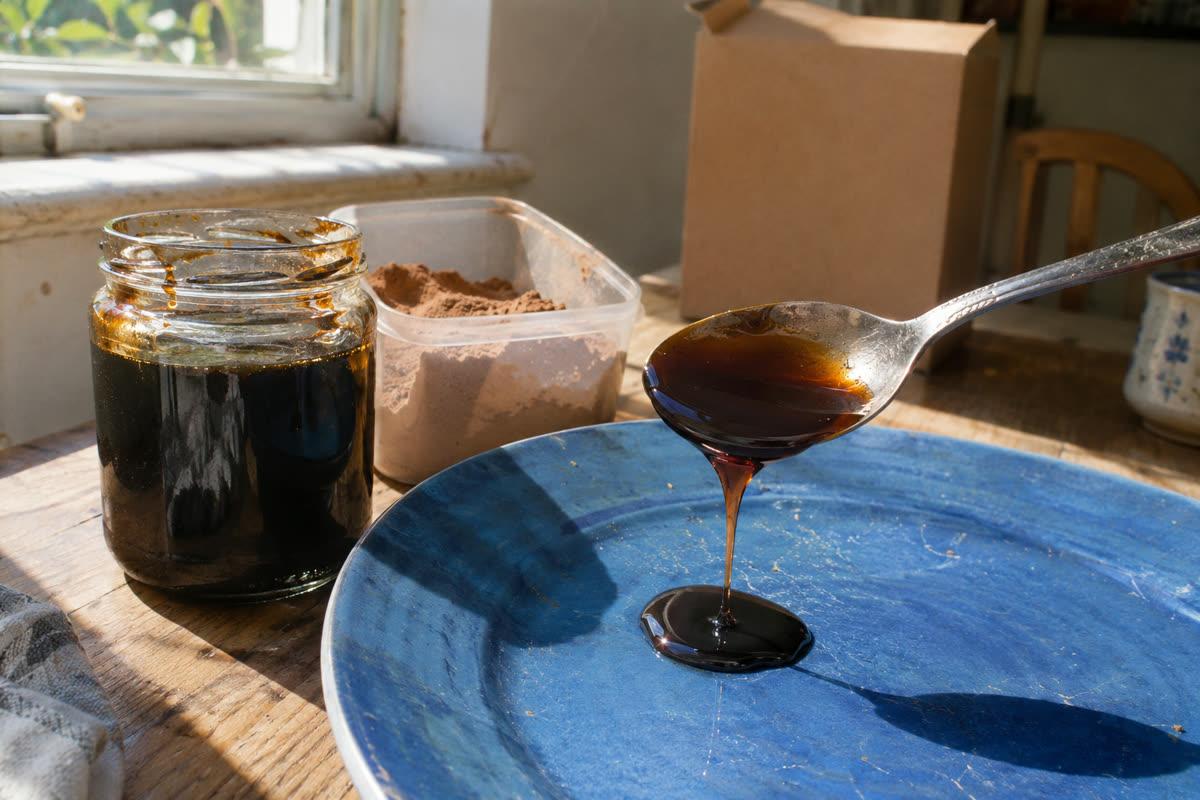
FDA’s gluten-free labeling Q&A says malt syrup and malt extract are interchangeable terms for a concentrate made from a water extract of germinated barley, and that “barley malt” and “barley malt extract” are used too6. FDA’s compliance policy says the unqualified terms “malt extract” and “malt syrup” should be applied only to products prepared from barley; if another malted grain is used, the product may carry a specific name, such as “extract of malted barley and corn”10.
Barley is a gluten grain11. The NIDDK lists it with wheat and rye, and says barley may be found in malt, malt extract, malt vinegar and brewer’s yeast11. Gluten Intolerance Group puts it in one line: malt usually comes from barley1. For the other gluten grains and their label names, see wheat, barley and rye names on ingredient lists.
Which malt wordings count as barley?
| Wording on the label | What the sources say | In a food with a gluten-free claim? |
|---|---|---|
| Malt extract, malt syrup, barley malt, barley malt extract | FDA: malt extract and malt syrup are interchangeable terms, “barley malt” and “barley malt extract” are used too6, and malt extract and malt syrup are derived from barley that has not been processed to remove gluten7 | FDA: cannot be used2, 31 |
| Malt flavor, malt flavoring | WK Kellogg Co says the malt in its Corn Flakes and Rice Krispies comes from barley and may contain gluten4. Gluten Intolerance Group: “Malt” in an ingredients list means the product is not gluten-free1 | FDA’s answer names malt extract “and other similar malt-derived ingredients”; the page does not mention malt flavor2 |
| Malt vinegar | FDA: derived from barley, fermented, and not processed to remove gluten8 | FDA: cannot be used8 |
| Malt beverages, beer | The NIDDK says drinks such as beer, lagers, ale, flavored liquors and malt beverages may also contain gluten12. FDA says beer is derived from malted cereal grains, most commonly malted barley or wheat13 | See our beer verdict and the alcohol guide |
Our verdict for the extract itself is at malt extract, and the grain behind it is at barley.
What a gluten-free claim does to the answer
FDA says a food labeled “gluten-free” cannot be intentionally made with an ingredient derived from wheat, rye, barley or their hybrids that was not processed to remove gluten14. Malt extract and malt syrup are ingredients of that kind7, and FDA says malt extract and similar malt-derived ingredients cannot be used in foods that bear the claim2.
On a food with no gluten-free claim, malt extract and malt syrup are still ingredients derived from barley7. A package that carries the claim and also lists malt extract or malt syrup does not fit FDA’s answer2, so compare the claim with the list and ask the maker.
Why the Contains line does not show malt
FALCPA’s list of major food allergens names wheat; barley and rye are not in it3. WK Kellogg Co shows what that means on a shelf: it says its Corn Flakes, Rice Krispies, Cocoa Krispies, Crispix and Frosted Flakes “do not list wheat as an allergen” but are not labeled gluten free because they contain malt4.
| Product | Malt wording in the ingredient list | Allergen statement on the same page |
|---|---|---|
| Chocolate Chip CLIF BAR | “BARLEY MALT EXTRACT”, inside the soy rice crisps15 | “CONTAINS SOY. MAY CONTAIN PEANUTS, TREE NUTS, MILK, SESAME, AND WHEAT.”16 |
| Kellogg’s Rice Krispies | “malt flavor”17 | “Does not contain Declaration Obligatory Allergens”18 |
| Kellogg’s Corn Flakes | “malt flavor”19 | “Does not contain Declaration Obligatory Allergens”20 |
| Tillamook Malted Moo Shake ice cream | “Malted Barley Extract”21 | “Contains: Egg, Milk, Soy.”22 |
In each case the malt shows up only in the ingredient list. Other cereals are on our cereal verdict. Our gluten scanner looks for gluten ingredient names in a photo of a label or in pasted text.
Malt vinegar, and the plain word “vinegar”
Gluten Intolerance Group says most vinegars are gluten-free, and that most varieties are distilled and made from inherently gluten-free ingredients such as grapes. The one it says needs to be avoided is malt vinegar, which is not distilled and is made from malt derived from barley23. The National Celiac Association also says malt vinegar is not gluten free, and adds that it is not distilled and contains gluten24, 25.
The wording that causes doubt is plain “vinegar”. On products that are not certified or labeled gluten-free, Gluten Intolerance Group says the general term could refer to malt vinegar, and that the product should be avoided unless the manufacturer can confirm it is not9. The National Celiac Association says flavored vinegars may contain malt or wheat26. Our verdicts: malt vinegar and vinegar.
Maltose and maltodextrin: look-alike words
Two ingredient names start with “malt” but are separate ingredients: Gluten Intolerance Group describes maltose as a type of sugar and maltodextrin as a thickener, flavor enhancer or filler30. It says both are gluten-free5, describing them as highly purified substances intentionally processed to remove all proteins, such as gluten27. For maltose made from barley malt, it says the sugar can be considered gluten-free because the malt has been processed to remove gluten and the maltose meets gluten-free standards28.
That is the charity’s position on purified sugars, and it does not extend to malt itself: on the same page it says “Malt” in an ingredients list means the product is not gluten-free1. Our verdict for maltodextrin shows the sources.
What to do with a label that lists malt
- Search the whole ingredient list for “malt”, “malted” and “barley”, including inside a longer name: on the Chocolate Chip CLIF BAR the barley malt extract sits inside the soy rice crisps15.
- Look for a gluten-free claim. FDA says malt extract and similar malt-derived ingredients cannot be used in a food that bears one2, so a claim together with malt extract or a similar malt-derived ingredient is a conflict to raise with the maker.
- With no claim, read malt extract, malt syrup, barley malt and malt vinegar as barley-derived6, 7, 8, and treat plain “malt” as barley-derived unless the maker says otherwise1.
- Do not stop at the Contains line: barley is not on the allergen list3.
- For a plain “vinegar” on a product with no claim, Gluten Intolerance Group’s advice is to avoid it unless the maker confirms it is not malt vinegar9.
The NIDDK’s own advice is to carefully read food labels to check for grains that contain gluten, such as wheat, barley and rye, and for ingredients or additives made from those grains29. Recipes change, so the package in your hand has the final word.
Verdicts in this guide
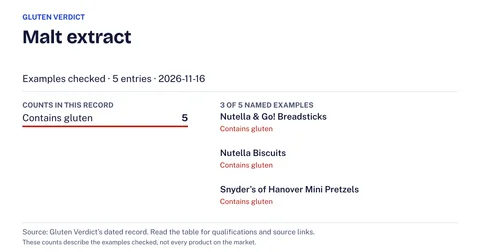 Malt extractContains glutenchecked Nov 16, 2026
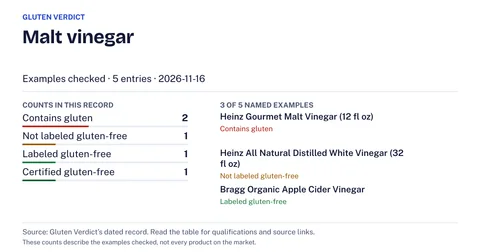 Malt vinegarContains glutenchecked Nov 16, 2026
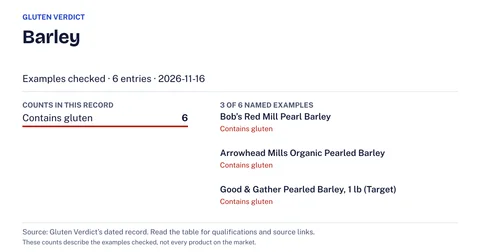 BarleyContains glutenchecked Nov 16, 2026
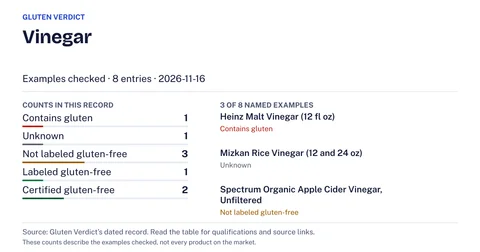 VinegarDepends on the product1 of 8 products we checked contains gluten: Heinz Malt Vinegar (12 fl oz)checked Nov 16, 2026
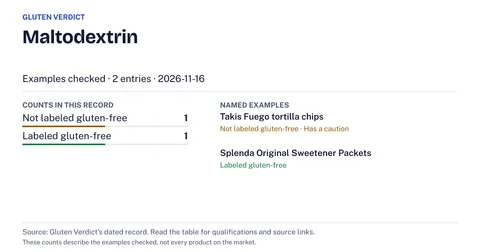 MaltodextrinNaturally gluten-freechecked Nov 16, 2026
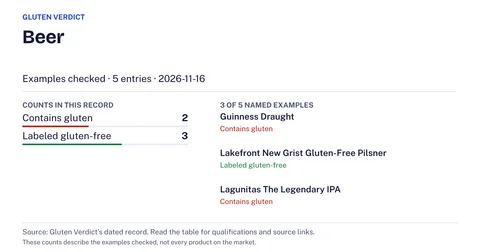 BeerDepends on the product2 of 5 products we checked contain gluten: Guinness Draught and Lagunitas The Legendary IPAchecked Nov 16, 2026
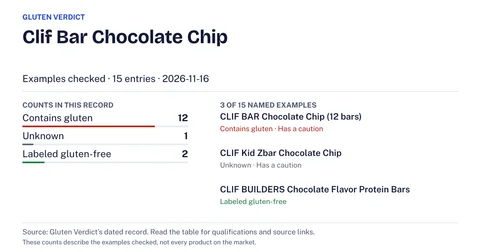 Clif Bar Chocolate ChipContains glutenClif Bar & Company · checked Nov 16, 2026
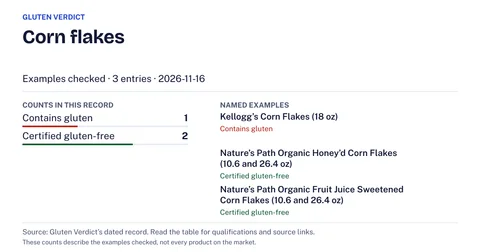 Corn flakesDepends on the product1 of 3 products we checked contains gluten: Kellogg’s Corn Flakes (18 oz)checked Nov 16, 2026
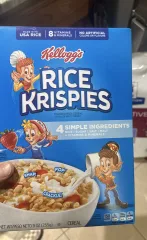 Rice KrispiesContains glutenWK Kellogg Co · checked Nov 16, 2026
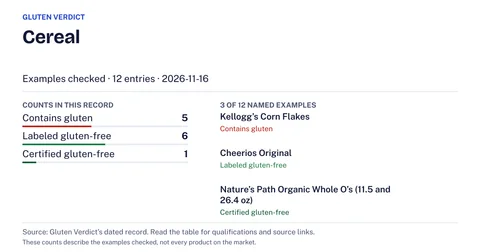 CerealDepends on the product5 of 12 products we checked contain glutenchecked Nov 16, 2026
Questions people ask
Does malt flavoring contain gluten?
WK Kellogg Co says the malt in its cereals comes from barley and may contain gluten, which is why it does not label them gluten free4. Gluten Intolerance Group says “Malt” in an ingredients list means the product is not gluten-free1.
Can barley malt syrup be in a food labeled gluten-free?
No. FDA says malt extract and other similar malt-derived ingredients cannot be used in foods that bear a “gluten-free” labeling claim2, and its Q&A answers “No” for barley malt and barley malt extract31.
Is malt the same as maltodextrin?
No. FDA describes malt extract and malt syrup as a concentrate of a water extract of germinated barley6. Gluten Intolerance Group describes maltodextrin as a thickener, flavor enhancer or filler that can be derived from starches including corn, potato, rice and wheat30. That charity says both maltose and maltodextrin are gluten-free5, while saying “Malt” in an ingredients list means the product is not gluten-free1.
More in Hidden gluten in ingredients, sauces and processed foods
 Wheat, barley and rye on an ingredient list: the names to look forLook up wheat, barley and rye names on a US ingredient list, from durum to malt, and sort each as contains gluten, depends on the maker, or lookalike.
 Vinegar, vanilla and other flavor extracts: what to check on the bottleSort a bottle of vinegar or extract into ordinary, check the label or avoid, using the ingredient line and what the charities and makers say.
 Where wheat, barley and rye hide in processed food: 15 places to checkFifteen processed foods where wheat, barley or rye turn up, the label step that catches each, and what US allergen law does and does not flag.
 Gluten-free snack bars: reading oats and barley malt on the wrapperRead a snack-bar wrapper in four steps (gluten-free claim, malt, oats, Contains line), with a Clif and a KIND bar worked through.
 Foods that contain gluten, aisle by aisle, and the label words that give them awayA store-order map of foods that contain gluten, which depend on the brand, and which need a cross-contact check, with the label words to look for.
 Maltodextrin, dextrin and glucose syrup made from wheat: what the label rules sayWhat US label law, FDA and the two US celiac charities say about wheat-made maltodextrin, dextrin and glucose syrup, and how to confirm one.
All 21 guides in Hidden gluten in ingredients, sauces and processed foods
Related guides
 The Contains line names wheat, not barley or rye: what US allergen labels coverWhat the US allergen Contains line covers, why it names wheat but not barley or rye, and which ingredient-list names stand in for them.
 What gluten is, which grains carry it and what “gluten-free” meansA plain definition of gluten, the grains that carry it, look-alike words such as malt and wheat starch, and what a US gluten-free label means.
 How to read a US food label for glutenWhere gluten shows up on a US food label: the gluten-free claim, the Contains line, the ingredient list and may-contain lines, and what each means.
 Gluten-free substitutes: the swap for each wheat ingredient and the label check it needsA lookup table of gluten-free swaps for wheat flour, pasta, bread, soy sauce, beer and more, with the one label check each swap needs.
Sources
- [1, 5, 27, 28, 30] Gluten Intolerance Group, Are Maltose, Maltodextrin, Glucose Syrup, Yeast Extracts, and Wheat Starch Gluten-Free?, checked Nov 17, 2026.
- [2, 6, 7, 8, 13, 14, 31] US Food and Drug Administration, Questions and Answers on the Gluten-Free Food Labeling Final Rule, checked Nov 17, 2026.
- [3] US Food and Drug Administration, Food Allergen Labeling and Consumer Protection Act of 2004 (FALCPA), checked Nov 17, 2026.
- [4] WK Kellogg Co, Kellogg’s FAQs, checked Nov 17, 2026.
- [9, 23] Gluten Intolerance Group, Should a person with celiac disease avoid vinegar and products containing vinegar?, checked Nov 17, 2026.
- [10] US Food and Drug Administration, CPG Sec 515.200 Malt Extract; Malt Syrup; Malted Cereal Syrup; Liquid Malt; Dried Malt, checked Nov 17, 2026.
- [11, 12, 29] National Institute of Diabetes and Digestive and Kidney Diseases (NIDDK), Eating, Diet, & Nutrition for Celiac Disease, checked Nov 17, 2026.
Read on 2026-11-17: under “What foods and drinks contain gluten?”, the list of grains names wheat and types of wheat; barley, “which may be found in malt, malt extract, malt vinegar, and brewer’s yeast”; rye; and triticale.
- [15, 16] Clif Bar & Company, CLIF BAR Chocolate Chip, checked Nov 17, 2026.
- [17, 18] WK Kellogg Co (SmartLabel), Kellogg’s Rice Krispies cereal, 9 oz, checked Nov 17, 2026.
Read on 2026-11-17: the ingredient list names rice, sugar, “contains 2% or less of” salt and malt flavor, then vitamins and minerals.
- [19, 20] WK Kellogg Co (SmartLabel), Kellogg’s Corn Flakes cereal, 18 oz, checked Nov 17, 2026.
Read on 2026-11-17: the ingredient list names milled corn, sugar, malt flavor and “contains 2% or less of” salt, then vitamins and minerals.
- [21, 22] Tillamook County Creamery Association, Malted Moo Shake Ice Cream, checked Nov 17, 2026.
- [24, 25, 26] National Celiac Association, Is vinegar gluten free?, checked Nov 17, 2026.