How to tell a host or relative you have celiac disease
Short answer
Tell the host when the invitation arrives, and cover four things:
- Say you have celiac disease and ask whether gluten-free food will be available; the NIH’s NIDDK says to bring gluten-free food if it will not be, or if you are unsure1.
- Explain cross-contact, not just bread: the Gluten Intolerance Group’s (GIG) sample message names crumbs from shared utensils or cutting boards2.
- Offer to help with the menu or bring a dish, as GIG’s sample message does2.
- At the table, GIG says it is okay to pause and check before you take a bite3, and always acceptable to say no thank you4.
Part of Explaining celiac and everyday social life, 15 guides
Key points
- Ask when the invitation arrives: GIG says a simple conversation at that point can limit the stress5.
- Cross-contact is the point to get across. NIDDK defines it as gluten-containing foods or products coming into contact with gluten-free foods6.
- A host cannot control what other guests do at a potluck or buffet, which is why GIG advises coming prepared7, 8.
- “Made with no gluten-containing ingredients” is a different statement from a gluten-free claim; FDA says that unless the label also bears the claim, consumers should not assume the food meets all FDA requirements for the claim9.
- A boundary statement is not an apology, GIG says10.
When to ask, and what to say first
Ask when the invitation arrives, not on the day. GIG’s advice for a family gathering is a simple conversation at that point5. NIDDK’s guidance for social gatherings is two steps: let the host know you have celiac disease, then find out whether gluten-free foods will be available1.
If you are a teen or still living at home, GIG says it is fine to ask a parent or trusted adult to have the conversation with you or for you, and that the same approach works for a partner’s family, friends or roommates11. GIG also suggests starting with appreciation, because that helps the conversation feel collaborative rather than demanding12.
Below are three drafts in our own words, by how well you know the person. Change them until they sound like you. The facts behind them (the grains, crumbs and shared spoons, the offer to bring a dish) are sourced in the sections that follow.
| Who | Message you can adapt |
|---|---|
| Close friend | Thanks for inviting me, I’m looking forward to it. Quick heads-up: I have celiac disease, so crumbs and shared spoons matter for me, not just bread. Can I bring a dish, or help you plan the menu? |
| Relative or in-law | Thank you for having us. I have celiac disease, so I avoid gluten completely, and that includes anything a gluten-containing food has touched. I’d love to help in the kitchen or bring something to share. Could we talk through the menu this week? |
| Acquaintance or a new host | Thanks for the invitation. I have celiac disease and avoid gluten completely, so I’ll bring a little something of my own. Please don’t change your menu for me. I just wanted you to know. |
What to name, and what to leave out
GIG says to explain what cross-contact is and why it matters, because many people think gluten-free simply means leaving out the bread13. NIDDK defines cross-contact as foods or products that contain gluten coming into contact with gluten-free foods, and says it can occur whenever food is grown, processed, stored, prepared or served6, 14.
Here is the one-sentence version: “I have celiac disease, so I avoid gluten completely, including crumbs from shared spoons, boards and frying oil.” Each part has a source:
- Wheat, barley and rye: NIDDK describes gluten as a protein found naturally in these grains15.
- Spoons and boards: GIG’s sample message to a host names crumbs from shared utensils or cutting boards2.
- Frying oil: GIG says that when a gluten-containing food is fried in oil, the used oil becomes a source of cross-contact16.
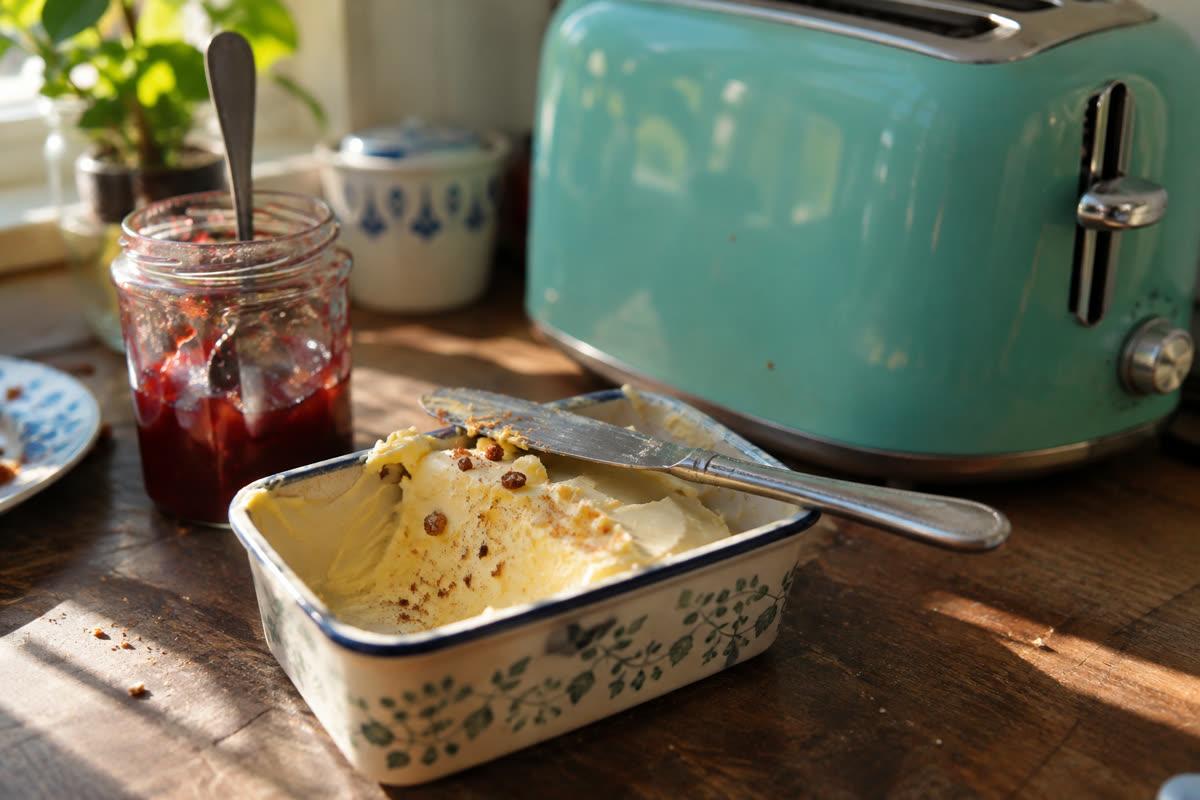
- Butter: GIG’s guide for people who support someone with celiac disease says even a crumb from shared butter or a cutting board can trigger symptoms in someone with celiac disease17.
- Bowls and serving spoons: GIG lists shared chip bowls, dips, serving utensils and buffet tables as ways gluten can reach otherwise gluten-free foods18.
- Toasters: GIG says toasters are virtually impossible to thoroughly clean, which it calls a significant issue in a shared household or when traveling19.
Leave out the symptom list and the diagnosis story: the host needs the rule, not the case file. If the host asks why it matters, one sourced line is that NIDDK says people with celiac disease need to follow a gluten-free diet for life20.
The longer explanation, and the replies to “but you look fine” and “isn’t this just a diet?”, belong in a separate conversation. Our guide on how to explain celiac disease to friends and family covers them.
When the host wants to cook for you
A host who offers to cook may still not know how cross-contact happens: GIG says hosts can listen with every good intention and not fully understand it7. GIG suggests a few gentle questions: how the meal will be served (buffet, family style or plated), whether sauces, gravies and seasonings are made from scratch, and whether the host would share ingredient labels21. If the host is keen, ask about separate serving utensils for the gluten-free dishes, or serving yours first22. GIG’s holiday guide adds two kitchen questions: is regular flour used in the same kitchen, and are surfaces, utensils, cookware and bakeware shared between gluten-containing and gluten-free things23.
What a label can and cannot tell you
- On a US food label, “gluten-free” is a voluntary claim, and FDA says that because it is not required on a food package, it may not appear even if the food is gluten-free24.
- NIDDK says that under FDA’s rule a food labeled gluten-free must contain less than 20 parts per million of gluten, which it calls too small to cause problems in most people with celiac disease25.
- “Made with no gluten-containing ingredients” is a different statement. FDA says that unless the label also bears a gluten-free claim, consumers should not assume the food meets all FDA requirements for the claim9.
- If a label does not say what is in a product, NIDDK says to ask the maker for an ingredients list, and that you cannot assume the product is gluten-free26.
| Dish | What to ask | Why |
|---|---|---|
| Gravy and sauces | Is it thickened with wheat flour? What went into it? | GIG lists flour, soy sauce and broth as what to ask about in sauces, gravies and seasonings27. GIG’s hosting tips suggest cornstarch or rice flour in place of wheat flour for thickening gravy28. Our verdict on flour. |
| Soy sauce in marinades and stir-fries | Which bottle was used? Could I see it? | FDA says that in general, soy sauce made from soybeans and wheat may not bear a gluten-free claim29. Our verdict on soy sauce. |
| Fries and fried food | Was it fried in oil that also cooked breaded food? | GIG says used frying oil from a gluten-containing food becomes a source of cross-contact16. Our verdict on french fries. |
| Butter and spreads on the table | Is there a separate dish or a fresh stick for me? | GIG says even a crumb from shared butter can trigger symptoms in someone with celiac disease17. Our verdict on butter. |
| Bread and rolls | Could my plate be served before the bread goes round? | NIDDK lists breads among foods made with gluten-containing grains30. GIG suggests serving the gluten-free dishes first22. Our verdict on bread. |
If you do not hear back, or the answers are unclear, NIDDK’s advice is the same as for bringing food: if you are unsure, bring your own1.
Bringing your own dish
GIG says it never hurts to come prepared with a dish, a snack or a small meal of your own, and that you can explain you were uncomfortable risking your health and wanted to be prepared. It adds that most hosts appreciate the honesty and that it takes the pressure off them to get everything perfect8. It calls a dish to share often the easiest approach, because it feels generous rather than like a workaround31.
- Pick something you love that everyone will enjoy, so it is not seen as “the gluten-free food” but simply as a great addition to the meal32.
- Bring your own serving utensil and keep the dish covered until it is time to eat33.
- At a buffet or potluck, ask to go first in line, or set your portion aside before other dishes go round34.
- Keep a backup in your bag, such as a protein bar or a sealed snack35. Some people bring their own plate and utensils to avoid cross-contact from shared dishes36.
GIG’s advice to hosts points the same way: be understanding if a guest chooses to bring their own food37. Its guide for supporters tells friends that a guest who skips the cookies or brings a dish to a potluck is acting for their health, not about the host38.
A line you can use when you arrive: “I brought something so you don’t have to worry about me. Everything looks wonderful.”
Potlucks, buffets and catered meals
GIG says a host cannot control what other guests do at a potluck or buffet7. For a party, GIG’s advice is to ask what food will be served before you go39.
If someone else is ordering the food, tell them what you need. GIG suggests asking whether the items are cooked in a shared fryer or on any shared equipment, which it calls the most common places for hidden gluten40.
At the table: when a dish is not right
GIG says it is okay to pause and check before you take a bite3. Its list of questions to keep ready:
- Would you mind reading me the ingredient label on that?41
- How was this dish prepared, and was the gluten-free dish prepared first?41
- Were the pans, utensils and surfaces washed between the gluten-containing dish and the gluten-free one?41
- Was anything fried in shared oil or cooked in the same pot as something with gluten?27
- Do the sauces, gravies or seasonings contain flour, soy sauce or broth?27
One case needs no question. GIG says that when one serving spoon has moved between a gluten-containing dish and a gluten-free one42, a clean spoon will not change that, and it is best to politely skip the dish43.
When you decide to pass, GIG says it is always acceptable to say no thank you4, and that nobody is owed further explanation44. Drafts in our own words:
- “Everything looks wonderful. I’m going to stick with what I brought.”
- “That spoon has been in both dishes, so I’ll skip this one. Thank you for putting this together.”
- “I know you’re trying to help. I have to skip it completely, but I’m glad to be here.”
If someone says “a little bit won’t hurt”, GIG’s advice is to stay calm and kind and simply repeat what you need45. Our wording for that moment is the last line above: short, warm and final.
GIG says that if advance notice does not work and someone brings you a surprise, it is always okay to thank them and politely decline46.
When a relative pushes back
GIG’s advice for doubt or pushback is a boundary-setting statement: one that clearly explains your situation, how it makes you feel, and what you are willing to discuss and what is off limits47. It says the statement is not an apology and should not include the words “I’m sorry.”10
A draft: “This is a medical need for me, and I’d rather not debate it. I’m happy to tell you what I can eat. Thank you for helping.”
GIG’s guide for the table gives a reason to stay warm: when a family member gets defensive, most of the time it comes from worry about getting it wrong, not from a lack of care, and a warm tone and a thank-you can settle things quickly48. When a conversation turns negative anyway, GIG’s boundary advice is to walk away, figuratively or literally49.
After the meal
Thank the host for the specific effort. GIG’s guide for gluten-free people suggests making sure they know how much you appreciate the effort when someone double-checks a restaurant menu or buys special ingredients for you50.
For next time, GIG’s example is a kind heads-up: “separate spoons for each dish make a big difference”51. GIG also suggests sharing your favorite gluten-free brands, recipes or tips for avoiding cross-contact, and says that when friends and family feel informed they feel more confident about supporting you52.
Verdicts in this guide
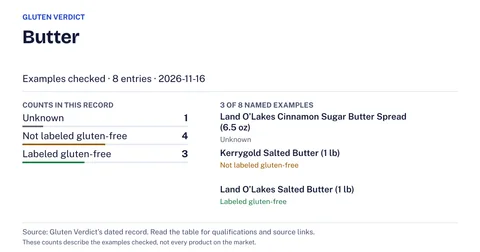 ButterNaturally gluten-freechecked Nov 16, 2026
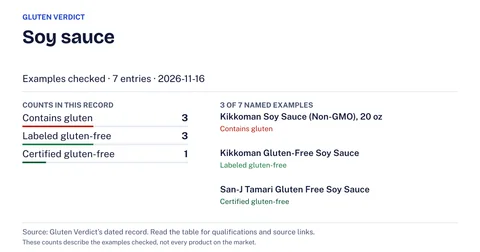 Soy sauceDepends on the product3 of 7 products we checked contain gluten: Kikkoman Soy Sauce (Non-GMO), 20 oz; San-J Organic Shoyu Soy Sauce; and Lee Kum Kee Premium Soy Sauce (No Preservatives Added)checked Nov 16, 2026
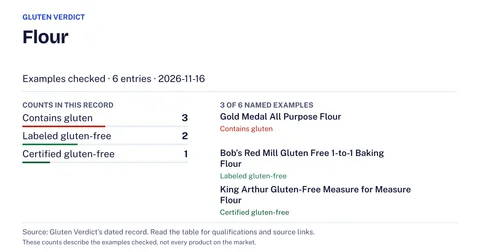 FlourContains glutenchecked Nov 16, 2026
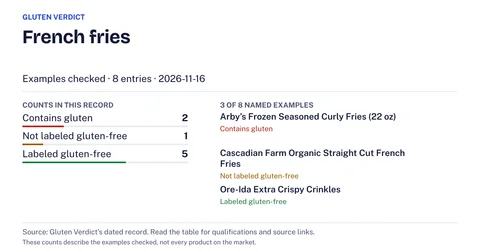 French friesDepends on the product2 of 8 products we checked contain gluten: Arby’s Frozen Seasoned Curly Fries (22 oz) and Checkers Frozen Crispy Seasoned Fries (28 oz)checked Nov 16, 2026
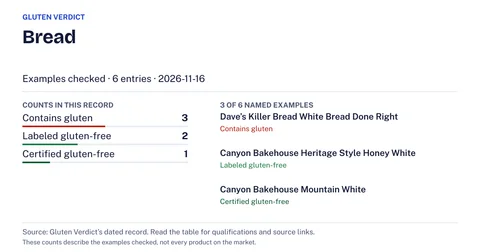 BreadContains glutenchecked Nov 16, 2026
Questions people ask
Do I have to explain what celiac disease is?
Not at length. NIDDK’s guidance for gatherings is to let the host know you have celiac disease and find out whether gluten-free foods will be available1. GIG adds one explanation, of cross-contact13.
The host says everything will be gluten-free. Can I relax?
Ask how it is being made. GIG lists questions on labels, shared utensils, shared oil, sauces and gravies41, 27. FDA says that unless a label bearing “made with no gluten-containing ingredients” also bears a gluten-free claim, consumers should not assume the food meets all FDA requirements for the claim9.
Is bringing my own food rude?
GIG says most hosts appreciate the honesty and that it takes the pressure off them8. NIDDK’s guidance is to bring gluten-free food if none is confirmed or you are unsure1.
What if the host says a little bit won’t hurt?
GIG’s advice is to stay calm and kind and simply repeat what you need45. NIDDK says people with celiac disease need to follow a gluten-free diet for life20.
Can a parent send the message for a teenager?
GIG says it is fine for a teen or someone still living at home to ask a parent or trusted adult to have the conversation with them or for them11.
More in Explaining celiac and everyday social life
 When a relative says a little gluten won’t hurt: what to say, and what to let goOne-line replies for the relative who scrapes off croutons or says one bite is fine, each with its source, plus what to push back on and what to let go.
 How to explain celiac disease to friends and familyA three-sentence explanation of celiac disease, then sourced replies to the usual questions: allergy, fad, how strict, and what to cook.
 What to say to someone with celiac disease, and what to skipSentences to use, and ones to skip, when you cook for, eat out with or work beside someone with celiac disease, each tied to the fact behind it.
 When your partner has celiac disease: gluten-free home or split kitchenChoose between a gluten-free home and a split kitchen, and find what to say at restaurants and to family, with NIH and charity sources.
 Gluten-free meals in a nursing home or assisted living: the rules and what to askWhich meal rules cover a nursing home or assisted living, what to ask on a tour, how to get a gluten-free diet into the care plan, and where to complain.
 When gluten-free eating wears you down: fewer decisions, same rulesEase gluten-free burnout with routines: check each product once, set a standing plan for eating out, and know which rules stay fixed.
Related guides
 How to cook dinner for a guest with celiac diseaseA host's plan for one dinner: what to ask the guest, a menu with few risk points, which labels to read, the cooking order, clean tools and serving.
 Gluten cross-contact at home: where it happens and what to do about itHow gluten reaches gluten-free food at home, whether to separate, wash or ask for each route, and which rules have lab data behind them.
 Gluten-free at work: catered lunches, client dinners, the office kitchen and business tripsWhat to ask a caterer, say to a server, label in the office fridge and carry on a business trip, from GIG, NIDDK, FDA and a chain's own allergen page.
 How to read a US food label for glutenWhere gluten shows up on a US food label: the gluten-free claim, the Contains line, the ingredient list and may-contain lines, and what each means.
Sources
- [1, 6, 14, 20, 25, 30] NIDDK (National Institutes of Health), Eating, Diet, & Nutrition for Celiac Disease, checked Nov 17, 2026.
- [2, 3, 5, 7, 8, 11, 12, 13, 21, 22, 27, 31, 32, 33, 34, 35, 36, 41, 42, 43, 45, 48, 51] Gluten Intolerance Group, A Seat at the Table: Talking to Family About Your Gluten-Free Needs, checked Nov 17, 2026.
- [4, 40, 44] Gluten Intolerance Group, Taking the stress out of the holiday buffets and parties, checked Nov 17, 2026.
- [9, 29] US Food and Drug Administration, Questions and Answers on the Gluten-Free Food Labeling Final Rule, checked Nov 17, 2026.
- [10, 47, 49] Gluten Intolerance Group, Setting healthy boundaries when you’re living gluten-free, checked Nov 17, 2026.
- [15, 26] NIDDK (National Institutes of Health), Treatment for Celiac Disease, checked Nov 17, 2026.
- [16, 19] Gluten Intolerance Group, Cross-contact, checked Nov 17, 2026.
- [17, 38, 50, 52] Gluten Intolerance Group, I heart my gluten-free friends and family: how to show love and support, checked Nov 17, 2026.
- [18, 39] Gluten Intolerance Group, Going out Gluten free: Dates, Parties and Everything in Between, checked Nov 17, 2026.
- [23, 46] Gluten Intolerance Group, 7 ways to navigate the holidays gluten-free, checked Nov 17, 2026.
- [24] US Food and Drug Administration, Gluten and Food Labeling, checked Nov 17, 2026.
- [28, 37] Gluten Intolerance Group, Tips for entertaining your gluten-free family and friends this holiday season, checked Nov 17, 2026.