Gluten-free in the UK: allergen rules, the Crossed Grain mark and pub and chip-shop food
Short answer
In the UK, “gluten-free” may be used only on food with no more than 20 mg of gluten per kg as sold1, and cereals containing gluten are one of 14 allergens that must be declared on packs and menus2, 4, 34. Check four things:
- The wording: “gluten-free”, or “very low gluten”, which the rule allows up to 100 mg/kg for foods made from specially processed gluten grains1, 3.
- The allergen emphasis: on a pack, allergens are emphasised each time they appear in the ingredients list, and the category covers barley and oats as well as wheat and rye4, 2.
- The marks: Crossed Grain is Coeliac UK’s certification for food products; its GF symbol on a menu or window is a separate scheme for venues5, 6.
- The counter: loose food must come with allergen information in writing or from staff, so ask for it, and ask what the fryer oil has cooked7, 8.
- Gluten-free limit
- No more than 20 mg of gluten per kg of food as sold for “gluten-free”; no more than 100 mg/kg for “very low gluten”1, 3
- Set by
- Commission Implementing Regulation (EU) No 828/2014, as published on legislation.gov.uk for the UK16
- Oats
- Oats in a food presented as gluten-free must be specially produced, prepared or processed to avoid contamination by wheat, rye or barley, and the oats’ gluten cannot exceed 20 mg/kg20
- Celiac society
- Coeliac UK
Part of Travel: Europe, 19 guides

Key points
- Both countries draw the line at 20 mg of gluten per kg: the UK allows the claim at “no more than” that figure in the food as sold, and the US rule says unavoidable gluten must be “below 20 ppm”1, 9.
- UK allergen law names cereals containing gluten (wheat, rye, barley, oats) as one allergen; the US list names wheat2, 10.
- Crossed Grain (products) and the GF accreditation symbol (venues) are two separate Coeliac UK schemes5, 37.
- A venue selling loose food can give allergen information in writing or by speaking to staff7; the FSA’s guidance to businesses lists spoken information with a clearly visible written notice as one way to provide it12.
- Sarson’s says its brown malt and distilled malt vinegars contain less than 20ppm, and that barley is still highlighted as an allergen in their ingredients lists; FDA says malt vinegar cannot be used in a US gluten-free claim13, 14, 15.
The UK gluten-free rule next to the US rule
The wording is set by Commission Implementing Regulation (EU) No 828/2014, which legislation.gov.uk publishes as it applies in the UK. The page says this version has not been amended by the UK since 31 December 2020, which it calls IP completion day16. The Food Standards Agency (FSA) notes that EU law retained at that point became “assimilated law” on 1 January 202417.
Under the regulation, “gluten-free” may be used only where the food as sold contains no more than 20 mg/kg of gluten1. A second wording, “very low gluten”, is for foods made with gluten grains that were specially processed to reduce gluten, up to 100 mg/kg3. Coeliac UK says no UK foods currently carry that wording, though products in other European countries may18.
| Question | UK | US |
|---|---|---|
| Gluten limit for the claim | No more than 20 mg/kg of gluten in the food as sold1 | Unavoidable gluten below 20 ppm, which the rule writes as below 20 mg per kg9 |
| Other words that count | “Very low gluten”, up to 100 mg/kg3 | “Free of gluten”, “without gluten” and “no gluten” are treated as equivalent to “gluten-free”19 |
| Oats | Must be specially produced, prepared or processed to avoid contamination by wheat, rye or barley, and the oats’ gluten cannot exceed 20 mg/kg20 | Oats do not have to be certified, but oats labeled gluten-free must contain less than 20 ppm21 |
| Allergen category that covers gluten | “Cereals containing gluten (such as wheat, rye, barley and oats)” is one of 142 | Wheat is on the list of major food allergens10 |
| How the allergen shows on a pack | Emphasised each time it appears in the ingredients list4 | A “Contains” line next to the ingredients, or the source in parentheses after the ingredient22, 23 |
Coeliac UK describes gluten free wheat starch as a specially manufactured wheat starch washed to 20 ppm or less24, and says it must always appear in the ingredients list if used25; our wheat starch entry covers it. The US side of this table is explained in how to read a US food label for gluten, and the UK legal detail in UK gluten-free labelling.
The 14 allergens on packs, in bakery cases and on menus
Food law requires only 14 allergens to be declared; the FSA’s list includes cereals containing gluten (such as wheat, rye, barley and oats)26, 2. Food Standards Scotland likewise says 14 allergens must be declared by law in the UK27. How the information reaches you depends on how the food is sold.
Pre-packed food
Pre-packed food must have an ingredients list, and allergens must be emphasised each time they appear in it4. In a shop that means barley or oats are picked out in the list, not only wheat4, 2.
Wrapped on the premises before you choose it (PPDS)
“Prepacked for direct sale” (PPDS) food is packaged where it is sold and is already in its packaging before it is ordered or selected28. The FSA’s examples include sandwiches and bakery products packed on site29. Such food must carry the name of the food and a full ingredients list with allergens emphasised30. The FSA page applies to England, Northern Ireland and Wales31; Food Standards Scotland says the same labelling has applied in Scotland and the rest of the UK since 1 October 202132.
Loose food, menus and takeaways
Loose, or non-prepacked, food is everything that is not pre-packed66. The FSA says the information requirements can apply to meals served in a restaurant, food from a takeaway and loose items at a bakery or deli counter33. A business selling it must supply information for every menu item that contains any of the 14 allergens34. That information can be written, or given by speaking to staff7; the FSA also allows spoken information if a clearly visible written notice explains how to get it12. Its own advice to businesses is that written information, supported by a conversation, works best35.
Telling customers which of the 14 allergens a menu item contains is the requirement34. A “gluten-free” menu claim is a separate promise: the FSA tells businesses that if they handle wheat flour and cannot remove the risk of cross-contamination through segregation by time and space, they should tell the customer and should not make gluten-free or wheat-free claims36.
Crossed Grain on a pack, or GF accreditation on a venue?
Coeliac UK runs two separate schemes that cover different things5, 37. Its site footer says its logos are Trade Marks of Coeliac UK11.
| Crossed Grain Trademark | Gluten Free Accreditation (GF symbol) | |
|---|---|---|
| What it covers | Food products: Coeliac UK calls it a certification scheme5 | Venues and caterers: the GF symbol on a menu says the dish is gluten-free according to the law and that the caterer meets all requirements of the Gluten Free Standard37 |
| What Coeliac UK says about it | Certified products have been through extra checks, including gluten analysis certificates and independent audits of how they are made38 | Accreditation is renewed annually39 |
| Where you see it | On the label of a certified food product40; Sarson’s says it has worked with Coeliac UK to add the trademark and a gluten-free claim to two of its vinegars41 | On websites, menus and in the windows of accredited venues6 |
Two details help at the door. Coeliac UK says you will not see disclaimer statements on the menus of its accredited venues42, and its list notes where accreditation does not reach, for example a chain’s self-serve salad bar43. Coeliac UK’s separate Venue Guide mixes member recommendations with accredited venues44, so a Venue Guide listing does not on its own mean accreditation44.
For how the Crossed Grain sits beside the legal claim, see UK gluten-free labelling; for EU countries, see gluten-free and very low gluten on EU labels.
Pub food and the chip shop: where wheat and barley sit
Food Standards Scotland’s page on cereals containing gluten lists foods where they can also be found: batter, breadcrumbs, bread, cakes, couscous, processed meat products, pasta, pastry, sauces, soups and fried foods dusted with flour45. That list maps straight onto a pub menu and a chip-shop counter.
| Item | Where the grain can sit | Our verdict |
|---|---|---|
| Battered fish | Batter45 | Fish and chips |
| Chips | The FSA says gluten-free chips cannot be cooked in oil previously used for battered fish8 | — |
| Pies and pasties | Pastry45 | — |
| Sausages | Processed meat products45 | Sausage |
| Gravy and pie fillings | Sauces and soups45 | Gravy, shepherd’s pie |
Coeliac UK’s eating-out advice is to double-check that the fryer and utensils are specifically used for gluten-free options46. At a chip shop, ask about it as well as reading the menu.
Malt vinegar, Worcester sauce and the other counter bottles
A US reader’s assumption about malt vinegar needs care. FDA says malt vinegar “cannot be used in foods that bear a ‘gluten-free’ labeling claim” in the US15. A British maker’s claim comes under the UK rule, which measures the food as sold1. Sarson’s says it has worked with Coeliac UK to add a gluten-free claim and the Crossed Grain trademark to its brown malt and distilled malt vinegars41, and that the finished products contain less than 20ppm13.
Its ingredient lists still name barley. The Sarson’s FAQ says barley from the barley malt vinegar and barley malt extract is highlighted as an allergen on the ingredients list14, and the product pages point to bold type for cereals containing gluten47. The Sarson’s FAQ is undated; it says new labels were rolling out, could take a couple of months to reach shops, and ends “watch this space early 2025!”48. An older bottle may not carry the claim.
| Product | Ingredients as printed on the page | Sarson’s gluten-free certification list |
|---|---|---|
| Malt Vinegar | Barley Malt Vinegar, Barley Malt Extract. Acidity 5%.49 | Named in the certified list50 |
| Distilled Malt Vinegar | Distilled Malt Vinegar (Barley).51 | Named in the certified list50 |
| Worcester Sauce | Barley Malt Vinegar, Water, Molasses, Sugar, Salt, Onion, Tamarind Concentrate, Anchovy Paste (Fish), Spices, Garlic Powder, Lemon Oil, Natural Flavourings.52 | Named in the list of products not yet certified53 |
The same maker has bottles on both lists50, 53. Read the label on the bottle in front of you; if a venue decants vinegar or sauce into its own bottle, ask to see the original. Our entries for malt vinegar, Worcestershire sauce, malt extract and barley cover the ingredients, and malt on food labels covers the label wording.
We have not read a maker’s page for HP or other brown sauces, or for non-brewed condiment, so we make no statement about them; the ingredient list on the bottle is the evidence to use.
Beer, cider and gluten-free beer at the bar
Coeliac UK’s alcohol page says cider, wine, sherry, spirits, port and liqueurs are gluten-free54, and that beers, lagers, stouts and ales contain varying amounts of gluten and are not suitable for a gluten-free diet, though gluten-free options exist55. Our entries cover beer and cider; the cider entry also covers flavoured versions.
Coeliac UK describes two kinds of gluten-free beer, naturally gluten-free and gluten-removed. By law either can be labelled gluten-free only at 20 ppm or less, and a gluten-removed beer made from barley must state on the label that it contains barley56. So “contains barley” on a bottle marked gluten-free is what Coeliac UK says to expect on a gluten-removed beer made from barley56.
Drinks above 1.2% alcohol by volume need not list all ingredients, but an allergen, including gluten-containing cereals, must be declared on the packaging, for example “contains barley”57.
What to say at the counter
- Ask for the allergen information. A venue must supply it for every menu item containing one of the 14 allergens34, in writing or by speaking to staff7.
- Name barley as well as wheat. In UK law the allergen is “cereals containing gluten”, which includes barley and oats2.
- Ask about the fryer, the utensils and the oil. Coeliac UK suggests checking they are specifically used for gluten-free options46, and the FSA says gluten-free chips cannot share oil used for battered fish8.
- Say it is a health need. Coeliac UK suggests explaining your dietary restrictions to a member of staff so they are understood as a health necessity and not a dietary choice58.
- If you can, call ahead and ask for a manager or chef, as Coeliac UK suggests59.
- If the kitchen cannot avoid cross-contamination, the FSA says it should tell customers it cannot provide an allergen-free dish60. Treat that as an answer.
May-contain lines and the 2026 Codex guidelines
In the US, FDA allows a voluntary advisory statement such as “made in a facility that also processes wheat” on a food that also carries a gluten-free claim, if it is truthful and not misleading61. Coeliac UK reports that the Codex Alimentarius Commission adopted new international guidelines on 6 July 202662, which say a product should not be labelled both “gluten free” and “may contain wheat, barley or rye”63. Coeliac UK says UK regulators and businesses still have to consider and implement them64, so a British label may not yet follow it64.
Verdicts in this guide
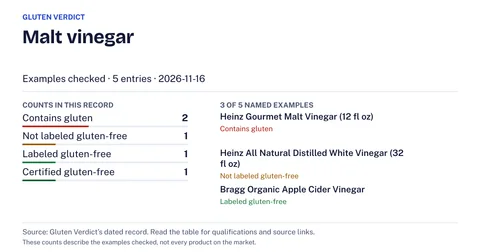 Malt vinegarContains glutenchecked Nov 16, 2026
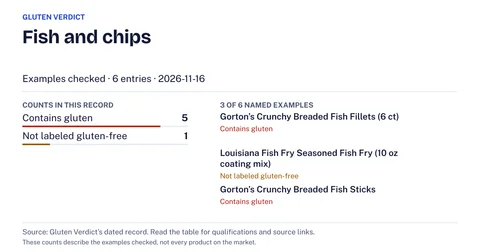 Fish and chipsDepends on the product5 of 6 products we checked contain glutenchecked Nov 16, 2026
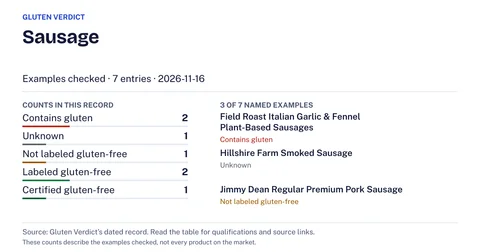 SausageDepends on the product2 of 7 products we checked contain gluten: Field Roast Italian Garlic & Fennel Plant-Based Sausages and Tofurky Plant-Based Italian Sausagechecked Nov 16, 2026
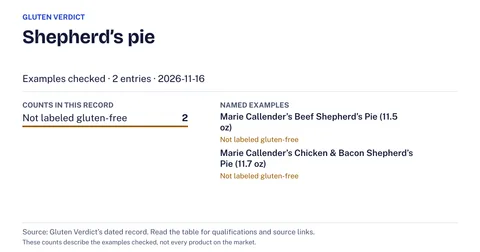 Shepherd’s pieDepends on the productchecked Nov 16, 2026
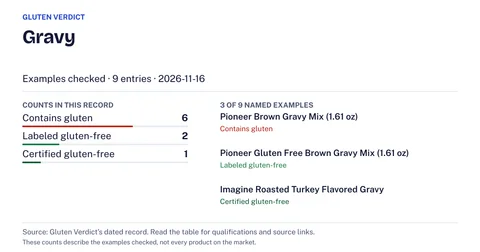 GravyDepends on the product6 of 9 products we checked contain glutenchecked Nov 16, 2026
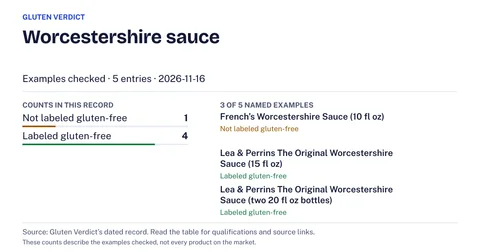 Worcestershire sauceDepends on the productchecked Nov 16, 2026
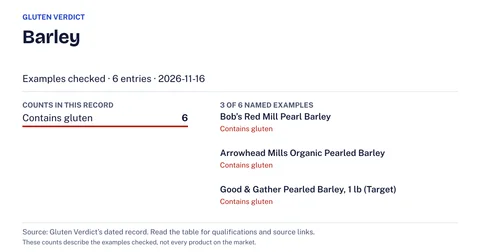 BarleyContains glutenchecked Nov 16, 2026
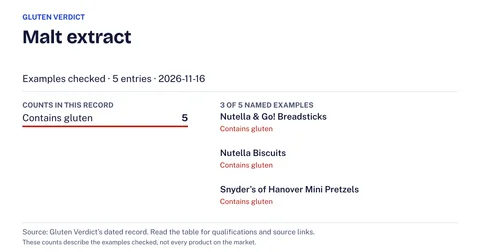 Malt extractContains glutenchecked Nov 16, 2026
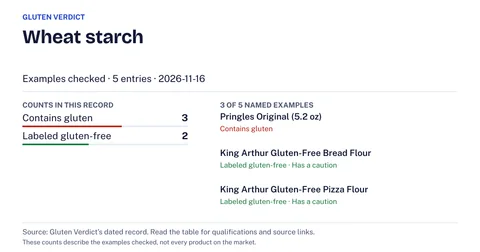 Wheat starchDepends on the product3 of 5 products we checked contain gluten: Pringles Original (5.2 oz), Jiffy Corn Muffin Mix, and Chex Mix Bold Garlic and Herbchecked Nov 16, 2026
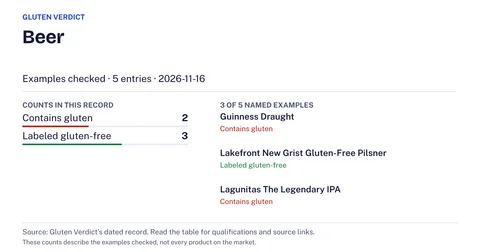 BeerDepends on the product2 of 5 products we checked contain gluten: Guinness Draught and Lagunitas The Legendary IPAchecked Nov 16, 2026
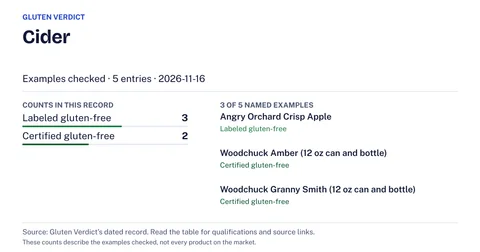 CiderNaturally gluten-freechecked Nov 16, 2026
Questions people ask
Is a UK “gluten-free” label the same as a US one?
Both use 20 mg of gluten per kg as the line. The UK allows the claim where the food as sold contains no more than 20 mg/kg1; the US rule requires any unavoidable gluten to be below 20 ppm, which it writes as below 20 mg per kg9. Oats and allergen wording differ, as the table above shows.
Is malt vinegar gluten-free in the UK?
Sarson’s says its brown malt and distilled malt vinegars contain less than 20ppm, which it calls the agreed standard for declaring a product gluten-free13, while the barley is still highlighted as an allergen in the ingredients list14. FDA’s position for US labels is that malt vinegar cannot be used in a gluten-free claim15. Read the bottle you are given.
Do British restaurants have to list allergens?
A business selling loose food must supply information for every menu item that contains any of the 14 allergens34, in writing or by speaking to staff7. Food Standards Scotland likewise says businesses must provide allergen information for prepacked and non-prepacked food65.
More in Travel: Europe
 Gluten-free in Ireland: labels, pub rules, Guinness and the Crossed Grain symbolWhat Irish labels, pub allergen rules and the Crossed Grain symbol say about gluten, and what Guinness lists, so a US traveler knows what to check.
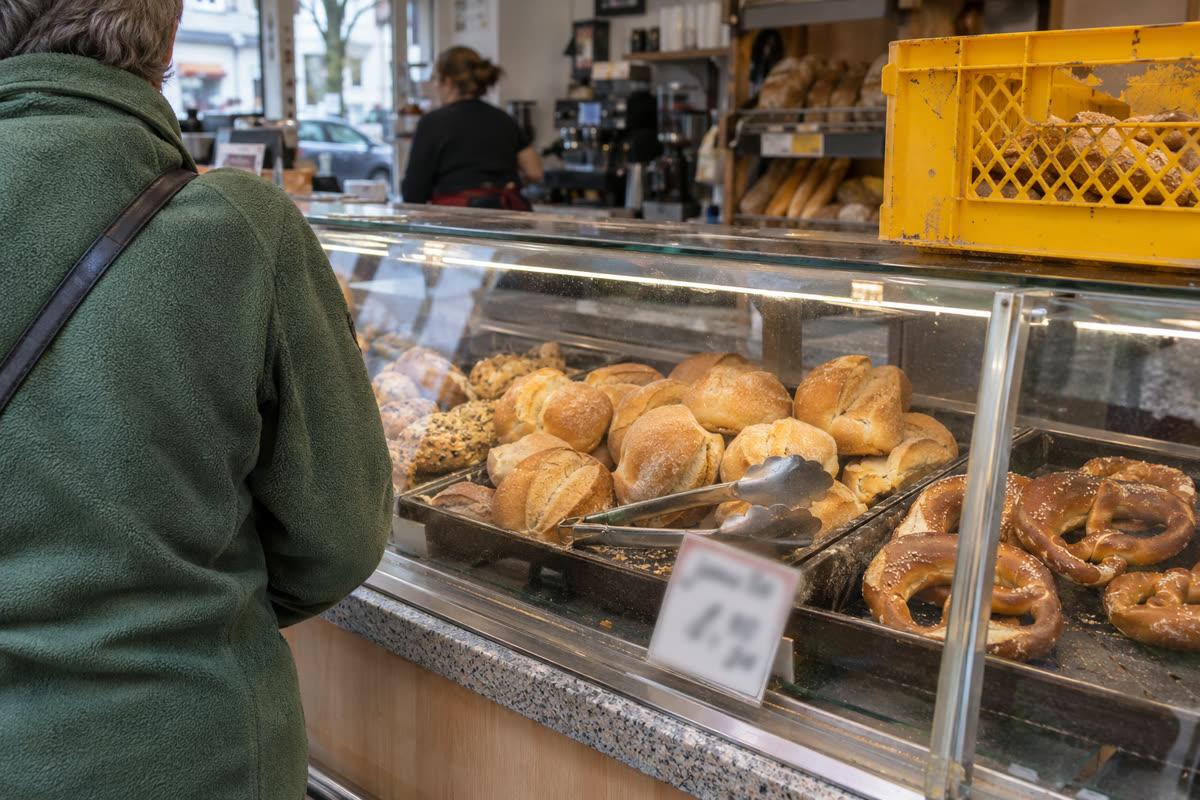 Gluten-free in Germany: what “glutenfrei” and German allergen rules tell youHow to read “glutenfrei” and German allergen rules, spot wheat in pretzels and Spätzle, and ask a restaurant for its allergen information.
 Gluten-free in Scotland: the rule, haggis, oatcakes, pies and whiskyWhat changes in Scotland: who sets the gluten-free rule, how oats count, and how to judge haggis, oatcakes, pies, broth and whisky.
 Gluten-free in Estonia, Latvia and Lithuania: label words, rye bread and dumplingsHow Estonia, Latvia and Lithuania word gluten-free claims, where rye, barley and wheat sit in local dishes, and which official pages to check.
 Gluten-free in Central Europe: the rules in five countries and where wheat hides in the dishesWhich gluten-free rule covers a pack in Austria, Czechia, Hungary, Poland and Switzerland, and where wheat enters schnitzel, dumplings and sauces.
 Gluten-free in Spain: what “sin gluten” means and what FACE coversWhat “sin gluten” means in Spain, what FACE’s marks and restaurant program say they cover, and which tapas need a question before you order.
Related guides
 Gluten-free and very low gluten on EU labels, and how allergens are highlightedWhat EU “gluten-free” and “very low gluten” claims permit, how cereals containing gluten are highlighted in ingredient lists, and the rules for loose food.
 UK gluten-free labelling: the legal rules, Natasha’s Law and the Crossed GrainWhat UK law requires on allergen and gluten-free labels, what Natasha’s Law added for food packed on site, and how the Crossed Grain mark differs.
 Malt on a food label: which forms are barley and what to checkWhat malt extract, syrup, flavoring and vinegar on a US label mean for gluten, why the Contains line misses barley, and what to check first.
 Gluten-free alcohol: what US beer, spirits, wine and cider labels may sayWhich US alcohol labels may say gluten-free, who sets the wording, and how beer, spirits, wine, cider and hard seltzer differ, each rule sourced.
Sources
- [1, 3, 20] legislation.gov.uk (UK law), Commission Implementing Regulation (EU) No 828/2014 as it applies in UK law, checked Nov 17, 2026.
- [2, 4, 8, 12, 17, 26, 33, 35, 36, 60] Food Standards Agency, Allergen guidance for food businesses, checked Nov 17, 2026.
- [5, 11, 38, 40] Coeliac UK, Look out for our Crossed Grain symbol, checked Nov 17, 2026.
- [6, 37, 43] Coeliac UK, Gluten free accredited venues, checked Nov 17, 2026.
- [7, 28, 34, 66] Food Standards Agency, Allergen information for pre-packed and loose foods, checked Nov 17, 2026.
- [9] eCFR (US Government Publishing Office), 21 CFR 101.91, Gluten-free labeling of food, checked Nov 17, 2026.
- [10, 22, 23] US Food and Drug Administration, Food Allergen Labeling and Consumer Protection Act of 2004 (FALCPA), checked Nov 17, 2026.
- [13, 14, 41, 48, 50, 53] Sarson's (Mizkan Euro), FAQs (Gluten Free FAQs), checked Nov 17, 2026.
Read on 2026-11-17: the list headed “Which Sarson’s products are gluten-free certified?” names Sarson’s Malt Vinegar and Sarson’s Distilled Malt Vinegar, each in 250ml, 284ml, 400ml and 568ml sizes.
Read on 2026-11-17: the list headed “Which Sarson’s products are not gluten-free certified?”, which the page introduces as products “still in the pipeline”, names Dip & Drizzle – Malt, Dip & Drizzle – Garlic, Distilled Pickling Vinegar, Malt Pickling Vinegar, Gravy Browning, Worcester Sauce, Red Cabbage, Sweet Onions, Silver Skin Medium & Tangy, Hot & Spicy Onions and Mixed Pickle.
- [15, 19, 21, 61] US Food and Drug Administration, Questions and Answers on the Gluten-Free Food Labeling Final Rule, checked Nov 17, 2026.
- [16] legislation.gov.uk (UK law), Commission Implementing Regulation (EU) No 828/2014: contents page and note on changes, checked Nov 17, 2026.
- [18, 24, 25] Coeliac UK, Gluten and the Law, checked Nov 17, 2026.
- [27, 45, 65] Food Standards Scotland, Managing allergens, checked Nov 17, 2026.
- [29, 30, 31] Food Standards Agency, Introduction to allergen labelling for PPDS food, checked Nov 17, 2026.
- [32] Food Standards Scotland, Prepacked for direct sale, checked Nov 17, 2026.
- [39] Coeliac UK, Gluten Free Accreditation (for venues), checked Nov 17, 2026.
- [42, 46, 58, 59] Coeliac UK, Hints and tips for eating out, checked Nov 17, 2026.
- [44] Coeliac UK, Travelling with coeliac disease, checked Nov 17, 2026.
- [47, 49] Sarson's (Mizkan Euro), Malt Vinegar, checked Nov 17, 2026.
- [51] Sarson's (Mizkan Euro), Distilled Malt Vinegar, checked Nov 17, 2026.
- [52] Sarson's (Mizkan Euro), Worcester Sauce, checked Nov 17, 2026.
- [54, 55, 56, 57] Coeliac UK, Alcohol, checked Nov 17, 2026.
- [62, 63, 64] Coeliac UK, Our impact on food labelling (may contain labelling), checked Nov 17, 2026.