Mechanically sorted or purity-protocol oats: what the makers' own pages say
Short answer
The Gluten Intolerance Group (GIG) names two main ways oat processors deal with stray gluten grains, and says some processors combine them36, 9. FDA's limit applies to the finished food whichever route a maker used1, 5:
- Purity Protocol: steps taken from growing through manufacturing to address the early stages of oat production, which GIG calls non-regulated7.
- Mechanical sorting: machines remove stray gluten grains after the oats reach a processing facility8.
- Either way, a “gluten-free” label requires that any unavoidable gluten in the finished food is below 20 parts per million5. Read the maker's own page to see which route it describes.
Part of Grains, flours and substitutes, 13 guides
Key points
- Cheerios' own page describes the sorting route: mechanical and optical sorting of oats that can co-mingle with wheat, barley and rye17, 18.
- Bob's Red Mill's gluten-free rolled oats page describes testing of incoming groats and a dedicated facility; it does not say how the oats are grown23, 24, 25.
- Oats do not have to be certified to be labeled gluten-free; they must contain less than 20 ppm of gluten1.
- Two of the pages we read, Oatly's and King Arthur's, say a product is gluten-free without describing a route28, 30.
- Of the maker pages we read, only the Bob's Red Mill rolled oats page gives a test figure23, so the questions near the end of this guide are worth asking.
What FDA requires, whichever route a maker uses
FDA's rule on the “gluten-free” claim says any unavoidable presence of gluten in the food bearing the claim must be below 20 ppm5. A food that bears the claim and fails the rule is deemed misbranded6.
For oats, FDA's Q&A page says they do not have to be certified to be labeled “gluten-free”, but oats that carry the claim must contain less than 20 ppm of gluten1. FDA also says any grain other than wheat, rye, barley or their hybrids can be labeled gluten-free if the unavoidable gluten from cross-contact is under that level3.
The background is FDA's explanation of cross-contact in grains generally, which does not name oats: crop rotation and the shared use of harvesting and transport equipment and storage silos often bring gluten-containing grains into contact with other grains, legumes and seeds2. The two routes below are the two main ways GIG says oat processors currently avoid or remove agricultural co-mingling with gluten grains36.
The two routes in plain words
Route one: steps from the field onward (Purity Protocol)
GIG describes Purity Protocol as taking place during the growing, harvesting, transporting, storage, processing and manufacturing of oats, a non-regulated set of steps aimed at the early stages of oat production7. GIG says the term describes a method developed by Montana Gluten Free Processors and later adopted by some US and Canadian oat companies10, and that the Gluten-Free Certification Organization (GFCO) worked with oat processors on an industry standard for Purity Protocol in 201711.
Route two: sorting out stray grains (mechanical sorting)
GIG describes mechanical sorting as machines that sort oats by size, shape and color and remove unwanted particles, including errant grains. It says sorting happens after the oats arrive at a processing facility, and that in most cases the processor sets limits on the level of gluten it will tolerate at receipt and rejects oats with high levels of gluten grains8. GIG adds that producers of mechanically sorted oats often set requirements for their growers and examine incoming oats by eye12.
Combined
GIG says some processors use Purity Protocol alone, some use Purity Protocol followed by mechanical sorting, and others rely on mechanical sorting9. GIG's article says both methods are effective ways of producing gluten-free oats, while noting that potential cross-contact can happen at any stage of either15. That is one organization's account of the industry; the maker pages below are what each maker says about itself.
What each maker's page says, read on 2026-11-17
The table sorts each product by the words on the maker's own pages. The last column says what the page does not describe, because that is where a purity-protocol claim or a sorting claim would be.
| Product | What the maker's page says | Route the wording supports |
|---|---|---|
| Cheerios (General Mills) | Says conventional farming practices and common grain handling procedures allow chances for wheat, barley and rye to co-mingle with its oats17. Says it uses a mechanical and optical sorting process to remove them18, and its FAQ says the oats are milled to separate out stray grains and then tested20. It tests multiple composited samples of finished product against FDA's standard for every production lot19. | Sorted after the fact. The pages give no test figure and the process page does not describe a protocol for growing the oats apart21. |
| Bob's Red Mill Gluten Free Old Fashioned Rolled Oats and Steel Cut Oats (oatmeal verdict) | Says all of the oat groats it receives undergo an R5 ELISA test to ensure no more than 19 parts per million of gluten23. Says its gluten-free oats are packaged in a dedicated facility, unlike its regular rolled oats24, and that the steel cut oats are tested again after processing26. | Tested groats and dedicated packaging. The rolled oats page does not say how the oats are grown, or whether sorting is used25. |
| Oatly oatmilk, US | Says its US products are made from certified gluten-free oats and labeled gluten-free27. | A certification claim, with no certifier named. The answer does not describe how the oats are grown, handled or sorted28. |
| King Arthur Rolled Oats | The product page lists the oats as gluten-free29. | A claim with no route. The page text we read does not describe a method or a test30. |
| Bob's Red Mill Old Fashioned Regular Rolled Oats | The product page makes no gluten-free claim35. | No claim. |
Two things the table shows. First, a mainstream cereal and a specialty oat can describe different steps behind a gluten-free label: Cheerios' page describes sorting18, while Bob's Red Mill's pages describe testing and a dedicated facility23, 24. Second, we do not call Bob's Red Mill a purity-protocol maker, because its gluten-free rolled oats page as we read it does not use that term or describe growing the oats apart25. None of the Cheerios, Bob's Red Mill rolled oats, Oatly or King Arthur pages we read describes oats grown and handled apart from gluten grains21, 25, 28, 30.
We have not read a Quaker page that describes how its oats are handled, so this guide does not place Quaker on either route. Our Quaker Instant Oatmeal verdict shows what we did find.
Certification marks on oat packs
A certification mark brings in a third party, which is different from a maker describing its own route. GIG says that during GFCO certification all procedures involved in oat processing are audited and the oats are tested multiple times13. GIG also says GFCO requires 10 ppm or less of gluten, against FDA's less than 20 ppm14.
A mark is not required for the claim1. When we searched the GFCO Product Finder on 2026-11-17, the search for “Cheerios” returned “No products found”31, and so did the search for “Quaker”32. That covers one certifier's directory only: it does not say whether a maker uses another certifier, or what route it follows.
Testing: what a maker can say about its own results
FDA says its rule does not prohibit a maker from stating any truthful and non-misleading information on its label, including the maximum amount of gluten the food may contain4. So giving a figure is something a maker may choose to do, and the absence of one is not a warning on its own.
The pages we read differ here. Bob's Red Mill gives a figure for incoming groats, no more than 19 parts per million23. Cheerios' pages describe its testing but give no figure21, 22.
What a maker page leaves out, and how to ask
If a page is silent on any of these, the maker's consumer line is the place to ask. Ask in writing so you have the answer:
- Are the oats grown, harvested and transported under a protocol that keeps gluten grains out, or are they ordinary oats that are sorted later?
- If they are sorted, what limit on gluten grains applies when the oats arrive, and is the sorting equipment used only for oats?
- Is the test run on the incoming oats, the milled flour or the finished product, and on every lot?
- Can the maker give the result as a number, and which test method does it use?
- Does an outside certifier audit the process, and is the product in that certifier's directory?
Where an oat product with no claim sits
A product with no gluten-free claim has not made one; oats do not need a certificate to carry it1. GIG's article advises consumers to be cautious of oat products that are not labeled or certified gluten-free16. The National Celiac Association says that a lot of sources of oats have had cross-contact with gluten-containing grains, even some labeled gluten-free33.
Our verdicts record which products carry a claim and what the maker's own pages said on the day we read them: see oatmeal, granola, granola bars and Honey Nut Cheerios. Whether oats suit a particular person with celiac disease is a medical question this guide does not answer; the National Celiac Association says to discuss it with a doctor or dietitian first34.
Verdicts in this guide
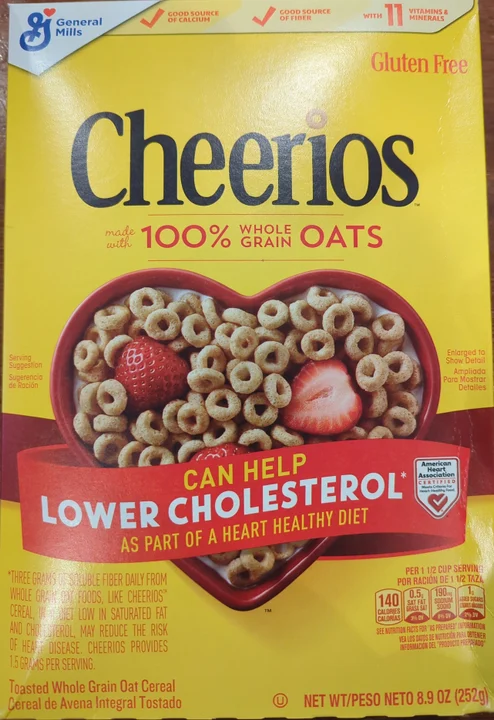 CheeriosLabeled gluten-freeWheat warning on 1 of 8 varieties we checkedGeneral Mills · checked Nov 16, 2026
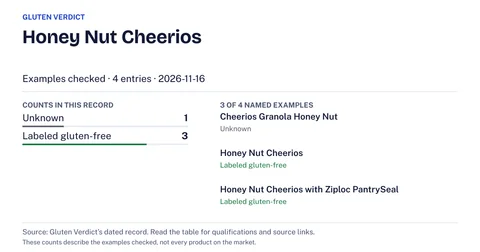 Honey Nut CheeriosLabeled gluten-freeGeneral Mills · checked Nov 16, 2026
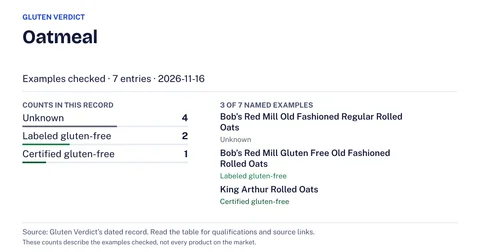 OatmealDepends on the productchecked Nov 16, 2026
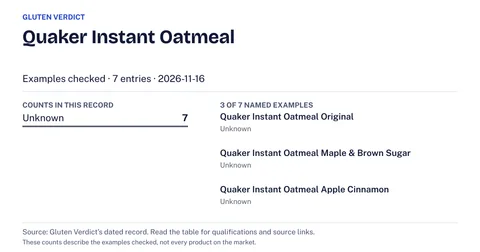 Quaker Instant OatmealUnknownThe Quaker Oats Company · checked Nov 16, 2026
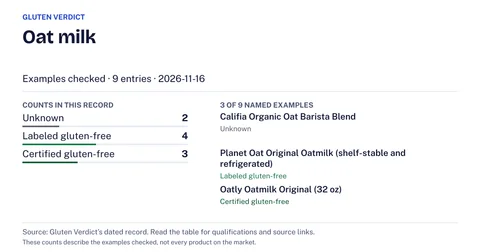 Oat milkDepends on the productchecked Nov 16, 2026
 GranolaDepends on the product1 of 6 products we checked contains gluten: Honey Bunches of Oats Honey Roasted Granolachecked Nov 16, 2026
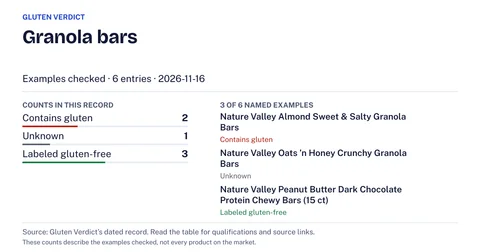 Granola barsDepends on the product2 of 6 products we checked contain gluten: Nature Valley Almond Sweet & Salty Granola Bars and Nature Valley Cinnamon Brown Sugar Soft-baked Oatmeal Squareschecked Nov 16, 2026
Questions people ask
Are mechanically sorted oats gluten-free?
Oats labeled gluten-free must contain less than 20 ppm of gluten1, and FDA's limit applies to the finished food whichever route a maker used5. GIG says both Purity Protocol and mechanical sorting are effective ways of producing gluten-free oats15.
Does a certification mark mean the same as a gluten-free claim?
Not necessarily. For the GFCO mark, GIG says the requirement is 10 ppm or less of gluten, while FDA's rule is less than 20 ppm14.
More in Grains, flours and substitutes
 Oats and celiac disease: what a gluten-free oat label does and does not tell youWhat FDA’s rule covers for oats, how makers get oats to the gluten-free limit, what avenin studies found, and what to ask your doctor.
 Gluten-free cereal: how to check a cereal boxCheck a cereal box in order: the gluten-free claim, malt and wheat in the ingredient list, the oats, then the maker’s own page for that flavour.
 Gluten-free breakfast: what to check on the label and in your kitchenGo through a usual breakfast item by item: what is gluten-free by nature, what needs a label check, and which kitchen habits cause trouble.
 Millet, sorghum, quinoa, buckwheat, teff, amaranth and wild rice: what the bag has to sayWhich grains and seeds are gluten-free plants, what makers and certifiers say about seven of them, and the cross-contact checks for bags, bins and blends.
 Gluten-free substitutes: the swap for each wheat ingredient and the label check it needsA lookup table of gluten-free swaps for wheat flour, pasta, bread, soy sauce, beer and more, with the one label check each swap needs.
 Cooking gluten-free pasta and rice noodles: what makers’ directions sayCompare what Jovial, Banza, Tinkyada, Lotus Foods and Thai Kitchen print for water, stirring, rinsing and time, then match the directions to your pasta.
Related guides
 Gluten-free oats by country: where the claim is allowed and where it is barredWhether oats can carry a gluten-free claim in the US, Canada, EU, UK, Australia and New Zealand, in each regulator’s own words.
 How to check a gluten-free seal in the certifier's own directorySearch GFCO's Product Finder by brand, product or UPC, read what an entry shows, and learn what a missing listing means for the seal on your pack.
 What to ask a food maker about gluten, and how to read the replyHow to write to a food maker about gluten: what to include, questions that get a usable answer, and how to sort the reply.
 What “may contain wheat” and “made in a facility with wheat” mean on a US labelHow to read “may contain wheat”, shared-facility and shared-equipment lines on US labels, with and without a gluten-free claim, and what to check next.
Sources
- [1, 2, 3, 4] US Food and Drug Administration, Questions and Answers on the Gluten-Free Food Labeling Final Rule, checked Nov 17, 2026.
- [5, 6] Electronic Code of Federal Regulations, 21 CFR 101.91 Gluten-free labeling of food, checked Nov 17, 2026.
- [7, 8, 9, 10, 11, 12, 13, 14, 15, 16, 36] Gluten Intolerance Group, Are Oats and Oat Flour Gluten-Free?, checked Nov 17, 2026.
- [17, 18, 19, 21] General Mills (Cheerios), Gluten Free Cheerios: our gluten-free process, checked Nov 17, 2026.
Read the page on 2026-11-17: it gives no parts-per-million figure and no test results, and it does not describe a protocol for growing or handling the oats apart from gluten grains before they reach the sorting step.
- [20, 22] General Mills (Cheerios), Cheerios FAQs, checked Nov 17, 2026.
Read the page on 2026-11-17: the gluten-free answers for Honey Nut Cheerios and Cheerios Protein give no parts-per-million figure and no test results.
- [23, 24, 25] Bob's Red Mill, Gluten Free Old Fashioned Rolled Oats, checked Nov 17, 2026.
Read the page on 2026-11-17: the product text does not say how the oats are grown, harvested or transported, does not use the term purity protocol, and does not mention a sorting step.
- [26] Bob's Red Mill, Gluten Free Steel Cut Oats, checked Nov 17, 2026.
- [27, 28] Oatly, Random Answers & FAQ, checked Nov 17, 2026.
Read the answer headed “What about allergens such as gluten, soy and nuts?” on 2026-11-17: it says the US products are made from certified gluten-free oats; it does not describe how the oats are grown, handled or sorted, names no certifier and gives no test figure.
- [29, 30] King Arthur Baking Company, Rolled Oats, checked Nov 17, 2026.
Read the page on 2026-11-17: the description says the oats are sustainably grown and processed; it does not say how gluten grains are kept out or removed, and gives no test figure or certifier.
- [31] Gluten-Free Certification Organization, GFCO Product Finder search: Cheerios, checked Nov 17, 2026.
Read the Product Finder results page for the search “Cheerios” on 2026-11-17: the results area reads “No products found”.
- [32] Gluten-Free Certification Organization, GFCO Product Finder search: Quaker, checked Nov 17, 2026.
Read the Product Finder results page for the search “Quaker” on 2026-11-17: the results area reads “No products found”.
- [33, 34] National Celiac Association, Why can I NOT tolerate GF oats?, checked Nov 17, 2026.
- [35] Bob's Red Mill, Old Fashioned Regular Rolled Oats, checked Nov 17, 2026.
Read the page on 2026-11-17: the description and nutrition text make no gluten-free claim.