Sin TACC in Argentina: the logo and the ANMAT gluten-free register
Short answer
TACC stands for trigo, avena, cebada and centeno: wheat, oats, barley and rye, the grains Ley 26.588 names when it tells the health authority to set what counts as gluten-free1. For a packaged food sold in Argentina, ANMAT asks you to check two things together, and the Código Alimentario Argentino puts the gluten limit behind both at 10 mg/kg2, 3:
Part of Gluten-free labeling law by country, 12 guides
Key points
- The law writes the two phrases together as “libre de gluten (sin TACC)”4.
- A gluten-free food must contain no prolamins or glutelins from wheat, rye, barley or oats, and registration needs an analysis plus a manufacturing-practice programme3, 5.
- The symbol the code prescribes reads “SIN GLUTEN”; ANMAT’s help page says companies have until 02/12/2026 to adopt the new logo, so shelves can carry earlier symbols6, 7.
- A register entry shows product type, brand, fantasy name, sales name, registration number and status, with no date column8.
- Restaurants and bars have a separate duty in the law: at least one gluten-free option or menu4, 9.
What TACC stands for and what Ley 26.588 says
TACC is the abbreviation Ley 26.588 uses for gluten from wheat, oats, barley and rye. The law tells the health authority to determine how much “gluten de trigo, de avena, de cebada o de centeno (TACC)” a food may contain to be classed as gluten-free1. It writes the two phrases side by side as “libre de gluten (sin TACC)”4.
What the law requires, in the updated text we read:
- A food sold as gluten-free must print the legend “Libre de gluten” and the symbol the authority sets, clearly visible on the pack10.
- The Ministry of Health must keep a register of the foods and medicines that meet the limit; the law says it is updated every two months and published once a year11.
- Printing “Libre de gluten” on a pack that does not meet the law’s requirement is an infraction12.
- A listed set of institutions and businesses, restaurants and bars among them, must offer at least one gluten-free option or menu4, 9.
The limit behind the claim: Article 1383 of the Código Alimentario
The law leaves the number to the authority1. It sits in Article 1383 of the Código Alimentario Argentino (CAA). A gluten-free food or drink is one that contains no prolamins or glutelins from wheat (every Triticum species), rye, barley, oats or their crossbreeds, and its gluten content may not exceed 10 mg/kg3.
- It can get there through its ingredients or through a process that removes gluten, together with manufacturing practices that prevent cross-contamination3.
- The code says the ELISA R5 Méndez method must be used to check the condition, and also allows ELISA G12 and any other method the national health authority evaluates and accepts13, 39.
- The words go in the name: the product’s name followed by “libre de gluten”, as part of the name in letters of equal prominence14.
- To be approved, makers and importers file with their jurisdiction’s health authority an analysis supporting the claim from an official body or an officially recognised entity, plus a good-manufacturing-practice programme5.
The 2023 joint resolution that wrote this version says the agreed definition is a maximum of 10 mg/kg of gluten proteins, reached either through ingredients and practices or through a technological process that lowers the content below that figure15. For how 10 mg/kg sits beside other countries’ limits, see gluten-free labeling laws by country; for the US rules a visitor will meet, see US gluten-free labels for visitors.
The symbol on the pack
Article 1383 bis of the code requires every food or drink sold in Argentina as gluten-free to carry a printed symbol: a circle with a crossed bar over three ears of grain, with “SIN GLUTEN” on the bar, in two variants6. The Ministry of Health adds that the logo may be used only on the labels of foods that meet the limit in Article 138316.
So the current official mark reads “SIN GLUTEN”, not “SIN TACC”6. The Asociación Celíaca Argentina describes the official symbol as “Sin Gluten”, shown clearly on the pack, with the legend “Libre de Gluten” followed by the sales name17. The association’s own app is called “App Sin TACC”38.
The logo is changing over. The 2023 resolution gave companies with approved gluten-free products three years to adapt19. ANMAT’s help page puts the end of that period at 02/12/2026, and says that until then you can find products with an earlier symbol or the new logo on the shelf7. We have not opened a page that shows the earlier symbols, so we do not describe them.
The ANMAT register: what it is and how to search it
Ley 26.588 makes the Ministry of Health keep a register11. ANMAT’s National Food Institute (INAL) provides it online as the Listado Integrado de Alimentos Libres de Gluten, LIALG, at listadoalg.anmat.gob.ar20.
The list is built from foods registered by the provincial health authorities, SENASA, the national wine institute (INV) and INAL itself, plus imported products admitted by import notice21. A product’s listing means an official analysis supporting the 10 ppm maximum and a good-manufacturing-practice programme have been filed22.
- Find the registration number on the pack: an RNPA, SENASA or INV number, the identification code the competent health authority gives a food so it can be sold across the country23.
- Type it into the search exactly as printed, keeping hyphens and slashes but leaving out the dots between digits. A partial number works if the digits are consecutive and the hyphens or slashes stay24.
- Or search by brand or fantasy name: fill in one of the two, not both, and keep multiple words consecutive25.
- In the results, look at the last column: ANMAT’s check is that the product appears with the status “Vigente”2.
ANMAT suggests repeating the check from time to time for products you buy routinely26. Additions and removals are loaded by the health authority that registered each product27.
Reading a register entry
A search returns a table. When we ran one on 2026-11-17 the columns were Tipo de Producto, Marca, Nombre de Fantasía, Denominación de venta, RNPA and Estado, and the Estado filter offers Vigente, Baja permanente and Baja provisoria8. None of the six columns is a date, so an entry does not say when the product was listed8.
The RNPA is several digits, and the first two show the jurisdiction where the food or drink was registered28.
A listing can be taken off the register in two ways. A removal is provisional in a case such as cross-contamination with gluten, and permanent in a case such as the product no longer being sold29.
Imported packs
Some imported products enter under an import notice and carry no RNPA, SENASA or INV number on the label. They can still be in the register once the competent health authority has overseen them on entry30. If a search by number finds nothing, ANMAT says to search again by brand or fantasy name and sales name31.
The Ministry of Health says Decreto 35/2025 sets the requirements for imported foods by country of origin: foods from the countries in the decree’s Annex III may be sold with a sworn declaration plus the origin country’s marketing authorization, free-sale certificate or equivalent32. Imported foods above 10 ppm that hold a gluten-free certification from one of those countries are shown separately in the official list and may carry the symbol and legends of their country of origin33.
What the logo and the register do not cover
- A symbol with no entry. If a pack shows the official symbol and, after every search option, the product is not in the register, ANMAT recommends that people with celiac disease avoid buying or eating it, and asks to be contacted34.
- Restaurants, bars and food service. The register’s help page describes searching by registration number, brand, fantasy name and sales name, not by restaurant or dish36. The law’s duty for restaurants and bars to offer at least one gluten-free option or menu is separate4, 9; the Ministry’s page gives 14 June 2024 as the end of their adaptation period35.
- Loose or bulk food. The Ministry’s shopping advice is to avoid loose or bulk products and choose sealed ones, since naturally gluten-free foods such as dried fruit and legumes can pick up gluten from other products when left open37.
The Asociación Celíaca Argentina recommends always checking the label and checking that the product is listed in its app or in ANMAT’s search18.
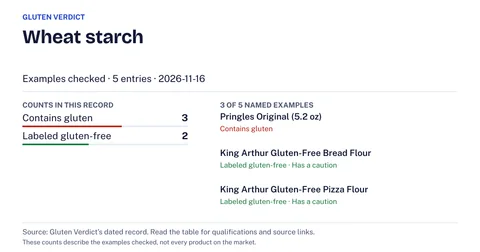
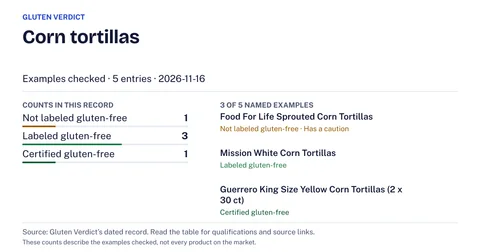
Our verdict pages cover foods and ingredients, not Argentine register entries; for two examples see wheat starch and corn tortillas.
Verdicts in this guide
Questions people ask
What does TACC stand for?
Trigo, avena, cebada and centeno: wheat, oats, barley and rye. The law writes it as “gluten de trigo, de avena, de cebada o de centeno (TACC)”1.
Is “sin TACC” the same as “libre de gluten”?
The law uses them together, as “libre de gluten (sin TACC)”4. The legend a gluten-free pack must print is “Libre de gluten”10.
What is Argentina’s gluten limit?
The Código Alimentario says the gluten content may not exceed 10 mg/kg3. ANMAT’s register FAQ gives the maximum as 10 ppm22.
Does the Argentine definition treat oats like wheat, rye and barley?
The definition lists oats among the grains whose prolamins and glutelins a gluten-free food must not contain3.
More in Gluten-free labeling law by country
 Gluten-free logos outside the US: who issues each one and what it requiresTell a certifier’s gluten-free logo from a maker’s own: who issues Crossed Grain, Coeliac Australia’s and Celiac Canada’s marks, and the limit each sets.
 What the Codex gluten standard says, and which countries follow itWhat Codex Standard 118-1979 sets for gluten-free food, why it is not law, and how the US, EU, UK, Canada, Australia, NZ and Argentina compare.
 Gluten-free and very low gluten on EU labels, and how allergens are highlightedWhat EU “gluten-free” and “very low gluten” claims permit, how cereals containing gluten are highlighted in ingredient lists, and the rules for loose food.
 Gluten-free labeling rules by country: ceilings, claim wording and where no rule was foundLook up the gluten-free limit and claim wording for the US, Canada, EU, UK, Australia, New Zealand and more, each figure tied to the page we read.
 UK gluten-free labelling: the legal rules, Natasha’s Law and the Crossed GrainWhat UK law requires on allergen and gluten-free labels, what Natasha’s Law added for food packed on site, and how the Crossed Grain mark differs.
 Gluten-free labelling in Australia and New Zealand: what the claim meansWhat “gluten free” and “low gluten” mean on Australian and New Zealand packs: no detectable gluten, no oats, no malt, and how US packs compare.
Related guides
 Reading US gluten-free labels as a visitor from the UK, EU, Canada or AustraliaWhat a US gluten-free claim, the Contains line, malt and alcohol labels mean if you are used to UK, EU, Canadian or Australian labels.
 Gluten-free in Argentina: sin TACC, the ANMAT list, parrilla and milanesaWhat “sin TACC” means, how to check a product in ANMAT’s official list, and how to judge parrilla, milanesa, empanadas and alfajores in Argentina.
 Starting a gluten-free diet: testing first, then labels, oats and the kitchenWhat NIH and the celiac charities say about starting a gluten-free diet: testing first, which foods to start with, a US label check, oats and the kitchen.
 Gluten-free in Spain: what “sin gluten” means and what FACE coversWhat “sin gluten” means in Spain, what FACE’s marks and restaurant program say they cover, and which tapas need a question before you order.
Sources
- [1, 4, 9, 10, 11, 12] Ministerio de Justicia de la Nación Argentina (Normativa nacional), Ley 26588, enfermedad celíaca (texto actualizado), checked Nov 17, 2026.
- [2, 7, 24, 25, 26, 31, 34, 36] ANMAT (Argentina), Listado Integrado de Alimentos Libres de Gluten, ayuda, checked Nov 17, 2026.
Read on 2026-11-17: the page’s search guidance covers searching by registration number (RNPA, SENASA or INV), by brand or fantasy name and by sales name; it does not mention restaurants, menus or dishes.
- [3, 5, 6, 13, 14, 39] Ministerio de Salud de la Nación Argentina, Código Alimentario Argentino, Capítulo XVII (artículos 1383 y 1383 bis), checked Nov 17, 2026.
- [8] ANMAT (Argentina), Listado Integrado de Alimentos Libres de Gluten, buscador, checked Nov 17, 2026.
Read on 2026-11-17: a search on the register’s home page (Estado set to Vigente, Denominación “harina de arroz”) returned a table with six columns: Tipo de Producto, Marca, Nombre de Fantasía, Denominación de venta, RNPA and Estado, and none of them is a date. The Estado filter on that page lists Todos, Baja permanente, Baja provisoria and Vigente.
- [15, 19] Secretaría de Agricultura, Ganadería y Pesca y Secretaría de Calidad en Salud (Argentina), Resolución Conjunta 32/2023, modificación del Código Alimentario Argentino, checked Nov 17, 2026.
- [16, 32, 33, 35] Ministerio de Salud de la Nación Argentina, Celiaquía: legislación, checked Nov 17, 2026.
- [17, 18, 38] Asociación Celíaca Argentina, Alimentación sin gluten, checked Nov 17, 2026.
- [20, 21, 22, 23, 27, 28, 29, 30] ANMAT (Argentina), Listado Integrado de Alimentos Libres de Gluten, preguntas frecuentes, checked Nov 17, 2026.
- [37] Ministerio de Salud de la Nación Argentina, Contaminación cruzada en la alimentación de las personas celíacas, checked Nov 17, 2026.