Gluten-free and very low gluten on EU labels, and how allergens are highlighted
Short answer
Read an EU pack in three steps:
- The claim. “Gluten-free” means no more than 20 mg of gluten per kg of food as sold, and “very low gluten” means no more than 100 mg/kg, allowed only for food made with ingredients specially processed to reduce gluten1, 2.
- The ingredient list. Cereals containing gluten (wheat, rye, barley, oats and their hybridised strains, as the UK FSA lists the Annex II entry) must be emphasised in the list through a typeset that clearly distinguishes them, for example by font, style or background colour; where there is no list, the word “contains” and the cereal’s name are used instead3, 4, 5.
- Loose and restaurant food. Allergen information is mandatory, the gluten-free claim rules apply to it whenever a claim is made, and Member States may set national rules on how that information is made available and presented6, 7, 8, 19.
Part of Gluten-free labeling law by country, 12 guides
Key points
- EU law has two separate rules: Regulation 828/2014 for the words “gluten-free” and “very low gluten”, and Regulation 1169/2011 for the allergen declaration1, 10.
- “Very low gluten” is a real EU claim with a higher ceiling than “gluten-free”: up to 100 mg/kg against 20 mg/kg1, 2.
- Oats are named in the EU definition of gluten, and oats in a gluten-free or very low gluten food must be specially produced and have a gluten content of no more than 20 mg/kg11, 12.
- Cereals containing gluten are emphasised inside the ingredient list; where there is no list, the word “contains” and the cereal’s name are used4, 5.
- As of FoodDrinkEurope’s October 2024 paper there were thus far no formal legal definitions of precautionary “may contain” labelling in the EU13.
Two rules apply: one for the claim, one for allergens
Regulation (EU) No 828/2014 governs the words “gluten-free” and “very low gluten”. It has applied since 20 July 2016 and is binding in its entirety and directly applicable in all Member States9. The Commission says it did not change the substance of the rules that Regulation (EC) No 41/2009 had set14.
Regulation (EU) No 1169/2011, the general food-information law, covers allergens. Its mandatory particulars include any ingredient listed in Annex II, or derived from a substance listed there, that is still present in the finished product10. “Cereals containing gluten” is one of the entries in that Annex3.
The two differ in one way that matters when you read a pack. A gluten claim is voluntary: the UK FSA’s guidance speaks of foods that have been voluntarily labelled “gluten-free”15. Voluntary food information in general must not mislead, must not be ambiguous or confusing and, where appropriate, must rest on relevant scientific data16. The allergen declaration is mandatory10.
The article wording quoted on this page is from Regulation 1169/2011 as published in the Official Journal in 2011. The Commission records that it was first amended through Delegated Regulation (EU) No 1155/201351, so check the current consolidated text on EUR-Lex before relying on exact wording.
What “gluten-free” allows on an EU pack
The condition is one number, measured on the food as sold to the shopper: no more than 20 mg/kg of gluten1.
The regulation defines “gluten” as the protein fraction from wheat, rye, barley, oats or their crossbred varieties and derivatives11. Oats are inside that definition, which is why the oats section below matters.
A food made only from ingredients that are naturally free of gluten may also carry the term. The regulation’s preamble says so, provided the general fair-information rules are met, and warns against suggesting special characteristics when all similar foods have them17. Coeliac UK says the UK label may apply to specialist products including foods with gluten free wheat starch as well as processed foods made from naturally gluten free ingredients18.
Other wording the regulation permits or bars
- Information on the absence or reduced presence of gluten may be given only through the Annex statements19. The UK FSA reads this as meaning no other such statement is permitted20.
- “Suitable for people intolerant to gluten” or “suitable for coeliacs” may accompany the claim21.
- “Specifically formulated for people intolerant to gluten” or “specifically formulated for coeliacs” may accompany it only when the food is specially produced, prepared or processed to reduce the gluten of an ingredient or to substitute naturally gluten-free ingredients22.
- Infant formula and follow-on formula may not carry gluten information of this kind23.
What “very low gluten” means and who may use it
“Very low gluten” is a second, narrower claim. It may be made only where the food consists of or contains one or more ingredients made from wheat, rye, barley, oats or their crossbred varieties that were specially processed to reduce gluten, and the food as sold contains no more than 100 mg/kg of gluten2.
| “Gluten-free” | “Very low gluten” | |
|---|---|---|
| Limit in the food as sold | No more than 20 mg/kg1 | No more than 100 mg/kg2 |
| Ingredient condition | None stated in the Annex beyond the 20 mg/kg limit1 | Food consisting of or containing ingredients made from wheat, rye, barley, oats or crossbred varieties that were specially processed to reduce gluten2 |
| Oats in the food | Specially produced, prepared or processed to avoid contamination; no more than 20 mg/kg in the oats12 | Same rule for the oats12 |
A food that meets only the “very low gluten” condition may therefore hold up to 100 mg/kg, above the 20 mg/kg that “gluten-free” allows1, 2. Check which of the two phrases is on the pack before comparing it with a gluten-free product.
Coeliac UK noted that there were no foods currently labelled “very low gluten” in the UK but that such products might be found in other European countries24.
Oats under the EU claim
A food presented as gluten-free or very low gluten may contain oats only if the oats were specially produced, prepared or processed to avoid contamination by wheat, rye, barley or their crossbred varieties, and the gluten content of the oats cannot exceed 20 mg/kg12. That oat limit applies even inside a “very low gluten” food12.
The preamble gives the reason: a major concern is contamination of oats with wheat, rye or barley during harvesting, transport, storage and processing25.
A gluten-free label does not take oats out of the allergen rules. The UK FSA’s guidance, which applies to England, Northern Ireland and Wales, says the cereal named in Annex II must still be indicated and emphasised in the list of ingredients26.
For the US side of the same question, see gluten-free oats vs regular oats. Our oatmeal verdict links the maker pages we read.
How cereals containing gluten are highlighted in the ingredient list
Regulation 1169/2011 requires the name of an Annex II substance to be emphasised in the list of ingredients through a typeset that clearly distinguishes it from the rest of the list, for example by font, style or background colour4. The UK FSA’s guidance on the UK version of the rule says a food business has flexibility in choosing the mode of emphasis27.
The UK FSA’s guidance gives the Annex II entry for cereals containing gluten as wheat (such as spelt and Khorasan wheat), rye, barley and oats or their hybridised strains3. The FSA adds that where a pack says spelt, Khorasan or Kamut, a specific reference to wheat would be required28.
The rule reaches derived ingredients. The allergen particular covers any ingredient derived from an Annex II substance and still present in the finished product10, and the FSA says such ingredients need to be emphasised in the list29. For ingredients we check, see wheat starch, malt extract and barley.
It is the cereal that gets highlighted, not the word “gluten”. The FSA says the word may be added after the cereal, but the regulation requires the cereal to be emphasised rather than the gluten30.
Where there is no ingredient list, and what is exempt
Where there is no list of ingredients, the allergen is shown with the word “contains” followed by the Annex II name5. No indication is required where the name of the food clearly refers to the substance concerned31.
Annex II also lists four exceptions to the cereals entry: wheat based glucose syrups including dextrose, wheat based maltodextrins, glucose syrups based on barley, and cereals used for making alcoholic distillates32. In the regulation as published in 2011, a footnote to the first two reads: “And the products thereof, in so far as the process that they have undergone is not likely to increase the level of allergenicity assessed by the Authority for the relevant product from which they originated”33. The FSA says substances derived from an allergenic ingredient and specifically exempted from declaration under Annex II do not need to be declared as allergens, and gives wheat glucose syrup as an example50.
A list of ingredients is not mandatory under Article 16(4) for drinks over 1.2 % alcohol by volume34. That exemption names points (b) and (l) of Article 9(1) only, and the allergen particular is point (c)10. Where a drink has no list, the allergen takes the form of the word “contains” plus its Annex II name5. Our beer verdict shows how a barley-based drink reads on the maker’s pages.
Loose, restaurant and takeaway food
For food sold without prepackaging, packed on the premises at the customer’s request or prepacked for direct sale, allergen information is mandatory, while other particulars are required only if a Member State adopts a national measure35. The Commission’s own summary says the same for non-prepacked food6.
Member States may adopt national measures on the means through which that information is made available and its form of expression and presentation8. The form of the information may therefore differ from one EU country to the next. See also our travel guides to France and Italy.
The gluten claim is a separate matter. The Commission says Regulation 828/2014 applies also to non-prepacked foods such as those served in restaurants, which the old rules did not cover7.
“May contain” lines: voluntary, with no formal EU legal definition
The allergen particular covers ingredients and processing aids used in making the food10. Information on possible and unintentional presence is a different thing: Article 36(3)(a) lists it as voluntary food information36, and it must meet the tests for voluntary information, not misleading, not ambiguous or confusing, and based on relevant scientific data where appropriate16.
FoodDrinkEurope, the food and drink industry association, wrote in October 2024 that there were thus far no formal legal definitions of precautionary allergen labelling in the EU13. Read each “may contain” line as the maker’s own statement.
A gluten-free claim and a “may contain” line can share a pack in the UK: the FSA’s guidance for England, Northern Ireland and Wales gives “gluten-free” with “may contain wheat (cereal)” as an example37, 38. For the US position see what “may contain wheat” means on a US label.
England, Wales and Northern Ireland after Brexit
The UK FSA’s allergen-labelling guidance, which applies to England, Northern Ireland and Wales38, describes its framework as largely contained in assimilated Regulation 1169/2011 for England and Wales and Regulation 1169/2011 for Northern Ireland39. The UK version of the 828/2014 Annex on legislation.gov.uk carries the same 20 mg/kg condition40, and on the day we read it said it had not been amended by the UK since the end of the Brexit transition41. For other countries’ rules, see gluten-free labeling rules by country.
How the EU rules differ from the US ones
| Question | EU | US |
|---|---|---|
| The gluten-free limit | No more than 20 mg/kg of gluten in the food as sold1 | Unavoidable gluten must be less than 20 ppm, with conditions on ingredients as well42 |
| A lower-gluten claim | “Very low gluten”, up to 100 mg/kg, for food made with specially processed ingredients2 | None on the FDA page we read; FDA names “gluten-free” and three equivalent phrases43, 44 |
| Other wording | Only the Annex statements, plus “suitable for” and “specifically formulated for” wording19, 21, 22 | “Free of gluten”, “without gluten” and “no gluten” are equivalent to “gluten-free”44 |
| Oats | Part of the definition of gluten; oats in a gluten-free food must be specially produced and at most 20 mg/kg11, 12 | Oats labeled gluten-free must contain less than 20 ppm45 |
| Which gluten grains the allergen rule names | Wheat, rye, barley, oats or their hybridised strains, as the UK FSA lists the Annex II entry3 | The major food allergen definition in FALCPA’s text on FDA’s page names wheat, and does not name barley, rye or oats46 |
| How allergens are shown | Emphasised in the ingredient list; “contains” plus the name where there is no list4, 5 | A “Contains” statement next to the list47, or the source in parentheses after the ingredient48 |
| Food served loose or in restaurants | Allergen information mandatory; the gluten-free claim rules apply whenever a claim is made6, 7, 19 | FDA’s rule applies to packaged foods; FDA recommends restaurants follow its definition if they make a claim49 |
Compare words, not numbers alone: the EU states its limit as “no more than 20 mg/kg”1 and FDA as “less than 20 ppm”42. For the US label in full, see how to read a US food label for gluten and reading US gluten-free labels as a visitor.
Verdicts in this guide
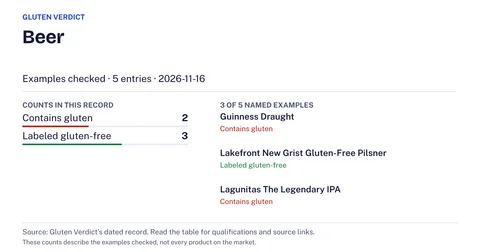 BeerDepends on the product2 of 5 products we checked contain gluten: Guinness Draught and Lagunitas The Legendary IPAchecked Nov 16, 2026
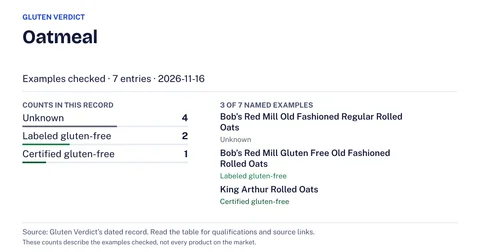 OatmealDepends on the productchecked Nov 16, 2026
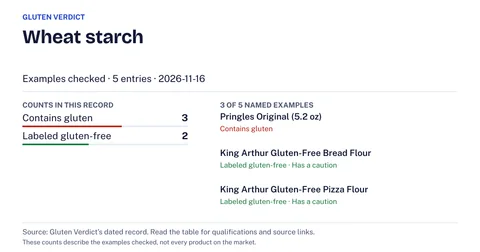 Wheat starchDepends on the product3 of 5 products we checked contain gluten: Pringles Original (5.2 oz), Jiffy Corn Muffin Mix, and Chex Mix Bold Garlic and Herbchecked Nov 16, 2026
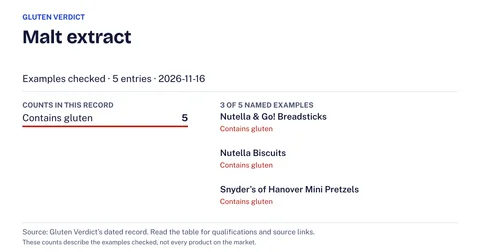 Malt extractContains glutenchecked Nov 16, 2026
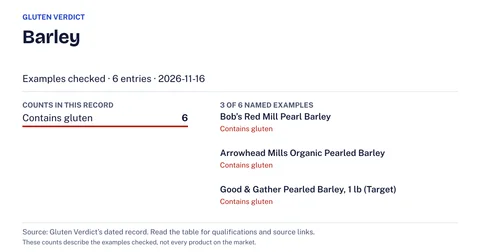 BarleyContains glutenchecked Nov 16, 2026
Questions people ask
Is “very low gluten” the same as gluten-free?
No. “Gluten-free” allows no more than 20 mg/kg1. “Very low gluten” allows up to 100 mg/kg and only for food made with ingredients specially processed to reduce gluten2.
Can an EU gluten-free product contain oats?
Yes, if the oats were specially produced, prepared or processed to avoid contamination and contain no more than 20 mg/kg of gluten12. The UK FSA’s guidance says the oats must still be emphasised in the ingredient list26.
Does a restaurant in the EU have to follow the gluten-free rule?
The Commission says Regulation 828/2014 applies also to non-prepacked food such as that served in restaurants7, and its conditions apply wherever a gluten statement is used19. Allergen information is mandatory for such food6.
Does the EU require a “Contains” line?
The regulation requires the word “contains” plus the cereal’s name where there is no list of ingredients5. Where there is a list, the cereal is emphasised in the list itself4.
Is there an EU-wide wording for “may contain”?
FoodDrinkEurope wrote in October 2024 that there were thus far no formal legal definitions of precautionary allergen labelling in the EU13.
More in Gluten-free labeling law by country
 Gluten-free labeling rules by country: ceilings, claim wording and where no rule was foundLook up the gluten-free limit and claim wording for the US, Canada, EU, UK, Australia, New Zealand and more, each figure tied to the page we read.
 Gluten-free labeling in Canada: the claim, the gluten-source declaration and oatsHow Health Canada's gluten-free claim works, how gluten sources and oats must be declared on a Canadian pack, and how it differs from the FDA rule.
 Gluten-free labelling in Australia and New Zealand: what the claim meansWhat “gluten free” and “low gluten” mean on Australian and New Zealand packs: no detectable gluten, no oats, no malt, and how US packs compare.
 Which gluten grains a pack’s allergen line must name, by countryWhether the allergen line must name barley, rye and oats, country by country: US, Canada, EU, UK, Australia and New Zealand, Brazil, Japan.
 UK gluten-free labelling: the legal rules, Natasha’s Law and the Crossed GrainWhat UK law requires on allergen and gluten-free labels, what Natasha’s Law added for food packed on site, and how the Crossed Grain mark differs.
 Gluten-free oats by country: where the claim is allowed and where it is barredWhether oats can carry a gluten-free claim in the US, Canada, EU, UK, Australia and New Zealand, in each regulator’s own words.
Related guides
 May-contain labels abroad: what each country’s regulator says about themWhether a “may contain” or shared-facility line is required, voluntary or guided by a scheme in the US, UK, EU, Canada, Australia, New Zealand and Codex.
 What the Codex gluten standard says, and which countries follow itWhat Codex Standard 118-1979 sets for gluten-free food, why it is not law, and how the US, EU, UK, Canada, Australia, NZ and Argentina compare.
 Gluten words on European food labels, language by languageFind the ingredient list, the gluten-cereal name and the gluten-free claim on a European pack in 11 languages, using words from the EU’s own texts.
 What a European restaurant must tell you about gluten, country by countryWhether restaurants in France, Germany, Austria, Italy, Spain and the UK must show allergens in writing or may answer aloud, and what to ask.
Sources
- [1, 2, 9, 11, 12, 17, 19, 21, 22, 23, 25] European Commission (EUR-Lex), Commission Implementing Regulation (EU) No 828/2014 on the requirements for the provision of information to consumers on the absence or reduced presence of gluten in food, checked Nov 17, 2026.
- [3, 15, 20, 26, 27, 28, 29, 30, 32, 37, 38, 39, 50] UK Food Standards Agency (GOV.UK), Food allergen labelling and information requirements: technical guidance, checked Nov 17, 2026.
Read on 2026-11-17: paragraph 19 of the guidance, which lists the Annex II allergens, gives four exceptions under “Cereals containing gluten”: wheat based glucose syrups including dextrose; wheat based maltodextrins; glucose syrups based on barley; and cereals used for making alcoholic distillates including ethyl alcohol of agricultural origin.
- [4, 5, 8, 10, 16, 31, 33, 34, 35, 36] European Commission (EUR-Lex), Regulation (EU) No 1169/2011 on the provision of food information to consumers, as published in the Official Journal on 22 November 2011, checked Nov 17, 2026.
- [6] European Commission, Mandatory food information, checked Nov 17, 2026.
- [7, 14, 51] European Commission, Gluten-free food, checked Nov 17, 2026.
- [13] FoodDrinkEurope (industry association), Precautionary Allergen Labelling (PAL), version 3, October 2024, checked Nov 17, 2026.
- [18, 24] Coeliac UK, Gluten and the Law, checked Nov 17, 2026.
- [40, 41] legislation.gov.uk, Regulation (EU) No 828/2014, Annex, UK version, checked Nov 17, 2026.
- [42, 43, 44, 45, 49] US Food and Drug Administration, Questions and Answers on the Gluten-Free Food Labeling Final Rule, checked Nov 17, 2026.
Read on 2026-11-17: the page contains no mention of a “very low gluten” claim; it covers the “gluten-free” claim and the three phrases it treats as equivalent.
- [46, 47, 48] US Food and Drug Administration, Food Allergen Labeling and Consumer Protection Act of 2004 (FALCPA), checked Nov 17, 2026.