Gluten-free in Spain: what “sin gluten” means and what FACE covers
Short answer
Spain follows the EU rule19, under which “sin gluten” may be used only for food with no more than 20 mg of gluten per kg as sold1. That is a limit on the food, not a promise about a kitchen11, so check in this order:
- Packs: look for “sin gluten”, which the EU rule allows only at 20 mg/kg or less1, or for the ELS Crossed Grain licence, whose code carries ES for Spain2, 3.
- Restaurants: look for the FACE program badge with the current year on the door or window4. FACE recommends venues in its program5.
- Everywhere else: say you have celiac disease and ask what is in each dish and how it is made, as FACE advises6, 70. Spanish rules let a venue answer orally if it keeps a written or electronic record7, 8.
- Tapas: ask about coatings, flour-bound fillings and fryer oil. FACE’s own kitchen advice is not to reuse oil that has fried gluten-containing food9.
- Gluten-free limit
- No more than 20 mg of gluten per kg of food as sold1; the regulation is directly applicable in all Member States18
- Oats
- In a food presented as gluten-free, oats must be specially produced to avoid contamination by wheat, rye or barley, and their gluten content cannot exceed 20 mg/kg25
- Celiac society
- Federación de Asociaciones de Celíacos de España (FACE)
Part of Travel: Europe, 19 guides
Key points
- EU law allows the claim only at 20 mg/kg or less in the food as sold1; FACE applies the same 20 ppm limit when it tests restaurant dishes offered as “sin gluten”10.
- FACE says offering gluten-free dishes in good faith does not, on its own, mean they are handled correctly11.
- The “Controlado por FACE” product mark was folded into the ELS in 2020 and is no longer awarded12; the FACE restaurant badge is a separate program4.
- EU allergen law names oats as well as wheat, rye and barley among the cereals containing gluten13; the US allergen list names wheat but not barley or rye14.
- FACE’s multilingual card lists croquettes, breadcrumbs and flour-made sauces and soups among the foods to avoid15, 16.
What “sin gluten” commits a pack or a menu to
The EU rule says the statement “gluten-free” may be made only where the food as sold to the final consumer contains no more than 20 mg/kg of gluten1. The Spanish text words it as «sin gluten»17, and the regulation is directly applicable in every Member State18, Spain included. FACE, the federation of Spanish celiac societies41, says on its page for visitors that Spain is governed by Regulations 1169/2011 and 828/201419.
Two things follow from the wording. The limit is on the food as sold, not on a kitchen’s habits. And FACE applies the same limit to restaurants: when it takes samples of dishes that venues offer as “sin gluten”, it treats 20 ppm as the legal maximum10. Using the claim at all is voluntary20, and where a food gives information on the absence or reduced presence of gluten, the regulation allows it only through its listed statements21.
| Statement | What the regulation allows | What FACE adds |
|---|---|---|
| “Sin gluten” (gluten-free) | No more than 20 mg/kg of gluten in the food as sold1 | FACE writes the figure as 20 ppm (mg/kg)22 |
| “Muy bajo en gluten” (very low gluten) | No more than 100 mg/kg, only for food with wheat, rye, barley or oats ingredients that were specially processed to reduce gluten23 | FACE calls “sin gluten” the only mention valid for people with celiac disease24 |
Oats are handled inside the same rule: oats in a food presented as gluten-free must be specially produced, prepared or processed to avoid contamination by wheat, rye or barley, and the oats’ gluten content cannot exceed 20 mg/kg25. FACE’s English page tells visitors not to consume products with “trigo, cebada, centeno, avena” in the ingredients unless it is an exception licensed with the ELS26.
A US comparison: FDA says any unavoidable gluten in a food labeled gluten-free must be less than 20 ppm27. The two rules are worded differently; the numbers are both 20.
How gluten shows up in allergen information, on packs and in bars
EU allergen law lists “cereals containing gluten” and names wheat, rye, barley and oats among them13. In the Spanish text the entry reads «Cereales que contengan gluten»28. The US list differs: it names wheat, not barley or rye14.
On a pack with an ingredient list, the allergen’s name must be emphasised through a typeset that clearly distinguishes it from the rest of the list, for example by font, style or background colour29. Without a list, the indication is the word ‘contains’ followed by the allergen’s name30.
A “may contain” line is a different matter. FACE says no regulation sets a limit for “traces” of any of the 14 allergens and that declaring them is voluntary31. For foods that are gluten-free by nature, FACE reports finding preventive labels such as «puede contener gluten» on the market and recommends buying only brands that do not carry them32.
In a restaurant or bar
EU law makes the allergen particulars mandatory for food offered without prepackaging33, 34 and lets Member States adopt national measures on how they are made available35. Spain’s Royal Decree 126/2015 covers food presented unpackaged to consumers and caterers36. It requires the allergen particulars37 and allows them to be given orally7, provided staff can supply them easily when asked38 and they are recorded in writing or electronically at the venue, where staff, inspectors and customers who ask can reach them8.
So a spoken answer from the server is a lawful way to give allergen information in Spain, as long as a record exists behind it. For venues that serve meals adapted to allergies or intolerances, the Decree says the information must be available and given whenever consumers or inspectors ask39. FACE puts it to diners this way: restaurants are obliged to give customers information on the allergens in the dishes they serve40.
What FACE’s marks and programs cover, in FACE’s words
FACE is made up of 17 regional federations and associations of celiac societies41. Its marks and programs cover different things, so a table is the quickest way to tell them apart.
| Mark or program | What it is | What FACE says it covers |
|---|---|---|
| ELS, the Crossed Grain (“Espiga Barrada”) licence | Licensed products carry the symbol and an alphanumeric code2; the first part of the code is the country, always ES for Spain3 | A limit of 20 mg/kg measured in the food as sold42, with an annual control of the food business’s hazard-analysis (APPCC) system43. Foods that are gluten-free by nature cannot be certified under it44 |
| “Controlado por FACE” | FACE’s older product mark | Folded into the ELS in 2020; FACE no longer awards it12 |
| FACE restaurant program badge | A badge with the current year on the main door or window of an advised venue4, renewed every year45 | Advice and checks on how the venue prepares gluten-free dishes, listed below |
| CELIGUIA digital product list | FACE’s digital list of gluten-free foods, inside its app. A company’s inclusion is voluntary, so the list does not cover every gluten-free product on the market46 | An individual review of each listed product’s ingredients, labelling and documentation47 |
What the restaurant program asks of a venue
- FACE’s staff visit the premises to assess whether a gluten-free offer is viable48.
- The venue’s gluten-free preparation protocols are adapted, from buying raw materials to serving49.
- The technical sheets of every ingredient used in gluten-free dishes are reviewed50.
- All staff, kitchen and dining room, are trained51.
- Dishes are sampled at random and periodically to check the gluten-free offer52.
A national brand can sign an agreement with FACE if it operates in at least two autonomous communities or has four venues in one53. For local venues, the regional member societies give technical support54.
What FACE does not promise
FACE’s own FAQ is plain about the limit: restaurants often offer gluten-free dishes with the best of intentions, but that does not on its own mean they are handled correctly, because a venue may lack good training or advice, may not choose or handle ingredients correctly and may overlook cross-contamination11. Even inside the program, FACE says a human error could cause a failure somewhere in the preparation chain or in carrying out the protocol55.
FACE’s checks are samples. It says it visits unannounced as a “mystery customer”56 and samples venues that offer gluten-free options whether or not they have an agreement with FACE57. If a sample from a program venue tests positive, FACE removes the venue from its database until the failure is found and corrected58. For a venue outside the program, the regional society contacts it to say that more than 20 ppm was detected, the legal maximum10.
FACE’s FAQ also says the health authorities report including checks on gluten-free products in a multi-year integrated food control plan run by the autonomous communities, though the results are not transparent59.
If you are served gluten in a program venue, FACE takes incident reports by form or email60. Among the failures it counts as incidents are a missing or wrong allergen card, not taking the precautions that avoid cross-contact, serving a gluten product by mistake, and staff who do not know the gluten-free offer61. For a venue outside the program, FACE says the person can take the case to the consumer office of their province or city62.
Finding program venues as a visitor
FACE’s advice to diners is to choose an advised venue that appears in CELIGUIA63, and its page for visitors repeats that FACE recommends program venues5. The app is exclusive to members of FACE’s societies64, but FACE says visitors to Spain can get temporary access by writing to facemovil@celiacos.org65. FACE’s English page for visitors lists paid access for one week or one month66, and says the app is only in Spanish67.
Inside the app, FACE says there is a barcode reader for the 16,000 products on its digital list68 and more than 5,000 advised venues, counting FACE’s and its member societies’69. Prices and terms can change, so confirm them with FACE before you travel.
Away from the program, FACE’s English page says to state that you have celiac disease on arrival if you cannot find a venue or prefer another restaurant70. FACE advises warning the venue ahead when possible71. For a particular town or region, it points visitors to the local celiac society72. Our guide to eating out with celiac disease covers the general questions.
On trains: FACE says high-speed trains with at-seat catering offer a gluten-free menu on request, and that specific gluten-free products can be bought in the cafeterias of all trains on the RENFE network73.
Tapas and bar food: the wheat route to ask about
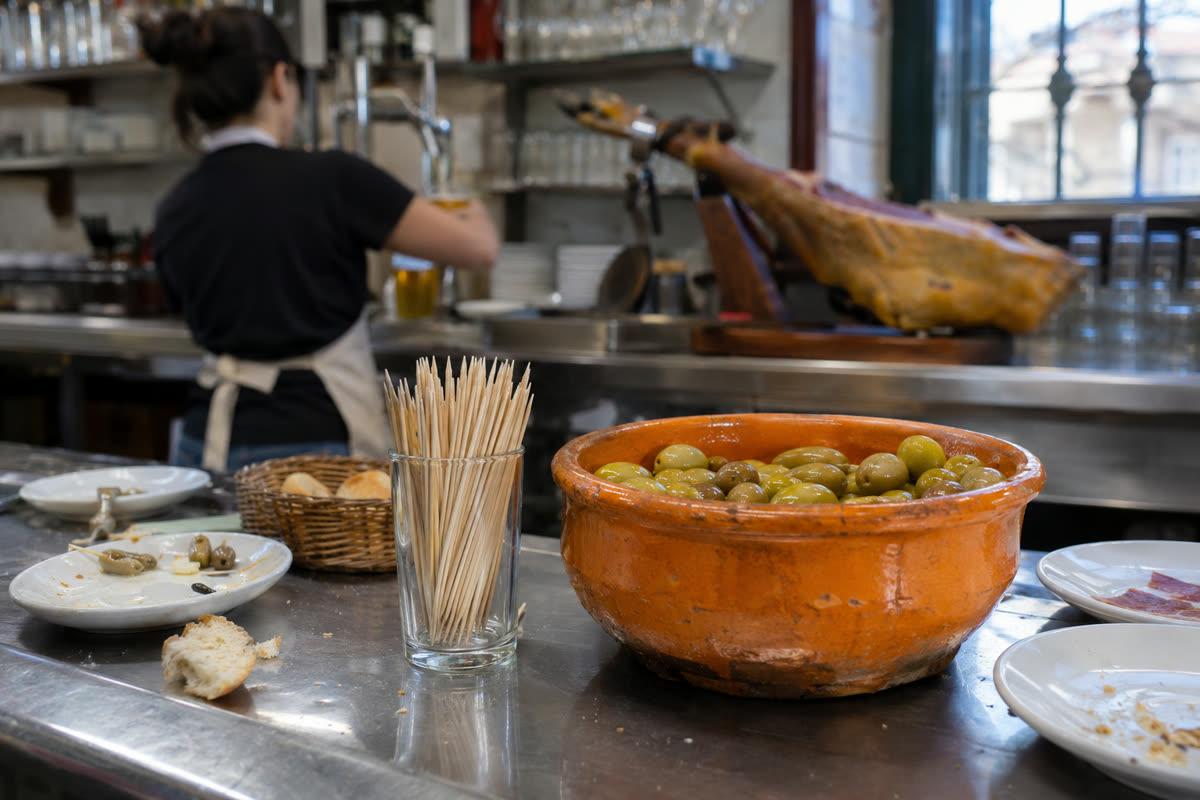
In a bar the wheat is rarely a named ingredient. It sits in coatings, binders and shared oil. The rows below use only what FACE’s traveler card and kitchen advice say, plus our verdicts, which looked at US products and do not describe any Spanish bar. Where no source describes a dish, the row gives a question to ask, not a claim about the dish.
| Food | Where gluten can come in | What we read |
|---|---|---|
| Croquetas and other croquettes | Ask about the filling and the coating | FACE’s French-language card lists croquettes and breaded coatings among foods that contain the cereals15. Ask what binds and coats them. |
| Fried seafood and meat in a batter or crumb coating | The batter, flour or breadcrumbs | FACE’s English card lists batter, breadcrumbs and crumbs among the foods to avoid16. See our calamari verdict for how breaded and plain products read. |
| Anything fried: potatoes, churros, fish | Oil shared with breaded or battered food | FACE says not to reuse oil that has fried gluten-containing food, because the protein is not broken down at high temperatures9. Ask whether the fryer is shared. Our churros verdict shows what the dough recipes we read use. |
| Chorizo and other cured meats | Added ingredients and processing | FACE lists chorizos among “conventional” foods that may or may not contain gluten depending on composition and process, so the label has to be read74. Its French card also lists many charcuterie products15. See our sausage verdict. |
| Sauces, stock and soups | Flour thickening, cubes and bases | FACE’s English card lists soups, sauces and gravies made with flour16; its French card lists bouillon cubes15. |
| Rice dishes such as paella | Stock, sauces and anything floured | FACE’s French card lists rice among foods people with celiac disease can eat, cooked without flour75. The stock and the cooking method are the questions. |
| Bread and sandwiches | The bread itself | FACE’s English card lists breads16. Bread made for people with celiac disease has to be ELS-licensed or carry “sin gluten”76. See our bread verdict. |
| Olives and olive oil | Ask what is in the jar | Our olives and olive oil verdicts rest on US makers’ pages, so they do not answer for a bar’s jar. Ask what is in it. |
| Horchata | What it is made from | Our horchata verdict found the answer depends on the product. Ask what it is made from. |
| Beer (cerveza) | Ask whether it is a licensed gluten-free beer | FACE recommends only beers licensed with the ELS77. |
The fryer deserves its own question because it touches so many tapas. FACE’s advice is general kitchen guidance, not a statement about Spanish bars, but it names the mechanism: gluten is not destroyed by frying temperatures9.
What to say, and what to ask
FACE’s English page for visitors gives this sentence to say on arrival: “Hola. Tengo enfermedad celiaca. No puedo comer gluten, es decir, alimentos que contengan trigo, centeno, cebada o avena.”78 FACE’s own English gloss of those sentences reads: “Hello. I have celiac disease. I cannot eat gluten, that means, foods containing wheat, rye, barley or oats.”79 The card then asks a question about the venue’s gluten-free options for people with celiac disease78.
Then ask, in plain English or by pointing at the dish:
- Is there an allergen list or card for the dishes? A missing or wrong one is a failure FACE counts as an incident61.
- Is the dish coated, floured or bound with anything, such as croquette filling, batter or breadcrumbs?15, 16
- Is the oil shared with breaded or battered food?9
- What goes into the stock, sauce or seasoning, and is any of it a cube or ready-made base?74, 15
- Is the bread a product made for people with celiac disease, with the claim or the licence?76
- Is this venue in FACE’s program? Look for the badge with the current year4.
Supermarkets, bulk food and the free-from shelf
FACE says you can buy gluten-free products in practically all Spanish supermarket chains, as well as in health food stores and specialised points of sale80. To find them, FACE’s page for visitors says to look on the label for the claim “sin gluten” or for an ELS licence81.
- Products made for people with celiac disease (bread, flour, pasta, biscuits, sweets): FACE says they must be ELS-certified or carry the “sin gluten” mention76.
- Everyday foods that are not made for celiacs: FACE says they may or may not contain gluten depending on composition and process, naming chorizos, flavoured yogurts, spices and sauces, so the label has to be read74.
- Bulk and craft-made food: FACE puts products made artisanally or sold loose in its group of unsuitable foods82, and says cross-contact is common in bulk products, so it recommends asking the person in charge about allergens83.
- Wheat starch: FACE says a product with wheat starch as an ingredient can still be suitable, because starch can be separated from gluten by wet milling84. See our wheat starch verdict.
- A pack labelled “sin gluten” that is missing from FACE’s digital list: FACE says it still has to meet the 20 mg/kg limit by law85.
Verdicts in this guide
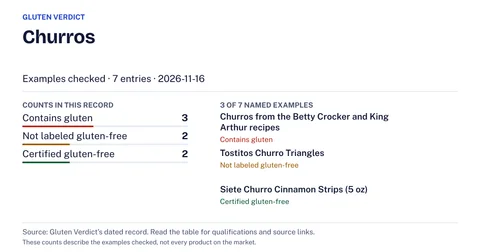 ChurrosContains glutenchecked Nov 16, 2026
 BreadContains glutenchecked Nov 16, 2026
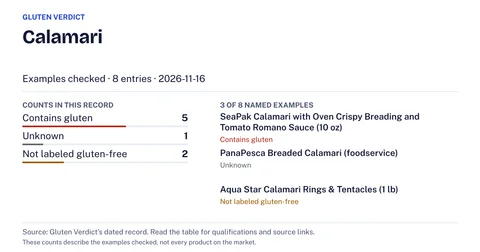 CalamariDepends on the product5 of 8 products we checked contain glutenchecked Nov 16, 2026
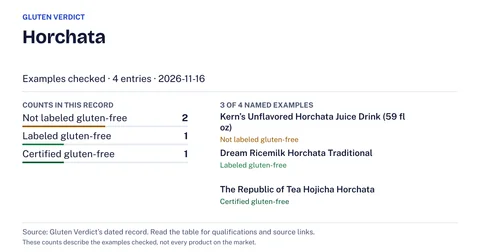 HorchataDepends on the productchecked Nov 16, 2026
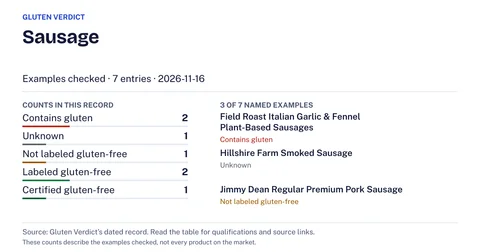 SausageDepends on the product2 of 7 products we checked contain gluten: Field Roast Italian Garlic & Fennel Plant-Based Sausages and Tofurky Plant-Based Italian Sausagechecked Nov 16, 2026
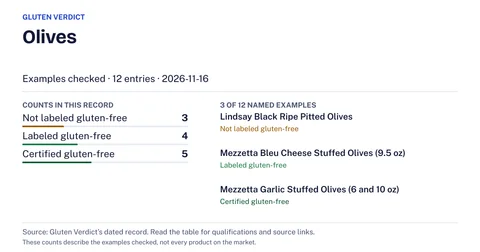 OlivesNaturally gluten-freechecked Nov 16, 2026
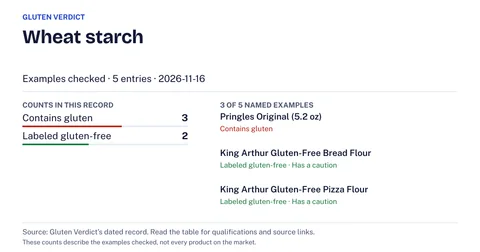 Wheat starchDepends on the product3 of 5 products we checked contain gluten: Pringles Original (5.2 oz), Jiffy Corn Muffin Mix, and Chex Mix Bold Garlic and Herbchecked Nov 16, 2026
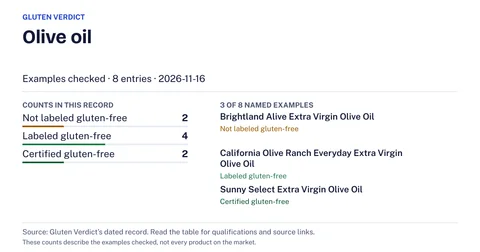 Olive oilUnknownchecked Nov 16, 2026
Questions people ask
Does “sin gluten” mean the same as the US “gluten-free”?
Both are limit-based claims for food. In the EU the food as sold must contain no more than 20 mg/kg of gluten1; FDA requires that any unavoidable gluten in a food labeled gluten-free be less than 20 ppm27. FACE writes the EU figure as 20 ppm (mg/kg)22.
If a tapas bar says “sin gluten”, is the kitchen held to the EU limit?
The limit is on the food as sold1, and FACE treats 20 ppm as the legal maximum when it tests restaurant dishes offered as “sin gluten”10. FACE also says offering gluten-free dishes in good faith does not, on its own, mean they are handled correctly11.
Does a Spanish restaurant have to tell me what gluten is in a dish?
EU law makes allergen particulars mandatory for food offered without prepackaging33, 34. Spain lets a venue give them orally if the information is also recorded in writing or electronically at the venue7, 8.
Is the “Controlado por FACE” mark still given out?
No. FACE says it was folded into the ELS in 2020 and is no longer awarded12.
Can I use FACE’s restaurant app without being a member?
The app is exclusive to members of FACE’s societies64. FACE says visitors can get temporary access by writing to facemovil@celiacos.org65.
More in Travel: Europe
 Gluten-free in Greece: what the label and the taverna promise, and what to askWhat “gluten-free” means in Greece, where wheat hides in Greek dishes such as gyro, orzo and pies, and what to ask at a taverna.
 Gluten-free in Italy: what the AIC program covers and what to askWhat “senza glutine” means in Italy, what AIC’s restaurant program asks of a kitchen, and the questions to ask in a restaurant, pharmacy or shop.
 Gluten-free in Germany: what “glutenfrei” and German allergen rules tell youHow to read “glutenfrei” and German allergen rules, spot wheat in pretzels and Spätzle, and ask a restaurant for its allergen information.
 Gluten-free in France: reading a pack, a menu and a “sans gluten” signWhat «sans gluten» means on a French pack, how restaurants must give allergen information, and what a bakery’s “sans gluten” sign does not promise.
 Gluten-free in the UK: allergen rules, the Crossed Grain mark and pub and chip-shop foodHow a British pack and menu differ from a US one: the 20 mg/kg rule, 14 allergens, Crossed Grain versus venue accreditation, and chip-shop condiments.
 Gluten-free in Central Europe: the rules in five countries and where wheat hides in the dishesWhich gluten-free rule covers a pack in Austria, Czechia, Hungary, Poland and Switzerland, and where wheat enters schnitzel, dumplings and sauces.
Related guides
 Gluten-free and very low gluten on EU labels, and how allergens are highlightedWhat EU “gluten-free” and “very low gluten” claims permit, how cereals containing gluten are highlighted in ingredient lists, and the rules for loose food.
 Fine on bread in Europe? What it does and does not showWhat a trip where bread felt fine does and does not show about celiac disease, and how EU and US gluten-free label rules compare.
 Gluten words on European food labels, language by languageFind the ingredient list, the gluten-cereal name and the gluten-free claim on a European pack in 11 languages, using words from the EU’s own texts.
 What a European restaurant must tell you about gluten, country by countryWhether restaurants in France, Germany, Austria, Italy, Spain and the UK must show allergens in writing or may answer aloud, and what to ask.
Sources
- [1, 18, 21, 23, 25] European Union (EUR-Lex), Regulation (EU) No 828/2014: gluten-free and very low gluten statements, checked Nov 17, 2026.
- [2, 4, 5, 19, 26, 66, 67, 70, 72, 77, 78, 79, 80, 81] FACE (Federación de Asociaciones de Celíacos de España), Information for celiac tourists visiting Spain, checked Nov 17, 2026.
Read on 2026-11-17: under “To access CELIGUIA app you can:” the page lists “Buy access for one week by €4.84.” and “Buy access for one month by €14.52.”
Read on 2026-11-17: under “To find gluten-free products you should look at the following information on the label:” the page lists the claim “sin gluten” and a licence with the European Licensing System (ELS or Crossed Grain Trademark – CGT).
- [3, 42, 43, 44] FACE (Federación de Asociaciones de Celíacos de España), Sistema de Licencia Europeo (ELS) o Espiga Barrada: requirements, checked Nov 17, 2026.
- [6, 40, 63, 71] FACE (Federación de Asociaciones de Celíacos de España), En restaurantes (eating out), checked Nov 17, 2026.
- [7, 8, 36, 37, 38, 39] Boletín Oficial del Estado (BOE), Real Decreto 126/2015: information on food sold unpackaged (consolidated text), checked Nov 17, 2026.
- [9] FACE (Federación de Asociaciones de Celíacos de España), Contacto cruzado (cross-contact), checked Nov 17, 2026.
- [10, 58] FACE (Federación de Asociaciones de Celíacos de España), Control analítico: what happens if gluten is detected in a venue’s gluten-free menu, checked Nov 17, 2026.
- [11, 59, 74] FACE (Federación de Asociaciones de Celíacos de España), Preguntas frecuentes (FAQ), checked Nov 17, 2026.
- [12] FACE (Federación de Asociaciones de Celíacos de España), Marca de Garantía “Controlado por FACE”, checked Nov 17, 2026.
- [13, 29, 30, 33, 34, 35] European Union (EUR-Lex), Regulation (EU) No 1169/2011 on food information to consumers (text as adopted, 2011), checked Nov 17, 2026.
- [14] US Food and Drug Administration, Food Allergen Labeling and Consumer Protection Act of 2004 (FALCPA), checked Nov 17, 2026.
- [15, 16, 73, 75] FACE (Federación de Asociaciones de Celíacos de España), De viaje (travel; includes FACE’s multilingual explanation card), checked Nov 17, 2026.
- [17] European Union (EUR-Lex), Reglamento de Ejecución (UE) n.º 828/2014 (Spanish text), checked Nov 17, 2026.
- [20, 22, 24, 31, 82, 83, 84] FACE (Federación de Asociaciones de Celíacos de España), Aprende a leer el etiquetado (learn to read the label), checked Nov 17, 2026.
- [27] US Food and Drug Administration, Questions and Answers on the Gluten-Free Food Labeling Final Rule, checked Nov 17, 2026.
- [28] European Union (EUR-Lex), Reglamento (UE) n.º 1169/2011 sobre la información alimentaria facilitada al consumidor (Spanish text as adopted, 2011), checked Nov 17, 2026.
- [32, 76] FACE (Federación de Asociaciones de Celíacos de España), Clasificación de los alimentos (classification of foods), checked Nov 17, 2026.
- [41, 45, 48, 49, 50, 51, 52] FACE (Federación de Asociaciones de Celíacos de España), FACE Restauración sin gluten (program page; footer), checked Nov 17, 2026.
- [46, 64, 65, 68, 69] FACE (Federación de Asociaciones de Celíacos de España), CELIGUIA, la app (the app), checked Nov 17, 2026.
- [47] FACE (Federación de Asociaciones de Celíacos de España), Lista digital de alimentos sin gluten, checked Nov 17, 2026.
- [53, 54] FACE (Federación de Asociaciones de Celíacos de España), ¿Cómo adherirse al proyecto FACE Restauración Sin Gluten/Gluten-Free?, checked Nov 17, 2026.
- [55, 60, 61, 62] FACE (Federación de Asociaciones de Celíacos de España), ¿Qué sucede si se produce una incidencia?, checked Nov 17, 2026.
Read on 2026-11-17: the list headed “¿Qué consideramos incidencia?” names not having an allergen card or having an incorrect one; not meeting the preventive measures needed to avoid cross-contact; serving a product with gluten by mistake; delivering the gluten-free order mixed with food that has gluten; and staff who do not know the gluten-free offer and protocol.
- [56, 57] FACE (Federación de Asociaciones de Celíacos de España), Control analítico (analytical control), checked Nov 17, 2026.
- [85] FACE (Federación de Asociaciones de Celíacos de España), Lista digital: products labelled “sin gluten” that are not on the list, checked Nov 17, 2026.