UK gluten-free labelling: the legal rules, Natasha’s Law and the Crossed Grain
Short answer
The allergen rules and the words “gluten-free” and “very low gluten” are set by law1, 2; the Crossed Grain symbol is Coeliac UK’s own trademark, a separate mark3. What you see depends on how the food was packed:
- Pre-packed food: cereals containing gluten (wheat, rye, barley, oats) must be named and emphasised in the ingredients list1, 4, 5.
- Packed on the premises before you order, such as a café sandwich (called PPDS): a full ingredients list with allergens emphasised, required across the UK since 1 October 20216, 7, 8.
- Loose or made to order: allergen information in writing or from staff, with a clear signpost to it when it is spoken9, 10.
- “Gluten-free” means no more than 20 mg/kg of gluten and “very low gluten” no more than 100 mg/kg; no other wording for the absence or reduced presence of gluten is permitted2, 11, 12.
Part of Gluten-free labeling law by country, 12 guides

Key points
- Gluten-free is a voluntary claim, but a food that carries it must meet Regulation (EU) No 828/201413.
- Natasha’s Law is the name Coeliac UK uses for the PPDS rule: food packed and sold on the same premises needs a full ingredients list14, 15, 44.
- Food packed after you order it is not PPDS and follows the loose-food rules16.
- A “may contain” line is voluntary information that must not mislead17, 18.
- The Crossed Grain is a Coeliac UK trademark scheme with its own checks; neither the FSA guidance nor the regulation mentions it19, 20, 21.
Which gluten wording the law controls
Two phrases are defined in Regulation (EU) No 828/2014, the rule the Food Standards Agency (FSA) points to for gluten claims13. The page we read is the UK version of the regulation, not amended by the UK since 31 December 202022.
| Wording | What the regulation says |
|---|---|
| Gluten-free | May only be made where the food as sold to the final consumer contains no more than 20 mg/kg of gluten2. |
| Very low gluten | Only for food made with ingredients from wheat, rye, barley or oats that were specially processed to reduce gluten, at no more than 100 mg/kg11. Coeliac UK says no foods are currently labelled this way in the UK23. |
The FSA says these rules apply to all foods, including food served in restaurants, and that no other statements describing the absence or reduced presence of gluten are permitted12. The regulation does allow “suitable for people intolerant to gluten” or “suitable for coeliacs” to accompany one of the two claims24.
“Gluten-free” is not an absolute claim. The FSA’s guidance says it differs from other free-from statements because it stipulates that gluten in the food is below 20mg/kg25.
Oats and gluten-free wheat starch
Oats in a food presented as gluten-free must have been specially produced, prepared or processed to avoid contamination by wheat, rye or barley, and their gluten content cannot exceed 20 mg/kg26. The oats still have to be named and emphasised in the ingredients list27.
Coeliac UK describes gluten-free wheat starch as a specially manufactured wheat starch washed so that its gluten level is within the Codex standard of 20 ppm or less28 and says it must always appear in an ingredients list if it has been used29.
Coeliac UK says the law does not specify that tests have to be done to prove foods are gluten free, though good practice will involve testing, and that authorities need to see due diligence and management of gluten to avoid cross contamination30.
Pre-packed food: the allergen rules
Pre-packed food is any food put into packaging before being placed on sale31. Cereals containing gluten are one of the 14 allergens that must be declared, listed by the FSA as “cereals containing gluten – including wheat (such as spelt and Khorasan), rye, barley and oats”1.
Allergenic ingredients must be emphasised every time they appear in the ingredients list, for example in bold, contrasting colours or by underlining them32. The FSA’s technical guidance describes the emphasis as contrasting font, size, style or background colour5.
The cereal has to be declared by its specific name: wheat, rye, barley or oats4. Spelt, Khorasan and Kamut need a specific reference to wheat33. An ingredient derived from one of these cereals is emphasised too, as in the FSA’s examples of wheat starch and barley malt extract34. Coeliac UK adds that even a tiny amount must still be listed35.
A pack may also carry an allergen advice statement that explains the emphasis, such as “Allergen Advice: for allergens including cereals that contain gluten see ingredients in red”36. Where products are sold in multi-packs, allergens must be displayed on the outer packaging37.
Exceptions to the cereals-containing-gluten allergen
| Ingredient | What the FSA guidance says |
|---|---|
| Wheat based glucose syrups, including dextrose | Listed as an exception38. |
| Wheat based maltodextrins | Listed as an exception38. |
| Glucose syrups based on barley | Listed as an exception38. |
| Cereals used for making alcoholic distillates, including ethyl alcohol of agricultural origin | Listed as an exception38. |
The FSA guidance gives these as exceptions under “Cereals containing gluten”38. A gluten-free claim is judged against its own limit, no more than 20 mg/kg2.
Drinks with no ingredients list
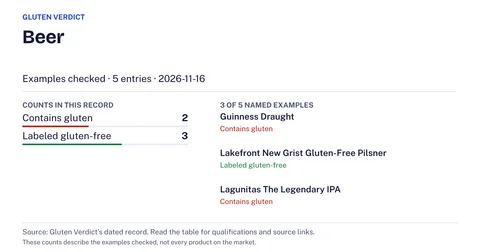
Alcoholic drinks above 1.2% alcohol by volume do not need an ingredients list; where there is none, allergens that are present and not clear from the name of the drink must be indicated39. The FSA says this is done with the word “contains” followed by the name of the allergen40. Our beer verdict covers the drink itself.
Natasha’s Law: food packed on the premises
Coeliac UK calls the rule “Natasha’s Law”14, 15. The FSA’s term is prepacked for direct sale, or PPDS: food packaged at the same place it is offered or sold to consumers and already in that packaging before it is ordered or selected41. Coeliac UK’s example is a packaged sandwich in a café42.
The label has to show the name of the food and the ingredients list with the 14 allergens emphasised within it43. The duty to label PPDS food this way6 came into effect in all four UK nations on 1 October 20217; Food Standards Scotland gives the same date and the same requirement for Scotland8. Coeliac UK says a PPDS label must carry a full ingredients list with allergens emphasised, just like pre-packed food44.
Written allergen information must be easily visible, clearly legible and not obscured in any way45.
What counts as PPDS and what does not
- PPDS: sandwiches placed into packaging by the food business and sold from the same premises46.
- Not PPDS: food packed after you order it, such as a sandwich or burger made and wrapped after taking an order. The same rules apply as to other non-prepacked food, such as meals served in a restaurant16.
- Not PPDS: food packed by one business and supplied to another for sale. That is prepacked food47.
- Not PPDS: food with no packaging, or packaging that lets the food be altered without opening or changing it, such as a hot dog served on a cardboard tray48.
When PPDS food is sold by phone or online, the FSA guidance says allergen information has to be available for free before purchase and at the moment of delivery49.
Loose and made-to-order food
Loose foods include everything that is not pre-packed. A business serving them has to supply information for every item on the menu that contains any of the 14 allergens50, and that information can be given in writing or by speaking to staff9.
The requirement is to provide information about the allergenic ingredients, not a full ingredients list, except for PPDS food51. Spoken information is allowed, but it must be easily accessible and accurate52, and the business must signpost where it can be found, for example by asking members of staff10.
The FSA’s best practice is to make the information easily available in writing and have staff support it with a conversation53. Menu logos or symbols can be used when accompanied by words and numbers54.
The “no gluten-containing ingredients” statement
The FSA says statements about non-gluten containing ingredients (NGCI) can be misleading to consumers55. Its best practice is to avoid a statement such as “this menu has been designed for a non-gluten diet”56, and to use a “gluten-free” statement instead where strict controls ensure no more than 20mg/kg of gluten57.
The Crossed Grain: a trademark, not a legal claim
Coeliac UK describes the Crossed Grain as its own certification scheme19. It says certified products have been through extra checks, including checking gluten analysis certificates and independent audits of how they are manufactured58, and brands renew their license to display the trademark59.
The legal test for the words “gluten-free” is the regulation’s limit of 20 mg/kg2. Neither the FSA’s technical guidance20 nor the regulation text21 mentions the Crossed Grain, and Coeliac UK’s page gives no gluten limit for the symbol60. What the symbol adds is Coeliac UK’s own checks, so read it as a different kind of statement from the legal wording. Our guide to how certification programs compare covers the schemes side by side.
May-contain lines
A precautionary allergen label, the “may contain” kind, is a statement businesses can choose to apply where there is an unavoidable risk of allergen cross-contamination17. Like any voluntary information it must not mislead consumers or be ambiguous or confusing18. The FSA’s best practice is to use it only when a risk assessment finds an unavoidable risk that segregation and cleaning cannot sufficiently control61.
Coeliac UK tells readers that using the statement is voluntary62, and that when they see one the manufacturer has decided there is an unavoidable risk of cross contamination with gluten63.
Gluten-free and may-contain on one pack
The FSA’s guidance says a “gluten-free” statement can be used in combination with a precautionary statement, for example “gluten-free” and “may contain wheat (cereal)”64. Coeliac UK reports that international Codex guidelines, adopted on 6 July 202665, make clear that a product should not be labelled both “gluten free” and “may contain wheat, barley or rye”66. Coeliac UK adds that the guidance now needs to be considered and implemented by regulators and businesses67; the FSA text we read today still says the two can be combined64.
For the same lines on US labels, see our may-contain wheat guide.
England, Wales, Scotland and Northern Ireland
The FSA’s technical guidance says the main allergen framework is assimilated Regulation (EU) No. 1169/2011 for England and Wales and Regulation (EU) No. 1169/2011 for Northern Ireland68. The page is marked as applying to England, Northern Ireland and Wales, with a separate publication for Scotland69.
For the gluten wording, the guidance says Regulation (EU) No. 828/2014 is enforced in Wales and in Northern Ireland by their own amending regulations70. For a question specific to Scotland, Food Standards Scotland is the page to check.
UK against the US: what to expect on a US label
| Question | UK | US |
|---|---|---|
| Which grains count as allergens | Cereals containing gluten, including wheat, rye, barley and oats1. | The 2004 FALCPA definition of a major food allergen names wheat but not barley, rye or oats71. |
| How the allergen is shown | Emphasised every time it appears in the ingredients list32. | A “Contains” line next to the ingredient list72, or the source named in parentheses after the ingredient73. |
| Gluten-free wording | Two terms, “gluten-free” and “very low gluten”; no other wording is permitted12. | “Gluten-free” plus three equivalent phrases: “free of gluten”, “without gluten” and “no gluten”74. FDA’s page has no “very low gluten” term75. |
| Oats | May appear in gluten-free food only if specially produced and at no more than 20 mg/kg26. | Oats labelled gluten-free must contain less than 20 ppm gluten; certification is not required76. |
The limit is worded differently too: the UK text says no more than 20 mg/kg2, and FDA says any unavoidable gluten must be less than 20 ppm77. For the US side in full, see how to read a US food label and our guide to US gluten-free labels for visitors; for other countries side by side, see gluten-free labelling laws by country and gluten source declaration by country.
Verdicts in this guide
Questions people ask
Is Natasha’s Law the same as the gluten-free law?
No. Natasha’s Law is the name Coeliac UK uses for the PPDS ingredients-list rule14, 44, which covers food packed on the premises where it is sold41. The gluten-free wording is controlled by Regulation (EU) No 828/201413.
Does “gluten-free” on a UK pack mean zero gluten?
No. The regulation allows the claim where the food contains no more than 20 mg/kg of gluten2, and the FSA describes it as not an absolute claim25.
Can a café put “gluten-free” on a menu item?
Only where the food meets the regulation’s limit of no more than 20 mg/kg2. The FSA says the gluten-free rules apply to food served in restaurants12, and that a “gluten-free” statement should be used where strict controls ensure no more than 20mg/kg of gluten57.
More in Gluten-free labeling law by country
 Gluten-free labelling in Australia and New Zealand: what the claim meansWhat “gluten free” and “low gluten” mean on Australian and New Zealand packs: no detectable gluten, no oats, no malt, and how US packs compare.
 Gluten-free and very low gluten on EU labels, and how allergens are highlightedWhat EU “gluten-free” and “very low gluten” claims permit, how cereals containing gluten are highlighted in ingredient lists, and the rules for loose food.
 Which gluten grains a pack’s allergen line must name, by countryWhether the allergen line must name barley, rye and oats, country by country: US, Canada, EU, UK, Australia and New Zealand, Brazil, Japan.
 Gluten-free labeling rules by country: ceilings, claim wording and where no rule was foundLook up the gluten-free limit and claim wording for the US, Canada, EU, UK, Australia, New Zealand and more, each figure tied to the page we read.
 Gluten-free labeling in Canada: the claim, the gluten-source declaration and oatsHow Health Canada's gluten-free claim works, how gluten sources and oats must be declared on a Canadian pack, and how it differs from the FDA rule.
 Reading US gluten-free labels as a visitor from the UK, EU, Canada or AustraliaWhat a US gluten-free claim, the Contains line, malt and alcohol labels mean if you are used to UK, EU, Canadian or Australian labels.
Related guides
 Gluten-free logos outside the US: who issues each one and what it requiresTell a certifier’s gluten-free logo from a maker’s own: who issues Crossed Grain, Coeliac Australia’s and Celiac Canada’s marks, and the limit each sets.
 May-contain labels abroad: what each country’s regulator says about themWhether a “may contain” or shared-facility line is required, voluntary or guided by a scheme in the US, UK, EU, Canada, Australia, New Zealand and Codex.
 Gluten-free in the UK: allergen rules, the Crossed Grain mark and pub and chip-shop foodHow a British pack and menu differ from a US one: the 20 mg/kg rule, 14 allergens, Crossed Grain versus venue accreditation, and chip-shop condiments.
 Gluten-free in Ireland: labels, pub rules, Guinness and the Crossed Grain symbolWhat Irish labels, pub allergen rules and the Crossed Grain symbol say about gluten, and what Guinness lists, so a US traveler knows what to check.
Sources
- [1, 32, 36, 37, 40] UK Food Standards Agency, Allergen labelling for food manufacturers, checked Nov 17, 2026.
- [2, 11, 21, 22, 24, 26] legislation.gov.uk (The National Archives), Commission Implementing Regulation (EU) No 828/2014, UK version, checked Nov 17, 2026.
Read on 2026-11-17: the regulation’s articles and annex, as published on legislation.gov.uk, do not mention the Crossed Grain symbol.
- [3, 59] Coeliac UK, Crossed Grain Trademark renewals, checked Nov 17, 2026.
- [4, 5, 6, 7, 10, 12, 13, 16, 17, 18, 20, 25, 27, 33, 34, 38, 39, 45, 46, 47, 48, 49, 51, 52, 53, 55, 56, 57, 61, 64, 68, 69, 70] UK Food Standards Agency, Food allergen labelling and information requirements: technical guidance, checked Nov 17, 2026.
Read on 2026-11-17: the guidance, including its list of relevant legislation, does not mention the Crossed Grain symbol.
Read on 2026-11-17: in paragraph 19, the entry “Cereals containing gluten” lists as exceptions wheat based glucose syrups including dextrose; wheat based maltodextrins; glucose syrups based on barley; and cereals used for making alcoholic distillates including ethyl alcohol of agricultural origin.
Read on 2026-11-17: the page header says “Applies to England, Northern Ireland and Wales” and links a separate “Publication for Scotland”.
- [8] Food Standards Scotland, Prepacked for direct sale, checked Nov 17, 2026.
- [9, 31, 41, 43, 50, 54] UK Food Standards Agency, Allergen information for pre-packed and loose foods, checked Nov 17, 2026.
- [14, 15] Coeliac UK, Coeliac UK welcomes ‘Natasha’s Law’, checked Nov 17, 2026.
- [19, 58, 60] Coeliac UK, Look out for our Crossed Grain symbol, checked Nov 17, 2026.
Read on 2026-11-17: the page says certified products have been through extra checks, including gluten analysis certificates and independent audits of how they are manufactured; it gives no gluten limit for the symbol.
- [23, 28, 29, 30] Coeliac UK, Gluten and the law, checked Nov 17, 2026.
- [35, 42, 44, 62, 63] Coeliac UK, How to read food labels, checked Nov 17, 2026.
- [65, 66, 67] Coeliac UK, Our impact on food labelling, checked Nov 17, 2026.
- [71, 72, 73] US Food and Drug Administration, Food Allergen Labeling and Consumer Protection Act of 2004 (FALCPA), checked Nov 17, 2026.
- [74, 75, 76, 77] US Food and Drug Administration, Questions and Answers on the Gluten-Free Food Labeling Final Rule, checked Nov 17, 2026.
Read on 2026-11-17: the page defines “gluten-free” and its three equivalent phrases; the term “very low gluten” does not appear on it.