Gluten-free labeling rules by country: ceilings, claim wording and where no rule was found
Short answer
The United States, the EU and the UK put the gluten-free line at 20 ppm (20 mg of gluten per kg)1, 10, 16; Canada follows 20 ppm as Health Canada’s position23; Argentina’s definition caps it at 10 mg/kg31; Australia and New Zealand ask for no detectable gluten and no oats28. For Brazil, Japan, India, Mexico and South Korea the tables say what we could open and mark the rest “not confirmed”.
Part of Gluten-free labeling law by country, 12 guides
Key points
- The same word can sit on different legal footing: in the US and the EU the claim has a numeric ceiling written into the rule1, 10, while in Canada the 20 ppm figure is Health Canada’s stated position, and the regulation text it quotes names no threshold22.
- Argentina’s Código Alimentario sets a maximum of 10 mg/kg for “libre de gluten”, the lowest number in the tables31.
- In Australia and New Zealand a “gluten free” claim also rules out oats and malted gluten cereals28; the US, EU, UK and Canada allow oats under conditions5, 12, 18, 26.
- A “very low gluten” claim, up to 100 mg/kg, exists in EU and UK law11, 17; the US rule defines no such claim4.
- Brazil’s law is a different kind of rule: every industrialised food must say “contém Glúten” or “não contém Glúten”35.
How to read the tables
Each row is one jurisdiction. The columns give the claim wording the rule allows, the ceiling or condition the rule sets, and what kind of text sets it. Every cell carries a marker to the passage we read, and the sources list at the end gives the date we read it.
The ceiling is given the way the rule words it, because the boundary words differ: the US text says any unavoidable gluten must be “below 20 ppm”1, while the EU and UK texts say “no more than 20 mg/kg”10, 16. Where we could not open a regulator’s own page, the row says “not confirmed” and no number is filled in from a blog or a forum.
These are labelling rules for food sold in the country. Our verdicts for individual foods are in every verdict, A to Z, and the rules for reading a US pack are in how to read a US food label for gluten.
Which countries set a gluten-free ceiling, and what the claim may say
| Jurisdiction | Claim wording | Ceiling or condition | What sets it |
|---|---|---|---|
| United States | “gluten-free”, and the equivalents “no gluten”, “free of gluten” and “without gluten”2 | Any unavoidable presence of gluten below 20 ppm, which the text equates with below 20 mg gluten per kg of food1 | 21 CFR 101.911 |
| Canada | “gluten-free”; it is prohibited to give the impression of a gluten-free food if it contains gluten protein from barley, oats, rye, triticale, wheat, kamut or spelt21, 25 | No threshold in the regulation text; Health Canada’s position is not exceeding 20 ppm as a result of cross-contamination22, 23; the CFIA says gluten present through cross-contamination “must not surpass 20 ppm”39 | Food and Drug Regulations B.24.018, with Health Canada’s position paper dated June 201221, 23 |
| European Union | “gluten-free”; information on absence or reduced presence of gluten may be given only through the Annex statements13 | No more than 20 mg/kg of gluten in the food as sold to the final consumer10 | Implementing Regulation (EU) No 828/2014, binding in all Member States15 |
| United Kingdom | “gluten-free”16 | No more than 20 mg/kg of gluten in the food as sold16 | The same regulation as it appears on legislation.gov.uk, not amended by the UK since 31 December 202019 |
| Australia and New Zealand | A “free” gluten claim under the nutrition content claim conditions28 | The food must not contain detectable gluten, oats or oat products, or malted cereals containing gluten or products of them28 | Schedule 4 to the Food Standards Code, which sets out information for Standard 1.2.730 |
| Argentina | “libre de gluten”, as part of the product’s name in letters of equal size and visibility32 | The gluten content may not exceed 10 mg/kg, and the food must contain no prolamins or glutelins from wheat, rye, barley, oats or their crossbreeds31 | Article 1383 of the Código Alimentario Argentino, replaced by Joint Resolution 32/2023 of 29 November 202333, 34 |
| Codex Alimentarius (international) | “gluten free”, as Health Canada describes Codex24 | Not exceeding 20 ppm, as Health Canada describes Codex24 | Codex Stan 118-1979. We could not open the Codex text itself, so this cell is Health Canada’s account of it, not Codex’s own words. |
Canada’s position paper is the clearest case of footing. It states that the regulations name no threshold22, and that Health Canada’s position is that a gluten-free claim at not more than 20 ppm from cross-contamination meets the intent of the regulation23. The Canadian Food Inspection Agency, which enforces the rule, says gluten present through cross-contamination in a food labelled gluten-free “must not surpass 20 ppm”39. Treat the Canadian cell as the stated approach of those agencies as of the pages we read, not as a figure in the regulation.
Where we found a statement or a register but no ceiling, or could not confirm a rule
| Jurisdiction | What we confirmed | What we did not confirm |
|---|---|---|
| Brazil | Lei nº 10.674 of 16 May 2003 requires every industrialised food to carry the inscription “contém Glúten” or “não contém Glúten”, as the case may be35 | A numeric ceiling: none appears in the published text of the law36. Brazil’s health regulator’s own rules on gluten-free claims were not opened. |
| Japan | Wheat is on the Consumer Affairs Agency leaflet’s list of specified ingredients whose labelling is mandatory37 | A general gluten-free claim standard: none is listed among the publications on the agency’s English food labelling page38. The agriculture ministry’s rice-flour standard page was not opened, so it is not confirmed. |
| India | Not confirmed on 2026-11-17. | We could not open the regulation text on India’s national food regulator’s own site from our fetch tools, so no ceiling or wording is given. |
| Mexico | Not confirmed on 2026-11-17. | We did not open a regulator page for NOM-051 or any gluten-free claim, so no ceiling or wording is given. |
| South Korea | Not confirmed on 2026-11-17. | We did not open a page from South Korea’s food and drug ministry, so no ceiling or wording is given. |
“Not confirmed” means we did not see the rule on the regulator’s own page on the date shown. It does not mean no rule exists.
Oats under each rule
Oats are where the rules visibly part. The US definition of a gluten-containing grain lists wheat, rye, barley and their crossbreeds, not oats3. The EU’s definition of gluten names oats14, and so does Canada’s25.
| Jurisdiction | Oats |
|---|---|
| United States | Oats need not be certified to carry the claim, but oats labeled gluten-free must contain less than 20 ppm gluten5 |
| Canada | A Marketing Authorization permits gluten-free claims for gluten-free oats of not more than 20 ppm of gluten from wheat, rye, barley or their hybrids, under conditions26; the oats must be identified as “gluten-free oats” wherever oats are named, including in the ingredient list27 |
| European Union | Oats must have been specially produced, prepared or processed to avoid contamination, and their gluten content cannot exceed 20 mg/kg12 |
| United Kingdom | The same condition as the EU text18 |
| Australia and New Zealand | A “free” gluten claim requires no oats or oat products28 |
| Argentina | Oats are named among the grains whose prolamins and glutelins a gluten-free food must not contain31 |
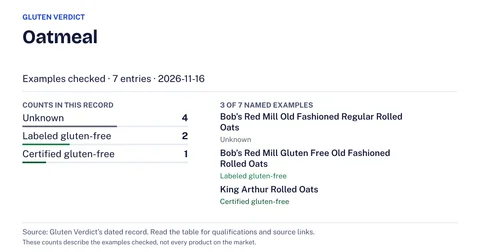
A food with oats in it can therefore carry a gluten-free claim under the US, EU, UK and Canadian rules when the oats meet the conditions above, but not under the Australian and New Zealand condition, and the Argentine text lists oats among the grains to exclude5, 12, 18, 26, 28, 31. See our oatmeal verdict for a food that depends on it.
“Very low gluten” and “low gluten” claims
EU law allows “very low gluten” only on food made with ingredients from wheat, rye, barley or oats that were specially processed to reduce gluten, at no more than 100 mg/kg11. The UK version of the regulation carries the same statement and number17, and Coeliac UK says no foods are currently labelled that way in the UK but that products may carry it in other European countries20.
Australia and New Zealand have a separate “low” gluten claim, with the condition of no more than 20 mg gluten per 100 g of the food29. That is a different claim from the EU’s “very low gluten”, written in a different unit, and we have not converted one into the other.
In the US text of the gluten-free rule we found no “very low gluten” or “low gluten” claim4.
Where the US rule stands next to the others
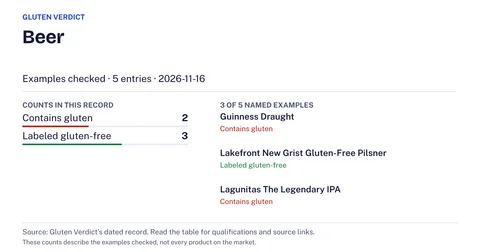
- Meat, poultry, certain egg products and most alcohol sit outside FDA’s gluten-free rule; USDA and TTB regulate those labels6. TTB authorizes “gluten-free” on an alcohol label when the product would qualify under FDA’s definition8, and allows a “processed to remove gluten” claim, with a qualifying statement and documentation to substantiate it, on products fermented from gluten-containing grains9. See beer.
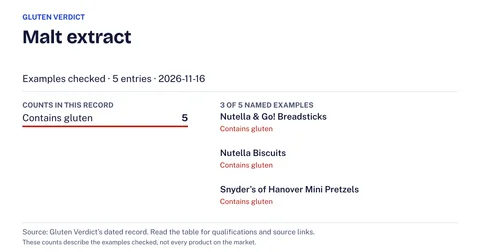
- On malt, FDA says malt extract and malt syrup are ingredients derived from barley that has not been processed to remove gluten7, and the Australian and New Zealand condition rules out cereals containing gluten that have been malted28. See malt extract.
- On the number, Argentina’s 10 mg/kg31 sits beside the 20 ppm of the US text1 and the 20 mg/kg of the EU and UK texts10, 16. Those are the figures as the sources give them.
- Brazil’s statement on every industrialised food35 is not a gluten-free claim standard: the law states no numeric limit36, and it applies whether or not a maker uses a claim35.
If you are planning a trip, the travel hub is where the country guides will sit. This page is the law they point to.
How we dated every cell
We read each rule on 2026-11-17 and the sources list gives the passage we relied on. Where a page could not be opened (the Codex standard sits behind a sign-in, Brazil’s presidency site redirected to its home page, and the Indian, Japanese agriculture ministry, Mexican and South Korean pages were not opened), we say so in the table and do not fill the cell from a secondary page.
A rule can change after the date we read it. If a pack carries a claim you want to check, the regulator’s page named in the sources list is the place to look.
Verdicts in this guide
Questions people ask
Is 20 ppm the gluten-free limit in every country?
No. The US, EU and UK texts use 20 ppm or 20 mg/kg1, 10, 16, Argentina’s text sets 10 mg/kg31, and the Australian and New Zealand condition is no detectable gluten28.
Does “gluten-free” on a foreign pack mean the same as in the US?
In the EU and UK the figure is 20 mg/kg, the same figure as the US 20 ppm1, 10, 16. In Australia and New Zealand the food must also contain no oats and no malted gluten cereals28, and in Argentina the definition names oats among the grains to exclude31.
Can a food made with oats be called gluten-free everywhere?
No. The US allows it when the oats are under 20 ppm5, the EU when they are specially produced and under 20 mg/kg12, and Canada under a Marketing Authorization with conditions26, while Australian and New Zealand conditions require no oats28.
More in Gluten-free labeling law by country
 Gluten-free and very low gluten on EU labels, and how allergens are highlightedWhat EU “gluten-free” and “very low gluten” claims permit, how cereals containing gluten are highlighted in ingredient lists, and the rules for loose food.
 Gluten-free labelling in Australia and New Zealand: what the claim meansWhat “gluten free” and “low gluten” mean on Australian and New Zealand packs: no detectable gluten, no oats, no malt, and how US packs compare.
 Which gluten grains a pack’s allergen line must name, by countryWhether the allergen line must name barley, rye and oats, country by country: US, Canada, EU, UK, Australia and New Zealand, Brazil, Japan.
 Gluten-free labeling in Canada: the claim, the gluten-source declaration and oatsHow Health Canada's gluten-free claim works, how gluten sources and oats must be declared on a Canadian pack, and how it differs from the FDA rule.
 Gluten-free oats by country: where the claim is allowed and where it is barredWhether oats can carry a gluten-free claim in the US, Canada, EU, UK, Australia and New Zealand, in each regulator’s own words.
 Gluten-free logos outside the US: who issues each one and what it requiresTell a certifier’s gluten-free logo from a maker’s own: who issues Crossed Grain, Coeliac Australia’s and Celiac Canada’s marks, and the limit each sets.
Related guides
 Reading US gluten-free labels as a visitor from the UK, EU, Canada or AustraliaWhat a US gluten-free claim, the Contains line, malt and alcohol labels mean if you are used to UK, EU, Canadian or Australian labels.
 UK gluten-free labelling: the legal rules, Natasha’s Law and the Crossed GrainWhat UK law requires on allergen and gluten-free labels, what Natasha’s Law added for food packed on site, and how the Crossed Grain mark differs.
 Sin TACC in Argentina: the logo and the ANMAT gluten-free registerWhat TACC stands for, what Argentina’s gluten-free law and symbol require, and how to look a product up in ANMAT’s register.
 What the Codex gluten standard says, and which countries follow itWhat Codex Standard 118-1979 sets for gluten-free food, why it is not law, and how the US, EU, UK, Canada, Australia, NZ and Argentina compare.
Sources
- [1, 2, 3, 4] US Government Publishing Office (eCFR), 21 CFR 101.91, Gluten-free labeling of food, checked Nov 17, 2026.
Read on 2026-11-17: the text of 21 CFR 101.91 defines the claims “gluten-free”, “no gluten”, “free of gluten” and “without gluten”; the words “very low” and “low gluten” do not appear in it.
- [5, 6, 7] US Food and Drug Administration, Questions and Answers on the Gluten-Free Food Labeling Final Rule, checked Nov 17, 2026.
- [8, 9] Alcohol and Tobacco Tax and Trade Bureau (TTB), TTB Ruling 2020-2: Gluten Content Statements in the Labeling and Advertising of Wine, Distilled Spirits, and Malt Beverages, checked Nov 17, 2026.
- [10, 11, 12, 13, 14, 15] European Commission (EUR-Lex), Commission Implementing Regulation (EU) No 828/2014 on gluten-free and very low gluten statements, checked Nov 17, 2026.
- [16, 17, 18, 19] legislation.gov.uk (The National Archives), Commission Implementing Regulation (EU) No 828/2014, Annex, UK version, checked Nov 17, 2026.
- [20] Coeliac UK, Gluten and the law, checked Nov 17, 2026.
- [21, 22, 23, 24, 25] Health Canada, Health Canada’s Position on Gluten-Free Claims, checked Nov 17, 2026.
- [26, 27] Health Canada, Gluten-free labelling claims for products containing specially produced “gluten-free oats”, checked Nov 17, 2026.
- [28, 29, 30] Food Standards Australia New Zealand (Federal Register of Legislation), Australia New Zealand Food Standards Code, Schedule 4, Nutrition, health and related claims, checked Nov 17, 2026.
- [31, 32, 33, 34] Boletín Oficial de la República Argentina, Resolución Conjunta 32/2023, Secretarías de Agricultura, Ganadería y Pesca y de Calidad en Salud, checked Nov 17, 2026.
- [35, 36] Câmara dos Deputados (Brasil), Lei nº 10.674, de 16 de maio de 2003, texto atualizado, checked Nov 17, 2026.
Read on 2026-11-17: the updated text of Lei nº 10.674 has four articles; Article 1 requires the inscription “contém Glúten” or “não contém Glúten”, Articles 2 and 3 are marked “(VETADO)”, Article 4 keeps Lei nº 8.543 in effect until the deadline in Article 1, paragraph 2, and no figure in mg/kg or ppm appears in the text.
- [37] Consumer Affairs Agency, Japan, Allergen labelling (leaflet), checked Nov 17, 2026.
Read on 2026-11-17: the leaflet “Allergen labelling” on the Consumer Affairs Agency’s English page lists, under “Specified ingredients”, shrimp, crab, walnut, wheat, buckwheat, egg, dairy products, and peanut, and marks labelling of them as mandatory. The leaflet shows no date we could read.
- [38] Consumer Affairs Agency, Japan, Food Labelling (English page), checked Nov 17, 2026.
Read on 2026-11-17: the English page “Food Labelling” on the Consumer Affairs Agency’s site lists these publications: Japan’s Food Labelling System, Food Allergy Communication Sheet, countries of origin of ingredients, Allergen labelling, expiration date labelling, an outline of labelling for nutrition and health claims, Nutrition Information Label, Criteria for Labeling Permission for “Foods for Special Dietary Uses”, three distribution manuals for non-genetically modified products, and inspection methods for foods containing allergens; none is titled as a gluten-free claim standard.
- [39] Canadian Food Inspection Agency, Compliance and enforcement of gluten-free claims, checked Nov 17, 2026.