What the Codex gluten standard says, and which countries follow it
Short answer
Codex Standard 118-1979 is the international reference text behind many national gluten-free rules, but Codex texts are voluntary and bind no country by themselves1, 22, 61. It sets two categories:
- Gluten-free: a gluten level not exceeding 20 mg/kg in the food as sold or distributed to the consumer2.
- A second category for foods specially processed to reduce gluten to a level above 20 up to 100 mg/kg, which must not be called gluten-free3, 4.
- Each country then writes its own rule: the EU and UK put both numbers into law5, 6, 7, 39, the US rule and Canada’s enforcement position use the 20 figure in their own wording8, 57, and Australia, New Zealand and Argentina set different conditions10, 11.
Part of Gluten-free labeling law by country, 12 guides

Key points
- Codex defines gluten-free food by a gluten level not exceeding 20 mg/kg as sold; “20 ppm” is the same figure in other units2, 8.
- Codex texts become law only when a country adopts them into its own legislation12.
- Codex’s second category (above 20 up to 100 mg/kg) is not a gluten-free claim4; the EU regulation has a “very low gluten” statement at no more than 100 mg/kg6, and the US does not define one13.
- The rules part ways on oats and on the number: Australia and New Zealand require no detectable gluten and no oats, and Argentina’s limit is 10 mg/kg14, 11.
- Codex’s 2026 “may contain” guidelines are a separate text from the gluten standard15.
What Codex is, and why it is not law
The Codex Alimentarius Commission is an intergovernmental body established by the Food and Agriculture Organization of the United Nations (FAO) and the World Health Organization (WHO)16. Its texts are voluntary and have no binding effect on national food legislation1; they are not mandatory unless a country adopts them or writes them into its own food law12. Codex says its standards are not a substitute for national legislation17.
Voluntary does not mean ignored. FAO describes Codex texts as internationally recognized benchmarks that support national legislation and facilitate international trade18. Codex says trade agreements encourage World Trade Organization members to harmonise national regulations with international standards, and that a member may set a stricter national standard but may be asked for scientific justification19, 20.
The standard in question is the Standard for Foods for Special Dietary Use for Persons Intolerant to Gluten, CXS 118-1979. The edition we read states “Adopted in 1979. Amendment: 1983 and 2015. Revision: 2008.”21. A 2026 peer-reviewed review calls it the main international reference for gluten-free labeling and says it was first issued in 1979 and last revised in 201522. Codex’s own standards page sits behind a sign-in, so we read the copy of the text that FAO hosts as a PDF.
What CXS 118-1979 says about gluten-free food
The standard covers foods for special dietary uses that have been formulated, processed or prepared for people intolerant to gluten23. Its gluten-free provisions are short:
| Provision | What the text says |
|---|---|
| Limit (section 3.1) | The gluten content shall not exceed 20 mg/kg in the food as sold or distributed to the consumer24. |
| Two routes to the claim (2.1.1) | Foods made only from ingredients that do not contain wheat, rye, barley, oats or their crossbred varieties25, and foods with ingredients from those grains that have been specially processed to remove gluten; both must meet the same 20 mg/kg limit26. |
| What “gluten” means (2.2.1) | A protein fraction from wheat, rye, barley, oats or their crossbred varieties and derivatives thereof, to which some persons are intolerant and that is insoluble in water and 0.5M NaCl27. |
| Oats (footnote to 2.1.1) | The footnote says oats can be tolerated by most but not all people who are intolerant to gluten, and leaves the allowance of oats not contaminated with wheat, rye or barley to the national level28. |
| Label wording (4.1) | The term “gluten-free” shall be printed in the immediate proximity of the name of the product29. |
| Foods gluten-free by nature (4.3) | Such a food may carry the statement “this food is by its nature gluten-free” if it meets the 20 mg/kg limit and the statement does not mislead; more detailed rules may be set nationally30. |
| Manufacturing (3.4) | Products are prepared with special care under Good Manufacturing Practice (GMP) to avoid contamination with gluten31. |
The limit is a concentration in the food as sold2, not an amount per serving32.
What the FAO/WHO experts say about the evidence behind the level
The FAO/WHO expert consultation on gluten, in a November 2025 summary, says Codex established in 2008 that gluten-free foods should contain no more than 20 mg/kg33. It adds that “this level” was primarily informed by a single double-blind randomised controlled trial, which showed that 50 mg of gluten daily for three months caused mucosal damage in most, but that the effect at 10 mg gluten was not statistically significant; the experts noted it was a study with a small number of participants34. Our history of the 20 ppm limit follows how the US came to the same figure.
The text in force in 2004 was different
In its 2004 final assessment report on gluten claims, the Australian and New Zealand food standards agency FSANZ described the Codex standard then in force as defining gluten-free by the total nitrogen content of the gluten-containing grains used, not exceeding 0.05 g per 100 g of the grains on a dry matter basis35. It described a revised standard as held at Step 7 of the Codex procedure, pending resolution of issues on the method of determining gluten and on the threshold levels of gluten tolerance in coeliac patients36. The edition we read lists a revision in 200821.
The second category: foods processed to reduce gluten
Codex’s second category is headed “Foods specially processed to reduce gluten content to a level above 20 up to 100 mg/kg”3, and the standard sets its ceiling at 100 mg/kg in the food as sold37. Codex does not let these foods carry the gluten-free term: it says they must not be called gluten-free, that their labelling should be determined at the national level4, and that decisions on marketing them may be determined nationally38.
The EU regulation has a matching statement. “Very low gluten” may be made only for food made from wheat, rye, barley or oats ingredients that were specially processed to reduce gluten, at no more than 100 mg/kg6, the same ceiling Codex sets for its second category37. The UK version of the regulation carries the same annex39, but Coeliac UK says there are no foods currently labelled “very low gluten” in the UK40.
The US went the other way. FDA’s 2013 final rule says it does not define “low gluten” or “very low gluten” claims13, and in the rule’s preamble FDA declined to adopt a tiered gluten labeling system41.
Australia and New Zealand have their own separate “low” gluten claim, set at no more than 20 mg gluten per 100 g of the food42. It is written in a different unit from Codex’s category, and we have not converted one into the other.
How the standard says gluten is measured
Codex requires that the quantitative determination of gluten be based on an immunologic method or another method with at least equal sensitivity and specificity43, and says the detection limit should be 10 mg gluten/kg or below44. It names the Enzyme-linked Immunoassay (ELISA) R5 Mendez method as the method for determination45.
The standard also says the prolamin content of gluten is generally taken as 50%46. A 2026 review says the factor applied is typically 2 on that assumption, and that the value, although applied universally, is not free of controversy47.
The same review says tying the rules to Codex introduces method dependency: the current Type I Codex approach relies on the R5 Méndez ELISA as the defining method, so results are comparable to the definition set by that method rather than necessarily to an independent reference value for gluten48.
National texts handle the method in their own ways. FDA’s rule says it will use a scientifically valid method that can reliably detect and quantify 20 ppm gluten in a variety of food matrices49. Argentina’s text names ELISA R5 Méndez, an analytical method it describes as based on Codex Stan 118-1979, and also allows the ELISA G12 method and any other method its national health authority evaluates and accepts50. Health Canada said that methods using the Mendez (R5) antibodies allow detection and quantification of gluten in processed foods51.
Which jurisdictions on our comparison table follow it
Our laws-by-country guide compares the rules we could open. The table sets each one against Codex. “What the source says” reports the source’s own words about the link to Codex, not our grading.
| Jurisdiction | Gluten-free limit as the rule words it | Second category | What the source says about Codex |
|---|---|---|---|
| United States | Unavoidable gluten below 20 ppm, which the text equates with below 20 mg gluten per kg of food8 | FDA does not define “low gluten” or “very low gluten” claims13 | FDA says it stated the 20 mg/kg equivalent to further harmonize its rule with international standards such as Codex Standard 118-197952, and that its definition is similar, but not identical, to Codex’s53 |
| European Union | No more than 20 mg/kg of gluten in the food as sold to the final consumer5 | “Very low gluten”, no more than 100 mg/kg6 | The regulation says the Codex standard should be taken appropriately into consideration54 |
| United Kingdom | The same sentence appears in the UK version of the regulation7 | The UK version carries the “very low gluten” statement at no more than 100 mg/kg39; Coeliac UK says no foods are currently labelled that way in the UK40 | Coeliac UK says the European Commission based the law on the revised Codex Standard, published in 200855 |
| Canada | No threshold in the regulation text, according to Health Canada’s June 2012 position page56; the CFIA says gluten present through cross-contamination must not surpass 20 ppm57 | Not named on Health Canada’s position page58 | Health Canada says the 20 ppm level is recognized internationally in Codex Stan 118-1979, which it says states that foods labelled gluten free shall not exceed 20 ppm9 |
| Australia and New Zealand | No detectable gluten, no oats or oat products, and no malted gluten cereals10 | A separate “low” gluten claim, no more than 20 mg gluten per 100 g42 | A 2026 review says the ANZ regulatory model differs fundamentally from the Codex approach59 |
| Argentina | The gluten content may not exceed 10 mg/kg11 | Not examined | The resolution says its proposal took as reference the international rules of Codex Alimentarius, Canada, the US, Australia and New Zealand and the EU, and regional rules of Uruguay and Chile60 |
Beyond our table, the 2026 review says that outside Europe many countries have adopted the Codex-recommended 20 mg gluten/kg threshold, although national implementations differ in scope and enforcement61. We did not confirm a numeric gluten-free ceiling for Brazil, Japan, India, Mexico or South Korea; the laws-by-country guide lists what we did and did not find.
Where national rules depart from Codex
- The boundary word. FDA says Codex and the earlier EU rule (Regulation No 41/2009) in general require that the gluten content “not exceed” 20 mg/kg62, while the US rule says unavoidable gluten must be below 20 ppm8. FDA said it did not consider the difference significant63.
- Processed ingredients. In 2013 FDA described Codex and the then-current EU rule as requiring gluten in ingredients processed to remove gluten not to exceed 20 mg/kg, whereas the US rule requires that using such an ingredient does not result in 20 ppm or more gluten in the finished food64.
- Oats. Codex’s definition of gluten names oats, and its footnote leaves oats to the national level27, 28. FDA says the US rule does not treat oats as a gluten-containing grain65, and oats labeled gluten-free must contain less than 20 ppm66. The EU requires specially produced oats with no more than 20 mg/kg67. Australia and New Zealand allow no oats in a gluten free claim10. A 2026 review of the Codex standard and national oat rules says the United States alone classifies oats as not containing gluten14.
- The kind of limit. Argentina sets a number, 10 mg/kg11. Australia and New Zealand set no number for the claim; a 2026 review says compliance therefore depends directly on the detection limit of the analytical method applied10, 68. Health Canada’s June 2012 position page says the Canadian regulations name none, and the CFIA, following Health Canada’s position, applies 20 ppm56, 57.
Codex and “may contain” labels
Codex adopted guidelines on precautionary allergen labelling, the “may contain” kind, on 6 July 202669. They were adopted as an annex to its General Standard for the Labelling of Pre-packaged Foods (CXS 1-1985)15, so they are a separate text from CXS 118-1979.
Coeliac UK reports that the guidelines use separate reference doses in risk assessment, 5 mg of wheat protein for wheat allergy and 4 mg of gluten from wheat, barley and rye combined for coeliac disease70, and that they make clear a product should not be labelled both “gluten free” and “may contain wheat, barley or rye”71.
A reference dose is not the gluten-free limit. The FAO/WHO experts agreed that reference doses for gluten in the precautionary labelling framework should not be used as the basis for defining gluten-free labelling72. In a board paper on the Codex proposals, the UK Food Standards Agency noted that precautionary thresholds are based on the amount of protein per portion, while the gluten-free threshold is a concentration irrespective of the amount consumed32.
Like other Codex texts, the guidelines are voluntary18, and Coeliac UK says they now need to be considered and implemented by regulators and businesses73. What each regulator has said so far is in may-contain labels by country.
When a label or article says it follows Codex
- Treat “follows Codex” as the maker’s or writer’s description. The claim that governs a pack is the national one, such as the US rule on a US label (see the FDA rule), because under the Codex framework enforcement lies with national competent authorities74.
- Check which category a number belongs to. A figure above 20 and up to 100 mg/kg is Codex’s second category, which must not be called gluten-free4.
- Ask which text and which test. The text we read lists a 2008 revision and a 2015 amendment21, and results are tied to the defining method behind them48 (see the methods section above).
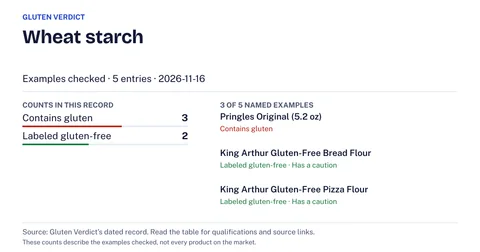
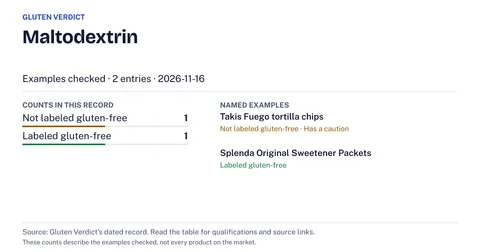
- Gluten-free wheat starch is an ingredient from wheat that has been processed to remove gluten: Coeliac UK says it is washed so it has a level of gluten within the Codex standard, 20 ppm or less75. The US rule allows such an ingredient only when the finished food stays below 20 ppm64. Our verdicts on wheat starch and maltodextrin show how ingredients that can come from wheat read on US labels.
Verdicts in this guide
Questions people ask
Is Codex a law?
No. Codex texts are voluntary and do not have binding effect on national food legislation1; a country can adopt one into its own law12.
Is 20 ppm the same as 20 mg/kg?
In the US rule, yes: it writes below 20 ppm gluten as below 20 mg gluten per kg of food8. Codex states its limit in mg/kg24.
Does Australia follow Codex?
Not on the gluten-free claim. Australia and New Zealand require no detectable gluten and no oats10, and a 2026 review says the ANZ labeling regulations are not aligned with other international regulations76.
Do the EU and the US treat Codex’s second category the same way?
No. The EU regulation has a “very low gluten” statement at no more than 100 mg/kg6, the same ceiling Codex sets for its second category37. FDA says its rule does not define the claim13, and it declined to adopt a tiered labeling system41.
More in Gluten-free labeling law by country
 Sin TACC in Argentina: the logo and the ANMAT gluten-free registerWhat TACC stands for, what Argentina’s gluten-free law and symbol require, and how to look a product up in ANMAT’s register.
 May-contain labels abroad: what each country’s regulator says about themWhether a “may contain” or shared-facility line is required, voluntary or guided by a scheme in the US, UK, EU, Canada, Australia, New Zealand and Codex.
 Gluten-free and very low gluten on EU labels, and how allergens are highlightedWhat EU “gluten-free” and “very low gluten” claims permit, how cereals containing gluten are highlighted in ingredient lists, and the rules for loose food.
 Which gluten grains a pack’s allergen line must name, by countryWhether the allergen line must name barley, rye and oats, country by country: US, Canada, EU, UK, Australia and New Zealand, Brazil, Japan.
 Gluten-free logos outside the US: who issues each one and what it requiresTell a certifier’s gluten-free logo from a maker’s own: who issues Crossed Grain, Coeliac Australia’s and Celiac Canada’s marks, and the limit each sets.
 UK gluten-free labelling: the legal rules, Natasha’s Law and the Crossed GrainWhat UK law requires on allergen and gluten-free labels, what Natasha’s Law added for food packed on site, and how the Crossed Grain mark differs.
Related guides
 Gluten-free labeling rules by country: ceilings, claim wording and where no rule was foundLook up the gluten-free limit and claim wording for the US, Canada, EU, UK, Australia, New Zealand and more, each figure tied to the page we read.
 How the 20 ppm gluten-free limit was chosen, and by whomWho set the 20 ppm gluten-free limit and when: the 2004 law, FDA's 2013 rule and its stated reasons, the 2020 follow-up rule, and Codex and EU wording.
 Gluten-free labeling in Canada: the claim, the gluten-source declaration and oatsHow Health Canada's gluten-free claim works, how gluten sources and oats must be declared on a Canadian pack, and how it differs from the FDA rule.
 Maltodextrin, dextrin and glucose syrup made from wheat: what the label rules sayWhat US label law, FDA and the two US celiac charities say about wheat-made maltodextrin, dextrin and glucose syrup, and how to confirm one.
Sources
- [1, 19, 20] FAO/WHO Codex Alimentarius, FAQ: Are Codex standards mandatory?, checked Nov 17, 2026.
- [2, 3, 4, 21, 23, 24, 25, 26, 27, 28, 29, 30, 31, 37, 38, 43, 44, 45, 46] FAO/WHO Codex Alimentarius, Standard for Foods for Special Dietary Use for Persons Intolerant to Gluten (CODEX STAN 118-1979), FAO-hosted PDF, checked Nov 17, 2026.
- [5, 6, 54, 67] European Commission (EUR-Lex), Commission Implementing Regulation (EU) No 828/2014, Annex, checked Nov 17, 2026.
- [7, 39] legislation.gov.uk (The National Archives), Commission Implementing Regulation (EU) No 828/2014, Annex, UK version, checked Nov 17, 2026.
- [8, 49] Electronic Code of Federal Regulations (eCFR), 21 CFR 101.91, Gluten-free labeling of food, checked Nov 17, 2026.
- [9, 51, 56, 58] Health Canada, Health Canada’s Position on Gluten-Free Claims, checked Nov 17, 2026.
Read on 2026-11-17: the page names no “low gluten” or “very low gluten” claim or other second category beside the gluten-free claim.
- [10, 42] Food Standards Australia New Zealand (Food Standards Code), Schedule 4: Nutrition, health and related claims, table “Conditions for nutrition content claims” (authorised version F2026C00415), checked Nov 17, 2026.
Read on 2026-11-17: the “Gluten Free” row of the table “Conditions for nutrition content claims” says the food must not contain (a) detectable gluten; or (b) oats or oat products; or (c) cereals containing gluten that have been malted, or products of such cereals.
Read on 2026-11-17: the “Low” row under the gluten claim in the table “Conditions for nutrition content claims” says the food contains no more than 20 mg gluten/100 g of the food.
- [11, 50, 60] Boletín Oficial de la República Argentina, Resolución Conjunta 32/2023, Secretarías de Agricultura, Ganadería y Pesca y de Calidad en Salud, checked Nov 17, 2026.
- [12, 16, 17] FAO/WHO Codex Alimentarius, About Codex (codex.fao.org), checked Nov 17, 2026.
- [13, 41, 52, 53, 62, 63, 64, 65] Federal Register (copy published by the US Government Publishing Office), Food Labeling; Gluten-Free Labeling of Foods (final rule, 78 FR 47154, August 5, 2013), checked Nov 17, 2026.
- [14, 76] Nutrition Reviews (PubMed abstract), Oats in Gluten-Free Diets: An Examination of the Codex Standard and Country-Specific Differences in Gluten-Free-Food Labeling Regulations (Faulkner-Hogg et al., Nutrition Reviews, 2026), checked Nov 17, 2026.
- [15, 18] FAO, Codex agrees on new guidance on “may contain” allergen labels (FAO news release, 7 July 2026), checked Nov 17, 2026.
- [22, 47, 48, 59, 61, 68, 74] Popping et al. (review), via Europe PMC, Gluten Analysis and Regulation: Scientific, Analytical, and Economic Dimensions of Gluten-Free Assurance (Popping et al., 2026, Compr Rev Food Sci Food Saf), checked Nov 17, 2026.
- [32] UK Food Standards Agency, FSA Position on the Codex Precautionary Allergen Labelling Standard including Allergen Thresholds (board paper FSA 25-12-05, 25 June 2026), checked Nov 17, 2026.
- [33, 34, 72] FAO and WHO, Ad hoc Joint FAO/WHO Expert Consultation on Risk Assessment of Food Allergens: reference dose(s) for cereals containing gluten or gluten (summary and conclusions, November 2025), checked Nov 17, 2026.
- [35, 36] Food Standards Australia New Zealand, Proposal P264 Final Assessment Report (17 March 2004): attachment on international gluten rules, checked Nov 17, 2026.
- [40, 55, 75] Coeliac UK, Gluten and the law, checked Nov 17, 2026.
- [57] Canadian Food Inspection Agency, Compliance and enforcement of gluten-free claims, checked Nov 17, 2026.
- [66] US Food and Drug Administration, Questions and Answers on the Gluten-Free Food Labeling Final Rule, checked Nov 17, 2026.
- [69, 70, 71, 73] Coeliac UK, Our impact on food labelling (“may contain” labelling campaign), checked Nov 17, 2026.