Who regulates a gluten-free claim: FDA, USDA or TTB
Short answer
Whose rule sits behind a gluten-free claim depends on what the product is:
- FDA covers most packaged foods and shell eggs; its rule defines the claim, and a food that bears it without meeting the definition is misbranded1, 2.
- USDA’s FSIS covers meat, poultry and certain egg products, and lists a “gluten free” claim among those it must approve before a label is used3, 4.
- TTB covers most alcohol and allows “gluten-free” only where the drink would qualify under FDA’s definition; a drink fermented from gluten grains may instead say it was processed to remove gluten, with a required qualifier5, 6.
- When a product could fall under two agencies, work out which one wrote its label before you judge the claim; the gray-zone section lists the common cases.
Part of Label reading and gluten-free claims, 17 guides
Key points
- FDA defines “gluten-free” and three equivalent phrases7; TTB ties its alcohol rule to that definition5.
- FSIS’s label approval guideline puts a “gluten free” claim in the group of claims that need label approval, and it states no parts-per-million figure8, 9.
- Shell eggs are FDA’s; certain egg products, meat and poultry are generally USDA’s; for meat products the split turns on how much meat, fat, tallow or meat extract is in them3, 10.
- Beer is split too: a malt beverage made with malted barley and hops answers to TTB, and a beer such as sorghum beer to FDA3, 11.
- A Contains line is voluntary on meat and poultry, as FSIS describes it12, and TTB does not require allergen disclosure on alcohol13.
Which agency covers which package
FDA’s gluten-free rule does not cover foods whose labeling USDA or TTB regulates, so the split starts there3.
| Product | Agency | What the agency says |
|---|---|---|
| Packaged foods, dietary supplements, fruits and vegetables, shell eggs, fish | FDA | FDA lists these as covered by its gluten-free rule1. |
| Meat, poultry and certain egg products | USDA (FSIS) | FDA says USDA generally regulates their labeling3. FSIS says label review for meat, poultry and egg products is required by statute14. |
| Distilled spirits, wines of 7 percent alcohol by volume or more, malted beverages made with both malted barley and hops | TTB | FDA names these as TTB’s3. |
| Beer that is not a malt beverage (FDA’s example is sorghum beer), and wine under 7 percent alcohol by volume | FDA | FDA gives sorghum beer as its example11; TTB says the other alcohol drinks fall to FDA15. |
| Game meat such as bison, deer and rabbit | FDA | FDA says it regulates game meats and game meat products16. |
The rest of this guide takes each agency in turn, then the cases where two could claim the product. Our own verdicts, such as hot dogs, eggs and beer, show what makers’ and charities’ pages say about gluten; they do not decide which agency approved a given label.
FDA: a written definition with a number
FDA’s rule is 21 CFR 101.91. It defines “gluten-free” as: the food is inherently gluten-free, or it contains no gluten-containing grain and no ingredient derived from one, unless that ingredient was processed to remove gluten and does not bring the food to 20 parts per million (ppm) or more gluten; and any unavoidable gluten must be less than 20 ppm17.
“Free of gluten”, “without gluten” and “no gluten” carry the same requirements7. Using the claim at all is voluntary18, but a food that bears it and fails the definition is deemed misbranded2.
FDA says it enforces the rule through routine post-market monitoring: sampling, inspections of manufacturing facilities, label reviews, and follow-up on complaints19. A state or local government may not set a different definition for these claims20.
A label can carry both a gluten-free claim and a voluntary line such as “made in a facility that also processes wheat”, as long as the statement is truthful and not misleading21. For the detail of the 20 ppm limit and how FDA checks it, see the FDA gluten-free rule guide.
USDA FSIS: meat, poultry and egg products
FSIS says label review for meat, poultry and egg products is required by statute14. Inside that system FSIS sorts claims, and its label approval guideline says special statements and claims include “natural” and negative claims such as “gluten free”22.
Appendix 1 of that guideline says FSIS must approve labels bearing those claims before they enter commerce, that the label is submitted for sketch approval, and that supporting documentation must be part of the labeling record4. The appendix lists “Gluten free (certified or non-certified)” among them8.
What the guideline does not give is a number. It states no parts-per-million limit for a gluten-free claim9. These pages therefore do not tell you whether FSIS applies FDA’s 20 ppm figure; FDA says it works with USDA and TTB to harmonize the requirements as much as possible, taking into consideration their different statutory authorities23. For a deli meat, sausage or jerky pack, the question to put to the maker is what standard it documented for the claim.
Allergen lines work differently on these products
The 2004 allergen labeling law, FALCPA, requires products under FDA’s jurisdiction that contain a major food allergen to identify it clearly on the label24. For meat, poultry and egg products, FSIS says all ingredients must be declared in the ingredients statement25; on meat and poultry labels it supports a Contains statement as a voluntary addition12. One it has accepted reads “Contains: milk, wheat gluten, soy”, placed right after the ingredients26.
Precautionary lines are limited too: FSIS allows factual statements about a plant’s environment in limited situations, where good manufacturing practices cannot reasonably eliminate the unintended presence of an ingredient27.
Where we have checked products, the verdicts for hot dogs, deli meat, sausage, bacon, ham, turkey and beef jerky record what makers’ and charities’ pages say about gluten.
TTB: wine, spirits and malt beverages
TTB’s Ruling 2020-2 authorizes “gluten-free” on an alcohol label if the product would be entitled to the claim under FDA’s definition5. It names products made without any ingredient that contains gluten, such as wine fermented from grapes or spirits distilled from potatoes, as eligible28.
For distilled spirits made from gluten grains, TTB permits the claim as long as good manufacturing practices prevent any gluten-containing material from entering the final product29. If protein-containing ingredients are added after distillation, the label may carry the claim if the maker is prepared to substantiate, on request, the absence of protein in the distillate, the absence of gluten in the added ingredients, and the precautions taken to prevent cross-contact30.
A drink that would not qualify under FDA’s definition cannot use “gluten-free” or an equivalent: TTB treats that claim as misleading31. A beverage fermented from gluten grains may say it was processed, treated or crafted to remove gluten, under conditions that include this qualifying statement beside it:
“Product fermented from grains containing gluten and [processed or treated or crafted] to remove gluten. The gluten content of this product cannot be verified, and this product may contain gluten.”6
TTB also treats a stated gluten level for a fermented drink, such as “contains x ppm”, as misleading without an appropriate basis or necessary qualification, pending a scientifically valid method for measuring gluten in such products32. It handles gluten-content statements as health-related statements33, makes the maker responsible for verifying a claim, and may ask for samples for laboratory analysis34.
Allergen lines on alcohol
TTB’s allergen FAQ says current rules do not require disclosing major food allergens on alcohol labels13. A maker that chooses to declare one must list all those used in production, including fining or processing agents35. A missing Contains line on a bottle therefore tells you little.
For the drinks themselves, see the gluten-free alcohol guide, how to look up a label in TTB’s COLA registry, and our verdicts for beer, wine and whiskey.
The three rules side by side
| Question | FDA | USDA FSIS | TTB |
|---|---|---|---|
| What the claim requires | The food meets the definition in 21 CFR 101.91, including less than 20 ppm for any unavoidable gluten17. | A “gluten free” claim is one FSIS must approve first, with supporting documentation4. The guideline gives no ppm figure9. | The drink would qualify under FDA’s definition5; spirits from gluten grains can qualify if good manufacturing practices keep gluten out29. |
| Allergen line | Required to identify clearly a major allergen the product contains24. | A Contains statement is voluntary on meat and poultry; all ingredients must be declared12, 25. | Not required; if one allergen is declared, all those used must be listed13, 35. |
| How the claim is checked | Routine post-market monitoring19. | Label approval before use4. | The maker verifies the claim; TTB may request samples34. |
Gray zones: when the agency is not obvious
- Meat products with little meat. FDA regulates meat products with 3% or less raw meat or less than 2% cooked meat; USDA regulates those with more than 3% raw or 2% or more cooked meat; the same page sets a 30% threshold for fat, tallow or meat extract10. A product with only a little meat can therefore fall under FDA rather than USDA.
- Sandwiches. FDA regulates closed-face sandwiches unless part of a dinner; USDA regulates open-face sandwiches and dinners that contain a sandwich36.
- Game meat. FDA regulates game meats such as bison, deer and rabbit16, even though such meat slaughtered under USDA voluntary inspection may carry a USDA voluntary mark of inspection37.
- Eggs. FDA regulates the labeling of shell eggs, and USDA generally regulates certain egg products3. Our eggs verdict covers what that means for a carton.
- Restaurants. FDA says its rule applies to packaged foods and recommends that restaurants making a gluten-free menu claim be consistent with its definition38; it adds that state and local governments play an important role in restaurant oversight39.
- Imports. A food FDA regulates has to meet the same federal requirements when imported, so a gluten-free claim on it must comply40.
None of this says whether a given label is right, only whose rule to read it against.
What to check when you cannot tell
- Name the product type: packaged food, meat or poultry, egg product, or alcohol. The first table gives the default agency for each.
- Read the exact words of the claim. On an FDA-regulated food, “gluten-free”, “free of gluten”, “without gluten” and “no gluten” mean the same thing7. On a drink fermented from gluten grains, “processed to remove gluten” with its qualifier is a different statement6.
- Read the whole ingredient list rather than relying on a Contains line, which is voluntary on meat and poultry12 and not required on alcohol13. See how to read food labels and the Contains line guide.
- If the number matters, ask the maker which standard its claim rests on, since the FSIS guideline names none9. For alcohol, look the label up in TTB’s COLA registry.
- For a specific food, start from every verdict, A to Z.
Verdicts in this guide
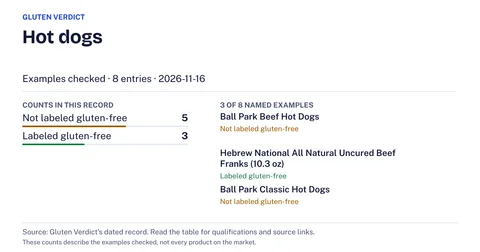 Hot dogsDepends on the productchecked Nov 16, 2026
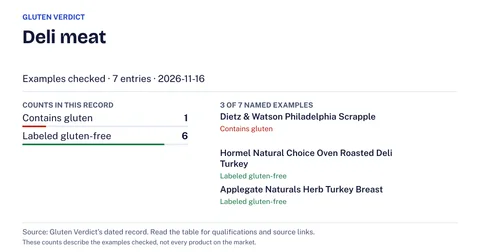 Deli meatDepends on the product1 of 7 products we checked contains gluten: Dietz & Watson Philadelphia Scrapplechecked Nov 16, 2026
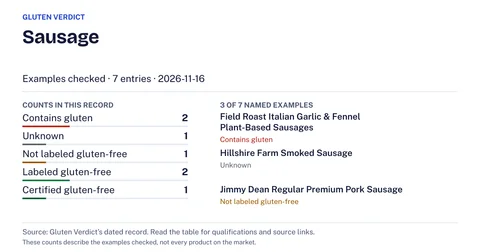 SausageDepends on the product2 of 7 products we checked contain gluten: Field Roast Italian Garlic & Fennel Plant-Based Sausages and Tofurky Plant-Based Italian Sausagechecked Nov 16, 2026
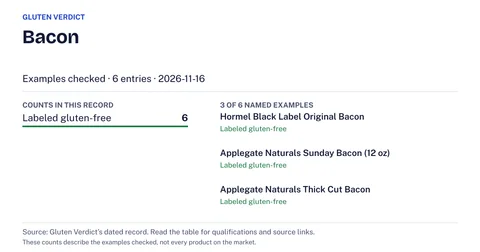 BaconDepends on the productchecked Nov 16, 2026
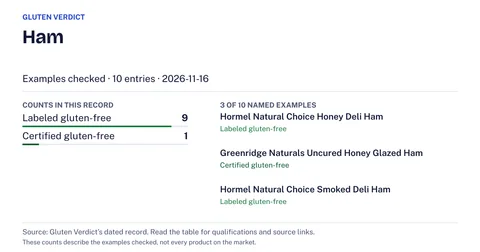 HamDepends on the productchecked Nov 16, 2026
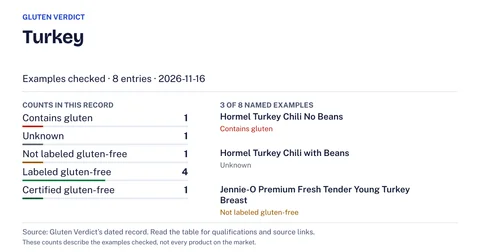 TurkeyNaturally gluten-free1 of 8 products we checked contains gluten: Hormel Turkey Chili No Beanschecked Nov 16, 2026
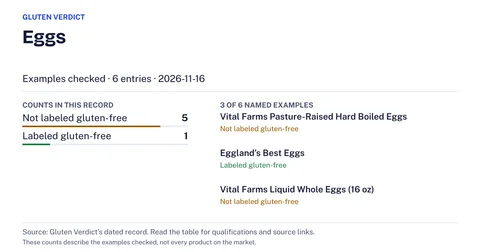 EggsNaturally gluten-freechecked Nov 16, 2026
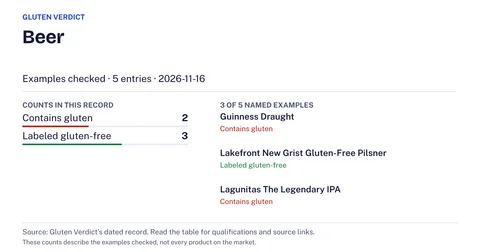 BeerDepends on the product2 of 5 products we checked contain gluten: Guinness Draught and Lagunitas The Legendary IPAchecked Nov 16, 2026
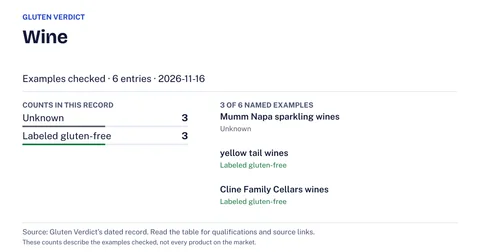 WineNaturally gluten-freechecked Nov 16, 2026
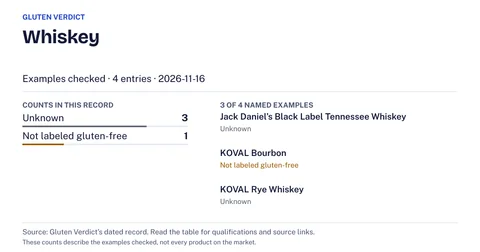 WhiskeyDepends on the productchecked Nov 16, 2026
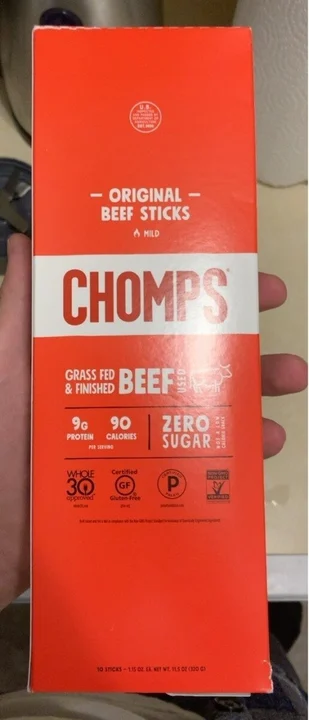 Beef jerkyDepends on the product3 of 8 products we checked contain gluten: Jack Link’s Original Beef Jerky, Jack Link’s Teriyaki Beef Jerky, and Old Trapper Teriyaki Beef Jerky (bulk)checked Nov 16, 2026
Questions people ask
Does USDA define “gluten-free” the way FDA does?
The FSIS label approval guideline we read lists “gluten free” among claims that need approval and states no numeric limit8, 9. FDA’s definition, with its 20 ppm figure, is in 21 CFR 101.9117. Ask the maker which standard it documented.
Are eggs regulated by FDA or USDA?
FDA regulates the labeling of shell eggs, and USDA generally regulates the labeling of certain egg products3.
Which agency regulates a gluten-free beer?
A beer that is a malt beverage made with malted barley and hops answers to TTB3, which allows “gluten-free” only if the beer would qualify under FDA’s definition5. A beer fermented from gluten grains may say it was processed to remove gluten, with TTB’s qualifier6. A beer that is not a malt beverage, such as sorghum beer, answers to FDA11.
Can a state set its own gluten-free definition?
Not for the claims FDA’s rule covers: a state or local government may not set a different definition or requirement for “gluten-free”, “no gluten”, “free of gluten” or “without gluten”20.
More in Label reading and gluten-free claims
 “Low gluten”, “gluten removed” and “gluten friendly” on a labelWhat “low gluten”, “gluten removed” and “gluten friendly” mean on a US label, which phrases FDA or TTB define, and what to ask the maker.
 Kosher and halal marks on food: what they say about glutenA kosher or halal mark and a gluten-free claim answer different questions. What each certifier says its mark covers, and where the gluten answer is.
 Fermented, hydrolyzed and distilled foods: how a gluten-free claim is checkedHow FDA’s 2020 rule checks a gluten-free claim on fermented, hydrolyzed and distilled foods, why a test cannot settle it, and where TTB takes over.
 How to read a US food label for glutenWhere gluten shows up on a US food label: the gluten-free claim, the Contains line, the ingredient list and may-contain lines, and what each means.
 The FDA gluten-free rule: what 21 CFR 101.91 requires and what 20 ppm measuresWhat FDA’s gluten-free rule requires, which claim words it covers, what 20 ppm means for a portion of food, and how FDA checks that a claim holds.
 The Contains line names wheat, not barley or rye: what US allergen labels coverWhat the US allergen Contains line covers, why it names wheat but not barley or rye, and which ingredient-list names stand in for them.
Related guides
 Gluten in sausage, hot dogs and deli meat: fillers, binders and flavoringsHow to read sausage, hot dog, deli meat and jerky labels for wheat, malt, starch and soy sauce, and which USDA label rules apply to meat.
 Gluten-free alcohol: what US beer, spirits, wine and cider labels may sayWhich US alcohol labels may say gluten-free, who sets the wording, and how beer, spirits, wine, cider and hard seltzer differ, each rule sourced.
 Plant-based meat, tofu and seitan: finding the wheat glutenSeitan and some meat substitutes are made from wheat gluten. How to spot it on a plant-based label, with ingredient lists from maker pages.
 A gluten-free grocery list by aisle for US supermarketsAn aisle-by-aisle gluten-free grocery list for US stores: what needs no label, what needs a check, and what stays off the list.
Sources
- [1, 39] US Food and Drug Administration, Gluten and Food Labeling, checked Nov 17, 2026.
- [2, 20] Electronic Code of Federal Regulations, 21 CFR 101.91 Gluten-free labeling of food, checked Nov 17, 2026.
- [3, 7, 11, 17, 18, 19, 21, 23, 38, 40] US Food and Drug Administration, Questions and Answers on the Gluten-Free Food Labeling Final Rule, checked Nov 17, 2026.
- [4, 8, 9, 22] USDA Food Safety and Inspection Service, FSIS Compliance Guideline for Label Approval (July 2020), checked Nov 17, 2026.
Read on 2026-11-17: Appendix 1, “Special Statements and Claims”, lists “Gluten free (certified or non-certified)”, lists “certified gluten free” as an example under “Certified Claims”, and names “gluten free”, “no gluten ingredients” and “not gluten free” among its “Negative or ‘Free’ claims”.
Read the guideline on 2026-11-17: no parts-per-million figure or other numeric gluten limit appears anywhere in the document.
- [5, 6, 15, 28, 29, 30, 31, 32, 33, 34] Alcohol and Tobacco Tax and Trade Bureau (TTB), TTB Ruling 2020-2: Gluten Content Statements in the Labeling and Advertising of Wine, Distilled Spirits, and Malt Beverages, checked Nov 17, 2026.
- [10, 16, 36, 37] US Food and Drug Administration, FDA Regulated Meats and Meat Products for Human Consumption, checked Nov 17, 2026.
- [12, 24] USDA Food Safety and Inspection Service, FSIS Compliance Guidelines: Allergens and Ingredients of Public Health Concern, checked Nov 17, 2026.
- [13, 35] Alcohol and Tobacco Tax and Trade Bureau (TTB), Major Food Allergen Labeling for Wines, Distilled Spirits, and Malt Beverages, checked Nov 17, 2026.
- [14, 25, 26, 27] USDA Food Safety and Inspection Service, Allergens - Voluntary Labeling Statements, checked Nov 17, 2026.