What to ask a food maker about gluten, and how to read the reply
Short answer
Write about one exact product, with its lot code, and ask five things. A reply counts only if it speaks to that product, in writing:
- Is this product made to meet FDA’s gluten-free rule, which among other requirements means any unavoidable gluten is less than 20 parts per million, and does the pack carry the claim? FDA treats the claim as voluntary and holds the maker responsible for it1, 2.
- Does any ingredient, flavoring or starch come from wheat, barley, rye or oats? GIG notes that barley and rye are not top US allergens, so gluten can hide behind other names3.
- Is it made on equipment shared with foods that contain gluten, and what happens between runs?4
- What checks back the claim: supplier certificates, tests or a certification program?5
- Does the answer cover the flavor, size and lot you hold? A maker’s claim is made food by food6.
Part of Label reading and gluten-free claims, 17 guides

Key points
- FDA’s rule does not require a maker to test for gluten, but the maker is responsible for a food labeled gluten-free meeting it, so “how do you check?” is a fair question2.
- “Made with no gluten-containing ingredients” is not the claim: FDA says that without a gluten-free claim on the label, consumers should not assume the food meets the rule7.
- A maker’s answer covers one product. Chex’s own FAQ says most flavors are gluten-free and Wheat Chex is not8.
- In one study by FDA scientists, published in 2015, 36 of 186 foods that were not labeled gluten-free and listed no wheat, rye or barley had more than 20 parts per million of gluten on at least one of two test kits9, 10.
- Keep the message, the reply, the date and the lot code. If the pack and the reply disagree, FDA says labeling concerns may be reported to it11.
When a message to the maker is the right step
Write when a product carries no gluten-free claim, or when the pack and the maker’s website disagree. The claim is voluntary1, so a pack may carry only an ingredient list.
An ingredient list alone leaves gaps. The National Celiac Association (NCA) says that on a product not labeled gluten-free you should watch for six words: wheat, rye, barley, malt, brewer’s yeast and oats12. It also recommends that processed foods, and naturally gluten-free grain products such as cereal and flours, be labeled gluten-free because they have a high risk of cross-contact13. The Gluten Intolerance Group (GIG) says products that look gluten-free from the ingredients but are oats, lentils or milled grain, bean, seed or legume products carry a higher risk of cross-contact and are best avoided unless certified or labeled14.
One study by FDA scientists, published in 2015, put numbers on this. It tested 275 foods labeled gluten-free and 186 foods that were not labeled gluten-free and listed no wheat, rye or barley; 3 of the 275 were mislabeled9. Among the 186, 36 (19.4%) had more than 20 parts per million of gluten on at least one of two test kits, and 19 had more than 10010. Oats in the food were strongly correlated with a positive result15. It is one survey of foods available in the United States, not a verdict on any product.
If the pack already carries the claim, the maker is the party FDA holds responsible for it2. A message then asks about the lot and the checks behind the claim rather than the basic question.
Meat, poultry and certain egg products are labeled under USDA rules, and most alcoholic drinks under TTB rules, not FDA’s gluten-free rule16. For those, ask which agency’s rules the label follows.
What to put in the message
A maker can only answer about what it can identify. Put these in, in this order, and keep to one product per message.
| Include | Why |
|---|---|
| Product name exactly as printed, with flavor and size | FDA says a maker using the claim on some foods does not mean every food it makes is free of gluten6. Chex’s own FAQ names Wheat Chex as the one flavor that is not gluten-free8. |
| Lot or best-by code and the UPC | FDA’s complaint instructions ask for the codes on the label or container, such as lot number, expiration date and UPC code17. They let the reply name the run you hold. |
| Where and when you bought it | FDA’s complaint instructions also ask for the date of purchase and the name and address of the place of purchase17. |
| What the pack says, quoted exactly | Quote the claim, the Contains line and any “made in a facility” line. Advisory lines are voluntary, and FDA says one may sit beside a gluten-free claim if it is truthful and not misleading18. The exact wording is what the maker has to explain. |
| What you need to know | Ask for facts about the product, not reassurance (see the questions below). One short question per fact gets a shorter, clearer reply. |
Questions that get a usable answer
These ask for a fact the maker can state about one product. Each row says what a usable reply contains and why the question matters.
| Ask | A usable reply contains | Why it matters |
|---|---|---|
| Is this exact product made to meet FDA’s gluten-free rule, and is the claim printed on this pack? | A yes or no for that product, and whether the claim is on the pack. | The claim means any unavoidable gluten is less than 20 parts per million, and the maker is responsible for that2. Makers may leave the claim off1. |
| Does any ingredient, flavoring, starch or yeast extract come from wheat, barley, rye or oats? | A named source for each ingredient you asked about, or a plain statement that none comes from those grains. | GIG notes that gluten is not considered a top US allergen (wheat is; barley and rye are not), so it can hide behind other names3. GIG lists modified food starch, dextrin, caramel color, natural flavors, vegetable protein and yeast extract as ingredients that may contain gluten depending on how they are made19, and for US yeast extract advises choosing one labeled gluten-free or contacting the maker20. |
| Is it made on lines or equipment shared with foods that contain gluten, and how are they cleaned or checked between runs? | Shared or dedicated, and the control used if shared. | FDA says shared production equipment for foods with and without gluten could result in cross-contact4. GIG says a GFCO-certified product made on shared equipment needs effective cleaning, with evidence given to GFCO regularly21. |
| What backs the claim for this product? | The check by name: ingredient-supplier certificates, in-house or laboratory tests, or a third-party certification. | FDA lists these as tools a maker may choose; testing itself is not required5, 2. FDA does not endorse any certification program22. GIG says GFCO requires a product to test at or below 10 parts per million23. |
| For oats, flours and other grain, bean or seed products: how is the grain sourced or sorted, and how is the finished product tested? | A description of the process for this product, not a brand-wide line. | Oats labeled gluten-free must contain less than 20 ppm24, and GIG calls oats a higher-risk product14. An example of a process answer is General Mills’ Cheerios FAQ, which says its oats are milled to separate out stray grains of wheat, barley and rye and then tested25. What each maker says about its oats is collected in our oat guide. |
| For a fermented or hydrolyzed food or ingredient, such as soy sauce or vinegar: what records back the claim? | Whether test results, supplier certificates or similar records exist for the food and its ingredients. | FDA says current gluten tests do not adequately detect gluten in fermented and hydrolyzed foods, so a maker using the claim must keep records26 that could include test results or a certificate of analysis27. They are kept at least 2 years and provided to FDA on request during an inspection28. The page says nothing about makers giving them to consumers28. |
Our verdicts show how makers split one brand by product: see Andes Mints, Krusteaz Gluten Free Flour and KIND Dark Chocolate Nuts & Sea Salt bars. For a product with no claim and oats on the list, see Nature Valley Crunchy Granola Bars. The label rules behind these questions are in how to read a US food label for gluten.
Questions that invite a form reply
A broad question is easy to answer with a brand-wide sentence, and makers publish those. Chex’s FAQ answers whether Chex cereal is gluten-free with “Most Chex cereal flavors are gluten-free”8. Cheerios’ FAQ says ingredients vary across its products and sends the reader to the label29. Both speak for the range, not the box you hold.
- “Is it gluten-free?” with no product named. Expect the brand-wide line. Name the product, flavor, size and lot.
- “Do you follow good manufacturing practices?” A yes describes the factory. FDA’s rule does not require a maker to test for gluten2, and a practice statement does not say whether anyone checked this product.
- “Is it okay for someone with celiac disease?” This asks for a medical judgment, not a fact about the product. Ask for the facts above instead.
- “Why does it say may contain wheat?” This is a fair question, but ask what the line refers to. GIG says such a line could refer to shared equipment with gluten-containing products or to other cross-contact risks including agricultural commingling30. The line is voluntary18, and the FDA-scientist study found gluten in a significant number of foods with advisory warnings31.
Reading the reply: confirmed, conditional or not an answer
This sort is ours, not an official scale. It grades what the reply says about your product, not whether the food suits you.
| Sort | What the reply looks like | What it does and does not tell you |
|---|---|---|
| Confirmed | Names your product and lot or size; says it meets FDA’s gluten-free rule or carries a certifier’s mark; says how that is checked. | It is the statement of the party FDA holds responsible for the claim2. It is still the maker’s own statement, so the check the reply names is the part to read5. |
| Conditional | A fact with a condition: only some flavors, only newer packs, no gluten ingredients but a shared line, a may-contain line, or no claim on this pack. | FDA allows a statement like “made with no gluten-containing ingredients” but says that without a gluten-free claim on the label, consumers should not assume the food meets the rule7. Advisory lines are voluntary18. Whether a condition is acceptable is your decision; we do not rate it. |
| Not an answer | A brand-wide sentence, a practice statement, a pointer back to the box, or a term such as “gluten-friendly” or “low gluten”. | GIG says that on labels, terms like these do not provide assurance that the maker took steps to prevent cross-contact32. A pointer back to the box adds nothing you could not read yourself; Cheerios’ FAQ, for one, ends its answer by telling readers to check the allergen statement on the box25. |
If the reply is conditional or not an answer, write back once with the single missing fact, for example whether the line is shared with wheat products. If the answer stays general, note that in your record.
What to keep, and how long a reply holds
- Your message as sent, with the date and the address it went to.
- The reply, complete, with its date and the sender’s name or ticket number.
- Photos of the front, the ingredient list, any advisory line and the lot code. FDA’s complaint instructions ask for photos of the product, label, ingredient statement and lot code17.
- The pack itself until you have used the lot. On a suspected illness from a food, FDA’s page says to keep any food packages because they may contain important information11.
A reply describes the product on the day it was written. A new pack design, a changed ingredient list or a different lot code is a reason to ask again.
If the reply and the pack disagree
Write back with a photo of the pack and the exact sentence from each, and ask which applies to that lot.
If the two still conflict, FDA says labeling concerns may be reported to it, and that anyone who believes an illness is associated with a particular food should contact a healthcare provider immediately11. It lists what a report should include, among them the purchase details, the lot code and photos17. FDA says it enforces the gluten-free rule through routine monitoring that includes following up on consumer and industry complaints33.
Sample message, with a blank for each fact
Fill each blank from the pack. Send it to the address or form on the pack or the maker’s contact page.
Subject: Gluten question: ____ (product name and size), lot ____
Hello, I bought ____ (product name, flavor, size) on ____ (date) at ____ (store). The lot or best-by code is ____ and the UPC is ____. The pack says ____ (quote the gluten-related lines exactly, or write “no gluten-free claim”). Please answer in writing about this product:
- Is it made to meet FDA’s gluten-free rule, and is the claim printed on this pack?
- Does any ingredient, flavoring, starch or yeast extract come from wheat, barley, rye or oats?
- Is it made on equipment shared with foods that contain gluten, and what is done between runs?
- What checks back the claim: supplier certificates, tests or a certification program?
- Does this answer apply to this size and lot?
Please reply to ____ (your email). I am keeping this message and your reply, with the date. Thank you.
Verdicts in this guide
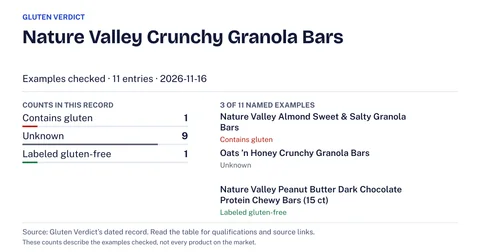 Nature Valley Crunchy Granola BarsUnknown1 of 11 varieties we checked contains gluten: Nature Valley Almond Sweet & Salty Granola BarsGeneral Mills · checked Nov 16, 2026
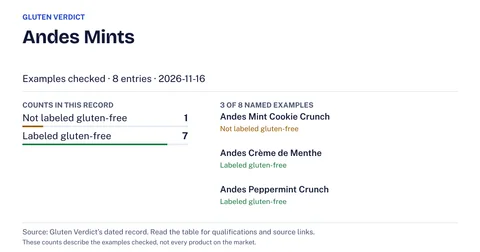 Andes MintsLabeled gluten-freeTootsie Roll Industries · checked Nov 16, 2026
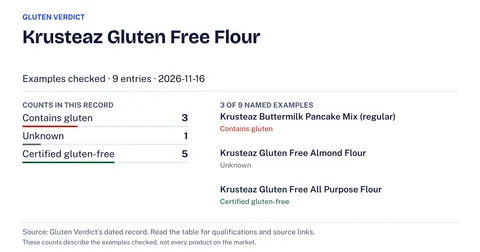 Krusteaz Gluten Free FlourCertified gluten-free3 of 9 varieties we checked contain gluten: Krusteaz Buttermilk Pancake Mix (regular), Krusteaz Honey Cornbread Muffin Mix (regular), and Krusteaz Pie Crust Mix (regular)Krusteaz · checked Nov 16, 2026
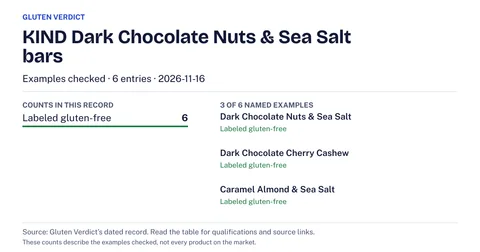 KIND Dark Chocolate Nuts & Sea Salt barsLabeled gluten-freeKIND (Mars) · checked Nov 16, 2026
Questions people ask
Do food makers have to test for gluten?
Not under FDA’s gluten-free rule. It does not require testing, but the maker is responsible for a food labeled gluten-free meeting the rule2. FDA lists in-house or laboratory tests, supplier certificates and certification programs as tools a maker may choose5.
More in Label reading and gluten-free claims
 How to check a gluten-free seal in the certifier's own directorySearch GFCO's Product Finder by brand, product or UPC, read what an entry shows, and learn what a missing listing means for the seal on your pack.
 What “may contain wheat” and “made in a facility with wheat” mean on a US labelHow to read “may contain wheat”, shared-facility and shared-equipment lines on US labels, with and without a gluten-free claim, and what to check next.
 Vegan, organic, non-GMO, natural and keto labels do not mean gluten-freeVegan, organic, non-GMO, natural, plant-based and keto labels describe other things. What each claims, and which gluten claim or source to check instead.
 Gluten-free certification programs compared: limit, testing and auditsHow GFCO, GFFP, NSF and the BRCGS-based marks differ on gluten limit, testing and audits, set against FDA’s 20 ppm rule for every claim.
 How to check whether a packaged food is gluten-freeA four-step check for one packaged food: the claim, the ingredient and allergen lines, the maker’s dated page and the certifier’s directory.
 When a gluten-free label looks wrong: what to keep, who to tell, where to lookFound wheat, barley or malt in a food labeled gluten-free? What to keep, whom to tell, which US agency takes the report, and where recalls are listed.
Related guides
 Gluten-free snack bars: reading oats and barley malt on the wrapperRead a snack-bar wrapper in four steps (gluten-free claim, malt, oats, Contains line), with a Clif and a KIND bar worked through.
 Gluten-free flour and baking mix cost per cup, with each maker’s statementWhat a cup of gluten-free flour or baking mix costs from each maker’s own price and label, shown beside what the maker says about gluten.
 1-to-1, all-purpose and bread flour blends: what each maker’s page says the bag is forWhat King Arthur and Bob’s Red Mill say their 1-to-1, all-purpose, bread and pizza gluten-free flours are for, and which bakes each sends elsewhere.
 Packing a gluten-free work lunch from shelf-stable foodsWhat to pack for a gluten-free office lunch, which packaged items to label-check once, and how to use a shared fridge, microwave and toaster.
Sources
- [1, 2, 4, 5, 6, 7, 11, 16, 17, 18, 22, 24, 26, 27, 28, 33] US Food and Drug Administration, Questions and Answers on the Gluten-Free Food Labeling Final Rule, checked Nov 17, 2026.
- [3, 19, 20] Gluten Intolerance Group, Advanced Label-Reading Tips, checked Nov 17, 2026.
- [8] General Mills (chex.com), Chex FAQs, checked Nov 17, 2026.
- [9, 10, 15, 31] Food Chemistry (PubMed record), Sharma, Pereira and Williams, Gluten detection in foods available in the United States: a market survey (2015), checked Nov 17, 2026.
- [12, 13] National Celiac Association, Can I eat a product that is not labeled gluten free but does not contain ingredients with gluten? (reviewed April 8, 2025), checked Nov 17, 2026.
Read on 2026-11-17: the answer says that if something is not labeled GF, watch out for these six words on the label: wheat, rye, barley, malt, brewer’s yeast and oats.
- [14] Gluten Intolerance Group, GIG FAQ: products that are not certified or labeled gluten-free, checked Nov 17, 2026.
- [21, 23, 30] Gluten Intolerance Group, Do All Wheat Mentions on Food Labels Mean Not Gluten-Free?, checked Nov 17, 2026.
- [25, 29] General Mills (cheerios.com), Cheerios FAQs, checked Nov 17, 2026.
- [32] Gluten Intolerance Group, Food Label Transparency, checked Nov 17, 2026.