Vinegar, vanilla and other flavor extracts: what to check on the bottle
Short answer
Most vinegars are on the National Celiac Association’s gluten-free list36, 6, with malt vinegar the one to avoid1; flavored vinegars, Asian rice vinegars and extracts with added ingredients are the ones to read. Read the bottle in this order:
- Look for malt: on a product that is not certified or labeled gluten-free, a plain “vinegar” could be malt vinegar3.
- For other vinegars, read the type. The National Celiac Association lists apple cider, distilled white, balsamic and wine vinegar as gluten-free6, and says flavored vinegars and Asian rice vinegars may contain gluten9.
- For an extract, read what follows the flavor. FDA’s standard lets pure vanilla extract carry glycerin, propylene glycol, sugar, dextrose or corn syrup22; McCormick’s artificially flavored vanilla bottles list vanillin and other artificial flavorings27, and one of them also lists corn syrup and caramel color28.
- If the bottle is silent on gluten, the questions at the end of this guide are the ones to send the maker.
Part of Hidden gluten in ingredients, sauces and processed foods, 21 guides
Key points
- The Gluten Intolerance Group says malt vinegar is the vinegar to avoid1; malt is derived from barley and malt vinegar is not distilled2. In the US, FDA says it cannot be used in foods that bear a gluten-free claim10.
- The National Celiac Association says plain distilled vinegars are gluten free even when made from gluten-containing grains7.
- FDA’s standard defines vanilla extract as a solution in aqueous ethyl alcohol of what can be extracted from vanilla beans21; McCormick’s pure bottle lists vanilla bean extractives in water and alcohol23.
- The artificially flavored McCormick bottles we read list more than the pure extracts do: vanillin and other artificial flavorings on one27, and natural flavorings, corn syrup and caramel color on the other28.
- Malt vinegar can also be inside other foods: the Celiac Disease Foundation says some potato chip seasonings, and salad dressings and marinades, may contain it14, 15.
Three checks for any bottle
The same three reads cover every vinegar and extract on the shelf. They take a few seconds and do not need the maker’s help.
- Is the type named? The Gluten Intolerance Group says that on a product that is not certified or labeled gluten-free, the general term “vinegar” could refer to malt vinegar, and that product should be avoided unless the manufacturer can confirm it is not malt vinegar3, 4.
- Is there a malt or barley word anywhere on the label, in the name or the ingredient line? If so, stop there and go to the malt vinegar section below.
- What comes after the flavor? The pure extract bottles we read list the flavor with water and alcohol, and one also lists sugar23, 25, 29; the artificially flavored bottles list more27, 28. Anything beyond the flavor, water and alcohol is the part to read (see the sections on extracts and on added ingredients).
A gluten-free claim on the package changes the first check. In the US, FDA says malt vinegar cannot be used in foods that bear a “gluten-free” labeling claim10; that rule does not apply to foods whose labeling USDA or TTB regulates37. On a bottle with no claim, read the type and the ingredient line.
Vinegar types: which are ordinary, which to check, which to avoid
The National Celiac Association begins its answer with “Most vinegars are gluten free”36 and names the examples in the table6. The Gluten Intolerance Group puts it the same way: most varieties are distilled and made from ingredients that are gluten-free by nature, such as grapes5. Where we have a verdict page for a type, it is linked.
| Type on the bottle | What the sources say | Our read |
|---|---|---|
| Apple cider vinegar | On the NCA list of gluten-free vinegars6. | Ordinary |
| Distilled, grain, spirit or white vinegar | On the NCA list; NCA says plain distilled vinegars are gluten free even when made from gluten-containing grains6, 7. | Ordinary |
| Balsamic vinegar and wine vinegar | On the NCA list6. | Ordinary; check the line if anything besides grape product is listed |
| Rice vinegar | NCA says Asian rice vinegars may contain wheat, and it will be listed on the ingredient label9. | Check the label |
| Flavored vinegars | NCA says they may contain malt or wheat and to read the ingredient label carefully9. | Check the label |
| Malt vinegar (and rye vinegar) | NCA says it is usually made from barley, may be made from rye, and is not gluten free8. | Avoid |
| Just “vinegar” on a food that is not certified or labeled gluten-free | GIG says it could be malt vinegar3. | Check the label or ask |
Our general page on vinegar covers the plain word; the sections below look at what the makers’ own pages show.
What maker pages show for cider and balsamic vinegar
Spectrum’s organic apple cider vinegar page lists one ingredient line: “ORGANIC APPLE CIDER VINEGAR. DILUTED WITH WATER TO 5% ACIDITY.”16 Bragg’s page lists organic apples and water, and carries the words “Gluten-Free” on the product header17.
Lucini’s Everyday balsamic vinegar of Modena lists wine vinegar and cooked grape must18. Those are the plain cases: a short line with no grain in it.
That ingredient-line test is the one to use on a bottle you are holding. Brands change recipes, so the label in your hand has the final word; our verdict pages show what each maker’s page said on the date we read it.
Distilled white vinegar and the distillation question
NCA says plain distilled vinegars are gluten free even when made from gluten-containing grains7. FDA’s questions and answers on the gluten-free labeling rule describe distilled foods and say examples include some vinegars and distilled water12.
Whether a fermented or distilled food may carry a gluten-free claim, and how FDA checks it, is a separate question from which bottle to buy. This guide stays with the bottle; a plain distilled white vinegar with a one-ingredient line is the ordinary case.
Rice vinegar: plain, seasoned and Asian-style
Kikkoman’s rice vinegar page lists its ingredients as “Rice Vinegar. Diluted With Water To 4.2% Acidity (42 Grain).”19 Marukan’s seasoned rice vinegar page says the product is “certified Vegan by Natural Food Certifiers, gluten free and Star K Kosher”20.
The caution comes from NCA, which says Asian rice vinegars may contain wheat and that it will be listed on the ingredient label9. So read the line on each bottle, seasoned and flavored rice vinegars included. Our rice vinegar page shows the products we checked.
Malt vinegar, and where it hides in other foods
GIG says malt vinegar is not distilled and that malt is derived from barley, a grain that is not gluten-free2. FDA describes malt vinegar as made by alcoholic and then acidic fermentation, without distillation, of an infusion of barley malt11.
The Celiac Disease Foundation lists malt vinegar among the forms of malt on its list of gluten sources13, and says it may be in some potato chip seasonings14 and in salad dressings and marinades15.
For malt in its other forms, see malt on a food label. For the vinegar itself, see our malt vinegar verdict.
Pure vanilla extract and vanilla flavor
FDA’s standard of identity (21 CFR 169.175) defines vanilla extract as a solution in aqueous ethyl alcohol of what can be extracted from vanilla beans21. The same standard allows glycerin, propylene glycol, sugar, dextrose or corn syrup as optional ingredients22; the questions at the end of this guide cover where those come from.
The pure bottles we read are short. McCormick’s pure vanilla extract lists “VANILLA BEAN EXTRACTIVES IN WATER & ALCOHOL”23 and says on the page that it is gluten free24. Nielsen-Massey’s lists water, cane alcohol, cane sugar and vanilla bean extractives25, and its page carries “Gluten-Free Certified”26.
Vanilla “flavor” and imitation bottles are a different product. McCormick’s Clear Vanilla Flavor, sold as artificially flavored, lists water, alcohol, vanillin, other artificial flavorings and citric acid27. Its Premium Vanilla Flavor lists water, alcohol, natural flavorings (including extractives of cocoa and of tea), vanillin and other artificial flavorings, corn syrup and caramel color, and the page has no gluten statement28. A page that says nothing about gluten does not tell you the bottle has gluten; it means the question goes to the maker.
Our vanilla extract verdict lists the bottles we checked, with the date we read each page.
Almond, lemon, peppermint and other extracts
The one other extract we read for this guide is McCormick’s pure almond extract. Its page lists “Water, Alcohol, & Oil of Bitter Almond” and the allergen line “Contains: Tree Nuts”29, and describes it as gluten free30.
We have not read a maker page for lemon, peppermint or other extracts, so this guide does not say anything about them. Use the same test: read the ingredient line, and treat anything beyond the flavor, water and alcohol as the part to read.
Natural flavors and caramel color
Added ingredients are where two bottles of the same flavor can differ. On natural flavors, GIG says that on a product not labeled or certified gluten-free, the term could mean a flavor made with a gluten-containing ingredient such as yeast extract grown on barley31. It adds that wheat in a natural flavor must be stated on the label of an FDA-regulated product32.
NCA says wheat has to be disclosed on foods FDA regulates, but malt or barley in a natural flavor does not, so NCA says to contact the manufacturer and ask33. Read more at natural flavors and in our guide to natural flavors, caramel color and modified food starch.
The two charities word the caramel color question differently. NCA says that regardless of the starting material, caramel is considered gluten free34; GIG says some sources suggest caramel color could potentially contain malt syrup35. See caramel color.
Questions to send the maker
When the line leaves it open, a short message to the maker settles it. Ask:
- What is the vinegar made from, and is it malt vinegar or distilled?
- Does any ingredient in this extract, including natural flavors and caramel color, come from wheat, barley or rye?
- Are the sweeteners or carriers in the extract (glycerin, sugar, corn syrup) from a gluten-containing source?
- Is the product made on lines shared with gluten-containing foods, and is it tested or certified gluten-free?
- Is this the recipe on the bottle I am holding, and when did it last change?
Keep the batch or lot code from the bottle with your question; makers change recipes, and the answer applies to that bottle.
Verdicts in this guide
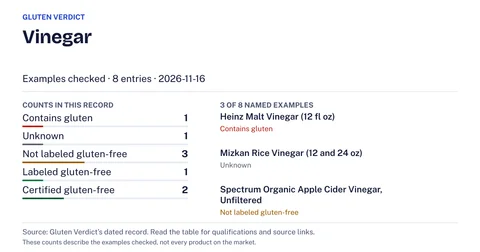 VinegarDepends on the product1 of 8 products we checked contains gluten: Heinz Malt Vinegar (12 fl oz)checked Nov 16, 2026
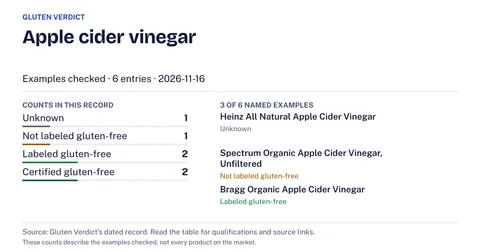 Apple cider vinegarNaturally gluten-freechecked Nov 16, 2026
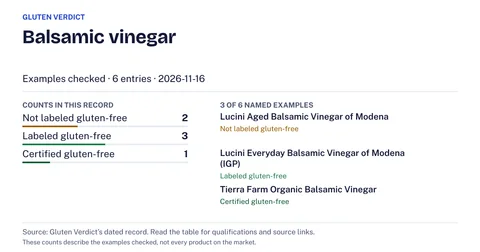 Balsamic vinegarNaturally gluten-freechecked Nov 16, 2026
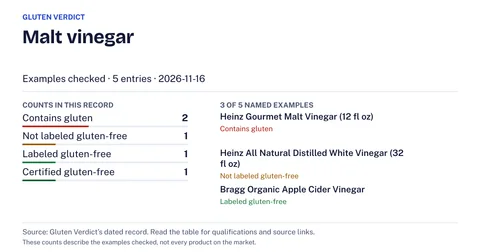 Malt vinegarContains glutenchecked Nov 16, 2026
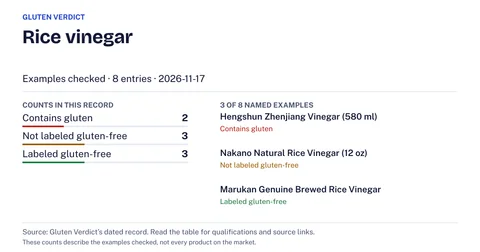 Rice vinegarDepends on the product2 of 8 products we checked contain gluten: Hengshun Zhenjiang Vinegar (580 ml) and Gold-Plum Chinkiang Vinegar (18.6 fl oz)checked Nov 17, 2026
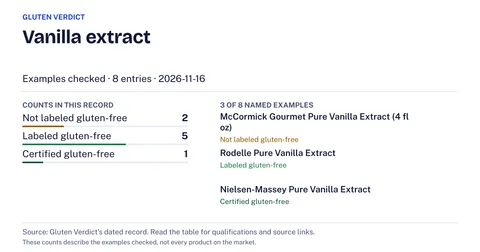 Vanilla extractDepends on the productchecked Nov 16, 2026
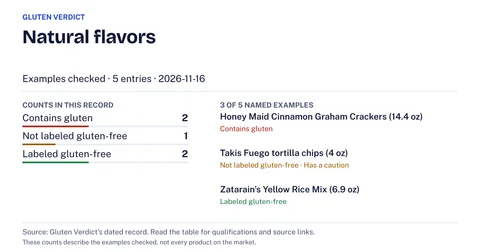 Natural flavorsDepends on the product2 of 5 products we checked contain gluten: Honey Maid Cinnamon Graham Crackers (14.4 oz) and Chex Mix Sour Cream & Onionchecked Nov 16, 2026
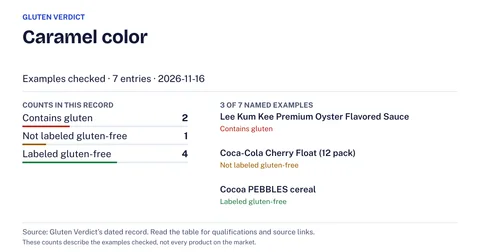 Caramel colorDepends on the product2 of 7 products we checked contain gluten: Lee Kum Kee Premium Oyster Flavored Sauce and Chex Mix Traditionalchecked Nov 16, 2026
Questions people ask
Is distilled white vinegar gluten-free?
The National Celiac Association says plain distilled vinegars are gluten free even when made from gluten-containing grains7.
Is malt vinegar the only vinegar to avoid?
The Gluten Intolerance Group says it is the only vinegar that needs to be avoided1. The National Celiac Association also tells readers to check flavored vinegars and Asian rice vinegars9.
Is pure vanilla extract gluten-free?
FDA’s standard defines the extract and lists its optional ingredients21, 22 but does not answer it for a given bottle. McCormick’s page says its pure extract is gluten free24, and Nielsen-Massey’s page carries “Gluten-Free Certified”26. Check the line on your own bottle.
More in Hidden gluten in ingredients, sauces and processed foods
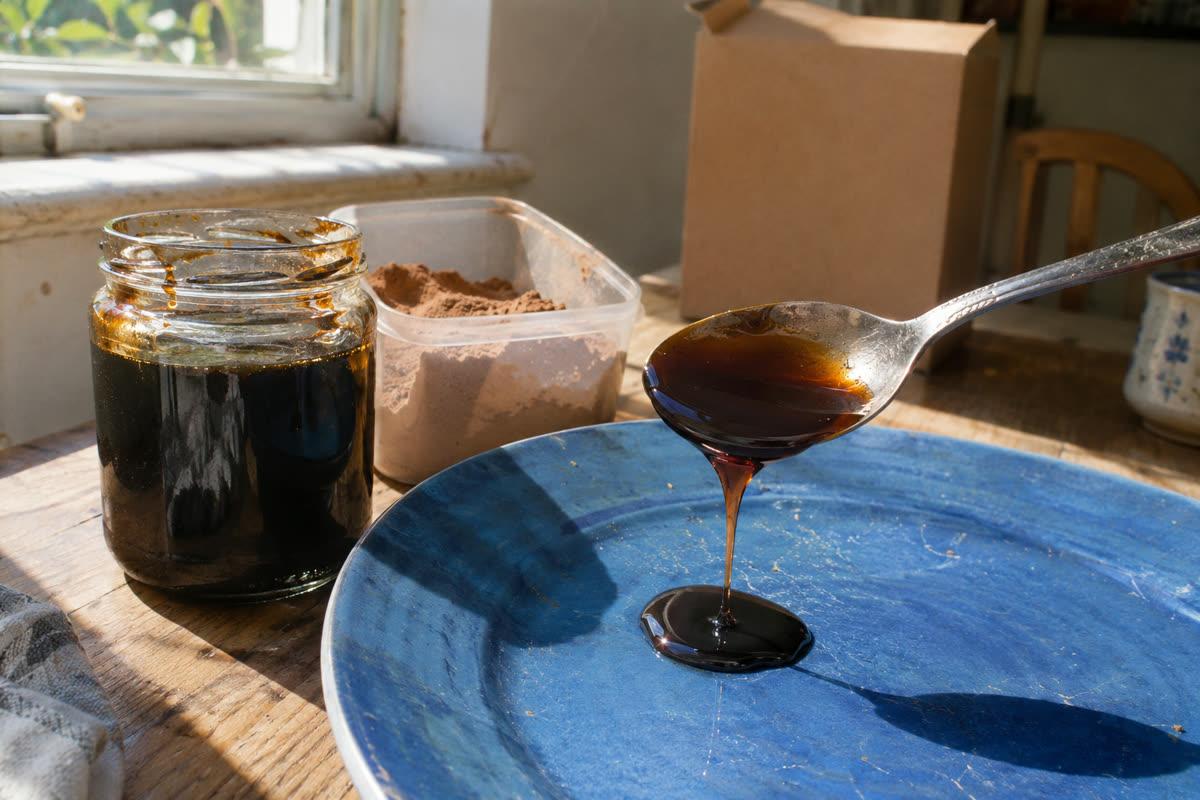 Malt on a food label: which forms are barley and what to checkWhat malt extract, syrup, flavoring and vinegar on a US label mean for gluten, why the Contains line misses barley, and what to check first.
 Wheat, barley and rye on an ingredient list: the names to look forLook up wheat, barley and rye names on a US ingredient list, from durum to malt, and sort each as contains gluten, depends on the maker, or lookalike.
 Natural flavors, caramel color and modified food starch: which can carry glutenWhich additives on a US label can come from a gluten grain, which sources describe as gluten free, and what the maker has to disclose.
 Where wheat, barley and rye hide in processed food: 15 places to checkFifteen processed foods where wheat, barley or rye turn up, the label step that catches each, and what US allergen law does and does not flag.
 What to use instead of soy sauce when you eat gluten-freeTamari, gluten-free soy sauce, coconut aminos and liquid aminos: what each maker says, how to confirm it on the bottle, and what changes when you cook.
 Foods that contain gluten, aisle by aisle, and the label words that give them awayA store-order map of foods that contain gluten, which depend on the brand, and which need a cross-contact check, with the label words to look for.
All 21 guides in Hidden gluten in ingredients, sauces and processed foods
Related guides
 Fermented, hydrolyzed and distilled foods: how a gluten-free claim is checkedHow FDA’s 2020 rule checks a gluten-free claim on fermented, hydrolyzed and distilled foods, why a test cannot settle it, and where TTB takes over.
 A starter gluten-free pantry: 30 shelf items and the label check for eachThirty shelf items for a first gluten-free pantry, tagged by the label check each needs, plus how to keep jars, toaster and colander apart at home.
 Liqueurs and cream liqueurs: what a maker’s page can and cannot tell youSplit a liqueur into base spirit, flavors, sugar and cream, read what each maker’s own page says about gluten, and know what to ask when it says nothing.
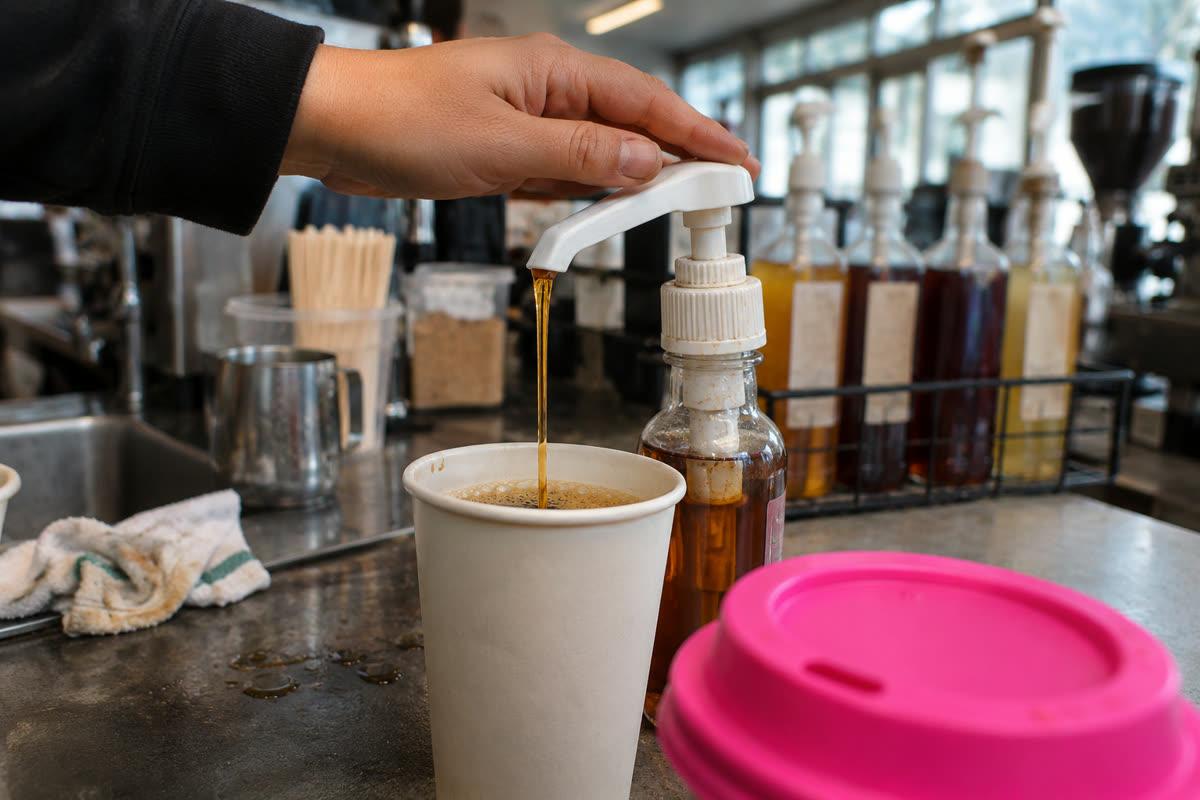 Reading the label of a flavored syrup, sauce or cookie topping for glutenHow to read coffee and bar syrup, sauce and cookie-topping labels for gluten, and what Torani, Monin and DaVinci Gourmet say on their own pages.
Sources
- [1, 2, 3, 4, 5] Gluten Intolerance Group, Should a person with celiac disease avoid vinegar and products containing vinegar? (GIG FAQ), checked Nov 17, 2026.
- [6, 7, 8, 9, 36] National Celiac Association, Is vinegar gluten-free? (NCA), checked Nov 17, 2026.
Read on 2026-11-17: the list headed “Some examples of gluten-free vinegars include:” names apple cider vinegar; distilled vinegar, grain vinegar, spirit vinegar and white vinegar; balsamic vinegar; and wine vinegar and grape vinegar.
- [10, 11, 12, 37] US Food and Drug Administration, Questions and Answers on the Gluten-Free Food Labeling Final Rule, checked Nov 17, 2026.
- [13, 14, 15] Celiac Disease Foundation, Sources of Gluten, checked Nov 17, 2026.
- [16] Spectrum Organics, Organic Apple Cider Vinegar, Unfiltered, checked Nov 17, 2026.
- [17] Bragg, Organic Apple Cider Vinegar, checked Nov 17, 2026.
Read on 2026-11-17: the Ingredients list on the product page names organic apples and water, and the product header carries the words “Gluten-Free”.
- [18] Lucini (California Olive Ranch), Everyday Balsamic Vinegar of Modena (IGP), checked Nov 17, 2026.
- [19] Kikkoman USA, Rice Vinegar (10 fl oz), checked Nov 17, 2026.
- [20] Marukan Vinegar (U.S.A.), Seasoned Gourmet Rice Vinegar, checked Nov 17, 2026.
- [21, 22] US Food and Drug Administration, 21 CFR 169.175 Vanilla extract, checked Nov 17, 2026.
Read on 2026-11-17: the list under “Vanilla extract may contain one or more of the following optional ingredients:” names glycerin, propylene glycol, sugar (including invert sugar), dextrose, and corn sirup (including dried corn sirup).
- [23, 24] McCormick, McCormick Pure Vanilla Extract, 2 fl oz, checked Nov 17, 2026.
- [25, 26] Nielsen-Massey Vanillas, Pure Vanilla Extract, checked Nov 17, 2026.
- [27] McCormick, McCormick Clear Vanilla Flavor, 2 oz, checked Nov 17, 2026.
- [28] McCormick, McCormick Premium Vanilla Flavor, 2 fl oz, checked Nov 17, 2026.
- [29, 30] McCormick, McCormick Pure Almond Extract, 2 fl oz, checked Nov 17, 2026.
- [31, 32] Gluten Intolerance Group, Are “natural flavors” a concern if I’m gluten-free? (GIG FAQ), checked Nov 17, 2026.
- [33, 34] National Celiac Association, Ingredients people question, checked Nov 17, 2026.
- [35] Gluten Intolerance Group, Advanced label reading tips, checked Nov 17, 2026.