A starter gluten-free pantry: 30 shelf items and the label check for each
Short answer
We sorted the 30 shelf items below by the check each needs: 9 need only a quick look at the ingredient list, 11 need the full label read, and 10 are best bought labeled or certified gluten-free. GIG says label reading is essential, and includes certified gluten-free logos, “gluten-free” labeled foods and ingredient lists1. In this order:
- Start with the nine plain staples (rice, quinoa, dried and canned beans, nuts, cooking oil, vinegar, honey and maple syrup) and check only that nothing was added. NIDDK lists rice among naturally gluten-free foods without additives or some seasonings, and GIG calls beans naturally gluten-free2, 3.
- Add the ten that are best bought as a labeled or certified version: pasta, oats, cornstarch, lentils, soy sauce, pure spices, flour blend, cereal, bars and crackers4, 5, 6.
- Read the ingredient list on the other eleven, because some brands and recipes add gluten, such as wheat flour in some specialty mustards or hydrolyzed wheat protein in some broths7, 8.
- In a shared home, sort out the toaster, colander and spreads before the shelf9, 10, 11.
Part of Grocery shopping and meal planning, 15 guides

Key points
- A gluten-free label on a food FDA regulates means less than 20 ppm; GFCO certification means 10 ppm or less12, 13.
- For lentils, oats and cornstarch, GIG and an NCA dietitian point to labeled or certified versions4, 14, 6.
- FDA says malt vinegar cannot be used in a food bearing a gluten-free claim, and soy sauce made from soybeans and wheat generally may not bear one15, 5.
- Skip bulk bins: GIG says any item in one is considered risky16.
- In a shared kitchen, GIG advises squeezable condiments, gluten-free foods stored above gluten-containing ones, and a designated toaster17, 18, 9.
How the 30 items are tagged
Each item carries one of three tags. The tags are our reading of what the sources below say about the item. They are not a verdict on any brand: where we have checked products, the item links to our verdict.
- Quick look. The plain product is gluten-free by nature, so you check only that nothing was added. NIDDK says many foods, such as rice, without additives or some seasonings, are naturally gluten-free2.
- Read the label. It depends on the brand or the recipe, so read the ingredient list and any gluten-free claim each time you buy.
- Labeled version. Buy one labeled gluten-free or certified, either because the usual version contains gluten or because the Gluten Intolerance Group (GIG) singles the item out for cross-contact.
“Labeled” and “certified” are not the same promise. On a food FDA regulates, a gluten-free label means less than 20 parts per million (ppm) of gluten12. GIG notes that a label claim is not third-party verified, and that GFCO’s certification standard is 10 ppm of gluten or less13. GFCO certifies products that carry its mark, not brands or factories19.
A missing claim on a naturally gluten-free food is not a warning. FDA says the claim is not required, so it may not appear even if the food is gluten-free20.
Grains and starches
| Item | Tag | What to check |
|---|---|---|
| Rice | Quick look | NIDDK names rice among naturally gluten-free foods2. Seasoned rice can carry soy sauce solids, wheat flour or wheat starch, and a pilaf can be made with orzo21, 22. Our verdict: rice. |
| Quinoa | Quick look | GIG lists quinoa among its gluten-free grains23. Buy it in a package rather than from a bulk bin (see the last section). Our verdict: quinoa. |
| Corn tortillas | Read the label | An NCA dietitian advises making sure corn-based flours such as masa are labeled gluten free, because they could have had cross-contact with gluten-containing grains in processing6. That answer does not name tortillas, so read the tortilla package itself. Our verdict shows what the brands we read list: corn tortillas. |
| Pasta | Labeled version | FDA lists pastas among foods that typically contain gluten24. GIG’s list names gluten-free pastas made from rice, corn, quinoa, amaranth, millet or legumes25. Our verdict: pasta. |
| Oats | Labeled version | Oats labeled gluten-free must contain less than 20 ppm of gluten, and FDA does not require oats to be certified to carry the claim26. GIG’s pantry list says to choose oats that are certified gluten-free, and adds that anyone with celiac disease should consult a physician or dietitian before including oats14. In its certification review, GFCO gives oats its highest ingredient risk level27. Our verdict: oatmeal. |
| Cornstarch | Labeled version | The same NCA dietitian names cornstarch among the corn-based products to buy labeled gluten free6. Our verdict: cornstarch. |
Beans, lentils and nuts
| Item | Tag | What to check |
|---|---|---|
| Dried beans and chickpeas | Quick look | GIG calls beans naturally gluten-free3. For dry beans it says washing and visually sorting for a stray grain works very well28. Our verdict: chickpeas. |
| Canned beans | Quick look | The same naturally gluten-free beans3. NIDDK’s caveat is additives or seasonings2, so read the list on any flavored or sauced can. |
| Lentils | Labeled version | GIG says lentils carry a higher cross-contact risk than other legumes or beans, so they should be labeled gluten-free or GFCO certified4. Our verdict: lentils. |
| Nuts | Quick look | GIG says plain, packaged nuts do not typically contain gluten, and to avoid nuts from bulk bins29. |
Oils, vinegar and sweeteners
| Item | Tag | What to check |
|---|---|---|
| Cooking oil | Quick look | In its certification review, GFCO treats fats and oils that do not have any protein as low-risk ingredients that do not require testing30. Read a cooking spray: GIG says certain brands contain wheat flour, but most do not31. Our verdict: olive oil. |
| Vinegar (white or apple cider) | Quick look | GIG says most vinegars are gluten-free and the one to avoid is malt vinegar32; FDA says malt vinegar cannot be used in a food bearing a gluten-free claim15. On a product that is not labeled or certified, the bare word “vinegar” could mean malt vinegar33. Our verdicts: vinegar and apple cider vinegar. |
| Honey | Quick look | GIG says honey is naturally gluten-free34, and its farmers market list says to check local honey for added flavors and for processing in a shared facility35. Our verdict: honey. |
| Maple syrup | Quick look | GIG says pure maple syrup is naturally gluten-free36. Our verdict: maple syrup. |
Sauces, seasonings and broth
| Item | Tag | What to check |
|---|---|---|
| Soy sauce | Labeled version | FDA says soy sauce is ordinarily made by fermenting soybeans and wheat, and that soy sauce made with wheat generally may not bear a gluten-free claim5. GIG says tamari is often but not always gluten-free37. Our verdict: soy sauce. |
| Broth | Read the label | GIG says some powdered or packaged broths contain gluten, such as yeast extract derived from barley, or hydrolyzed wheat protein8. Our verdict: chicken broth. |
| Pure spices | Labeled version | GIG says spices are used in small amounts, which reduces but does not eliminate the risk of exposure38, and advises choosing spices labeled gluten-free or GFCO certified39. Our verdict: spices. |
| Spice blends | Read the label | GIG’s list reads “pure spices are gluten-free, but be cautious of mixed spice packages”40, and it says certain brands of taco seasoning contain wheat41. |
| Mustard | Read the label | GIG says wheat flour could be added as a thickener in some specialty mustards, English mustard among them7. Our verdict: mustard. |
| Hot sauce | Read the label | GIG’s list names hot sauce among its condiments25. Brands differ: hot sauce. |
| Ketchup | Read the label | GIG says some brands of specialty ketchup may use additional ingredients such as malt vinegar or miso, which may not be gluten-free42. |
| Salad dressing | Read the label | GIG says salad dressings may contain malt vinegar, soy sauce or flour43; its list reads “gluten-free salad dressing (or make your own)”25. |
Baking basics
| Item | Tag | What to check |
|---|---|---|
| Gluten-free flour blend | Labeled version | GIG says to choose certified or gluten-free labeled products for lentils and for any milled products made from grains, seeds or legumes44. Our verdict on one brand’s blends: King Arthur gluten-free flour. |
| Baking powder | Read the label | GIG’s baking list names baking powder, baking soda and vanilla extract25. Brands differ: baking powder. |
| Vanilla extract | Read the label | Read the list on the bottle you buy. Our verdict: vanilla extract. |
Breakfast and snacks
| Item | Tag | What to check |
|---|---|---|
| Cereal | Labeled version | GIG says some popular corn flake and crisp rice cereals are made with malt from barley45. |
| Granola and energy bars | Labeled version | GIG says many are made with oats and often are not labeled or certified gluten-free46. |
| Crackers | Labeled version | GIG’s list names gluten-free crackers25. FDA lists breads, cakes, cereals, pastas and many other grain-based foods as typically containing gluten24. |
| Potato and corn chips | Read the label | For processed and flavored chips, GIG says some brands use wheat starch or whole wheat in their reconstituted chips, as opposed to sliced potatoes or corn only47. |
| Peanut butter and tahini | Read the label | GIG’s list names nut butters25. What jars listed: peanut butter and tahini. |
In a mixed household: spreads, toaster, colander and shelves
GIG’s pantry bulletin asks the layout question up front: will the whole kitchen be gluten-free, or a shared space? In a shared kitchen it suggests sealed containers, with gluten-free foods stored above those that contain gluten48.
Jars and spreads
- GIG’s list says to buy condiments in squeezable containers in a shared kitchen, to avoid cross-contact by double dipping17.
- GIG calls double-dipping, the use of the same serving utensil in both types of food, one of the most common ways crumbs get into gluten-free food49. If a jar is shared, it says housemates need to understand why50.
- Coeliac UK, a UK charity, suggests separate condiments, or at least clean cutlery for shared butters, jams and spreads11.
Toaster, colander and boards
- Toaster: GIG puts toasters, air fryers and blenders at the top of its list of appliances to designate gluten-free only9, and offers a toaster bag as a temporary solution when a second appliance is not an option yet51. Coeliac UK says to use toaster bags or consider a separate toaster52.
- Colander: GIG says colanders, sifters and waffle irons are harder to clean thoroughly and should not be shared if possible; if they are, clean them thoroughly between every use10. It notes that starchy pastas can leave residue in mesh-like strainers53.
- Boards and wooden tools: Coeliac UK says you may want separate bread boards54. GIG says wood fibers could harbor gluten particles55.
The two charities treat sponges differently. Coeliac UK says you do not need separate cloths or sponges56; GIG says shared sponges and dish rags should be replaced or laundered frequently57.
Shelves and labels
In the same fridge or cupboard, GIG says to put gluten-free packages above gluten-containing ones and keep them securely packaged18. It also suggests labeling food, utensils and cookware when in doubt58, and assigning one color to everything strictly gluten-free, such as cutting boards, mixing bowls and storage containers59.
When only some members of a household are gluten-free, GIG recommends a separate set of the hard-to-clean items strictly for gluten-free food prep60. The kitchen setup guide goes through what to replace, wash or share, and the pantry clean-out guide covers the old stock.
Buying and restocking
Skip the bulk bins. GIG says any item in a bulk bin is considered risky and should be avoided16, because gluten-containing ingredients could linger on scoops or surrounding bins61.
Recipes and sourcing change. GIG’s list ends with a reminder to always confirm the gluten-free status of foods purchased every time you shop62, so a favorite jar gets its label read again when the package looks different.
One cost point we can source: GIG’s 2021 bean article, citing the Northarvest Bean Growers Association, says dry beans cost about half the price per serving of store-brand canned beans63. We give no basket total, because no source we have read prices a gluten-free first stock-up. Gluten-free on a budget covers what costs extra, and the gluten-free grocery list goes aisle by aisle.
Verdicts in this guide
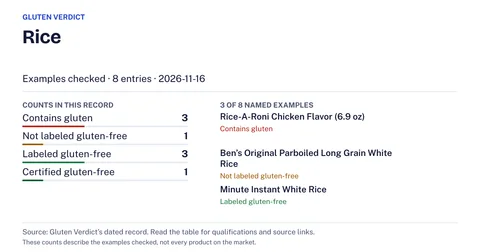 RiceNaturally gluten-free3 of 8 products we checked contain gluten: Rice-A-Roni Chicken Flavor (6.9 oz), Near East Original Rice Pilaf, and Ben’s Original Ready Rice Rice PilafBuy it labeled gluten-freechecked Nov 16, 2026
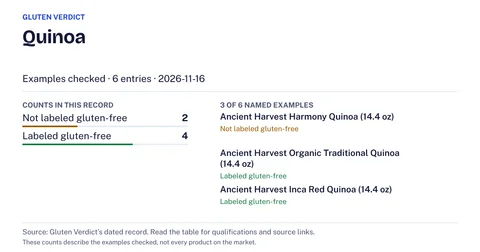 QuinoaNaturally gluten-freeBuy it labeled gluten-freechecked Nov 16, 2026
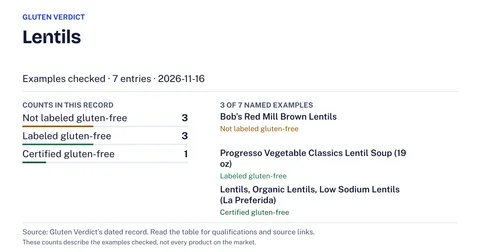 LentilsDepends on the productchecked Nov 16, 2026
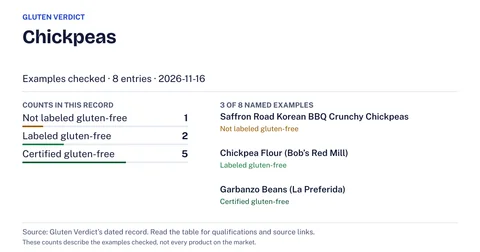 ChickpeasNaturally gluten-freechecked Nov 16, 2026
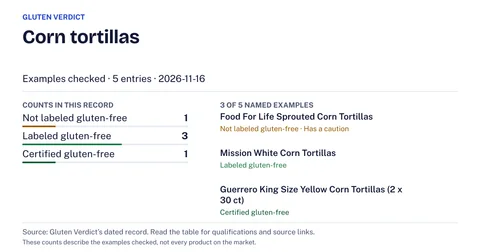 Corn tortillasDepends on the productchecked Nov 16, 2026
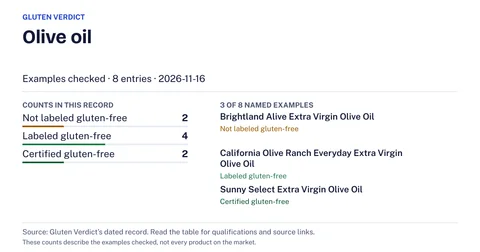 Olive oilUnknownchecked Nov 16, 2026
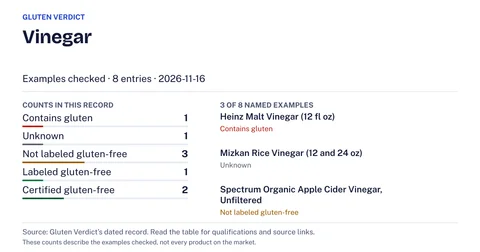 VinegarDepends on the product1 of 8 products we checked contains gluten: Heinz Malt Vinegar (12 fl oz)checked Nov 16, 2026
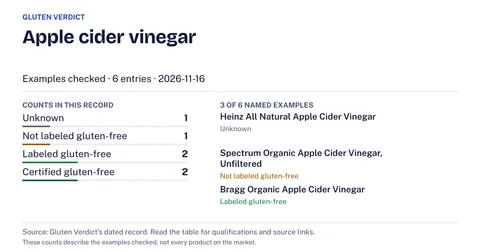 Apple cider vinegarNaturally gluten-freechecked Nov 16, 2026
 Soy sauceDepends on the product3 of 7 products we checked contain gluten: Kikkoman Soy Sauce (Non-GMO), 20 oz; San-J Organic Shoyu Soy Sauce; and Lee Kum Kee Premium Soy Sauce (No Preservatives Added)checked Nov 16, 2026
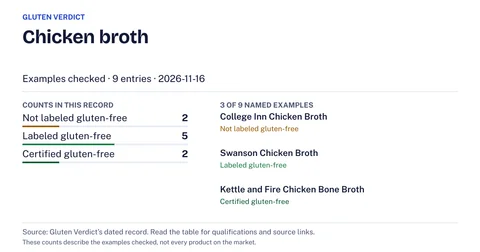 Chicken brothDepends on the productchecked Nov 16, 2026
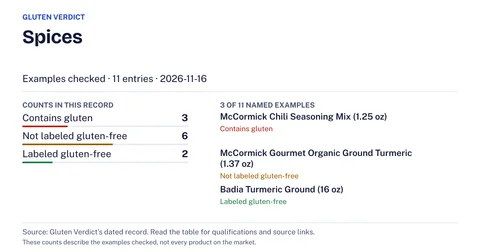 SpicesDepends on the product3 of 11 products we checked contain gluten: McCormick Chili Seasoning Mix (1.25 oz), Lawry’s Chili Spices & Seasonings Mix (1.48 oz), and McCormick Cheesy Taco Seasoning Mix (1.12 oz)checked Nov 16, 2026
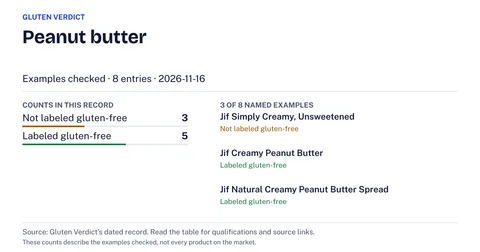 Peanut butterDepends on the productchecked Nov 16, 2026
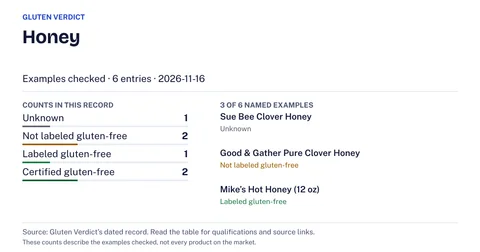 HoneyDepends on the productchecked Nov 16, 2026
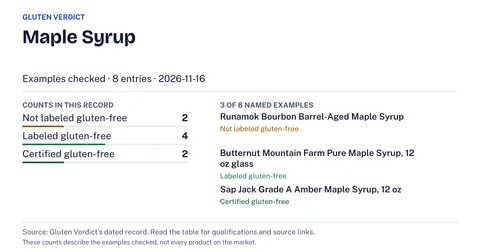 Maple SyrupNaturally gluten-freechecked Nov 16, 2026
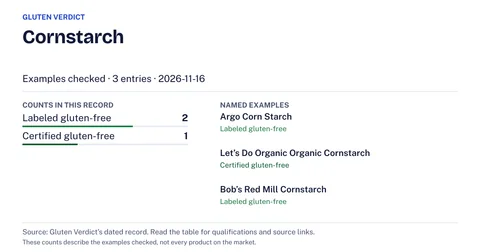 CornstarchNaturally gluten-freeBuy it labeled gluten-freechecked Nov 16, 2026
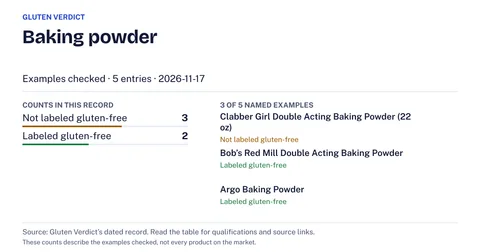 Baking powderDepends on the productchecked Nov 17, 2026
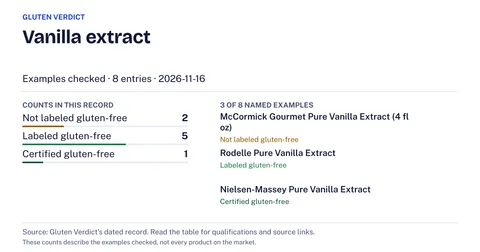 Vanilla extractDepends on the productchecked Nov 16, 2026
 OatmealDepends on the productchecked Nov 16, 2026
 PastaContains glutenchecked Nov 16, 2026
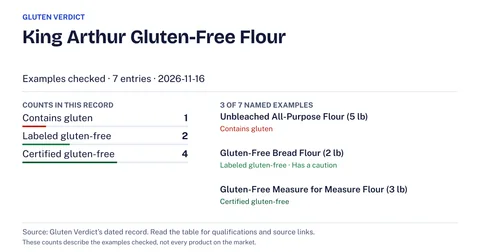 King Arthur Gluten-Free FlourCertified gluten-free1 of 7 varieties we checked contains gluten: Unbleached All-Purpose Flour (5 lb)Wheat warning on 2 of 7 varieties we checkedKing Arthur Baking Company · checked Nov 16, 2026
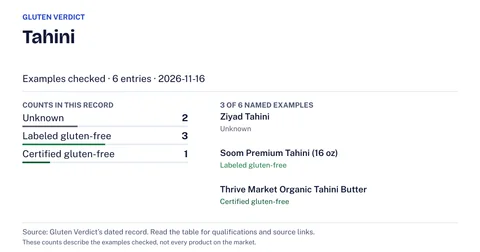 TahiniDepends on the productchecked Nov 16, 2026
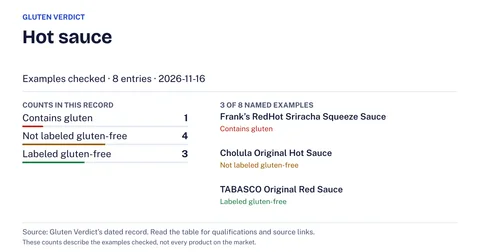 Hot sauceDepends on the product1 of 8 products we checked contains gluten: Frank’s RedHot Sriracha Squeeze Saucechecked Nov 16, 2026
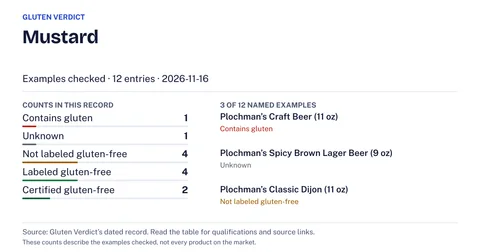 MustardDepends on the product1 of 12 products we checked contains gluten: Plochman’s Craft Beer (11 oz)checked Nov 16, 2026
Questions people ask
Does every item in a gluten-free pantry need a gluten-free label?
No. FDA says the claim is not required, so a naturally gluten-free food may not carry it20. The tags above separate plain staples from items where a labeled version is worth buying.
More in Grocery shopping and meal planning
 Gluten-free grocery shopping: what to check at the shelf, the bulk bins and the checkoutOne reading order for any US supermarket pack, plus what to do about bulk bins, frozen cases, wheat starch and storage once the bags are home.
 A gluten-free grocery list by aisle for US supermarketsAn aisle-by-aisle gluten-free grocery list for US stores: what needs no label, what needs a check, and what stays off the list.
 A gluten-free meal plan as a shopping template, by meal slotA weekly gluten-free shopping template: staples for each meal slot, the check each packaged item needs, and a ledger of when you last read each label.
 How to check a grocery listing for gluten before you orderRead an online grocery listing for gluten in a fixed order, tell a store tag from a maker claim and a certifier mark, and re-check on reorders.
 How to build a gluten-free emergency food supplyBuild a gluten-free emergency food supply: a stock list by food type, reading a freeze-dried pouch, maker shelf-life claims and what to bring to a shelter.
 Store-brand gluten-free: what the tag, claim or seal rests onSort a store-brand item into certified, maker-stated or ingredient-only, see what each lets you conclude, and know what to ask the store.
Related guides
 Going gluten-free: what to remove and what to keep in your pantry and kitchenSort a full pantry into foods to remove, labels to read and plain foods to keep, then decide on shared jars, toasters and pans.
 Setting up a gluten-free kitchen: what to replace, wash or shareWalk each kitchen zone and decide, item by item, what to replace, what to wash and what a mixed household can keep sharing, with charity sources.
 Sharing butter, jam and spreads with gluten eatersHow crumbs reach shared butter, jam and peanut butter, and what a second jar, squeeze bottle, knife rule or shelf each does and does not do.
 Toasters, colanders, cast iron, wood and air fryers: which can be cleanedWhich kitchen items the charities say to keep, wash or replace after going gluten-free, item by item, with what the studies we found measured.
Sources
- [1, 16, 48] Gluten Intolerance Group, Gluten-Free Pantry Essentials, checked Nov 17, 2026.
- [2] National Institute of Diabetes and Digestive and Kidney Diseases (NIDDK), Eating, Diet, & Nutrition for Celiac Disease, checked Nov 17, 2026.
- [3, 63] Gluten Intolerance Group, 5 Reasons Beans Are a Perfect Gluten-Free Staple, checked Nov 17, 2026.
- [4] Gluten Intolerance Group, If my lentils are organic, do they still need to be labeled gluten-free?, checked Nov 17, 2026.
- [5, 15, 26] US Food and Drug Administration, Questions and Answers on the Gluten-Free Food Labeling Final Rule, checked Nov 17, 2026.
- [6] National Celiac Association, Is there gluten in corn?, checked Nov 17, 2026.
- [7, 8, 21, 22, 29, 31, 41, 42, 43, 45, 46, 47] Gluten Intolerance Group, 38 Foods Where Gluten May Be “Hidden”, checked Nov 17, 2026.
- [9, 50, 51, 57, 59] Gluten Intolerance Group, Your Kitchen, Their Kitchen, Our Kitchen: Navigating Gluten-Free Cohabitation, checked Nov 17, 2026.
- [10, 18, 49, 58, 61] Gluten Intolerance Group, 25 Ways Cross-Contact Could Happen (And How to Avoid It), checked Nov 17, 2026.
- [11, 52, 54, 56] Coeliac UK, Avoid Gluten Free Cross Contamination at Home, checked Nov 17, 2026.
- [12, 20, 24] US Food and Drug Administration, Gluten and Food Labeling, checked Nov 17, 2026.
- [13, 23] Gluten Intolerance Group, 35+ Alternative Gluten-Free Grains and Flour Substitutes, checked Nov 17, 2026.
Read on 2026-11-17: the page introduces its list with “Below is a list of gluten-free grains that can be eaten whole or milled and used as flour” and names amaranth, rice, buckwheat, cornmeal, polenta, grits and hominy, millet, oats, quinoa, sorghum and teff.
- [14, 17, 25, 40, 44, 62] Gluten Intolerance Group, Gluten-Free Pantry Essentials (bulletin with shopping list, updated October 2020), checked Nov 17, 2026.
Read on 2026-11-17: the “Gluten-Free Shopping List” in this bulletin names, among other items, beans, lentils, nuts, seeds, gluten-free chicken, vegetable and beef broth, rice, gluten-free crackers, gluten-free oats, corn tortillas, gluten-free cereals and granolas, quinoa, pasta (gluten-free pastas made from rice, corn, quinoa, amaranth, millet and legumes), tamari or gluten-free soy sauce, gluten-free salad dressing (or make your own), vinegar (all except malt vinegar), ketchup, mustard, mayonnaise, hot sauce, nut butters, olive, vegetable and coconut oil, spices, a multi-purpose gluten-free flour blend, cornstarch or arrowroot powder, and baking powder, baking soda and vanilla extract.
- [19, 27, 30] Gluten Intolerance Group, How Does GFCO Certify Gluten-Free Food?, checked Nov 17, 2026.
- [28] Gluten Intolerance Group, How to Wash Beans & Grains, checked Nov 17, 2026.
- [32, 33] Gluten Intolerance Group, Should a person with celiac disease avoid vinegar and products containing vinegar?, checked Nov 17, 2026.
- [34, 36] Gluten Intolerance Group, 31 December Food Holidays to Celebrate Gluten-Free, checked Nov 17, 2026.
- [35] Gluten Intolerance Group, Farmers Markets - A Gluten-Free Win!, checked Nov 17, 2026.
- [37] Gluten Intolerance Group, Advanced Label-Reading Tips, checked Nov 17, 2026.
- [38, 39] Gluten Intolerance Group, Are spices gluten-free?, checked Nov 17, 2026.
- [53, 55, 60] Gluten Intolerance Group, The Tools to Replace in Your Gluten-Free Kitchen, checked Nov 17, 2026.