May-contain labels abroad: what each country’s regulator says about them
Short answer
A “may contain” line is a maker’s choice, not a requirement, on every regulator page we read: FDA, Health Canada and FSANZ call it voluntary5, 19, 24, and the European Commission and the UK Food Standards Agency say businesses “may use” or “may choose” it16, 10, though GOV.UK guidance says a UK business with an uncontrollable cross-contamination risk should use one7. In July 2026 Codex adopted international guidelines that use a 4 mg gluten reference dose to decide when such a line is needed, but Codex standards bind no country until it adopts them29, 31, 32, 14.
Part of Gluten-free labeling law by country, 12 guides
Key points
- The regulator pages we read treat the line as a maker’s choice: FDA says section 403(w) of the FD&C Act does not address it1, Health Canada says there is no requirement for or prohibition of it19, and FSANZ says the Food Standards Code does not regulate it24.
- Whether a gluten-free claim may sit next to a may-contain line differs: FDA’s rule does not prohibit it if the statement is truthful and not misleading5, the Canadian Food Inspection Agency says doing so “should be done with caution”43, while Coeliac UK reports that the new Codex guidelines say a product should not carry both “gluten free” and “may contain wheat, barley or rye”30.
- Australia and New Zealand add an industry scheme, VITAL, whose statement reads “May be present”26; the VITAL pages we read do not mention gluten28.
- A line is not a gluten reading: in one study of ordinary foods without gluten ingredients, 3 of 77 products with a may-contain statement and 3 of 51 without one had gluten at or above 20 mg/kg39.
- Codex’s 4 mg gluten reference dose is for deciding whether a line is needed, not for defining gluten-free31, 32, 35.
Three statements that can share a pack
A packaged food from abroad can carry three different kinds of statement about gluten. Only the third is a may-contain line.
- A gluten-free claim, which is its own statement under its own rules. Codex’s level for it is gluten no higher than 20 mg/kg36; our guide to gluten-free labeling laws by country sets out each country’s rule.
- An allergen declaration in the ingredient list. In the EU, an ingredient made from a cereal containing gluten has to be named by its cereal, such as wheat, rye, barley or oats17; in Australia and New Zealand, barley, oats and rye must be declared if they contain gluten25.
- A may-contain or shared-facility line, which says cross-contact is possible rather than naming an ingredient1. FDA calls it an allergen advisory statement and notes that outside FDA it is often called precautionary allergen labeling, PAL4.
The rest of this page is about the third kind. For the US rules in detail, see what “may contain wheat” means on a US label; for the wording of the claim itself, see how to read a US food label for gluten.
What each regulator says about the line, at a glance
| Place | Required? | What the page says |
|---|---|---|
| United States (FDA) | No: voluntary | Section 403(w) of the FD&C Act does not address advisory statements1. A statement must be truthful and not misleading, and is not a substitute for good manufacturing practices2. |
| United Kingdom (England, Wales, Northern Ireland) | Not stated as a requirement on the pages we read | GOV.UK guidance says a business that has identified an uncontrollable cross-contamination risk should use PAL7; the FSA calls it something businesses “may choose” to do10. |
| European Union | A choice for the business | The European Commission says businesses “may use” precautionary allergen labelling, which must be based on a thorough risk assessment16. |
| Canada | No: voluntary | The CFIA says manufacturers and importers “may” declare cross-contamination statements42. A Health Canada page dated March 2012 says there is no regulatory requirement for, or prohibition of, precautionary labelling19. |
| Australia and New Zealand | No: not regulated by the Code | FSANZ says voluntary PAL statements are not regulated by the Food Standards Code and points to the Allergen Bureau24. The Allergen Bureau’s VITAL scheme gives makers a risk-based method and the wording “May be present”26. |
| Brazil | Not confirmed | We have not confirmed ANVISA’s rule, so this page says nothing about Brazil. |
| Codex (international) | Voluntary until a country adopts it | Guidelines on precautionary allergen labelling were formally adopted on 6 July 2026, according to Coeliac UK29; Codex standards are voluntary for countries14. |
The FSA’s board paper applies to England, Northern Ireland and Wales11; we did not read Food Standards Scotland’s position.
United States: voluntary, with FDA guidance on how to use it
FDA’s allergen guidance says section 403(w) of the Federal Food, Drug, and Cosmetic Act does not address allergen advisory statements such as “may contain”1. Such a statement is not a substitute for good manufacturing practices or allergen preventive controls and must be truthful and not misleading2. FDA adds that truthful, non-misleading statements “may be acceptable in certain circumstances” but cannot be used in lieu of those controls3.
On a pack that also says gluten-free, FDA’s gluten-free rule does not prohibit a voluntary advisory statement such as “made in a facility that also processes wheat”, provided the statement is truthful and not misleading5. FDA looks at such labels case by case, and a food with a gluten-free claim must meet the rule whether or not an advisory statement is also printed6.
United Kingdom and European Union: a choice for the maker
United Kingdom
GOV.UK’s guidance for food businesses says that if a business has identified a risk of allergen cross-contamination that cannot be controlled, it should use precautionary allergen labelling to warn consumers7. The same page says that using PAL when no genuine risk to the consumer has been identified could be misleading and therefore breach food law40. The FSA’s June 2026 board paper puts it as a choice: businesses must take all possible steps to avoid cross-contamination, but it is not always possible to remove the risk entirely, and they “may choose” to warn consumers with a PAL10.
The same GOV.UK page says not to use a may-contain line in combination with a free-from statement for the same allergen8. The page does not mention gluten9, so it does not say how that applies to a gluten-free claim.
The FSA paper also records that allergen charities reported “a strong consumer misconception that it is more regulated than it currently is”12, and that it is hard to judge what a PAL means “if the basis on which PAL is applied varies from product to product (and internationally)”13.
European Union
The European Commission’s allergies page says that where there is a risk of unintentional allergen presence through cross-contamination, businesses “may use” precautionary allergen labelling such as “may contain”, that it should not be used as a substitute for good manufacturing practices, and that it must be based on a thorough risk assessment16. The Commission’s 2017 allergen notice covers how allergens are declared in the ingredient list; it does not contain the words “precautionary” or “may contain”18.
Canada: voluntary, with a 2012 policy page and a CFIA page for businesses
The Canadian Food Inspection Agency’s page for food businesses says manufacturers and importers “may” declare a cross-contamination statement when, despite all reasonable measures, food allergens are unintentionally present, and that such a statement is not a substitute for good manufacturing practices42. Health Canada’s page on precautionary statements, dated March 2012, says they are made by manufacturers and importers on a voluntary basis, above the labelling the regulations require, and that there is no regulatory requirement for, or prohibition of, precautionary labelling19. The Health Canada page is dated March 2012, so check the regulators’ sites for newer guidance before relying on it.
The 2012 page says precautionary labelling should only be used when, despite all reasonable measures, the inadvertent presence of allergens is unavoidable, and must not be used when an allergen is deliberately added20. Its policy on wording is non-prescriptive: statements must be truthful, clear and non-ambiguous, and not a substitute for Good Manufacturing Practices21. On a pack that also carries a gluten-free claim, the CFIA says using the claim together with a “may contain wheat” statement, while possibly factual, “should be done with caution”43.
The page does not mention gluten23. A footnote shows why the wording of a line is not a level: it reports that in Health Canada’s survey results “may contain trace(s) of” was the most commonly used statement and implies a very small amount, yet Health Canada and CFIA laboratory results found an allergen at up to 6,500 parts per million in a chocolate product carrying a “traces” statement22.
Australia and New Zealand: not regulated, with an industry scheme
FSANZ’s allergen labelling page for food businesses says voluntary precautionary allergen labelling statements such as “may contain” or “may be present” are not regulated by the Food Standards Code, and points readers to the Allergen Bureau website24.
The Allergen Bureau runs VITAL, a risk-based method that food manufacturers use to assess allergen cross contact and to decide on a precautionary statement in the form “May be present: allergen x, allergen y.”26. Its consumer page says that if an assessment finds allergens may be present at or above the reference dose, a PAL statement should be applied27.
We read the VITAL home page and its program, science, consumer and FAQ pages, and none of them contains the words gluten, wheat or cereal28. From those pages we cannot say whether a VITAL statement covers gluten. We have not read Coeliac Australia’s guidance on may-contain statements, so this page does not cover it.
Codex: international guidelines adopted in July 2026
Codex develops international standards that influence food regulation and industry practice around the world33. Its standards are voluntary: countries are not obligated to adopt them, though many benchmark national rules to Codex texts14.
Coeliac UK reports that the Codex Alimentarius Commission formally adopted its guidelines on precautionary allergen labelling on 6 July 202629; the FAO’s news release places the adoption in the Commission’s 49th Session, held from 6 to 10 July 202641. As Coeliac UK describes them, the final guidelines use two reference doses, 5 mg of wheat protein for wheat allergy and 4 mg of gluten from wheat, barley and rye combined for coeliac disease31. They state that precautionary labelling should be based on risk assessment and that a product should not be labelled both “gluten free” and “may contain wheat, barley or rye”30.
An FAO/WHO expert consultation recommended the same 4 mg figure as the basis for deciding whether a precautionary label for cereals containing gluten should be applied34. The same experts said reference doses for gluten in the PAL framework should not be used as the basis for defining gluten-free labelling35. Coeliac UK draws the same line: the gluten-free threshold decides whether a food can be called gluten free, while a reference dose is used to assess whether unintended gluten contamination creates enough risk for a precautionary warning32.
Adoption by Codex does not change any country’s rules by itself: Coeliac UK says the guidance now needs to be considered and implemented by regulators and businesses33. Before the adoption, the FSA noted a gluten-specific problem in the Codex proposals: people with coeliac disease use both PAL and free-from labels, but PAL thresholds were based on protein per portion while the gluten-free threshold is a concentration15.
What a line, or no line, tells you
A 2022 study in Food and Chemical Toxicology analysed ordinary food products without gluten-containing ingredients, with and without a “may contain wheat/gluten” or similar statement38. In that study, 20 of 77 products with a statement and 10 of 51 without one had gluten at or above 5 mg/kg, and 3 of 77 and 3 of 51 had gluten at or above 20 mg/kg39. It is one study of one set of products, so it shows what was found in those foods, not how any other pack behaves.
The FAO/WHO experts list the “confusing use of gluten-free and precautionary allergen labelling (PAL) statements for cereals containing gluten on the same product” as one concern with current labelling practices37.
Because the line is the maker’s choice10, 19, a pack without one is silent about cross-contact rather than cleared of it: the FSA paper says it is not always possible to remove cross-contamination risk entirely10.
Reading a foreign pack with our tools
Sort the statements first: a gluten-free claim, an allergen declaration and a may-contain line are three different things, and the rules above apply only to the last. Our gluten scanner looks for gluten ingredient names in a photo of the label or pasted text.
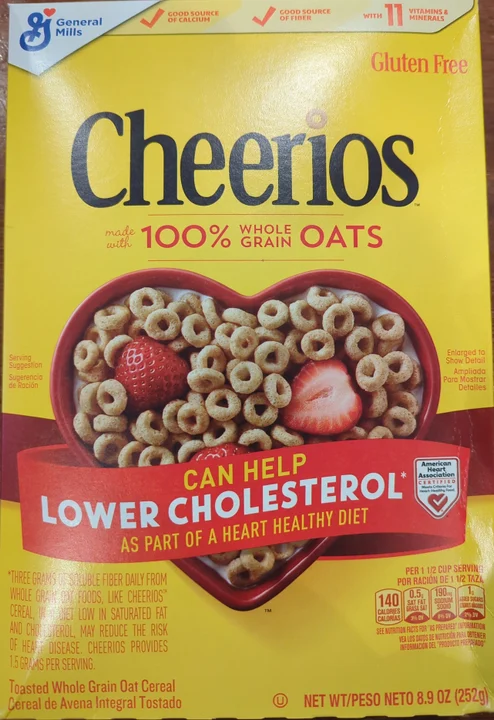
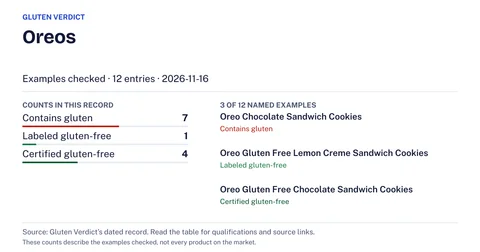
Where we have checked a food, its verdict records what the maker’s own pages say about may-contain and shared-equipment lines, with the date we read them; the Cheerios and Oreos records are examples. Recipes and labels change, so the pack in your hand has the final word.
Verdicts in this guide
Questions people ask
Can a pack say gluten-free and may contain wheat?
In the US, FDA’s rule does not prohibit a truthful, non-misleading advisory statement on a food with a gluten-free claim5. GOV.UK guidance says not to pair a may-contain line with a free-from statement for the same allergen, though that page does not mention gluten8, 9. In Canada, the CFIA says using a gluten-free claim with a “may contain wheat” statement, while possibly factual, should be done with caution43. Coeliac UK reports that the new Codex guidelines say a product should not carry both30.
What does “may contain traces of” mean?
Health Canada’s page notes that this wording implies a very small amount, and also reports a chocolate product with a “traces” statement that held an allergen at up to 6,500 parts per million22. That footnote concerns allergens in general; the page does not mention gluten23.
More in Gluten-free labeling law by country
 Gluten-free oats by country: where the claim is allowed and where it is barredWhether oats can carry a gluten-free claim in the US, Canada, EU, UK, Australia and New Zealand, in each regulator’s own words.
 Gluten-free labelling in Australia and New Zealand: what the claim meansWhat “gluten free” and “low gluten” mean on Australian and New Zealand packs: no detectable gluten, no oats, no malt, and how US packs compare.
 Reading US gluten-free labels as a visitor from the UK, EU, Canada or AustraliaWhat a US gluten-free claim, the Contains line, malt and alcohol labels mean if you are used to UK, EU, Canadian or Australian labels.
 Which gluten grains a pack’s allergen line must name, by countryWhether the allergen line must name barley, rye and oats, country by country: US, Canada, EU, UK, Australia and New Zealand, Brazil, Japan.
 Gluten-free labeling in Canada: the claim, the gluten-source declaration and oatsHow Health Canada's gluten-free claim works, how gluten sources and oats must be declared on a Canadian pack, and how it differs from the FDA rule.
 Gluten-free logos outside the US: who issues each one and what it requiresTell a certifier’s gluten-free logo from a maker’s own: who issues Crossed Grain, Coeliac Australia’s and Celiac Canada’s marks, and the limit each sets.
Related guides
 What “may contain wheat” and “made in a facility with wheat” mean on a US labelHow to read “may contain wheat”, shared-facility and shared-equipment lines on US labels, with and without a gluten-free claim, and what to check next.
 How to read a US food label for glutenWhere gluten shows up on a US food label: the gluten-free claim, the Contains line, the ingredient list and may-contain lines, and what each means.
 Gluten-free labeling rules by country: ceilings, claim wording and where no rule was foundLook up the gluten-free limit and claim wording for the US, Canada, EU, UK, Australia, New Zealand and more, each figure tied to the page we read.
 What the Codex gluten standard says, and which countries follow itWhat Codex Standard 118-1979 sets for gluten-free food, why it is not law, and how the US, EU, UK, Canada, Australia, NZ and Argentina compare.
Sources
- [1, 2, 3, 4] US Food and Drug Administration, Questions and Answers Regarding Food Allergens, Including the Food Allergen Labeling Requirements of the FD&C Act (Edition 5), checked Nov 17, 2026.
- [5, 6] US Food and Drug Administration, Questions and Answers on the Gluten-Free Food Labeling Final Rule, checked Nov 17, 2026.
- [7, 8, 9, 40] GOV.UK, Food labelling and packaging: Precautionary allergen labelling (PAL), checked Nov 17, 2026.
Read on 2026-11-17: the page “Precautionary allergen labelling (PAL)” in GOV.UK’s food labelling and packaging guide for businesses does not contain the word “gluten”.
- [10, 11, 12, 13, 14, 15] UK Food Standards Agency, FSA Position on the Codex Precautionary Allergen Labelling Standard including Allergen Thresholds (board paper FSA 25-12-05), checked Nov 17, 2026.
- [16] European Commission, Allergies: allergen labelling in the EU, checked Nov 17, 2026.
- [17, 18] European Commission (EUR-Lex), Commission Notice 2017/C 428/01 on information on substances or products causing allergies or intolerances, checked Nov 17, 2026.
Read on 2026-11-17: the five pages of the Notice (OJ C 428, 13.12.2017) do not contain the words “precautionary” or “may contain”.
- [19, 20, 21, 22, 23] Health Canada, The Use Of Food Allergen Precautionary Statements On Prepackaged Foods (March 2012), checked Nov 17, 2026.
Read on 2026-11-17: the page, dated March 2012, does not contain the word “gluten”.
- [24, 25] Food Standards Australia New Zealand, Allergen labelling for food businesses, checked Nov 17, 2026.
- [26, 28] Allergen Bureau (VITAL program), VITAL: Voluntary Incidental Trace Allergen Labelling, checked Nov 17, 2026.
Read on 2026-11-17: the VITAL home page and the VITAL Program, VITAL Science, VITAL and the Consumer and VITAL FAQs pages (vital.allergenbureau.net) do not contain the words “gluten”, “wheat” or “cereal”.
- [27] Allergen Bureau (VITAL program), VITAL and the Consumer, checked Nov 17, 2026.
- [29, 30, 31, 32, 33] Coeliac UK, Our impact on food labelling (may contain labelling campaign), checked Nov 17, 2026.
- [34, 35, 36, 37] FAO and WHO, Ad hoc Joint FAO/WHO Expert Consultation on Risk Assessment of Food Allergens: reference dose(s) for cereals containing gluten or gluten (summary and conclusions, November 2025), checked Nov 17, 2026.
- [38, 39] PubMed (Food and Chemical Toxicology), Risk of consuming products with or without precautionary wheat or gluten labelling for persons with coeliac disease, checked Nov 17, 2026.
- [41] Food and Agriculture Organization of the United Nations, Codex agrees on new guidance on “may contain” allergen labels (FAO news release, 7 July 2026), checked Nov 17, 2026.
- [42, 43] Canadian Food Inspection Agency, Allergen-free, gluten-free and cross-contamination statements, checked Nov 17, 2026.