Gluten-free in New Zealand: the shared food code, oats, Marmite and the border
Short answer
New Zealand and Australia share one Food Standards Code1, and its “gluten free” claim means no detectable gluten, no oats and no malted gluten cereals2. Four things to know on arrival:
- Coeliac NZ suggests choosing packs that say “gluten free” or carry its Crossed Grain logo24; products that only qualify under the Codex standard cannot carry those words in New Zealand32.
- Oats cannot carry the claim15, and Coeliac NZ advises against including oats in a gluten-free diet18.
- New Zealand Marmite contains derivatives of barley and wheat, by its maker’s own FAQ39.
- Declare all food, packaged included, on your arrival declaration42, 41.
- Gluten-free limit
- No figure in the claim: the food must contain no detectable gluten2
- Oats
- A food containing oats or oat products cannot carry the gluten free claim2
- Celiac society
- Coeliac New Zealand
Part of Travel: the Americas and Oceania, 10 guides
Key points
- The claim is “no detectable gluten”, not a 20 ppm figure, and the Code excludes oats and malted gluten cereals2.
- Coeliac NZ’s label rule that no wheat, rye, barley, oats or gluten on the ingredient list means gluten free applies to products made in NZ and Australia only25.
- Coeliac NZ lists pies, pastry, batter-cooked food and beer as not gluten free unless specified gluten free22.
- Beer and spirits do not have to declare barley, rye, oats or wheat7.
- Any food, fresh, dried, natural or packaged, is a risk item to declare at the border42.
One food code for two countries
All food sold in Australia and New Zealand has to comply with the Australia New Zealand Food Standards Code1. The “gluten free” claim you read on a New Zealand pack is therefore the claim in the Australian Code, and our Australia travel guide covers the same rule from the Australian side.
Schedule 4 of the Code sets the conditions for the claim: the food must not contain detectable gluten, oats or oat products, or cereals containing gluten that have been malted, or products of such cereals2, 4. The condition is written as “detectable gluten”, not as a parts-per-million limit. Coeliac NZ describes the same test: gluten free products in New Zealand are tested to have no detectable gluten according to the FSANZ guidelines31.
| Question | US label (FDA rule) | New Zealand label (shared Code) |
|---|---|---|
| Gluten level behind the claim | Any unavoidable presence of gluten must be less than 20 ppm13 | The food must not contain detectable gluten2 |
| Oats | Oats labeled gluten-free must contain less than 20 ppm gluten14 | Oats and oat products cannot carry the claim2 |
| Products that only qualify under the international Codex standard | Not addressed on the FDA page we read | Cannot carry the wording “gluten free” in New Zealand, according to Coeliac NZ32 |
Schedule 4 also lists a separate “Low” gluten level, for a food that contains no more than 20 mg gluten/100 g3. It sits beside the “Free” level in the Code’s table; the gluten free conditions are the ones quoted above.
Coeliac NZ’s advice for imported gluten free products is to always check the nutritional information panel33. For the US version of label reading, see how to read a US food label for gluten.
Reading a New Zealand label
The Code makes barley, oats and rye declarable allergens when they contain gluten8. When a food contains one of them with gluten, the cereal’s name goes in the ingredient list and “gluten” goes in the summary statement9. Wheat is declared by that name in both places10.
Three exemptions matter to a gluten-free shopper. Glucose syrups made from wheat starch are exempt from declaring wheat, on the condition that they have no more than 20 mg/kg detectable gluten, though a glucose syrup with any detectable gluten cannot be labelled gluten free6, 5. Beer and spirits do not have to declare barley, rye, oats or wheat7, so a beer label need not name its barley. And “may contain” statements are voluntary and not regulated by the Code12.
Coeliac NZ gives its own label rules, and they come with limits. Attributed to Coeliac NZ:
- Rule 1: try to choose foods labelled “gluten free” or carrying the Crossed Grain logo24.
- Rule 2: if wheat, rye, barley, oats or gluten is not on the ingredient list, Coeliac NZ says there are no ingredients derived from gluten-containing grains and the product is gluten free, and it limits this to products manufactured in NZ and Australia25.
- Rule 3, an exception to Rule 2: some wheat-derived ingredients are so highly processed they contain “no detectable gluten”, and Coeliac NZ names caramel from wheat, dextrose from wheat, glucose syrup from wheat and maltodextrin26.
- “If in doubt, leave it out”27.
Makers change recipes and wording. Coeliac NZ’s advice when something looks different is to contact the manufacturer directly28.
Oats: no gluten-free claim, and a stricter position from Coeliac NZ
Under Schedule 4, a food containing oats or oat products cannot carry the gluten free claim2. Coeliac NZ’s position statement says New Zealand and Australian legislation does not allow oats to be labelled gluten free, and that this includes imported oats15. In the US, by contrast, oats labeled gluten-free are allowed when they contain less than 20 ppm gluten14.
Because the claim is closed to oats, Coeliac NZ notes that wording such as “wheat free”, “low gluten”, “uncontaminated” or “pure” is often used on them16. Those words are not the Code’s gluten free claim, which has the conditions quoted above2.
Coeliac NZ’s Medical Advisory Panel statement (revised February 2025)20 goes further than the label law. It advises against including oats in a gluten-free diet because of contamination risk with standard oat products, and notes that a small number of people will not tolerate “pure” oats18. The statement says studies indicate an estimated 8% of individuals with coeliac disease may react to “pure”, uncontaminated oats17, and it recommends working with a medical specialist and dietitian before introducing pure or gluten free oats19.
That is one charity’s position for its own members. For how other countries treat oats, see our guide to oats, gluten-free and regular and gluten-free labelling laws by country. Our own page for oatmeal shows what the packs we checked say.
Pies, sausages, hot chips and other hidden gluten on Coeliac NZ’s list
Coeliac NZ counts wheat, barley, rye and oats as the gluten-containing grains21. It then lists foods in two groups, both “unless specified gluten free”.
| Food | Where Coeliac NZ lists it |
|---|---|
| Pies and pastry, bread, biscuits, cakes | Foods that are not gluten free unless specified gluten free22 |
| Foods cooked in batter, such as fish and chips | Foods that are not gluten free unless specified gluten free22 |
| Beer | Foods that are not gluten free unless specified gluten free22 |
| Sausages, saveloys, cocktail sausages, luncheon meats | Foods that may contain hidden sources of gluten unless specified gluten free23 |
| Hot chips, chips/crisps, gravy, pasta sauces, soups, baked beans, soy sauce (soya sauce) | Foods that may contain hidden sources of gluten unless specified gluten free23 |
So the bakery cabinet, the takeaway counter and the pie warmer are places to ask whether an item is specified gluten free, and to read the label of anything packaged. Food sold without a label, such as at a café or takeaway, still has to have its allergen declarations displayed with the food or given on request11.
Marmite and Vegemite are not the same spread
New Zealand Marmite and UK Marmite are made to different recipes by different companies, according to Sanitarium, which owns the New Zealand one38. A traveller who knows the British jar should not carry its status over to the New Zealand one.
On gluten, Sanitarium’s FAQ answers directly: New Zealand Marmite contains derivatives of barley and wheat, both gluten containing grains39. Vegemite, the Australian spread, is made by Bega: it says regular Vegemite is made of yeast that contains gluten, and that a separate Gluten Free Vegemite uses gluten free yeast40.
Sanitarium describes Marmite as a yeast extract46; our yeast extract page covers where its gluten can come from. Read the jar in your hand, because makers can change recipes.
Marks, accreditation and eating out
The Crossed Grain logo is a certified trademark owned by Coeliac NZ, for products produced and licensed in New Zealand and sold in New Zealand and Australia29. Coeliac NZ says every product displaying it has been reviewed and approved under its certification programme30.
For eating out, Coeliac NZ runs a Dining Out Programme. It says its research found that differences in gluten-free practice across the industry mean gluten-free customers cannot trust a label alone34. The programme offers training and an independent audit, with an endorsement from Coeliac NZ35.
Accredited venues are listed in Coeliac NZ’s Dining Guide. When we read it, the list was short, with six entries, two of them hospitals, across a handful of towns36, so do not expect an accredited venue in every town on your route. Away from those venues, Coeliac NZ’s own travel advice (written for New Zealanders going abroad) suggests, before you go, contacting your accommodation provider45 and the local coeliac society if there is one37. For New Zealand that society is Coeliac NZ.
Declaring food at the New Zealand border
New Zealand Customs says you must declare all risk items on your arrival declaration, whether they are in hand luggage or checked bags41. The risk items list starts with any food, fresh, dried, natural or packaged42, which takes in packaged gluten-free snacks you carry from home.
If you are unsure, declare the item for inspection or use the marked amnesty bins; an undeclared risk item may bring a fine or prosecution43. Ministry for Primary Industries officers inspect the items and decide whether they can be returned to you44.
We could not read the Ministry for Primary Industries’ own pages on 2026-11-17 (they sit behind a bot check), so this section rests on New Zealand Customs’ page. Check the current rules on both sites before you fly.
Verdicts in this guide
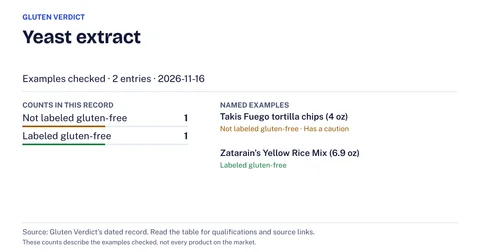 Yeast extractDepends on the productchecked Nov 16, 2026
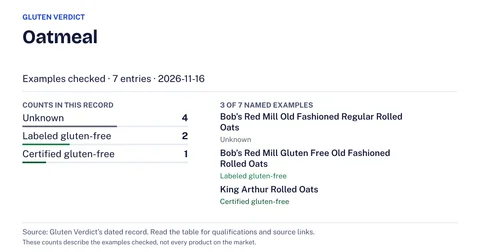 OatmealDepends on the productchecked Nov 16, 2026
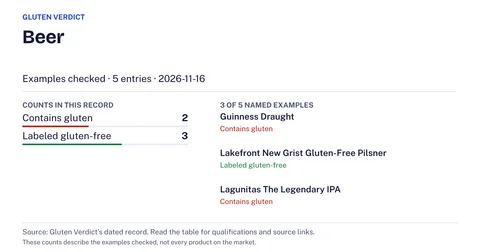 BeerDepends on the product2 of 5 products we checked contain gluten: Guinness Draught and Lagunitas The Legendary IPAchecked Nov 16, 2026
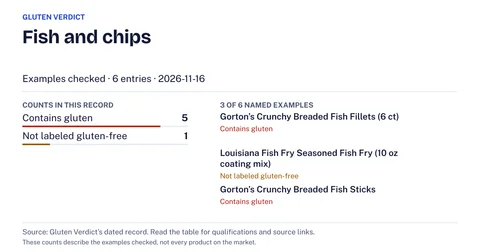 Fish and chipsDepends on the product5 of 6 products we checked contain glutenchecked Nov 16, 2026
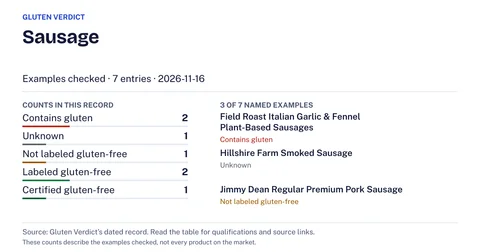 SausageDepends on the product2 of 7 products we checked contain gluten: Field Roast Italian Garlic & Fennel Plant-Based Sausages and Tofurky Plant-Based Italian Sausagechecked Nov 16, 2026
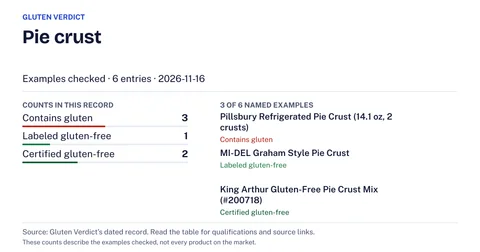 Pie crustContains glutenchecked Nov 16, 2026
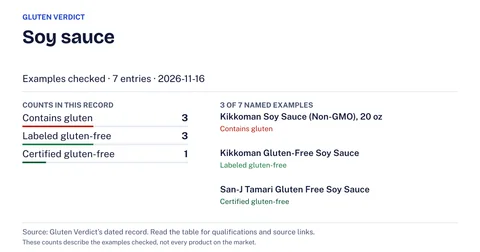 Soy sauceDepends on the product3 of 7 products we checked contain gluten: Kikkoman Soy Sauce (Non-GMO), 20 oz; San-J Organic Shoyu Soy Sauce; and Lee Kum Kee Premium Soy Sauce (No Preservatives Added)checked Nov 16, 2026
Questions people ask
Is gluten-free labelling in New Zealand the same as in Australia?
Yes. Food sold in both countries must comply with the one Food Standards Code1, whose gluten free claim means no detectable gluten and no oats or malted gluten cereals2.
Can oats be labelled gluten free in New Zealand?
No. Coeliac NZ says New Zealand and Australian legislation does not allow it, including for imported oats15.
Is Marmite gluten free?
Not New Zealand Marmite: its maker says it contains derivatives of barley and wheat39. UK Marmite is made to a different recipe by a different company38.
Does a 20 ppm gluten-free logo from overseas count in New Zealand?
Coeliac NZ says products that only qualify under the Codex standard cannot carry the wording “gluten free” in New Zealand32.
More in Travel: the Americas and Oceania
 Eating gluten-free in Australia: the oats rule, Vegemite and the borderWhat “gluten free” means on an Australian pack, why oats cannot carry the claim, which Vegemite to check, and what to declare on arrival.
 Eating gluten-free in Canada: gluten-source labels, poutine and Tim HortonsHow a Canadian label names gluten sources, what Health Canada says about gluten-free claims, and how to judge poutine and Tim Hortons.
 Gluten-free in Mexico: tortillas, Maggi seasonings and the Mexican allergen lineTell a corn tortilla from a corn-and-wheat blend, spot the Maggi seasonings that list wheat, read the Mexican allergen line and ask about the griddle.
 Gluten-free in Peru: chifa soy sauce, bread in the sauce and Ley 31881Where wheat enters Peruvian cooking (sillao in chifa dishes, bread in sauces), what Peru’s gluten-free label law settles, and how to plan trek meals.
 Gluten-free in the Caribbean: island dishes, jerk labels and cruise port daysWhich Caribbean doughs, soup mixes and jerk sauces list wheat, what a cruise line’s dietary request covers on a port day, and what to ask.
 Gluten-free in Argentina: sin TACC, the ANMAT list, parrilla and milanesaWhat “sin TACC” means, how to check a product in ANMAT’s official list, and how to judge parrilla, milanesa, empanadas and alfajores in Argentina.
Related guides
 Gluten-free labelling in Australia and New Zealand: what the claim meansWhat “gluten free” and “low gluten” mean on Australian and New Zealand packs: no detectable gluten, no oats, no malt, and how US packs compare.
 Gluten-free oats by country: where the claim is allowed and where it is barredWhether oats can carry a gluten-free claim in the US, Canada, EU, UK, Australia and New Zealand, in each regulator’s own words.
 Oats and celiac disease: what a gluten-free oat label does and does not tell youWhat FDA’s rule covers for oats, how makers get oats to the gluten-free limit, what avenin studies found, and what to ask your doctor.
 Bringing gluten-free food into Canada, Mexico, Australia and New ZealandWhat a US traveler can carry into Canada, Mexico, Australia and New Zealand: declare food, pack to each country’s list, and know what to buy there.
Sources
- [1] Food Standards Australia New Zealand, Food Standards Code, checked Nov 17, 2026.
- [2, 3] Food Standards Australia New Zealand (Federal Register of Legislation), Australia New Zealand Food Standards Code, Schedule 4, Nutrition, health and related claims, checked Nov 17, 2026.
- [4, 5, 6, 7] Food Standards Australia New Zealand, Product exemptions from allergen labelling, checked Nov 17, 2026.
Read on 2026-11-17: the list of foods and ingredients FSANZ assessed for exemption from allergen labelling names glucose syrups made from wheat starch (exempt from declaring wheat; a footnote says glucose syrups must have no more than 20 mg/kg detectable gluten to meet the requirements for the exemption); fully refined soybean oil (exempt from declaring soy); the soy derivatives tocopherols and phytosterols (exempt from declaring soy); and distilled alcohol from wheat or whey (exempt from declaring wheat or milk).
Read on 2026-11-17: the list headed “Other exemptions” names, among others, “beer or spirits do not have to declare barley, rye, oats or wheat”.
- [8, 9, 10, 11, 12] Food Standards Australia New Zealand, Allergen labelling for food businesses, checked Nov 17, 2026.
- [13, 14] US Food and Drug Administration, Questions and Answers on the Gluten-Free Food Labeling Final Rule, checked Nov 17, 2026.
- [15, 16, 17, 18, 19, 20] Coeliac New Zealand, Coeliac NZ position statement: Oats and coeliac disease, checked Nov 17, 2026.
- [21, 22, 23] Coeliac New Zealand, Common Sources of Gluten, checked Nov 17, 2026.
- [24, 25, 26, 27] Coeliac New Zealand, How to Read Food Labels, checked Nov 17, 2026.
- [28] Coeliac New Zealand, Reading Food Labels: staying vigilant, checked Nov 17, 2026.
- [29, 30, 31, 32, 33] Coeliac New Zealand, Crossed Grain Logo, checked Nov 17, 2026.
- [34, 35] Coeliac New Zealand, Dining Out Programme, checked Nov 17, 2026.
- [36] Coeliac New Zealand, Dining Guide, checked Nov 17, 2026.
Read on 2026-11-17: the Dining Guide page lists six entries: a caterer (Paella Pan) with no town given, two Auckland entries (Southern Cross Hospital North Harbour, a medical facility, and The Attic restaurant and bar), Diner 66 in Christchurch, Mercy Hospital in Dunedin (a medical facility) and Munch in Palmerston North. The page's own metadata gives a last-modified date of 4 May 2022.
- [37, 45] Coeliac New Zealand, Travelling with Coeliac Disease, checked Nov 17, 2026.
- [38, 39, 46] Sanitarium (Marmite NZ), Marmite FAQ, checked Nov 17, 2026.
- [40] Bega Cheese (Vegemite), Vegemite FAQs, checked Nov 17, 2026.
- [41, 42, 43, 44] New Zealand Customs Service, What you can and can’t bring, checked Nov 17, 2026.
Read on 2026-11-17: under “Risk items - Declare”, the list “Risk items include:” names, first, “any food (fresh, dried, natural or packaged)”, then plants or seeds, wooden items, animals or animal products, traditional/herbal medicines, and used shoes, sports or outdoor equipment.