Gluten-free in Portugal: the couvert, pastelarias and what to ask
Short answer
Portugal follows the EU rule: «isento de glúten» means no more than 20 mg of gluten per kg of food as sold1. In a restaurant, work through these four points:
- The couvert cannot be charged if you did not ask for it and it was not eaten or handled, and the consumer directorate recommends telling the staff to take away what you did not want2, 3.
- Allergen information for each dish has to be available, in writing or by mouth, but the Portuguese celiac association (APC) says a restaurant is not obliged to serve a meal without gluten4, 5.
- APC names these examples to ask about: flour in sauces, stock in rice and soup, crumbs and croutons, and oil shared with breaded food6, 7, 8.
- In APC’s view a non-certified pastelaria that makes gluten-free items in the same place as gluten items is not suitable for celiacs9.
- Gluten-free limit
- No more than 20 mg of gluten per kg of food as sold, for the statement «isento de glúten»1
- Set by
- Commission Implementing Regulation (EU) No 828/2014, directly applicable in every EU member state22
- Oats
- In a food presented as gluten-free, oats must be specially produced to avoid contamination by wheat, rye, barley or their crossbred varieties, and their gluten content cannot exceed 20 mg/kg26
- Celiac society
- Associação Portuguesa de Celíacos (APC)
Part of Travel: Europe, 19 guides
Key points
- The EU wording is «isento de glúten», at no more than 20 mg/kg1; FDA’s rule says any unavoidable gluten must be less than 20 ppm10.
- EU allergen law names “cereals containing gluten”, including barley, rye and oats11; the US list names wheat but not barley or rye12.
- A couvert that is eaten or handled can be charged even if you did not order it13, 14.
- The Portuguese rule on allergen information for food served without a pack covers restaurants and pastelarias15.
- APC publishes a Portuguese statement for explaining the diet to a waiter or chef, and a word list for reading labels16, 17.
The couvert: what it is and what you owe
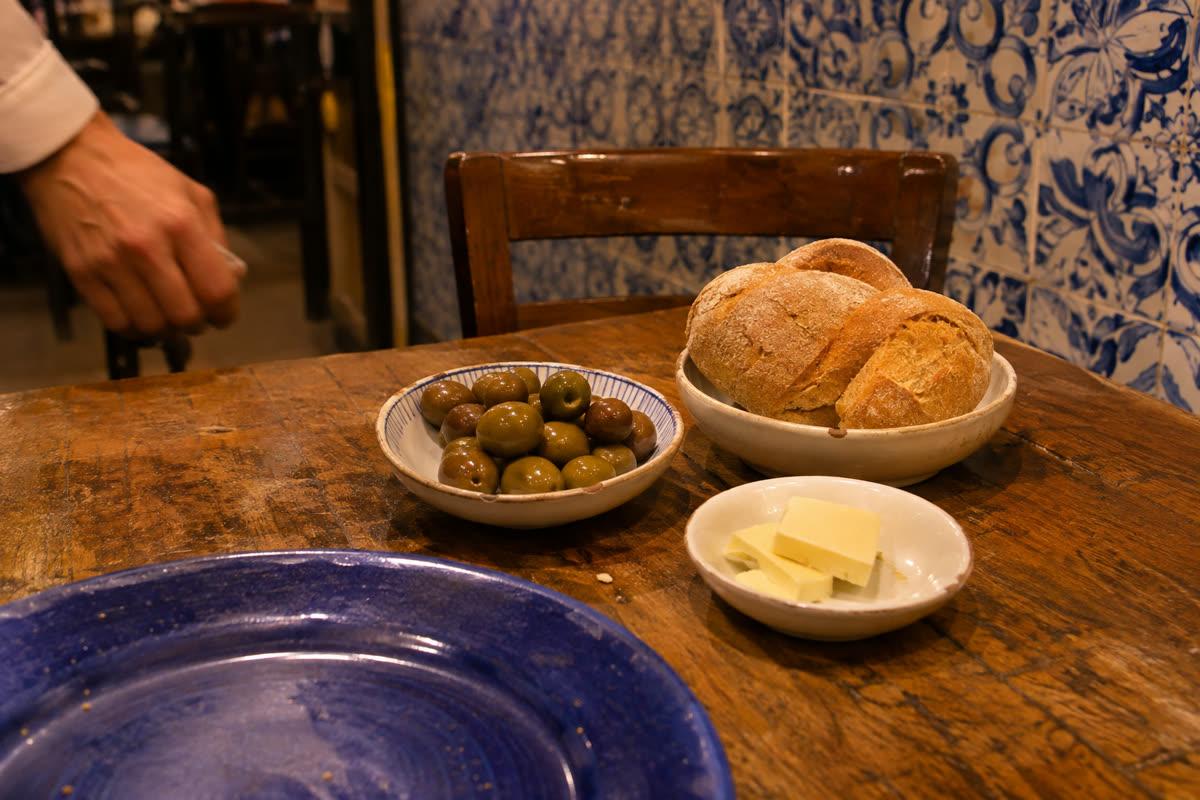
The Direção-Geral do Consumidor (DGC) guide, written with the restaurant trade association AHRESP, defines the couvert as a set of foods or appetisers identified on the menu, supplied at the customer’s request before the meal starts18. A venue that has a couvert has to list it, with its price, on its price list, which has to be written in Portuguese19.
The price list has to carry this sentence: “Nenhum prato, produto alimentar ou bebida, incluindo o couvert, pode ser cobrado se não for solicitado pelo cliente ou por este inutilizado”20. The guide reads that as: no charge if you did not ask for the couvert and it was not eaten or handled2.
| What happened | Can it be charged? |
|---|---|
| You did not ask for it, and it was not eaten or handled | No2 |
| You did not ask for it, but it was eaten or handled | Yes, even though you did not ask13 |
“Handled” has a meaning: the guide says the couvert counts as used when the customer has handled it, for example by opening a pack of butter or taking a product out of its packaging, even without eating it14.
The guide recommends that a customer who is given products they did not want or ask for tells the staff and has them taken off the table3. It also recommends, as good practice, that the venue asks the customer first whether they want these products21. For a celiac traveler there is a second reason to say it at once: bread you decline is bread no one touches next to your plate.
«Isento de glúten» on a pack, next to the US rule
Regulation (EU) No 828/2014 is binding in its entirety and directly applicable in all Member States22. Its Portuguese text allows the statement «isento de glúten» only where the food, as sold to the final consumer, contains no more than 20 mg/kg of gluten1. APC’s FAQ gives the same figure as 20 ppm (mg/kg)23.
A second wording, «teor muito baixo de glúten», is allowed only on food made with ingredients from wheat, rye, barley, oats or their crossbred varieties that were specially processed to reduce gluten, at no more than 100 mg/kg24. It is a different claim from «isento de glúten», with a higher limit24, 1.
| United States (FDA) | Portugal (EU rules) | |
|---|---|---|
| Gluten-free claim | Any unavoidable presence of gluten in the food must be less than 20 ppm10 | No more than 20 mg/kg of gluten in the food as sold25 |
| Oats | See our US label guide | Oats in a gluten-free food must be specially produced to avoid contamination and cannot exceed 20 mg/kg26 |
| Allergen list | Wheat is on the list; barley and rye are not12 | “Cereals containing gluten”: wheat, rye, barley, oats, spelt, kamut or their hybridised strains11 |
In the ingredient list, EU law requires the allergen’s name to be emphasised in a typeset that clearly distinguishes it from the rest of the list, for example by font, style or background colour27. APC describes it for visitors as bold type, and says some products also carry «Pode conter vestígios de glúten», which it renders as “May contain traces of gluten”28.
APC says specific gluten-free products carry the cut-stem symbol, and that some everyday products, among them some yogurts, hams and cheeses, already say «isento de glúten»29. A wording to watch on menus: Pastéis de Belém’s menu uses «sem glúten», while the Portuguese text of the regulation uses «isento de glúten»30, 1. We found no source on how the rule treats «sem glúten» on a menu, so ask a venue what it means by it.
What a restaurant has to tell you about allergens
For food offered without prepackaging, EU law makes the allergen particulars mandatory, meaning any Annex II ingredient or processing aid still present in the finished product31, 32. Member States may adopt national measures concerning the means through which they are made available33.
Portugal did so in Decreto-Lei n.º 26/2016. Its preamble says collective catering covers every establishment that prepares food ready for the final consumer as a professional or business activity, and names restaurants, canteens, schools, hospitals and catering companies, and also pastelarias and similar places15. Article 4 says the allergen information has to be available in any medium that lets the consumer take it in easily34. ASAE (Autoridade de Segurança Alimentar e Económica) is responsible for checking compliance35.
APC summarises this for diners: venues must have the allergen-causing ingredients of each dish available for consultation, including gluten4. The information can be written (menu or technical sheets), spoken, or in another clear and up-to-date format, and APC adds that venues are not obliged to provide a meal without gluten, so talking to the staff is the better approach5.
Information on request is not the same as a kitchen that avoids cross-contact. The rule covers what is in a dish; whether the grill, fryer or board is shared is a question to ask.
What the Portuguese celiac association advises when you eat out
APC’s first suggestion is a venue with its certification symbol, APC/Biotrab36. Its “Onde comer” page groups certified places by type, from restaurants and bakeries and pastelarias to ice-cream shops and hotels, and links to a map37. We do not list venues; use APC’s map and check it on the day.
APC says it increasingly sees places that advertise gluten-free menus but, when contacted, finds no precautions in choosing raw materials or in avoiding gluten contamination during handling38. It advises explaining that the reason is health and repeating the message, because venues also get «sem glúten» requests that are a mere dietary choice39.
For the answer itself, APC’s English page for visitors tells diners to insist that the waiter asks in the kitchen how the food is prepared, and not to accept an immediate answer that it is fine40.
Pastelarias and the pastel de nata
A pastelaria is inside the allergen rule described above15, 34.
The Fábrica dos Pastéis de Belém says its “Mestres” recreate every day the custard (“creme”) and the puff pastry (“massa folhada”) from which its pastéis are made41. The Celiac Disease Foundation, a US charity, lists pastries among the common foods that contain gluten42. Put together, the question for a pastel de nata is what its shell is made of, and the answer is the pastelaria’s to give; we found no authority page that states it for any particular shop.
Where a pastelaria also makes gluten-free items, APC’s position is that a non-certified padaria or pastelaria producing gluten-free items in the same place as gluten items is not suitable for celiacs9. The Celiac Disease Foundation lists non-certified baked goods, such as “gluten-free” goods from otherwise gluten-containing bakeries, among easily contaminated foods43.
A pastelaria that does name gluten-free items separately looks like this on a menu: Pastéis de Belém marks two miniature desserts «(sem glúten)» and explains its footnote30. For the US picture of pastry crust, see our pie crust verdict.
Classic dishes APC tells diners to ask about
APC’s advice page names several traditional dishes and what to check. Where we have a verdict for an ingredient, it links to it.
| Dish or food | What APC says | What to ask |
|---|---|---|
| Torricado, grilled meat | In a torricado the bread may be grilled on the same grill as the meat, so even a plain grilled steak can end up contaminated44 | Is the bread toasted on the grill used for meat? |
| Pataniscas | They can raise doubt about flour in suspension in the kitchen44 | Is there flour in the batter, and in the air near my food? |
| Empadão | The minced meat may have been prepared on equipment where gluten has passed45 | What equipment is the meat prepared on? |
| Feijoada and cozido à portuguesa | APC points to farinheira and other sausages45 | Which sausages are in it? |
| Arroz de marisco | APC points to “delícias do mar”45 | Is “delícias do mar” in it, and what stock is used? |
| Caldeirada | APC points to cooking stocks45 | What stock is used? |
| Rice in general | APC gives stock cooked into rice as an example of a risky ingredient, and says to ask to check the label8 | Is the rice cooked with stock, and can I see the label? |
| Soup | Soups can have stock, a base with gluten, or pasta or croutons not mentioned on the menu7. The Celiac Disease Foundation adds that cream-based soups use flour as a thickener and many soups contain barley46 | What is the base, and is anything added at the end? |
APC says dishes like these, and other dishes with sauces even when built on foods that are naturally free of gluten, are normally ruled out for celiacs because of what is added to them45. Its list of things to name when explaining the diet includes sauces made with wheat flour, breadcrumbs, croutons, some stock cubes, oil used to fry gluten-containing foods and mustard condiments6. The Celiac Disease Foundation likewise notes that many sauces and gravies use wheat flour as a thickener47. Our verdicts cover breadcrumbs and bread.
We did not find an authority page on how bacalhau com natas, bacalhau à Brás or sardines on bread are made, so this guide does not describe them. The questions above carry over: what thickens the sauce, what stock is in it, and whether bread or breading touches the fish.
Fried food and shared oil
APC’s English page tells visitors to be careful with fried food because the oil may be contaminated by other food, with rice because it may be prepared with stock, and with potato chips because some commercial ones may contain traces of gluten48. APC’s Portuguese page lists, among things to name to the kitchen, oil used to fry gluten-containing foods such as salgados, breaded items and some pre-fried potatoes6.
APC’s FAQ says cooking oil is naturally free of gluten, but that to avoid cross-contamination it should be kept exclusively for gluten-free products49. The Celiac Disease Foundation also lists fried foods cooked in oil shared with breaded products among the places where cross-contact can occur50. See our verdicts for olive oil and French fries.
A card to show: APC’s own Portuguese
APC prints a statement on its Tourism page for visitors to use when they explain what they can and cannot eat16. The Portuguese below is APC’s, reproduced as printed; we have not edited it. The right-hand column only says what each part covers.
| APC’s Portuguese, as printed | What this part covers |
|---|---|
| “Por questões de saúde eu não posso comer nada que contenha glúten na sua composição, nomeadamente farinha e derivados de trigo, centeio, cevada e aveia.”51 | The health reason, and the grains by name51 |
| “Na prática, NÃO POSSO COMER NADA que contenha pão (incluindo broa de milho), pão ralado, bolacha, batatas pré-fritas, massas, farinheira e alheira, alimentos que sejam fritos no mesmo óleo que os salgados e também não posso comer molhos que sejam confecionados com farinha de trigo, cerveja, mostarda, molho de soja, molho inglês.”52 | A list of what the person cannot eat, with bread (broa de milho named separately), crumbs, pre-fried potatoes, pasta, two sausages, food fried in shared oil, and sauces52 |
| “POSSO COMER milho, arroz e seus derivados, tapioca e mandioca, batata, soja, feijão, grão, ervilhas, lentilhas, fruta fresca, legumes, leite, iogurte, manteiga, grelhados e confeções simples de: carne, peixe, ovos, marisco (sem delícias do mar).”53 | A list of what the person can eat53 |
APC’s English guidance gives its own short version, with its translation: tell the waiter you cannot eat “trigo, cevada e centeio”, and that you can eat “carne, peixe, ovos, leguminosas, batata, arroz branco simples, vegetais e frutas”54.
For reading packs, APC lists these names, in its own English and Portuguese, as the ones to look for on the packaging. The list is APC’s, and the notes in brackets are its own17.
| On the Portuguese label | APC’s English |
|---|---|
| Trigo e variantes: Triticale, Espelta, Kamut | Wheat and variants: Triticale, Spelt, Kamut17 |
| Centeio | Rye17 |
| Cevada | Barley17 |
| Aveia | Oat, “if you can’t eat it”17 |
| Malte e Xarope de Malte | Malt and Malt Syrup17 |
| Extracto de Malte | Malt Extract17 |
| Amido dos cereais proibidos | Starch from banned cereals17 |
| Amido (sem indicar origem) | Starch (without indicating source)17 |
| Amido Modificado (sem indicar origem) | Modified Starch (without indicating source)17 |
| Proteína vegetal (sem indicar origem) | Vegetable protein (without indicating source)17 |
| Fibras alimentares (sem indicar origem) | Dietary fibre (without indicating source)17 |
| Aditivos E-14XX | Additives E-14XX17 |
Supermarkets, pharmacies and health shops
APC says gluten-free products are sold in several supermarkets, among them Continente, Auchan, Pingo Doce, El Corte Inglés, Intermarché, Aldi, Lidl, Mercadona and, in the Algarve, Supermercados Apolónia, and through some online stores. It adds a nationwide network of health shops such as Celeiro and some pharmacies55.
On the shelf, look for the cut-stem symbol or the words «isento de glúten»29, and read the ingredient list for the allergen names in bold28. Wine and port: APC’s FAQ lists wine, port wine, madeira wine, champagne and cider as free of gluten56, and says traditional beer contains gluten because it is brewed from fermented cereals, mainly barley57. See our verdicts for wine and beer.
Questions to ask at the table
- Is the couvert on your price list, and can you take it away?
- Can I see the allergen information for this dish, or ask the kitchen?
- What thickens the sauce or the soup, and is there stock in the rice?
- Is the bread, or the breading, cooked on the same grill, fryer or board as my food?
- Is the oil in the fryer used for breaded food too?
- If you say «sem glúten» or «isento de glúten», what does that mean here?
- For a pastelaria: what is the shell made of, and is the gluten-free item made in the same place?
Take APC’s statement with you in print or on your phone, ask politely, and let the answer from the kitchen, not the first answer at the table, decide. If you are still in doubt, order something else.
Verdicts in this guide
 BreadContains glutenchecked Nov 16, 2026
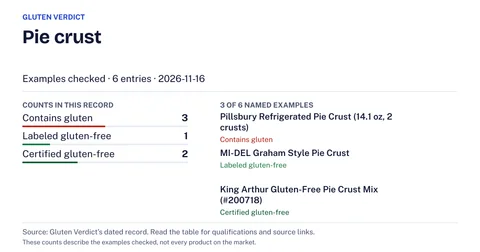 Pie crustContains glutenchecked Nov 16, 2026
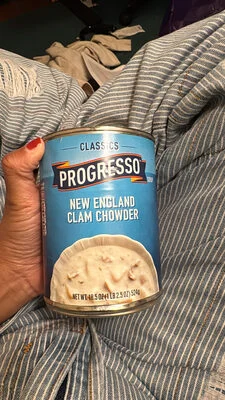 SoupDepends on the product3 of 8 products we checked contain gluten: Campbell’s Condensed Tomato Soup (10.75 oz), Campbell’s Condensed Cream of Mushroom Soup (10.5 oz), and Progresso Traditional Chicken Noodlechecked Nov 16, 2026
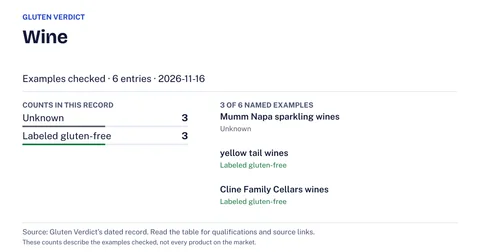 WineNaturally gluten-freechecked Nov 16, 2026
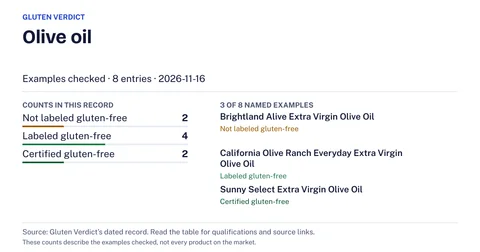 Olive oilUnknownchecked Nov 16, 2026
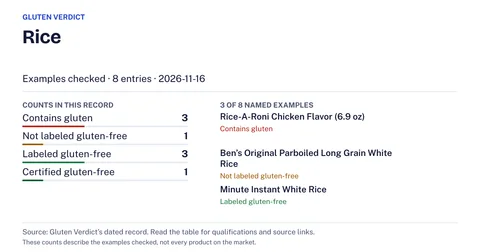 RiceNaturally gluten-free3 of 8 products we checked contain gluten: Rice-A-Roni Chicken Flavor (6.9 oz), Near East Original Rice Pilaf, and Ben’s Original Ready Rice Rice PilafBuy it labeled gluten-freechecked Nov 16, 2026
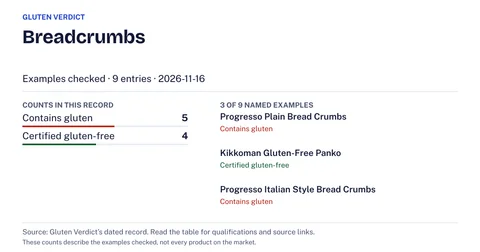 BreadcrumbsContains glutenchecked Nov 16, 2026
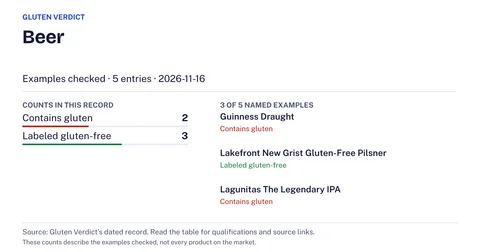 BeerDepends on the product2 of 5 products we checked contain gluten: Guinness Draught and Lagunitas The Legendary IPAchecked Nov 16, 2026
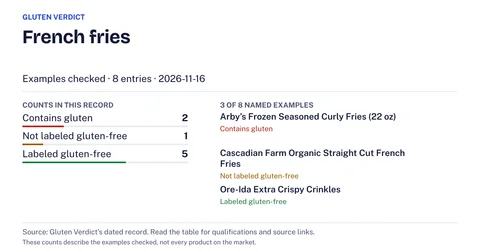 French friesDepends on the product2 of 8 products we checked contain gluten: Arby’s Frozen Seasoned Curly Fries (22 oz) and Checkers Frozen Crispy Seasoned Fries (28 oz)checked Nov 16, 2026
Questions people ask
Do I have to pay for the couvert I did not order?
Not if you did not ask for it and it was not eaten or handled; if it was eaten or handled it can be charged even when you did not ask2, 13. The DGC guide recommends telling the staff to take away what you do not want3.
Is the gluten-free limit in Portugal the same as in the US?
It is worded differently. The EU statement «isento de glúten» is allowed at no more than 20 mg/kg25; FDA’s rule says any unavoidable presence of gluten must be less than 20 ppm10.
Does a Portuguese restaurant have to serve a gluten-free meal?
APC says venues are not obliged to provide a meal without gluten5. They do have to make allergen information available34.
More in Travel: Europe
 What a European restaurant must tell you about gluten, country by countryWhether restaurants in France, Germany, Austria, Italy, Spain and the UK must show allergens in writing or may answer aloud, and what to ask.
 Gluten-free in the Netherlands and Belgium: labels, fryers, waffles and beerWhat glutenvrij and sans gluten mean on a pack, what Dutch and Belgian counters must tell you, and the fryer, waffle and beer questions to ask.
 Gluten-free in Central Europe: the rules in five countries and where wheat hides in the dishesWhich gluten-free rule covers a pack in Austria, Czechia, Hungary, Poland and Switzerland, and where wheat enters schnitzel, dumplings and sauces.
 Gluten-free in Estonia, Latvia and Lithuania: label words, rye bread and dumplingsHow Estonia, Latvia and Lithuania word gluten-free claims, where rye, barley and wheat sit in local dishes, and which official pages to check.
 Gluten-free in Greece: what the label and the taverna promise, and what to askWhat “gluten-free” means in Greece, where wheat hides in Greek dishes such as gyro, orzo and pies, and what to ask at a taverna.
 Gluten-free in Turkey: reading labels and menusTurkey’s gluten-free label rule, where wheat enters a Turkish menu (bulgur, şehriye, flour, mixes), and who to ask. Sources are Turkish and linked.
Related guides
 Gluten-free and very low gluten on EU labels, and how allergens are highlightedWhat EU “gluten-free” and “very low gluten” claims permit, how cereals containing gluten are highlighted in ingredient lists, and the rules for loose food.
 Fine on bread in Europe? What it does and does not showWhat a trip where bread felt fine does and does not show about celiac disease, and how EU and US gluten-free label rules compare.
 Gluten words on European food labels, language by languageFind the ingredient list, the gluten-cereal name and the gluten-free claim on a European pack in 11 languages, using words from the EU’s own texts.
 Gluten-free in Brazil: the “contém glúten” line, pão de queijo, farofa and tapiocaHow to read Brazil’s mandatory “contém glúten” line, and how to judge pão de queijo, farofa, tapioca and fried snacks by recipe and kitchen.
Sources
- [1, 24] European Union (EUR-Lex), Commission Implementing Regulation (EU) No 828/2014, Portuguese text, checked Nov 17, 2026.
- [2, 3, 13, 14, 18, 19, 20, 21] Direção-Geral do Consumidor (with AHRESP), Guia: Regras e boas práticas na restauração (setembro 2023), checked Nov 17, 2026.
- [4, 5, 6, 7, 8, 9, 36, 38, 39, 44, 45] Associação Portuguesa de Celíacos (APC), Cuidados a ter na restauração, checked Nov 17, 2026.
- [10] US Food and Drug Administration, Questions and Answers on the Gluten-Free Food Labeling Final Rule, checked Nov 17, 2026.
- [11, 27, 31, 32, 33] European Union (EUR-Lex), Regulation (EU) No 1169/2011 on the provision of food information to consumers, checked Nov 17, 2026.
- [12] US Food and Drug Administration, Food Allergen Labeling and Consumer Protection Act of 2004 (FALCPA), checked Nov 17, 2026.
- [15, 34, 35] República Portuguesa (Diário da República), Decreto-Lei n.º 26/2016, de 9 de junho, checked Nov 17, 2026.
- [16, 17, 28, 29, 40, 48, 51, 52, 53, 54, 55] Associação Portuguesa de Celíacos (APC), Tourism: Visiting Portugal, checked Nov 17, 2026.
Read on 2026-11-17: the list under “The only forbidden Portuguese ingredients for celiac that you should look out for on the packaging are:” gives each name in English and Portuguese: wheat and variants (triticale, spelt, kamut) “Trigo e variantes: Triticale, Espelta, Kamut”; rye “Centeio”; oat “Aveia (if you can’t eat it)”; barley “Cevada”; cereals “Cereais”; starch from banned cereals “Amido dos cereais proibidos”; starch (without indicating source) “Amido (sem indicar origem)”; modified starch (without indicating source) “Amido Modificado (sem indicar origem)”; vegetable protein (without indicating source) “Proteína vegetal (sem indicar origem)”; dietary fibre (without indicating source) “Fibras alimentares (sem indicar origem)”; malt and malt syrup “Malte e Xarope de Malte”; malt extract “Extracto de Malte”; additives E-14XX “Aditivos E-14XX”.
- [22, 25, 26] European Union (EUR-Lex), Commission Implementing Regulation (EU) No 828/2014, checked Nov 17, 2026.
- [23, 49, 56, 57] Associação Portuguesa de Celíacos (APC), Dieta isenta de glúten: FAQ’s, checked Nov 17, 2026.
- [30] Fábrica dos Pastéis de Belém, Menu, checked Nov 17, 2026.
Read on 2026-11-17: the pastelaria menu marks two items “(sem glúten)”, a Miniatura de chocolate and a Miniatura de cheesecake, and its footnote (3) reads “Produzido com ingredientes certificados isentos de glúten.”
- [37] Associação Portuguesa de Celíacos (APC), Onde comer, checked Nov 17, 2026.
Read on 2026-11-17: under the heading “Estabelecimentos Certificados” the page lists the categories Cadeias de restauração, Gelaterias, Hotéis, Padarias / Pastelarias, Restaurantes, Refeições prontas, Talhos and Cozinha, and links to a map of certified points of sale and establishments.
- [41] Fábrica dos Pastéis de Belém, Fabrico (Receita Secular), checked Nov 17, 2026.
- [42, 43, 46, 47, 50] Celiac Disease Foundation, Sources of Gluten, checked Nov 17, 2026.
Read on 2026-11-17: the list headed “Common Foods That Contain Gluten” names “Breads and Pastries” (croissants, pita, naan, bagels, flatbreads, cornbread, potato bread, muffins, donuts, rolls) and “Baked Goods” (cakes, cookies, pie crusts, brownies).