Gluten-free in Peru: chifa soy sauce, bread in the sauce and Ley 31881
Short answer
In the Peruvian recipes we read, wheat can enter through sauces: sillao, the Peruvian name for soy sauce25, seasons arroz chaufa, a chifa fried rice25, 26, the lomo saltado recipes we read call for it23, 24, and soy sauce is ordinarily fermented from soybeans and wheat11. Check four things:
- Soy-sauce dishes such as arroz chaufa and lomo saltado: ask which sillao or salsa de soya goes in. The two Peruvian sillao product pages we read list wheat20, 21, 22.
- Sauces thickened with bread or crackers: a national tourism recipe for ají de gallina soaks bread in the broth and blends it into the sauce27, and a huancaína recipe it publishes blends in crackers28.
- Packaged food: Ley 31881 lets a label say “sin gluten” or “libre de gluten” only if the food meets conditions set in a regulation1, which in the latest notice we read (February 2025) was still a draft7, 8, 10.
- Treks and remote lodges: tell the operator before you go. One trekking blog post about an Inca Trail agency says to tell the agency at least 7 days before departure41, and GIG suggests packing gluten-free staples for remote areas18.
- Gluten-free limit
- No numeric limit appears in the text of Ley N° 31881; it leaves the conditions for a “sin gluten” label to a regulation4, 1
- Set by
- Ley N° 31881, published 27 September 2023; its regulation was still a draft in the latest notice we read, February 20254, 8, 10
- Oats
- The text of Ley N° 31881 does not mention oats4
Part of Travel: the Americas and Oceania, 10 guides
Key points
- Chifa is the Chinese-Peruvian cooking of Peru26; arroz chaufa, a chifa dish, is seasoned with sillao, Peruvians’ word for soy sauce25, 26. In the US, FDA says that, in general, a soy sauce made from soybeans and wheat may not carry a gluten-free claim12.
- Ají de gallina is thickened with bread27, so the recipe, not the dish’s name, decides.
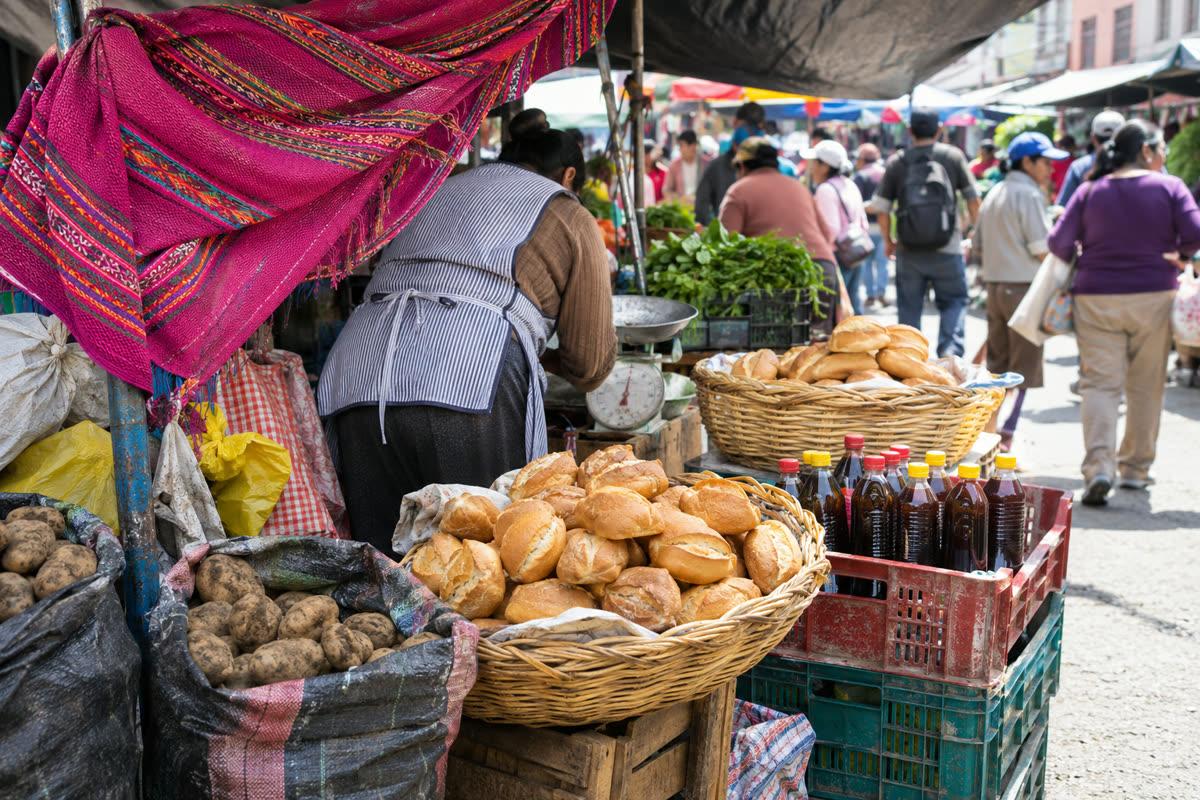
- Cebiche and causa limeña, as the national tourism site’s recipes give them, are built on fish, potato, ají and lime31, 29; the kitchen’s own practices still need a question19.
- Ley 31881 sets no numeric gluten limit in its text4; for a US “gluten-free” claim, FDA requires any unavoidable gluten to be under 20 parts per million13.
Why does soy sauce run through Peruvian cooking?
Chifa is the mix of Peruvian creole and Chinese cooking that Chinese immigrants carried to Peru from the middle of the 19th century26. Peruvians call soy sauce sillao25. Arroz chaufa, a fried rice, is a dish of that cooking26, seasoned with sillao and sesame oil25. Soy sauce also appears in the lomo saltado recipes we read: a PromPerú recipe adds “la salsa de soya” to the beef23, and a second PromPerú article adds a splash of sillao and oyster sauce24.
FDA describes soy sauce as ordinarily made by fermenting soybeans and wheat, though some soy sauces are made without wheat11. GIG’s travel advice makes the same point in plain terms: many experienced gluten-free eaters know that typical soy sauce contains gluten, but not everyone notices it in a new dish14.
Peruvian product pages say so too. A Peruvian supermarket’s page for Nakamito sillao says it is made by fermenting soybeans, wheat, water and salt, and declares soy and wheat as allergens20, 21. The page for an Aji-no-sillao product describes a sauce made from soy and wheat22. We read two products; another brand may differ, so the label of the bottle in the kitchen is what counts.
In the US, FDA says that, in general, a soy sauce made from soybeans and wheat may not carry a gluten-free claim12. That is a US rule; we read no Peruvian rule on soy sauce. For our own verdicts, see soy sauce, fried rice and oyster sauce, which also appears in the lomo saltado article24.
Where else can wheat sit in a dish: bread and crackers in the sauce?
PromPerú’s ají de gallina recipe tells the cook to soak bread in the broth and blend it with nuts into the sauce27. A sauce thickened with bread is a gluten question unless the bread is gluten-free. Ask what thickens it, and see our bread verdict.
The huancaína sauce on boiled potatoes is blended from yellow ají, fresh cheese, oil, milk, salt and, in one PromPerú article’s recipe, half a package of crackers (galletas)28. That source does not say what the crackers are made of, so ask whether the sauce uses them and, if so, which kind.
Dish by dish: what the recipes we read list
These are recipes from Peru’s national tourism site and a news site, not any restaurant’s kitchen. A restaurant can change them, so use the last column as the question to ask.
| Dish | What the recipe lists | Ask |
|---|---|---|
| Lomo saltado | Soy sauce (“salsa de soya”)23; sillao and oyster sauce in a second article24 | Which sillao, and whether it is a wheat-based one |
| Arroz chaufa | Sillao and sesame oil on fried rice25 | Which sillao |
| Ají de gallina | Bread soaked in the broth and blended into the sauce27 | What thickens the sauce |
| Papa a la huancaína | Yellow ají, fresh cheese, oil, milk, salt and, in one recipe, crackers28 | Whether crackers go in |
| Causa limeña | Potato, ají cream, oil, salt and lime juice, with a filling such as avocado, tomato and egg, crab dressed with mayonnaise, or sautéed prawns29, 30 | What is in the filling and any sauce |
| Cebiche | Fish, onion, ají limo, salt and lime juice, served with sweet potato, lettuce and corn31, 32 | Whether anything else is added or fried alongside |
Which dishes do the recipes we read leave wheat out of?
Start with dishes whose recipes list no wheat, barley or rye: in the table above, PromPerú’s cebiche31, 32 and causa limeña29, 30. For the plain ingredients, see our verdicts on potatoes, rice and corn.
GIG’s advice for any country is to learn what the local cuisine consists of, so you can spot dishes that may be naturally gluten-free and the items to watch out for15. A recipe on paper is not a kitchen, though. GIG’s own dining questions apply here: whether separate cutting boards, utensils, fryers and toasters are used to avoid cross-contact19.
Is quinoa gluten-free?
GIG’s page on gluten-free grains lists quinoa33, 35 and calls quinoa, with amaranth and buckwheat, a “pseudocereal”34. Our quinoa verdict covers what can still go wrong (cross-contact in harvesting, processing or a bulk bin) and which maker pages say gluten-free. We did not read a Peruvian source on quinoa labeling, so we say nothing about how Peruvian packs are labeled.
Pisco, beer and the rest of the drinks list
Indecopi, a Peruvian government agency, describes pisco as a spirit distilled from freshly fermented grape must, with no water, sugar or other inputs added36. That starts from grapes, not from a grain36. GIG says the liquid that comes off a still becomes gluten-free37, and adds that a spirit could still encounter gluten or traces of it after distillation, for example whiskey aged in a beer barrel38. A cocktail is more than its pisco, so ask what else goes in the glass.
Beer is a different case: GIG says it most commonly begins with the fermentation of wheat or barley39. See our beer verdict. We found no source on chicha morada, chicha de jora or Inca Kola, so we give no ruling on them.
What does Peru’s gluten-free label law settle?
Ley 31881 was published in El Peruano on 27 September 20234. Its stated aim is to give consumers, especially people with celiac disease, gluten intolerance or gluten allergy, information to make informed choices5. Foods labeled “libre de gluten” or “sin gluten” must meet conditions that a regulation will set, and the maker must have a good manufacturing practices program set by DIGESA1. The law lets the Ministry of Health authorize a symbol of a barred ear (“espiga barrada”) inside a circle on packages, as the regulation specifies2.
The law told the Ministry of Health to write that regulation within sixty days of the law taking effect3. What we found instead is a draft: Ministerial Resolution 314-2024/MINSA, of May 2024, published a draft regulation for comment6, 9, and Resolution 112-2025/MINSA, of February 202510, says that draft was reformulated7 and published a new version for ninety days of comment8. We did not find an approving decree, and we have not confirmed which packs carry the symbol.
The text of the law itself states no numeric gluten limit and does not mention oats4. For comparison, FDA’s definition of “gluten-free” for foods it regulates says any unavoidable presence of gluten must be less than 20 parts per million13. A “sin gluten” label bought in Peru therefore cannot be read as meeting a US number, and the label is a reason to ask, not an answer.
How do I plan meals for a trek or a remote lodge?
A Local Trekkers Peru blog post about Inca Trail meals describes an agency it names, Viajero Tours, that asks travelers about dietary restrictions before the trek. Its list of options includes gluten-free for celiacs40. The post says each meal is prepared separately with clean utensils to prevent cross-contamination42, and that travelers should inform the agency at least 7 days before departure so ingredients can be planned41. That is one tour blog’s description of one agency’s service, so confirm the same points with the operator you book.
GIG suggests packing gluten-free staples such as bread, pasta or cereal, especially in remote areas where gluten-free awareness may be limited18, and keeping small packaged snacks on hand for daily travel17.
In practice: ask the operator or lodge in writing, before you pay, who cooks, what the sauces and soups are thickened with, and which sillao is used; then carry your own backup.
Words you will see, and where we read them
GIG advises a printed translation card in a country where you do not speak the language16. We found no Peru-specific card we could read, so we do not print one. These are the Spanish words we met in the sources above, with the place we read each one.
| Word | Where we read it |
|---|---|
| sillao | Peruvians’ colloquial name for soy sauce, on a chaufa recipe25 and in a lomo saltado article24 |
| salsa de soya | The lomo saltado recipe’s wording for the soy sauce added to the beef23 |
| trigo | The allergen line of a Nakamito sillao page: “Contiene soya y trigo”21 |
| pan | The bread soaked in the broth for ají de gallina27 |
| galletas | The crackers in one huancaína recipe28 |
| libre de gluten, sin gluten | The two wordings Ley 31881 uses for a label1 |
| celiaquía | The word for celiac disease in Ley 31881’s statement of purpose5 |
Verdicts in this guide
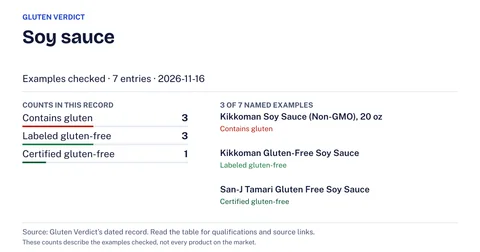 Soy sauceDepends on the product3 of 7 products we checked contain gluten: Kikkoman Soy Sauce (Non-GMO), 20 oz; San-J Organic Shoyu Soy Sauce; and Lee Kum Kee Premium Soy Sauce (No Preservatives Added)checked Nov 16, 2026
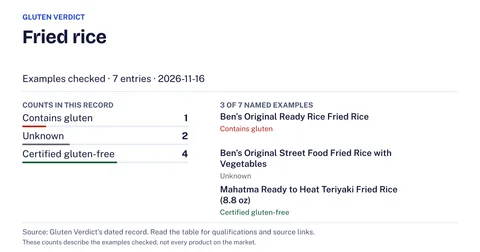 Fried riceDepends on the product1 of 7 products we checked contains gluten: Ben’s Original Ready Rice Fried Ricechecked Nov 16, 2026
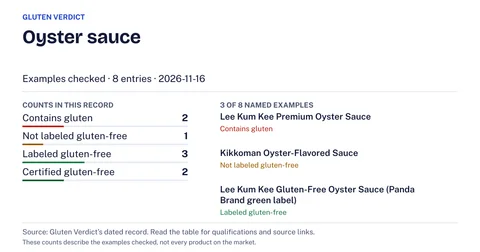 Oyster sauceDepends on the product2 of 8 products we checked contain gluten: Lee Kum Kee Premium Oyster Sauce and Lee Kum Kee Panda Brand Oyster Flavored Saucechecked Nov 16, 2026
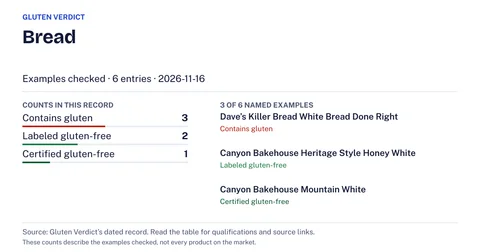 BreadContains glutenchecked Nov 16, 2026
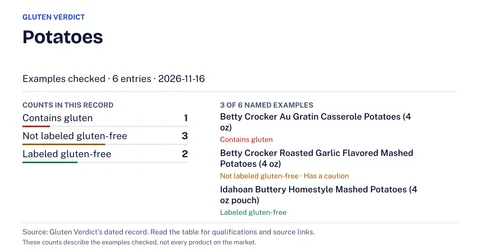 PotatoesNaturally gluten-free1 of 6 products we checked contains gluten: Betty Crocker Au Gratin Casserole Potatoes (4 oz)checked Nov 16, 2026
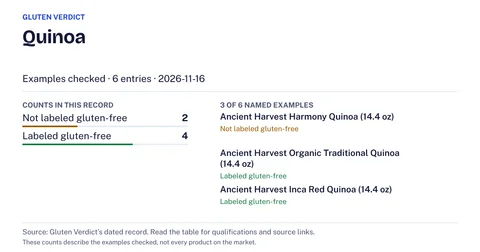 QuinoaNaturally gluten-freeBuy it labeled gluten-freechecked Nov 16, 2026
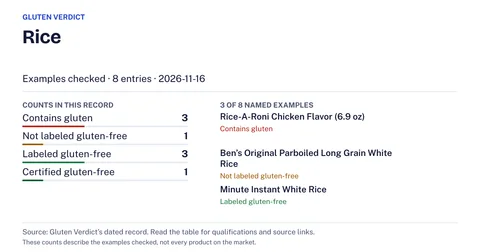 RiceNaturally gluten-free3 of 8 products we checked contain gluten: Rice-A-Roni Chicken Flavor (6.9 oz), Near East Original Rice Pilaf, and Ben’s Original Ready Rice Rice PilafBuy it labeled gluten-freechecked Nov 16, 2026
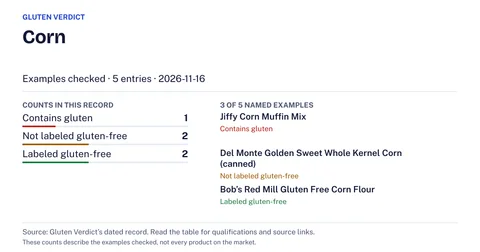 CornNaturally gluten-free1 of 5 products we checked contains gluten: Jiffy Corn Muffin Mixchecked Nov 16, 2026
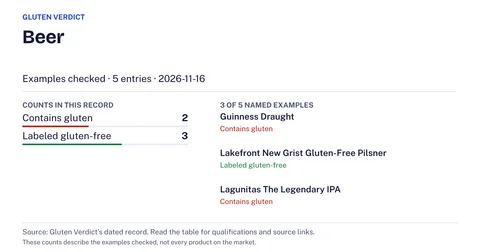 BeerDepends on the product2 of 5 products we checked contain gluten: Guinness Draught and Lagunitas The Legendary IPAchecked Nov 16, 2026
Questions people ask
Is lomo saltado gluten-free?
The recipes we read season it with soy sauce23, 24, and soy sauce is ordinarily fermented from soybeans and wheat11. Ask which sillao the kitchen uses.
Does Peru have a gluten-free labeling law?
Yes: Ley 31881 says foods labeled “libre de gluten” or “sin gluten” must meet conditions set in a regulation1. In the latest notice we read, from February 2025, that regulation was still a draft8, 10.
Is quinoa gluten-free?
GIG lists it among gluten-free grains33, 35. See our quinoa verdict for cross-contact.
Is pisco gluten-free?
Indecopi describes pisco as distilled from fermented grape must36, and GIG says distilled liquid becomes gluten-free37. Cocktails add other ingredients, so ask about them.
How far ahead should I tell a trek operator?
One tour blog’s post about an Inca Trail agency says to inform the agency at least 7 days before departure41. Ask the operator you book for its own deadline.
More in Travel: the Americas and Oceania
 Gluten-free in the Caribbean: island dishes, jerk labels and cruise port daysWhich Caribbean doughs, soup mixes and jerk sauces list wheat, what a cruise line’s dietary request covers on a port day, and what to ask.
 Gluten-free in Hawaii, Puerto Rico and the US Virgin IslandsDoes the US gluten-free label rule hold in Hawaii, Puerto Rico and the USVI? Plus poke sauce, SPAM, musubi, seasoning packets and rum.
 Gluten-free in Brazil: the “contém glúten” line, pão de queijo, farofa and tapiocaHow to read Brazil’s mandatory “contém glúten” line, and how to judge pão de queijo, farofa, tapioca and fried snacks by recipe and kitchen.
 Gluten-free in Mexico: tortillas, Maggi seasonings and the Mexican allergen lineTell a corn tortilla from a corn-and-wheat blend, spot the Maggi seasonings that list wheat, read the Mexican allergen line and ask about the griddle.
 Gluten-free in New Zealand: the shared food code, oats, Marmite and the borderWhat a US visitor needs for gluten-free food in New Zealand: the shared Australian claim, oats, Marmite, Coeliac NZ marks and border declaration.
 Gluten-free in Argentina: sin TACC, the ANMAT list, parrilla and milanesaWhat “sin TACC” means, how to check a product in ANMAT’s official list, and how to judge parrilla, milanesa, empanadas and alfajores in Argentina.
Related guides
 Soy, hoisin, oyster, teriyaki and fish sauce: which bottles carry wheatSoy, hoisin, oyster, teriyaki and fish sauce compared by the ingredient lists of Kikkoman, Lee Kum Kee, San-J and Red Boat, plus what to ask at a counter.
 Ordering gluten-free at a Chinese restaurant: sauces, coatings, wine, woks and MSGWhere wheat enters Chinese-restaurant cooking (sauces, coatings, cooking wine, woks), why MSG is not a gluten source, and what to ask before you order.
 What to use instead of soy sauce when you eat gluten-freeTamari, gluten-free soy sauce, coconut aminos and liquid aminos: what each maker says, how to confirm it on the bottle, and what changes when you cook.
 Gluten-free substitutes: the swap for each wheat ingredient and the label check it needsA lookup table of gluten-free swaps for wheat flour, pasta, bread, soy sauce, beer and more, with the one label check each swap needs.
Sources
- [1, 2, 3, 4, 5] Peruvian Congress and Presidency, published in El Peruano, Ley N° 31881, Ley que promueve brindar información de los alimentos que no contienen gluten (El Peruano), checked Nov 17, 2026.
Read on 2026-11-17: the page gives the publication date 27/09/2023 and the full text of Ley N° 31881 (articles 1 to 5 and three final provisions). The text states no numeric gluten limit and does not mention oats (avena).
- [6, 9] Ministerio de Salud del Perú, published in El Peruano, Resolución Ministerial 314-2024/MINSA: draft regulation of Ley 31881 published for comment, checked Nov 17, 2026.
- [7, 8, 10] Ministerio de Salud del Perú, published in El Peruano, Resolución Ministerial 112-2025/MINSA: new draft regulation of Ley 31881 published for comment, checked Nov 17, 2026.
- [11, 12, 13] US Food and Drug Administration, Questions and Answers on the Gluten-Free Food Labeling Final Rule, checked Nov 17, 2026.
- [14, 15, 16, 17] Gluten Intolerance Group, Traveling Gluten-Free with Confidence, checked Nov 17, 2026.
- [18] Gluten Intolerance Group, Travel Made Easy: Embracing Your Adventures Gluten-Free, checked Nov 17, 2026.
- [19] Gluten Intolerance Group, Traveling Gluten-Free, checked Nov 17, 2026.
- [20, 21] Plaza Vea (Peru), Sillao claro Nakamito, botella de 500 ml (product page), checked Nov 17, 2026.
- [22] Plaza Vea (Peru), Sillao Aji-no-sillao, botella de 150 ml (product page), checked Nov 17, 2026.
- [23] PromPerú (peru.info), Lomo saltado, recipe from the Platos Bandera series, checked Nov 17, 2026.
- [24] PromPerú (peru.info), Perfecta fusión: la historia del lomo saltado, checked Nov 17, 2026.
- [25, 26] Infobae, Cómo hacer arroz chaufa, el plato de arroz frito típico de la cocina chifa peruana, checked Nov 17, 2026.
- [27] PromPerú (peru.info), Ají de gallina, recipe from the Platos Bandera series, checked Nov 17, 2026.
- [28] PromPerú (peru.info), 5 recetas peruanas que puedes preparar en cualquier momento, checked Nov 17, 2026.
- [29, 30] PromPerú (peru.info), Causa limeña, recipe from the Platos Bandera series, checked Nov 17, 2026.
- [31, 32] PromPerú (peru.info), Cebiche, recipe from the Platos Bandera series, checked Nov 17, 2026.
- [33, 34, 35] Gluten Intolerance Group, Alternative Gluten-Free Grains and Flour Substitutes, checked Nov 17, 2026.
Read on 2026-11-17: the page has an entry headed “Quinoa” in its list of gluten-free grains and flour substitutes; the entry describes the saponins as a natural, bitter-tasting coating and does not mention gluten.
- [36] Indecopi (Peru), Indecopi presents the digital publication Pisco, la primera Denominación de Origen del Perú, checked Nov 17, 2026.
- [37, 38, 39] Gluten Intolerance Group, Does Fermentation or Distillation Make a Product Gluten-Free?, checked Nov 17, 2026.
- [40, 41, 42] Local Trekkers Peru, Food on the Inca Trail: menus and dietary restrictions, checked Nov 17, 2026.
Read on 2026-11-17: under “Dietary restrictions and special options”, the list headed “Available options” names vegetarian and vegan; gluten-free (for celiacs); lactose-free; low-sodium or low-sugar; and specific allergies (nuts, seafood, etc.).