Gluten-free food for camping and hiking: pack lists and label checks
Short answer
Build the menu in four steps, then check every item on the package in your hand:
- Pack by trip length: on a day hike food stays cold or non-perishable, and after the first day of a backpacking trip it has to be shelf-stable1, 2.
- Read each pouch meal on its maker’s own page: Mountain House says its gluten-free meals are GFCO certified, Backpacker’s Pantry says 24 are certified and tested to 20 ppm, and Peak Refuel says none are certified3, 4, 5.
- Check bars, cereal, granola, noodles and oats against their labels: wheat, malt and oats not labeled gluten-free are the usual catches6, 7, 8, 13.
- In a shared camp kitchen, wash with soap and water, avoid sharing hard-to-clean tools, avoid double-dipping into shared jars, and note each item’s label details before you repack it9, 10, 46, 11.
Part of Travel planning and logistics, 22 guides
Key points
- Three pouch makers make three different statements: GFCO certified, tested to 20 ppm with a shared-facility warning, and gluten free by ingredient, not certified, in a facility that also handles wheat3, 4, 32, 12.
- Trail staples where the label decides: bars (wheat, oats or barley malt extract), cereal with malt, granola with regular oats, ramen and couscous6, 7, 13, 41.
- Fruit, cheese and nuts are naturally gluten-free and need no claim14, 15.
- NPS tells backpackers to take food out of its original package, so keep the ingredient list before you do11.
- A shared camp kitchen: soap and water, avoid shared colanders and sifters, no double-dipping into jars, and a wiped prep surface9, 10, 16, 46.
How does the pack list change with trip length?
USDA’s FSIS (its food inspection arm) sorts outdoor food by how long you are out. One meal and some snacks are likely all a short hike needs17. On a day hike, food can ride in your pack if it stays cold, or you can choose non-perishable food1. Past the first day of a backpacking trip, cold food covers only that day and the rest has to be shelf-stable2. Gluten changes what you pick inside each of those groups.
| Trip | How the food travels | Gluten checks that matter most |
|---|---|---|
| Day hike | Cold in the pack, or non-perishable1 | Fruit, cheese and nuts are naturally gluten-free, per the Celiac Disease Foundation14. For anything bought without a gluten-free claim, read its label18. |
| Car camping with a cooler | Cooler; FSIS says to discard perishable food at the end of the trip if the cooler has no ice or the gel pack is no longer frozen19 | Gluten Intolerance Group’s road-trip dry-goods tote lists canned beans, canned fish, nuts, dried fruit, quick-cook brown rice, rice cakes, nut butter and gluten-free bread20. GIG’s rule for a shared fridge or cupboard, gluten-free packages above gluten-containing ones and securely packaged, is a habit worth copying in a cooler21. |
| Backpacking one or two nights | Cold food on day one, then shelf-stable2 | Pouch meals (next section), bars and noodles: read each label18. Powdered sauce mixes: FSIS says to check the ingredient list22. |
| A week in the backcountry | FSIS’s page treats any backpacking trip over one day the same way: after the first day, pack shelf-stable food2. NPS suggests compact, compressible, high-calorie foods with little smell23 | Carry non-perishable backup food in case you are caught somewhere without gluten-free options24. Keep each item’s label details when you repack (last section). |
FSIS lists the shelf-stable staples backpackers use: pre-packaged shelf-stable meals, peanut butter, canned fish and meat, dried noodles and soups, jerky, dehydrated food, whole or dried fruit, nuts, and powdered milk and fruit drinks25. Soup and noodles from that list also appear on the Celiac Disease Foundation’s lists: soup among foods to verify26, noodles among common foods that contain gluten13. The sections below take the groups one at a time.
What do the freeze-dried pouch makers say about gluten?
The three brands below each answer differently, so a pouch from one brand tells you nothing about another’s. Even a meal name can repeat: Mountain House and Peak Refuel both sell a Breakfast Skillet27, 28, and each maker’s statement covers only its own pouch.
| Maker | Gluten-free claim | Facility statement |
|---|---|---|
| Mountain House | Not every meal is gluten-free; the ones that are carry a GFCO certification, an icon on the front of the pouch and a GFCO logo on the back29, 3 | Says shared equipment can introduce trace gluten and that third-party certification is meant to control for it30. The page does not say which allergens its plant handles31. |
| Backpacker’s Pantry | 24 certified gluten-free meals, tested to a 20 ppm threshold, with a certified seal on the front of the package4 | All its products are made in a facility that processes peanuts, milk, soy, wheat, gluten, egg and tree nuts; it describes a very small risk of cross-contamination32 |
| Peak Refuel | No certified gluten-free meals; says several meals contain no gluten or wheat, and calls them gluten free by ingredient5, 12 | Made in a facility that also makes meals containing gluten; the company says it cleans and tests each line for allergens5. Its gluten-free page says the facility is not certified gluten-free58. |
What that means at the pack table:
- A certification mark and a plain “gluten-free by ingredient” statement are different promises. In the US, FDA’s rule requires foods labeled “gluten-free” to contain less than 20 parts per million of gluten33. Gluten Intolerance Group says GFCO certification means 10 ppm of gluten or less34.
- A shared-facility line and a gluten-free claim can sit on one label; FDA allows both when the statement is truthful and not misleading35. FDA also notes that shared production equipment could lead to gluten cross-contact36.
- Read the pouch in your hand. Mountain House says to scan for wheat, barley, rye, malt and soy sauce, and that recipes change37, 38. It also says freeze-drying does not add gluten and that the recipe and handling are what matter39.
- Check oats separately. Peak Refuel’s list includes Creamy Peaches & Oats, but neither of its pages says whether the oats are labeled gluten-free28; FDA requires oats labeled gluten-free to contain less than 20 ppm40.
Which trail foods need a label check, and which of ours cover them?
The Celiac Disease Foundation’s advice is to read the label of any food you buy when “gluten-free” is not on it18. These are the trail staples where the label decides. The right column links our own verdict pages, which show what each maker’s pages said and when we read them.
| Trail food | What to check | Our verdicts |
|---|---|---|
| Energy bars | The Celiac Disease Foundation says some bars may contain wheat as an ingredient and most use oats that are not gluten-free6. Example: Clif’s Chocolate Chip bar page lists soy rice crisps made with barley malt extract41, and FDA says malt extract cannot be used in a food labeled gluten-free42. Its allergen line also reads “MAY CONTAIN … WHEAT”43. | Clif Bar Chocolate Chip |
| Granola and cereal | The foundation says corn flakes and rice puffs often contain malt extract or flavoring, and granola is often made with regular oats7. | Granola |
| Oatmeal packets and loose oats | Look for oats specifically labeled gluten-free8; FDA says oats labeled gluten-free must contain less than 20 ppm40. | Oatmeal · Quaker Instant Oatmeal |
| Jerky | The foundation lists pre-seasoned meats among foods to verify by label or maker26. FDA says soy sauce made from soybeans and wheat may not carry a gluten-free claim44, and notes USDA generally regulates meat labeling, which FDA’s gluten-free rule does not cover45. | Beef jerky |
| Instant noodles and couscous | The foundation’s list of common foods that contain gluten names ramen and couscous, and notes rice noodles are gluten free13. | Ramen · Couscous |
| Rice, dried pasta and sauce mixes | NPS lists rice and pastas among compact, high-calorie foods for backpackers23, and FSIS says to check the ingredient list of powdered sauce mixes22. | Rice |
| Peanut butter | FSIS lists peanut butter in plastic jars as a shelf-stable staple25. At a shared camp table, a jar is a double-dip risk46. | Peanut butter |
| S’mores | The foundation lists graham crackers among common foods that contain gluten13. | Graham crackers · Marshmallows |
| Instant coffee and hot chocolate | Neither coffee nor hot chocolate is named on the Celiac Disease Foundation’s Sources of Gluten page, so its general advice applies: read the label18. | Instant coffee · Hot chocolate |
For the may-contain wording on bars and mixes, see may-contain wheat labels.
What should I check at a trailhead or camp store?
A camp store is where a plan meets what is on the shelf. A short routine:
- Read the ingredient list, not just the front. The gluten-free claim is voluntary, so a food can meet the definition without carrying it15.
- Treat a missing ingredient list as a no. The Celiac Disease Foundation’s advice: when you cannot verify the ingredients, or the list is unavailable, do not eat it47.
- Skip the bulk bins. Gluten Intolerance Group warns that gluten-containing ingredients can linger on scoops or surrounding bins48.
- Keep one backup food in your pack that you have already checked24.
For park lodges and in-park restaurants, see national park lodge dining; for the drive to the trailhead, gluten-free road trips.
How do I run a shared campsite kitchen?
Cross-contact is gluten reaching food that has none, generally through shared utensils or a shared cooking or storage environment57. In a shared camp kitchen, think utensils, colanders and sifters, jars and the prep surface10, 46. These steps follow Gluten Intolerance Group’s and the Celiac Disease Foundation’s advice:
- Wash first. Gluten Intolerance Group says thorough cleaning with soap and water is sufficient for most cooking equipment and utensils9. If the campsite has no clean water, FSIS says you can bring your own for food preparation and cleaning utensils49.
- Avoid sharing the hard-to-clean items. GIG names colanders and sifters and says they should not be shared between gluten-free and non-gluten-free use, if possible, and otherwise cleaned thoroughly between every use10. At camp, think strainers and mesh baskets.
- Pick one prep spot and wipe it down; GIG says to wipe surfaces often and always after making dishes with gluten-containing ingredients16.
- No double-dipping. GIG calls it one of the most common ways crumbs reach gluten-free food50, and the Celiac Disease Foundation lists butter, peanut butter, jam, mustard and mayonnaise as condiments that may become contaminated that way46. Use your own jar or a clean spoon each time.
- Label your bag. GIG suggests labeling food, utensils and cookware51.
- GIG suggests bringing your own grill or rack for the campfire pit in case the campground does not provide one52. A rack of your own also keeps the cooking surface yours, which is our habit, not GIG’s stated reason.
One planning step of our own: cook your meal first, on a surface you have just wiped, before anyone’s bread, pasta or noodles reach the pan. No source we read sets an order of cooking, so treat it as a habit, not a rule.
How do I store food without losing the label?
The National Park Service says storage rules differ by park, and some parks allow or require portable containers for backpackers, some provide food lockers, and some require food to be hung from food poles53. Check before you pack.
- The Park Service tells backpackers to take food out of its original package and use resealable bags11. That also removes the ingredient list and any may-contain line. Before you repack, photograph the ingredient panel and maker name, and write what each bag holds on it.
- Keep gluten-free bags above gluten-containing ones and securely packaged, as GIG advises for a shared fridge or cupboard21.
- NPS’s bear-storage page says not to store food in your tent or backpack54, and to place bear-resistant containers on flat, level ground 100 feet or more from your campsite55.
- NPS says to pack out all uneaten food, food particles and wrappers56.
Verdicts in this guide
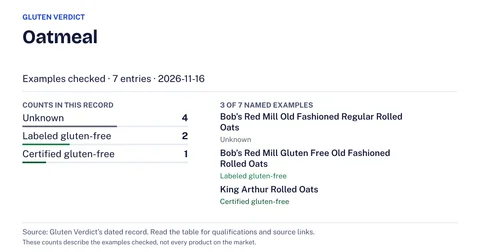 OatmealDepends on the productchecked Nov 16, 2026
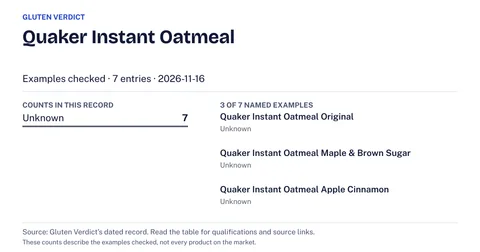 Quaker Instant OatmealUnknownThe Quaker Oats Company · checked Nov 16, 2026
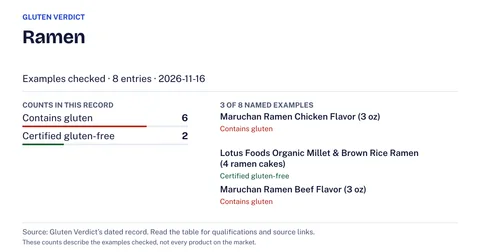 RamenContains glutenchecked Nov 16, 2026
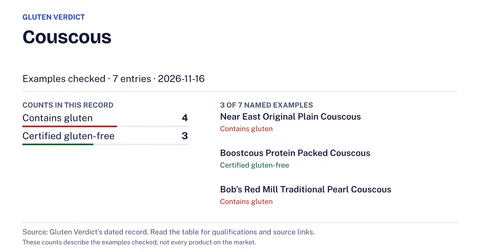 CouscousContains glutenchecked Nov 16, 2026
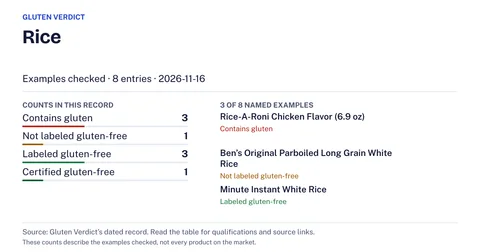 RiceNaturally gluten-free3 of 8 products we checked contain gluten: Rice-A-Roni Chicken Flavor (6.9 oz), Near East Original Rice Pilaf, and Ben’s Original Ready Rice Rice PilafBuy it labeled gluten-freechecked Nov 16, 2026
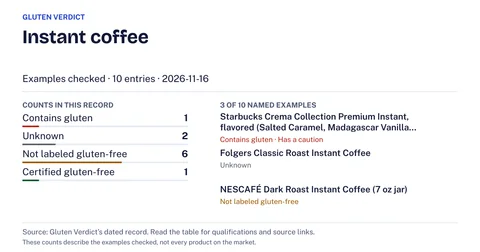 Instant coffeeDepends on the product1 of 10 products we checked contains gluten: Starbucks Crema Collection Premium Instant, flavored (Salted Caramel, Madagascar Vanilla, Molten Chocolate, Pumpkin Spice)checked Nov 16, 2026
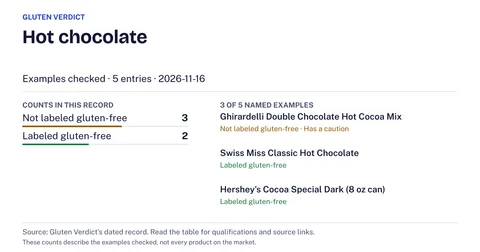 Hot chocolateDepends on the productchecked Nov 16, 2026
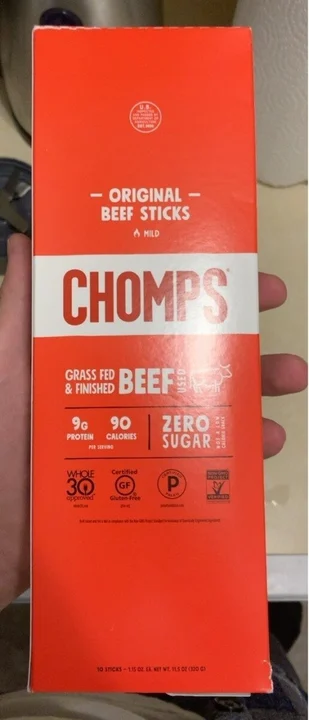 Beef jerkyDepends on the product3 of 8 products we checked contain gluten: Jack Link’s Original Beef Jerky, Jack Link’s Teriyaki Beef Jerky, and Old Trapper Teriyaki Beef Jerky (bulk)checked Nov 16, 2026
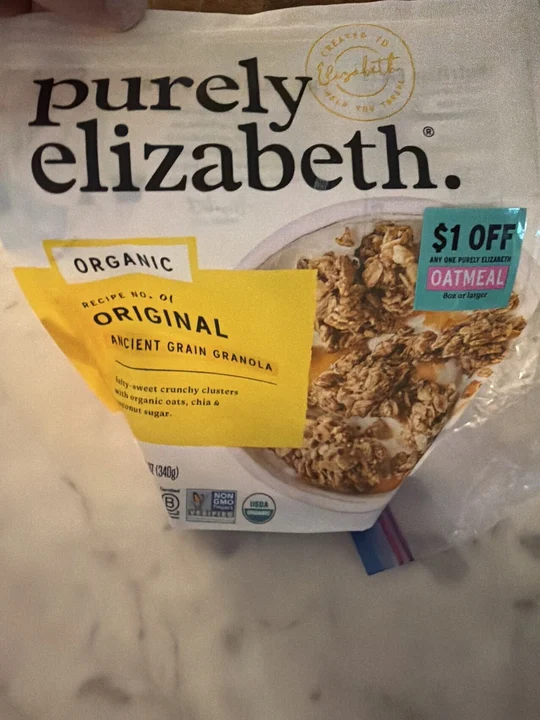 GranolaDepends on the product1 of 6 products we checked contains gluten: Honey Bunches of Oats Honey Roasted Granolachecked Nov 16, 2026
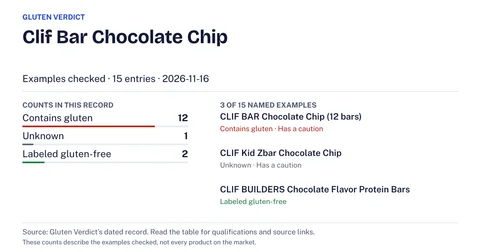 Clif Bar Chocolate ChipContains glutenClif Bar & Company · checked Nov 16, 2026
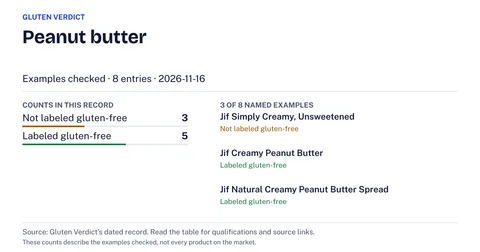 Peanut butterDepends on the productchecked Nov 16, 2026
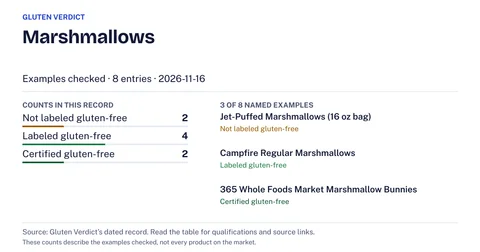 MarshmallowsDepends on the productchecked Nov 16, 2026
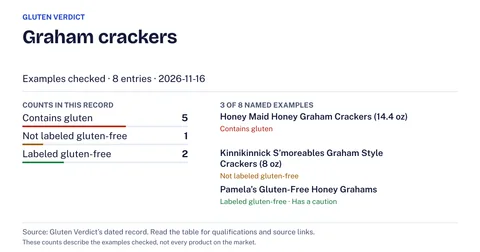 Graham crackersContains glutenchecked Nov 16, 2026
Questions people ask
Is freeze-dried food gluten-free?
Not by default. Mountain House says freeze-drying does not add gluten and that the recipe and handling are what matter39. Backpacker’s Pantry and Peak Refuel both say their meals come from facilities that handle wheat32, 12.
Do oats in trail mix or instant oatmeal count as gluten-free?
Only oats labeled gluten-free do. FDA says those must contain less than 20 ppm40, and the Celiac Disease Foundation says to look for oats specifically labeled gluten-free8. See our verdicts for oatmeal and Quaker Instant Oatmeal.
More in Travel planning and logistics
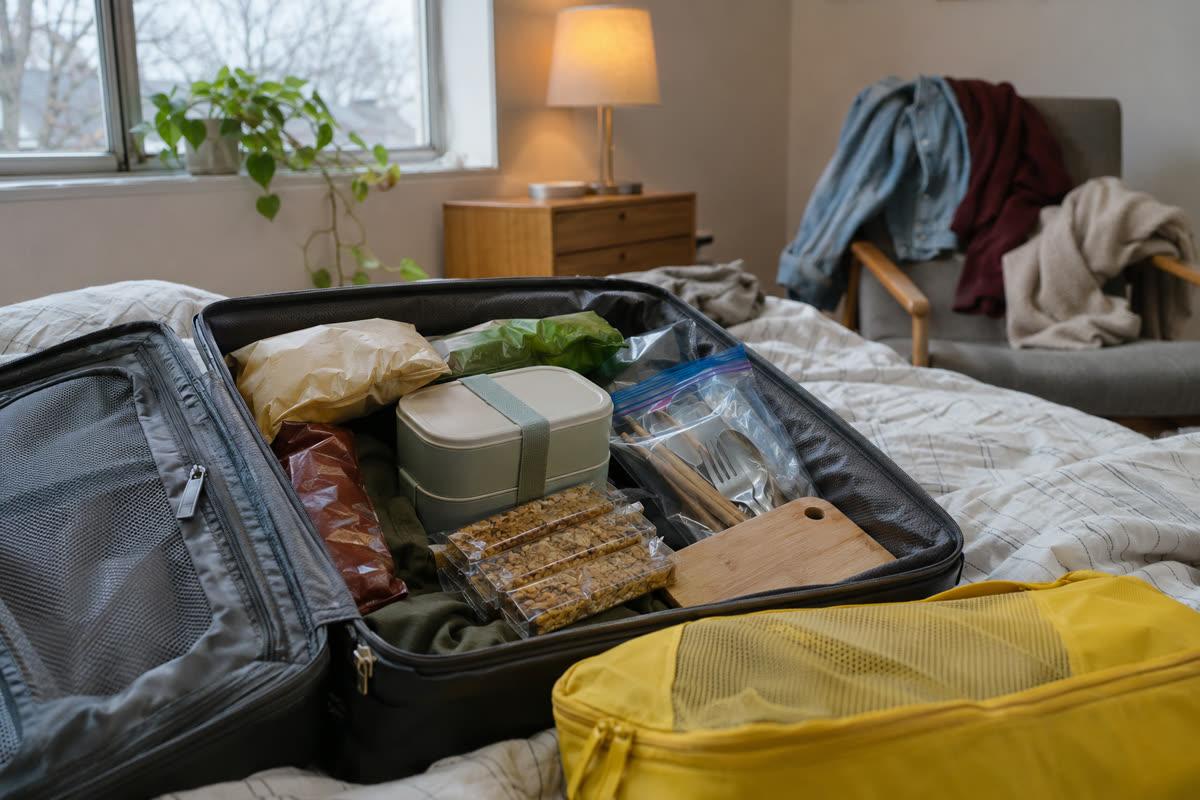 Gluten-free travel packing checklist by trip typeWhat to pack for a flight, hotel, rental kitchen or road trip, with TSA and airline limits and what sensors and enzyme pills do not show.
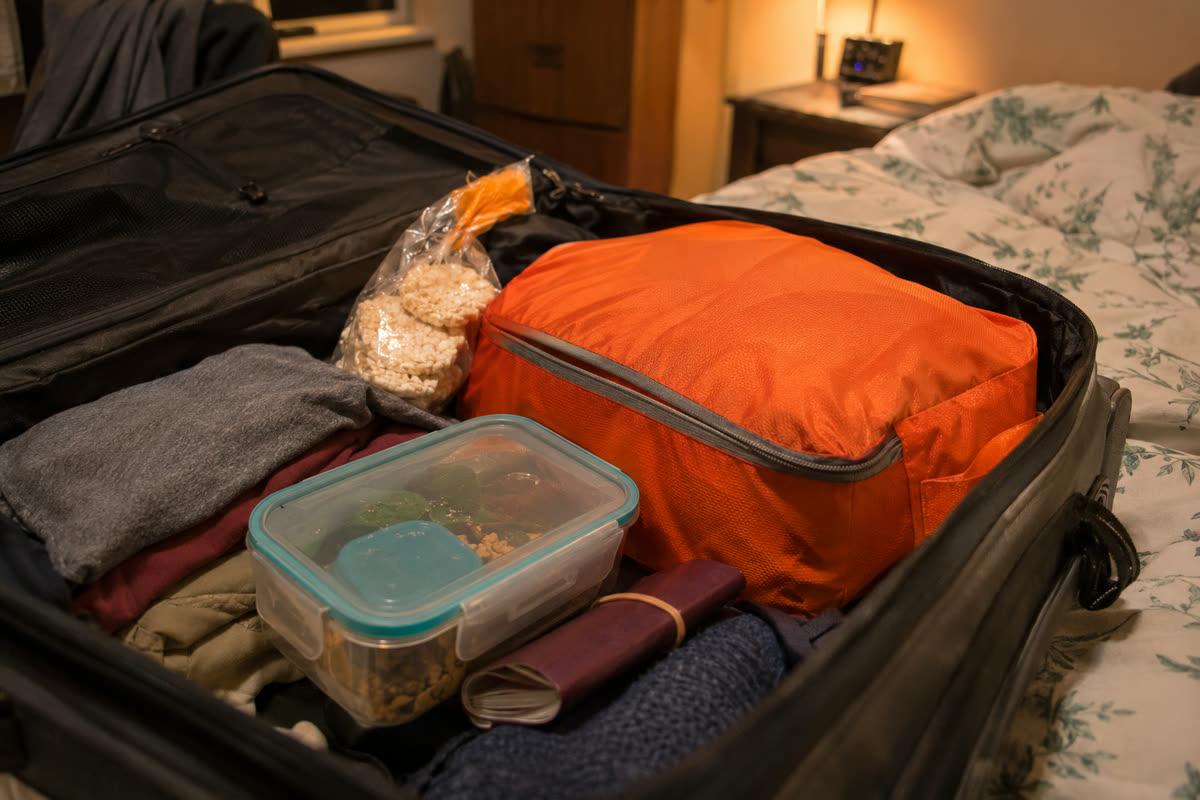 Planning a gluten-free trip: what to arrange, in orderA gluten-free trip in order: how you will eat, what to tell hotels and airlines, which cards and notes to carry, and what food to pack.
 Setting up a gluten-free kitchen in a vacation rentalAsk the host, pack the few items that hold gluten, and wash a rental kitchen with soap and water, with each step tied to a source.
 Gluten-free on a road trip: stops, snacks, cooler and hotel nightsPlan each driving day: chain stops with dated verdicts, snacks read at the gas station, a cooler packed to USDA time limits and hotel fridge questions.
 Flying gluten-free: what to arrange, pack and ask, from booking to landingA gluten-free flight in order: the airline's special-meal request, what TSA allows through the checkpoint, and the food to carry as a backup.
 Gluten-free on long-distance trains and buses: your own food, onboard menus and stopsWhat Amtrak, Greyhound and FlixBus say about your own food, gluten-free meals and stops, and how to pack for a long train or bus day.
Related guides
 Gluten-free dining at national park lodges: what to ask and what to packHow national park lodge dining works on a gluten-free diet: what each operator's own page says, what to send before you arrive, and what to pack.
 Gluten-free snack bars: reading oats and barley malt on the wrapperRead a snack-bar wrapper in four steps (gluten-free claim, malt, oats, Contains line), with a Clif and a KIND bar worked through.
 Sleepaway camp, Scouts and school trips for a gluten-free child: what to ask and what to sendWhat to ask a camp, Scout unit or school in writing, what goes on the health form, what food to send, and where gluten-free camps run.
 What “may contain wheat” and “made in a facility with wheat” mean on a US labelHow to read “may contain wheat”, shared-facility and shared-equipment lines on US labels, with and without a gluten-free claim, and what to check next.
Sources
- [1, 2, 17, 19, 22, 25, 49] USDA Food Safety and Inspection Service, Hiking, camping and boating food guidance, checked Nov 17, 2026.
Read on 2026-11-17: the list under “What Foods to Bring?” names pre-packaged, shelf-stable meals; peanut butter in plastic jars; concentrated juice boxes; canned tuna, ham, chicken, and beef; dried noodles and soups; beef jerky and other shelf-stable meats; dehydrated foods; whole or dried fruits; nuts; and powdered milk and fruit drinks.
- [3, 27, 29, 30, 31, 37, 38, 39] Mountain House, Gluten-Free Freeze-Dried Meals, checked Nov 17, 2026.
Read on 2026-11-17: the page names no allergens or ingredients handled in the plant where its meals are made.
- [4, 32] Backpacker’s Pantry, Customer Service (FAQs), checked Nov 17, 2026.
- [5, 28] Peak Refuel, Freeze Dried Meal FAQs, checked Nov 17, 2026.
Read on 2026-11-17: the FAQ answer lists the meals not containing gluten as Mountain Berry Granola, Strawberry Granola, Sweet Pork & Rice, Breakfast Skillet, Butternut Dal Bhat, Chicken Coconut Curry, Chicken Teriyaki Rice and Creamy Peaches & Oats; neither it nor the gluten-free collection page says whether the oats in Creamy Peaches & Oats are labeled gluten-free.
- [6, 7, 8, 13, 18, 26, 46, 47, 57] Celiac Disease Foundation, Sources of Gluten, checked Nov 17, 2026.
Read on 2026-11-17: the list headed “Common Foods That Contain Gluten” names, among others, couscous (under Pastas); ramen, udon, soba made with only a percentage of buckwheat flour, chow mein and egg noodles (under Noodles), with a note that rice noodles and mung bean noodles are gluten free; and graham crackers (under Crackers).
Read on 2026-11-17: the list headed “Foods That May Contain Gluten”, which the page says must be verified by reading the label or checking with the manufacturer or kitchen staff, names, among others, energy bars and granola bars, candy and candy bars, soup, pre-seasoned meats, salad dressings and marinades, and soy sauce.
- [9, 10, 16, 21, 34, 48, 50, 51] Gluten Intolerance Group, 25 Ways Cross-Contact Could Happen (And How to Avoid It), checked Nov 17, 2026.
- [11, 23, 53, 54, 55, 56] National Park Service, Storing food in bear country, checked Nov 17, 2026.
- [12, 58] Peak Refuel, Gluten Free Freeze Dried Meals (collection page), checked Nov 17, 2026.
- [14, 24] Celiac Disease Foundation, Tips for Traveling Gluten-Free, checked Nov 17, 2026.
- [15, 35, 36, 40, 42, 44, 45] US Food and Drug Administration, Questions and Answers on the Gluten-Free Food Labeling Final Rule, checked Nov 17, 2026.
- [20] Gluten Intolerance Group, Traveling Gluten-Free, checked Nov 17, 2026.
- [33] US Food and Drug Administration, Gluten and Food Labeling, checked Nov 17, 2026.
- [41, 43] Clif Bar & Company, Chocolate Chip CLIF BAR Energy Bar, checked Nov 17, 2026.
- [52] Gluten Intolerance Group, Let’s Go Camping – Gluten-Free Style!, checked Nov 17, 2026.