Sleepaway camp, Scouts and school trips for a gluten-free child: what to ask and what to send
Short answer
Put your child’s diet on the health form, then contact the camp yourself: the American Camp Association says to do both1. Do the same with a Scout leader or trip leader, and before you decide what to send, ask in writing:
- Who prepares the food, and how gluten-free meals are kept apart from the rest2, 3.
- Who on the staff, volunteers included, is told about the diet4, 5.
- Whether the camp can meet the need or the family should supply the food, which Scouting America says may be necessary6.
- What your child should do, and whom to tell, if something goes wrong7.
Part of Kids, school, college and family, 21 guides
Key points
- We group the camps the sources describe into three kinds: gluten-free for the whole session46, a regular camp with a gluten-free session or kitchen49, 50, and a regular camp that accommodates the diet9. The question list is the same for each.
- The American Camp Association tells parents to note a nutrition plan on the Health History form and also contact the camp to confirm it can address it1.
- Scouting America does not mandate and does not recommend that leaders take responsibility for managing a youth’s food allergies, so ask a leader what they will agree to10.
- The Department of Education says schools must give students with disabilities equal access to field trips11, and the Celiac Disease Foundation says you can file a 504 plan in a federally funded school to arrange accommodations for your child with celiac disease12.
- The Justice Department’s Q&A says the ADA does not require every place of public accommodation that serves food to the public to provide gluten-free food13, and a Justice Department bulletin says summer camps must make reasonable modifications unless they would fundamentally alter the camp14.
What to ask a camp before you sign up
The American Camp Association’s list of questions for choosing an overnight camp includes: “How will the camp meet my child’s special dietary or physical needs?”15 Send the question by email so the answer is in writing. FARE, the food allergy charity, tells families to give the camp written instructions16 and to make personal contact with the director, counselor or division supervisor before the camper arrives17. FARE writes about food allergy, not celiac disease, but its questions carry over to a gluten-free diet.
Questions worth putting to the camp:
- Who prepares meals and snacks: the camp’s own kitchen, a caterer, or the cabin group at a cookout?
- Where are gluten-free meals made and stored, and with which utensils and surfaces?
- How do buffets, self-serve lines and shared serving spoons work? FARE’s guidance for camp staff says a camper might need to go first in a buffet line18.
- Who is told about the diet: kitchen staff, the cabin counselor, the nurse, volunteers and the staff who run trips away from camp? FARE’s list asks how the camp communicates and tracks food allergy information19, says anyone who may offer food or plan events needs to know4, and says volunteers who come for a day or two need to understand the camp’s policy5.
- Can I see the menu and the ingredient labels ahead of time? Scouting America’s guidance tells families to review the menu with the camp20.
- What happens at the camp store, at the campfire and at birthday treats? Scouting America’s guidance notes that food can turn up at trading posts, camp stores and camp activity areas21.
- May I send my child’s food, and where will it be stored? Scouting America’s guidance says families may need to provide all of it, and to agree storage at camp and during travel6.
- What is the plan if my child is exposed to gluten? FARE lists “What limits the camp’s ability to care for your child?” among its questions22. Our guide to what to do after being glutened covers the steps afterwards.
Keep the replies. If a camp says only that it can accommodate the diet, ask what that means in practice: the Celiac Kids Connection says it remains important to ensure the camp’s gluten-free status and protocols before registering23.
The health form: what goes on the diet line
The American Camp Association’s parent handout covers this directly. If your child needs a particular nutrition plan because of allergies, intolerances or a diagnosis, note it on the Health History form and also contact the camp to make sure it has noted the need and can address it. The handout adds that you should discuss how your child will receive meals and snacks, then explain that to your camper1.
Write the diet as your child’s own clinician or care plan states it, not as this page does. If the form has an allergy box and no diet box, use the free-text line, say in plain words what your child eats and avoids, and name whom the camp should call with questions.
Some camps ask for proof of diagnosis. Celiac Camp in California says that, given limited space, it can only accommodate campers diagnosed by a physician with celiac disease or gluten intolerance24. The Celiac Disease Foundation offers a sample diagnosis letter template for physicians and describes such a letter as essential in setting up accommodations for a student25.
Camp paperwork is separate from school paperwork. FARE’s camp guide says: “Do not simply transfer school documentation; camp is different from school.”26
Medication handling varies by camp. Celiac Camp asks that essential medications be pre-sorted into a seven-day pill sorter with a printed schedule27, and Camp Celiac in Pennsylvania says two full-time registered nurses handle all non-emergency medical needs, including administering medications28. Ask for the camp’s own medication form early. What belongs on any medical line is for your child’s clinician.
The Justice Department’s ADA manual describes a private summer camp that asks parents for a questionnaire and medical documentation about their children’s ability to take part in camp activities29. It says the camp may not use that information to screen out children with disabilities30.
Kitchen questions: who cooks and how gluten-free meals are kept apart
The Gluten Intolerance Group (GIG) defines cross-contact as gluten crumbs or particles getting into gluten-free ingredients or food in amounts that could cause an adverse reaction31. Each set-up in the table is a place to ask.
| Set-up at camp | What to ask | What the sources say |
|---|---|---|
| Buffet, family-style or self-serve lines | Can my child be served first, or have a plate made by staff? | GIG says any buffet-style display of food introduces new opportunities for cross-contact32. FARE says a camper might need to go first in a buffet line18. |
| Shared serving spoons and knives in jars | Is each condiment served with a clean utensil? | GIG says one of the most common ways gluten crumbs get into gluten-free food is “double-dipping” or the use of the same serving utensil in both types of food3. |
| Food from home, or made for your child | Is there a separate shelf, bin or fridge space? | The Celiac Disease Foundation’s school recommendations say to designate space for gluten-free food storage that is separate from gluten-containing food storage2. |
| Hands before meals | Soap and water at the dining hall, or only sanitizer? | GIG says wet wipes, detergent on a wet cloth and soap and water remove food proteins, while hand sanitizer and dry towels are often found to leave residue33. The CDF recommendations include requiring children with celiac disease to wash their hands with water and soap before and after eating34. |
| Cabin cookouts and patrol cooking | Who cooks, in which pot, and with whose spoon? | Scouting America’s Cooking merit badge page notes that foods may need to be kept separate during preparation and serving35. |
| Ingredients you cannot read on a package | Can I see the package or the recipe? | GIG, writing about eating out, suggests asking to see the package of any questionable ingredient36. The same request can be put to a camp cook. |
The CDF’s recommendations are written for schools and other learning environments, and they are voluntary37. We use them here as a list of things worth asking for, not as a rule a camp must follow.
What food to send, and what to leave to the camp
Scouting America’s guidance says it may be necessary for the family to provide all food for the youth, and that the family should agree with unit and camp leadership on storage at camp and during travel, food service methods and availability6. A day camp can ask the same: the Farmer, Forester, Chef camp that the CDF listed in 2024 required campers in its gluten-free session to bring a gluten-free lunch and snacks each day38. The American Camp Association’s packing tips for overnight camps list “Food (candy, snacks)” under “Don’t Pack”87, so ask whether food from home is allowed before you pack any.
There are three ways to split the food. The camp cooks everything and has confirmed in writing how. The camp cooks most meals and you send what it cannot match, such as breakfast foods and snacks. Or you supply it all. For the middle split, the CDF recommendations suggest parents provide gluten-free snack or treat items to be stored for an unexpected activity involving food39.
For packaged foods, FDA’s gluten-free rule requires that any unavoidable presence of gluten in the food be less than 20 parts per million40. FDA’s rule does not prohibit a voluntary advisory line such as “made in a facility that also processes wheat” on a food that also carries a gluten-free claim, provided the statement is truthful and not misleading41. Our guide to reading a food label for gluten goes through the rest.
For snacks on the move, GIG describes certified gluten-free bars as a great compact option42. Brands differ, and our granola bars verdict shows how the bars we checked compare.
For campfire food, GIG’s camping post offers foil-packet meals and s’mores among its camping ideas43. Each part of a cookout needs its own label check. Our verdicts show what the products we checked say: marshmallows, hot dogs, graham crackers and hot chocolate. For pack lists and stove cooking, see gluten-free food for camping and hiking.
Gluten-free camps and camps that already serve gluten-free kids
The Celiac Disease Foundation’s post “Check Out Celiac Camps for Summer 2024” opens by saying there are gluten-free summer camps for children and teens with celiac disease44. The Celiac Kids Connection says these camps are typically sponsored by a celiac or gluten-free group rather than by the camp site, and run for one or two sessions a summer8. It advises booking early because most fill up45.
| Kind of camp | Examples the sources name | What to check |
|---|---|---|
| A gluten-free camp, where every meal and snack is gluten-free | Celiac Camp at Camp Arroyo in California says all meals and snacks will be gluten free46. Camp Celiac in Pennsylvania describes itself as a one-week camp for children with celiac disease aged 8 to 1647. | Eligibility and other allergies. Celiac Camp says it can only accommodate campers diagnosed by a physician24, and asks families whose camper has food allergies beyond dairy, nuts or soy to contact it when applying48. |
| A regular camp with a gluten-free session or kitchen | Farmer, Forester, Chef, a day camp at Powisett Farm for ages 6 to 11, reserves a session for gluten-free campers49. The Celiac Kids Connection list says NJY Camps have a dedicated gluten-free kitchen that lets campers eat gluten free in any session, at overnight camps in Milford, PA50 and Camp Eagle Hill has a separate, dedicated gluten-free kitchen space51. | Whether the arrangement covers every session or one week, and what the day camp requires you to bring38. |
| A regular camp that accommodates the diet | The Celiac Kids Connection says many great camps are not specifically gluten free but can accommodate the gluten-free diet9. | Everything in the question list above, in writing. The same list says to ensure the camp’s gluten-free status and protocols before registering23. |
Lists go out of date. The Celiac Kids Connection page ends “Originally posted February, 2017. Updated January, 2026.”52 and the Celiac Disease Foundation post we read is the one for summer 2024. Take dates, ages, fees and rules from each camp’s own page. The Celiac Kids Connection says it does not endorse the camps it lists53, and neither do we.
Scouting: campouts, cooking and shared pots
Scouting America publishes food allergy guidance, revised September 2024. It is written for food allergies, but it describes itself as a framework for planning for a participant with food allergies, sensitivities or intolerances54, so we use it here for its planning steps. Read it with that scope in mind.
- The family leads. The guidance says the responsibility for managing a medical condition lies with the individual or the individual’s parents or guardians55, and that planning should begin as soon as possible, with leaders and health care providers included56.
- Leaders opt in. Scouting America does not mandate and does not recommend that leaders take responsibility for managing a youth’s food allergies10. Ask the leader what they will agree to do.
- Every activity counts. The guidance tells families to consider all activities, such as merit badge courses, craft activities, cracker barrel and travel57.
Before a campout:
- Complete the Annual Health and Medical Record. Parts A and B are for every participant in every Scouting activity, including day camps and weekend trips under 72 hours58. A pre-participation physical is needed for long-term camps and events of more than 72 hours59.
- Meet the camp leadership, which may include the camp director, the camp health officer and the food service director60.
- Review the menu and agree alternatives with the camp20, and agree whether you supply the food and where it is stored6.
- Ask whether the camp takes part in Scouting America’s “Special Needs Prepared” program, which Scouting America says it has piloted to certify camps, and what accommodations it has for your Scout61.
For patrol cooking, the Cooking merit badge’s camp cooking page tells Scouts to ask who they are cooking for, including whether anyone has food allergies, intolerances or other dietary needs62. If your Scout cooks with a patrol, ask who prepares the gluten-free portion, in which pot and with whose spoon; the table above has the utensil and buffet questions.
School field trips: the letter, the chaperone, the bagged lunch
GIG names school field trips, along with school meals and classroom parties, among the situations where you cannot be there to help monitor what your child eats63. In a school, the Department of Education says schools must provide equal access to students with disabilities to participate in all aspects of the program, including field trips11. The Celiac Disease Foundation says you can file a 504 plan in a federally funded school to arrange accommodations for your child with celiac disease12. Our guide to the 504 plan covers the plan itself.
The letter
GIG’s School Letters page offers templates to explain a child’s restrictions to the teacher or responsible adult at school64. It lists four: one for teachers and administrators at the elementary level, one for middle and high school, one for the nurse and one for school field trips65. Each comes as a Word version to edit or a PDF to fill in with your child’s name66. For a trip, use the field trip letter, add the date, the destination and the meal plan, and send it to the trip leader and every chaperone.
The chaperone and the plan
The CDF’s recommendations define learning environments to include field trips and any school-sponsored events67. Among them:
- Make sure those responsible, including chaperones, are informed of the accommodation plan68.
- Tell the parents the plan at least one week before the activity69, and engage them in planning for off-site activities70.
- Consider inviting a parent to accompany an activity that needs an accommodation71.
- If an outside vendor provides food, notify the vendor and request a written plan covering the food, labels or ingredient lists, and the method of preparation72.
- If the school provides the food for an off-site activity, package it to prevent cross-contact and label it clearly as gluten-free73.
- Give the child unrestricted access to the bathroom and to health or counseling staff when a gluten exposure is suspected74.
These are voluntary recommendations, and the CDF says any action taken has to be consistent with local, state and federal law37. Use them as a checklist to bring to the trip leader, not as a statement of what a school must do.
The bagged lunch
For events where you know what food will be served, GIG suggests bringing your own food that is similar to what everyone else is having75. Pack a lunch that needs no heating and no sharing, label it with your child’s name, and put the spare snack in the same bag. See also school party and birthday food, youth sports snacks and tournaments and the school plan for teachers.
Private camps and the ADA: where to read
The federal law the Justice Department pages below discuss is the Americans with Disabilities Act (ADA). What follows is what Justice Department pages say. It is not legal advice, and whether a particular camp is covered is a question for the camp or a lawyer.
- Coverage. A bulletin from the Justice Department and the US Attorney’s Office for the District of New Jersey says the ADA requires summer camps, both private and those run by towns or municipalities, to provide reasonable modifications when necessary for campers with disabilities to participate fully, unless the camp can show a modification would fundamentally alter its services and activities14. The Department’s child care FAQ says child care services provided by government agencies, such as summer programs, must comply with title II76, and that activities controlled by religious organizations are not covered by title III77. That FAQ is about child care centers, so ask a church-run or temple-run camp how it applies.
- Whether celiac disease counts. The Department’s Q&A on a university agreement says some people with food allergies have a disability under the ADA, particularly those with more significant or severe responses to certain foods, and that this would include individuals with celiac disease78.
- No general duty to serve gluten-free food. The same Q&A says the ADA does not require every place of public accommodation that serves food to provide gluten-free or allergen-free food, and that the university case involved a mandatory meal program for a defined group of students13. The ADA manual says that as a general rule a public accommodation is not required to alter its inventory to carry special products, including foods that meet special dietary needs79. It also says a public accommodation must reasonably modify its policies, practices or procedures to avoid discrimination, unless that would fundamentally alter what it provides80.
- Individual assessment and cost. The bulletin says camps must evaluate each child on an individual basis81 and that parents cannot be required to pay the cost of the reasonable modifications necessary for their child to fully participate82.
Read together, these pages leave the practical question open: which modification is reasonable for a given camp. That is why the written question matters. Ask what the camp can do for your child, and if it declines, ask for the decision and the reason in writing.
What the child should be told to do
Children can carry part of the plan. These points come from camp and Scouting guidance written for food allergy and from school recommendations, so treat them as a starting list for your own conversation with your child.
- Never trade food with other campers, and never eat anything with unknown ingredients83, 84.
- Read every available label and check any questionable ingredient with a parent, guardian or knowledgeable adult unit leader85. The CDF recommendations suggest helping children, as their age and ability allow, to read and understand the labels of foods provided by others86.
- Tell the counselor, the nurse or the camp director about problems. The American Camp Association’s general advice to parents is to talk with their child about telling them about problems or things that are troublesome at camp7; it is not written about food.
- Wash hands with soap and water before eating34. GIG says hand sanitizer and dry towels are often found to leave residue behind33.
Role-play the first day: who your child tells, what they say, and what they do if the only food on offer is not theirs. If your child is exposed, our guide on what to do after being glutened covers the steps.
Verdicts in this guide
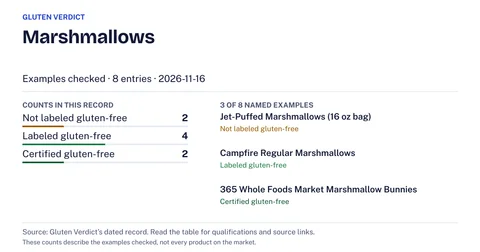 MarshmallowsDepends on the productchecked Nov 16, 2026
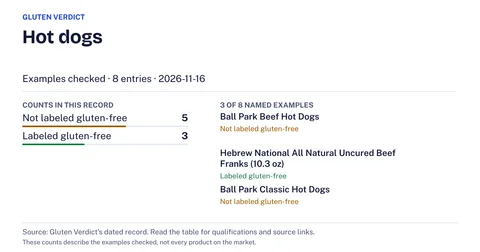 Hot dogsDepends on the productchecked Nov 16, 2026
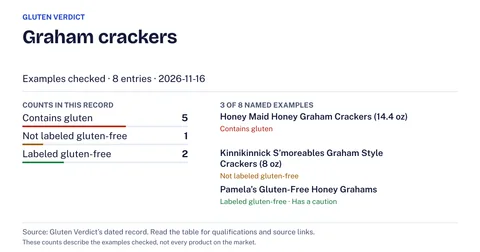 Graham crackersContains glutenchecked Nov 16, 2026
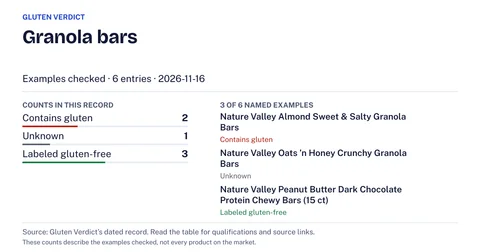 Granola barsDepends on the product2 of 6 products we checked contain gluten: Nature Valley Almond Sweet & Salty Granola Bars and Nature Valley Cinnamon Brown Sugar Soft-baked Oatmeal Squareschecked Nov 16, 2026
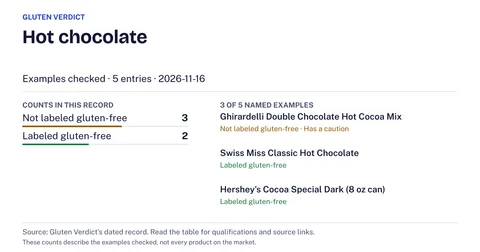 Hot chocolateDepends on the productchecked Nov 16, 2026
Questions people ask
Does a camp have to serve gluten-free food?
The Justice Department’s Q&A says the ADA does not require every place of public accommodation that serves food to provide gluten-free or allergen-free food, and notes that the university case involved a mandatory meal program for a defined group of students13. A Justice Department bulletin says summer camps must provide reasonable modifications unless they would fundamentally alter the camp’s services14. Ask the camp what it can do, and get the answer in writing.
Can my child go to a camp that is not a gluten-free camp?
The Celiac Kids Connection says many great camps are not specifically gluten free but can accommodate the gluten-free diet9. It also says to ensure the camp’s gluten-free status and protocols before registering23.
Will a Scout leader manage my child’s meals?
Scouting America does not mandate and does not recommend that leaders take responsibility for managing a youth’s food allergies10, and its guidance says that responsibility lies with the individual or the individual’s parents or guardians55. The guidance is written for food allergies.
Does “gluten-free” on a snack mean it has no gluten at all?
FDA’s rule does not say a gluten-free food has none: it says any unavoidable presence of gluten in the food must be less than 20 parts per million40.
More in Kids, school, college and family
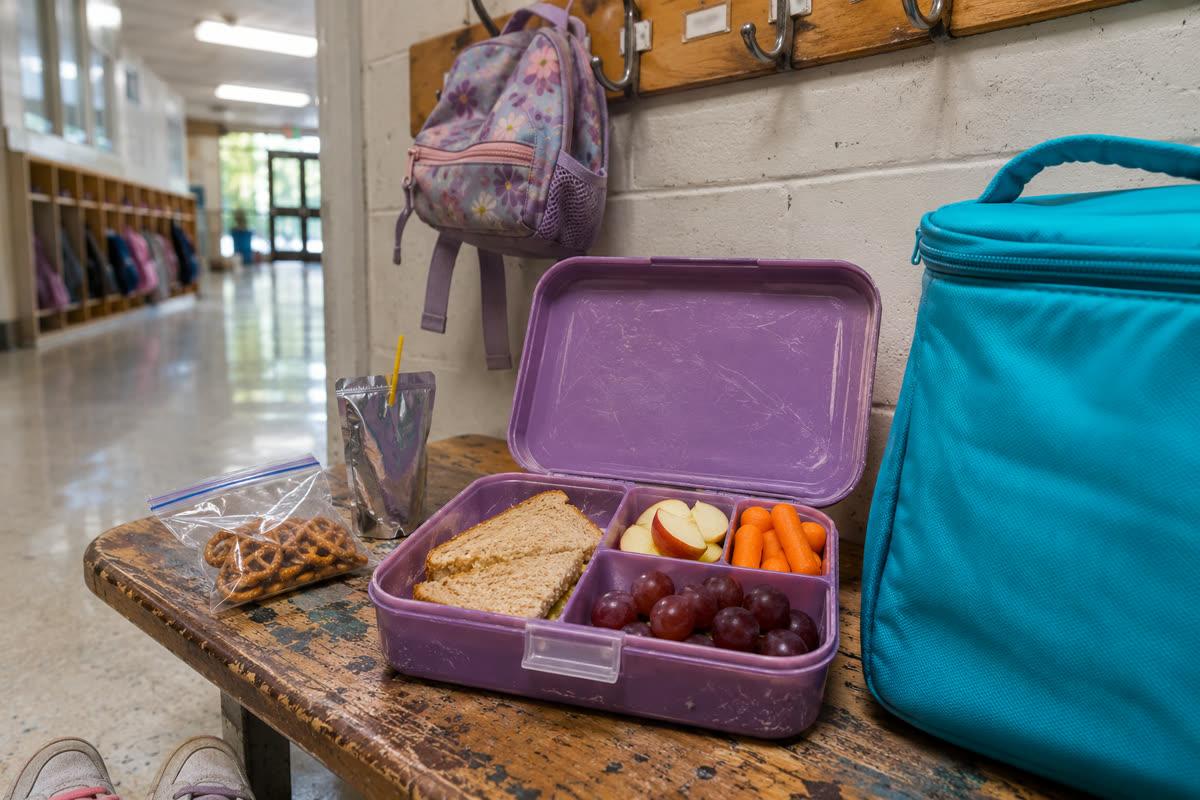 Gluten-free school lunches and classroom snacks: a checklist for parentsHow to prove each lunchbox item, read a snack label for oats, malt and wheat, brief the teacher, and when the school cafeteria is the better route.
 Why Goldfish, Cheez-It and Nutri-Grain contain gluten, and what a swap has to showSee the wheat ingredient in Goldfish, Cheez-It and Nutri-Grain in each maker's words, then check any swap against a gluten-free claim or certifier mark.
 A gluten-free kid at a birthday party: the host text, the cake knife and the snack tableA parent’s plan for a celiac child at a party or sleepover: the host text, own food, cake and snack-table cross-contact, and hand washing.
 A care sheet for the babysitter or grandparent of a child with celiac diseaseA one-page care sheet for a babysitter or grandparent: the checked foods, the kitchen cross-contact points, what to do after an exposure, and whom to call.
 Youth sports with a gluten-free kid: team snacks, the coach and tournament weekendsA parent’s plan for team snacks, sports drinks, a coach card and tournament weekends with a gluten-free child, with a source for each claim.
 Your child has celiac disease: a first-week plan for the kitchen, labels, school and talking to your childThe first week after a child’s celiac diagnosis, in order: the diet plan, first labels, kitchen, two school routes, talking to your child and follow-up.
Related guides
 Talking to your child’s teacher about celiac disease: a script, a one-page sheet and the classroom questionsA two-minute script, a one-page sheet, a template email and the classroom questions about snacks, crafts and trips, drawn from US celiac charity guidance.
 If you think you were glutened: what the celiac organizations say to doWhat the celiac charities, FDA and NIDDK say to do after accidental gluten exposure, when to contact a clinician, and how to trace the cause.
 A 504 plan and school meal rules for celiac disease: what to ask for and where to complainMeal substitution or a 504 plan for a child with celiac disease: what each rule says, what the medical statement must hold, and where to complain.
 Gluten-free food for camping and hiking: pack lists and label checksPack gluten-free camping and hiking food by trip length, check pouch meals and bars against their labels, and run a shared camp kitchen.
Sources
- [1, 7] American Camp Association, Healthy Camp: parent information (2020 update), checked Nov 17, 2026.
- [2, 34, 37, 39, 67, 68, 69, 70, 71, 72, 73, 74, 86] Celiac Disease Foundation, Managing Celiac Disease in Learning Environments (voluntary recommendations, 2020 coalition), checked Nov 17, 2026.
- [3, 31, 32, 36] Gluten Intolerance Group, 25 Ways Cross-Contact Could Happen (And How to Avoid It), checked Nov 17, 2026.
- [4, 5, 16, 17, 18, 19, 22, 26] FARE (Food Allergy Research & Education), Heading to Camp, checked Nov 17, 2026.
- [6, 10, 20, 21, 54, 55, 56, 57, 60, 83, 84, 85] Scouting America, Food Allergy Guidance (revised September 2024), checked Nov 17, 2026.
- [8, 9, 23, 45, 50, 51, 52, 53] Celiac Kids Connection (Boston Children’s Hospital), Gluten Free Summer Camps, checked Nov 17, 2026.
Read on 2026-11-17: the page lists camps under the headings California, Georgia, Massachusetts, Michigan, Minnesota, New York, Nova Scotia (Canada), Ohio, Oklahoma, Ontario (Canada), Oregon, Pennsylvania and Texas, and ends with the line “Originally posted February, 2017. Updated January, 2026.”
- [11] US Department of Education, Disability Discrimination: Equal Access to Opportunities, checked Nov 17, 2026.
- [12, 25] Celiac Disease Foundation, Resources for K-12 Students, checked Nov 17, 2026.
- [13, 78] ADA.gov archive (US Department of Justice), Questions and Answers about the Lesley University Agreement and potential implications for individuals with Food Allergies, checked Nov 17, 2026.
- [14, 81, 82] US Department of Justice and US Attorney’s Office, District of New Jersey, Summer Camps and the ADA (bulletin, May 2015), checked Nov 17, 2026.
- [15, 87] American Camp Association, How to Choose a Camp: Preparing For Camp, checked Nov 17, 2026.
Read on 2026-11-17: under “Packing Tips For Overnight Camps”, the list headed “Don't Pack” includes “Food (candy, snacks)”.
- [24, 27, 46, 48] Celiac Camp at Camp Arroyo, Celiac Camp FAQ, checked Nov 17, 2026.
- [28, 47] Camp Celiac (Pennsylvania), Camp Celiac home page, checked Nov 17, 2026.
- [29, 30, 79, 80] ADA.gov (US Department of Justice), ADA Title III Technical Assistance Manual, checked Nov 17, 2026.
- [33, 42, 75] Gluten Intolerance Group, Navigating School Parties and Community Events this Fall, checked Nov 17, 2026.
- [35] Scouting America, Cooking merit badge, requirement 1D: food-related health concerns, checked Nov 17, 2026.
- [38, 44, 49] Celiac Disease Foundation, Check Out Celiac Camps for Summer 2024, checked Nov 17, 2026.
- [40, 41] US Food and Drug Administration, Questions and Answers on the Gluten-Free Food Labeling Final Rule, checked Nov 17, 2026.
- [43] Gluten Intolerance Group, Let’s Go Camping – Gluten-Free Style!, checked Nov 17, 2026.
- [58, 59] Scouting America, Medical Information and First Aid, checked Nov 17, 2026.
- [61] Scouting America, Special Needs & Disabilities, checked Nov 17, 2026.
- [62] Scouting America, Cooking merit badge, requirement 5: Camp Cooking, checked Nov 17, 2026.
- [63, 64, 65, 66] Gluten Intolerance Group, School Letters, checked Nov 17, 2026.
Read on 2026-11-17: the list headed “The letters included here are:” names a school letter to teacher and administrators for elementary school, one for middle and high school, one for the nurse and one for a school field trip, each as a Word version and a PDF version.
- [76, 77] ADA.gov (US Department of Justice), Commonly Asked Questions about Child Care Centers and the Americans with Disabilities Act, checked Nov 17, 2026.