Gluten-free food at the airport: what to check first and what to ask at the counter
Short answer
At an airport counter, work through four steps, and treat your own bag as the fallback:
- Open the chain’s own allergen page on your phone, remembering that a chain can say its nutrition values may vary by location27.
- Ask the counter about the fryer, the cooking surface and the sauces, the places Gluten Intolerance Group (GIG) points to18, 19, 22.
- For a sealed package, look for a “gluten-free” claim: FDA’s rule covers packaged foods and means less than 20 parts per million of gluten4, 6.
- If staff hesitate to check ingredient labels on packaged sauces or mixes, or confirm that gluten-free food shares cooking oil or grill space with heavily breaded items, GIG says to consider eating elsewhere or sticking strictly to pre-packaged or pre-verified items20, 36. In a terminal, that can mean eating what you packed.
Part of Travel planning and logistics, 22 guides
Key points
- GIG says many airport restaurants do not offer gluten-free menu options, and that fast food and quick-service restaurants may have little time to thoroughly check ingredients10, 13.
- FDA says its gluten-free regulation applies to packaged foods; for unpackaged food such as restaurant food, it says it monitors reported information and shares complaints with state and local partners4.
- The two airport dining pages we read said little or nothing about how kitchens work, so treat an operator’s page as a pointer to where to ask32, 34.
- TSA allows solid food in carry-on bags; liquid or gel food over 3.4 oz is not allowed in a carry-on1.
Why an airport counter is a hard place to check
GIG’s travel bulletin says many airport restaurants do not offer gluten-free menu options10. Its restaurant tips add that fast food and quick-service restaurants may have little time to thoroughly check ingredients13, and that fast-food establishments are less likely to be able to make appropriate adjustments, with cross-contact a possible issue14.
One study analyzed results from a portable gluten test, the Nima device, shared by users across the United States8. It found gluten detected in 32% of foods labeled gluten-free at restaurants7. The authors note that the device may detect gluten below 20 parts per million, which could mean an exposure of unknown clinical significance, and they call their findings a potential concern9. It is one study of users who chose to share their results8, and the abstract we read does not mention airports.
What the airport’s page and the chain’s page can tell you
Open both before you reach the terminal. They answer different questions, and neither replaces asking.
The airport operator’s dining page
Treat an operator’s page as a pointer to what is in the terminal. The two we read said little or nothing about how a kitchen works32, 34. JFK’s dining page says its dining options “cover a range of dietary needs and preferences”33, but on the day we read it the page named no gluten-free item, menu or kitchen practice34. SFO’s grab-and-go page for Terminal 2 lists a market with “vegan and gluten-free options”31; the page does not describe how those items are prepared or kept apart from other food32.
Read a line like that as a pointer to where to ask, not as an answer.
The chain’s own allergen page
Chains such as Chipotle, Sweetgreen and Buffalo Wild Wings publish allergen information for their own menus24, 26, 28, which you can read on a phone while you stand in line. Chipotle’s page says that a customer who is highly sensitive to gluten and wants gloves changed should say so at the start of the order24, and that items containing corn, including chips, may have trace amounts of gluten from potentially co-mingling with gluten-containing grains in the field25. Buffalo Wild Wings’ guide says it cannot eliminate the risk of cross-contact and that no items are certified gluten-free28.
These pages are written for the chain as a whole. Sweetgreen sends you to a location chooser26 and says its nutrition values may vary by location27. Buffalo Wild Wings marks some items “at select locations”30 and suggests checking its guide each time you dine29. Whether the counter in your terminal follows the page is a question for that counter.
The questions to ask at the counter, in order
A busy counter answers short, specific questions best. GIG’s question lists (the 2026 one written for caregivers ordering for a child) point at the same few places where gluten reaches an order: the oil, the cooking surface and the sauces18, 19, 22. Ask in this order and stop when you hear a refusal or a shared-oil answer.
- Say it in one sentence, then ask. The NIDDK’s advice for eating out is to ask about ingredients, how food is prepared and whether a gluten-free menu is available, and to ask to talk with the chef for more detail23.
- The fryer: GIG’s question is whether the fries are “cooked in a dedicated fryer” or whether they “share oil with breaded items”18.
- The surface: GIG suggests asking whether the item is cooked on a clean section of the grill or flat-top, separate from breaded foods19. Its FAQ adds that if a grill is shared, you can ask how it is cleaned and how often21. GIG’s tips also say to ask for food prepared on a clean surface with clean utensils16.
- The sauces: GIG asks whether a sauce is certified gluten-free and, if it is made in-house, whether staff know if it contains gluten. It notes that Worcestershire-type sauces and soy sauce could contain gluten22.
Timing helps when you can choose it. GIG’s tips say to time a meal before or after the busiest mealtime, when you will have more time and easier access to the people who can help15. In a terminal you often cannot choose; when you can, that is the moment to ask.
Grab-and-go and sealed packages
FDA’s gluten-free rule is about packaged foods. FDA says its gluten-free regulation applies to packaged foods, and that for unpackaged food, such as food served in restaurants, it will monitor reported information and pass complaints to state and local partners4. A food that carries “gluten-free”, “no gluten”, “free of gluten” or “without gluten” must contain less than 20 parts per million of gluten6.
FDA also says packaged foods may be sold in some retail and food-service establishments, such as some carry-out restaurants, and recommends that a restaurant making a gluten-free claim on its menu be consistent with FDA’s definition5. That is a recommendation, not the rule. So a labeled package is read as a package, and made-to-order food gets the questions above. For the label itself, see how to read a food label for gluten, or paste the ingredients into our gluten scanner.
Chain verdicts we have already written
Our verdicts for these chains cite the chain’s own pages and give the date we read them. Each one is about the chain’s pages, not about the kitchen at a particular airport location, so use it for the chain’s ordering information and then ask the counter.
- Chipotle
- Panera
- Five Guys
- Sweetgreen
- Tim Hortons
- Wendy’s
- Buffalo Wild Wings
- Burger King fries
- Starbucks egg bites
- Starbucks Pink Drink
The full list is on the restaurants page.
A short layover and a long one
Short layover
With little time, the questions compete with the line and the boarding clock. GIG’s travel bulletin recommends packing gluten-free snacks and even meals from home, which it says can save time, money and stress when the unexpected occurs11. A short layover is when the bag does the work.
Long layover
With time, open the chain’s page first, then pick a counter that is not in its rush and ask the questions in order. GIG says to allow extra time to discuss your needs when ordering17. If the first counter will not check a label, you have time to try another.
Food you carry through security
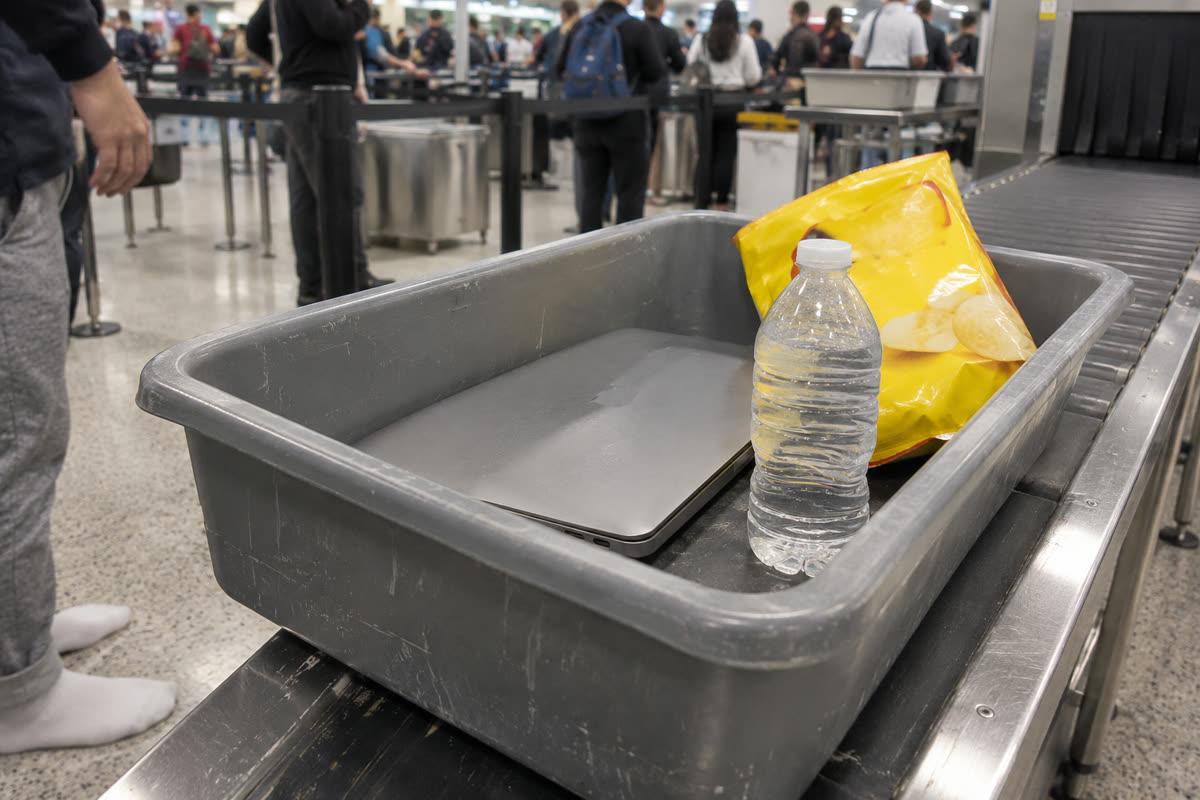
TSA says solid food items, meaning not liquids or gels, can go in carry-on or checked bags, and that liquid or gel food items larger than 3.4 oz are not allowed in carry-on bags1. Liquids, gels and pastes in containers of 3.4 ounces (100 milliliters) or less fit in one quart-sized bag3. Officers may ask you to separate foods from the rest of your bag for the X-ray2.
GIG’s travel bulletin puts it simply: for ultimate ease, pack dry snacks35. Its 2026 article suggests carrying small, compact, shelf-stable snacks at all times12. Special meals, the rest of TSA’s food list and international legs are in our guide to flying gluten-free.
When to stop asking and eat your own food
GIG lists signs that should make you consider eating elsewhere or sticking strictly to pre-packaged or pre-verified items. Two of them: kitchen staff refusing or hesitating to check ingredient labels on packaged sauces or mixes, and confirmation that gluten-free foods share cooking oil or grill space with heavily breaded items20, 36. GIG wrote that list for caregivers ordering for a child.
At a terminal, “elsewhere” may be one more counter with the same answers, which is why the snacks in your bag matter. For the restaurant questions beyond airports, see our guides on eating out with celiac disease and where gluten hides in restaurant kitchens.
Verdicts in this guide
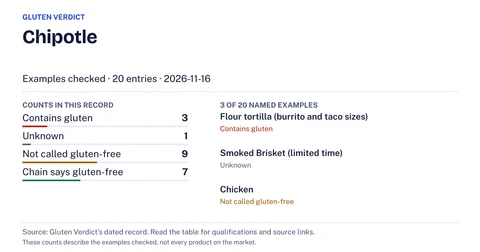 ChipotleDepends on the order3 of 20 menu items we checked contain gluten: Flour tortilla (burrito and taco sizes), Burrito, and QuesadillaChipotle Mexican Grill · checked Nov 16, 2026
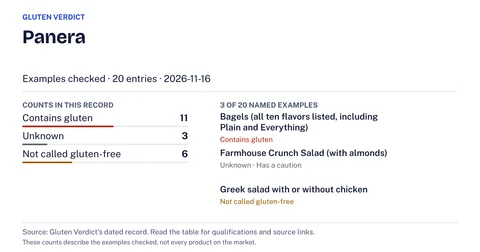 PaneraDepends on the order11 of 20 menu items we checked contain glutenPanera Bread · checked Nov 16, 2026
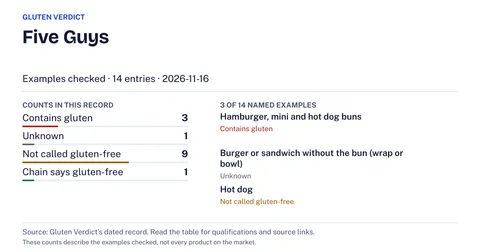 Five GuysDepends on the order3 of 14 menu items we checked contain gluten: Hamburger, mini and hot dog buns; Malt vinegar (fry condiment); and Oreo® Cookie Pieces shake mix-inFive Guys · checked Nov 16, 2026
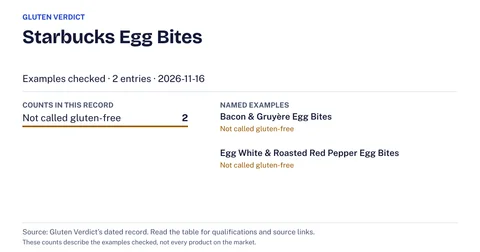 Starbucks Egg BitesNot called gluten-freeStarbucks · checked Nov 16, 2026
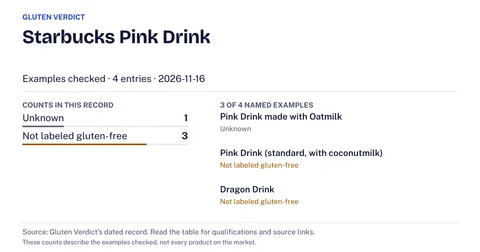 Starbucks Pink DrinkNot labeled gluten-freeStarbucks · checked Nov 16, 2026
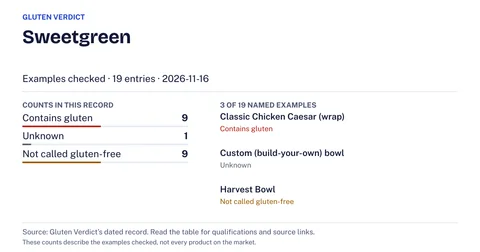 SweetgreenDepends on the order9 of 19 menu items we checked contain glutenSweetgreen · checked Nov 16, 2026
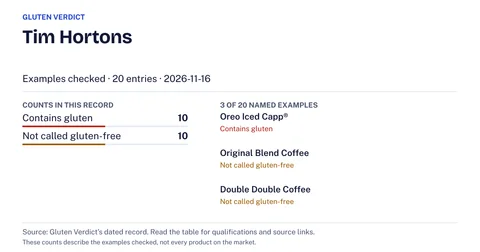 Tim HortonsDepends on the order10 of 20 menu items we checked contain glutenTim Hortons · checked Nov 16, 2026
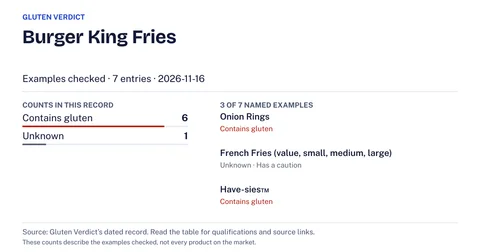 Burger King FriesUnknown6 of 7 menu items we checked contain glutenBurger King · checked Nov 16, 2026
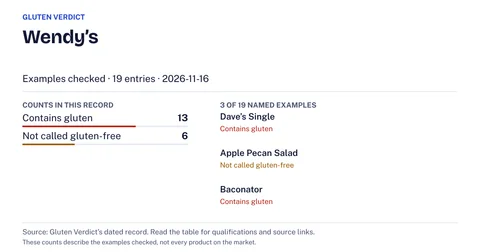 Wendy’sDepends on the order13 of 19 menu items we checked contain glutenWendy’s · checked Nov 16, 2026
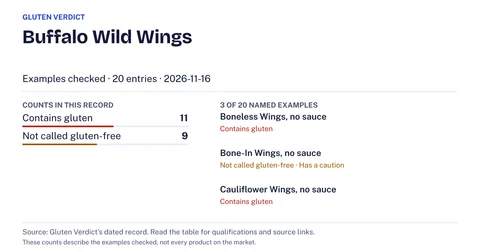 Buffalo Wild WingsDepends on the order11 of 20 menu items we checked contain glutenBuffalo Wild Wings · checked Nov 16, 2026
Questions people ask
Can I bring my own gluten-free food through airport security?
TSA says solid food items can go in carry-on or checked bags, while liquid or gel food items larger than 3.4 oz are not allowed in carry-on bags1.
More in Travel planning and logistics
 Flying gluten-free: what to arrange, pack and ask, from booking to landingA gluten-free flight in order: the airline's special-meal request, what TSA allows through the checkpoint, and the food to carry as a backup.
 Planning a gluten-free trip: what to arrange, in orderA gluten-free trip in order: how you will eat, what to tell hotels and airlines, which cards and notes to carry, and what food to pack.
 Gluten-free on a road trip: stops, snacks, cooler and hotel nightsPlan each driving day: chain stops with dated verdicts, snacks read at the gas station, a cooler packed to USDA time limits and hotel fridge questions.
 How to judge a city for celiac disease: three signals you can checkSize up any US city for celiac disease with three checks: a hospital celiac program, the state’s restaurant allergy law and validated restaurants.
 Gluten-free food through TSA security: what carries on and what goes in a checked bagWhich gluten-free foods go in a carry-on or checked bag under TSA’s own pages, and how the 3.4-ounce liquid limit applies to spreads, soups and dips.
 Traveling with a gluten-free child: TSA’s rules for children’s food and what to packWhat TSA says about a child’s food and screening, how to pack the snack bag, and how to brief the adults who will feed a gluten-free child.
Related guides
 Eating out with celiac disease: what to check, ask and watch forPlan a restaurant meal with celiac disease: what to check before you go, the questions to ask in order, how to read the answers, and what studies measured.
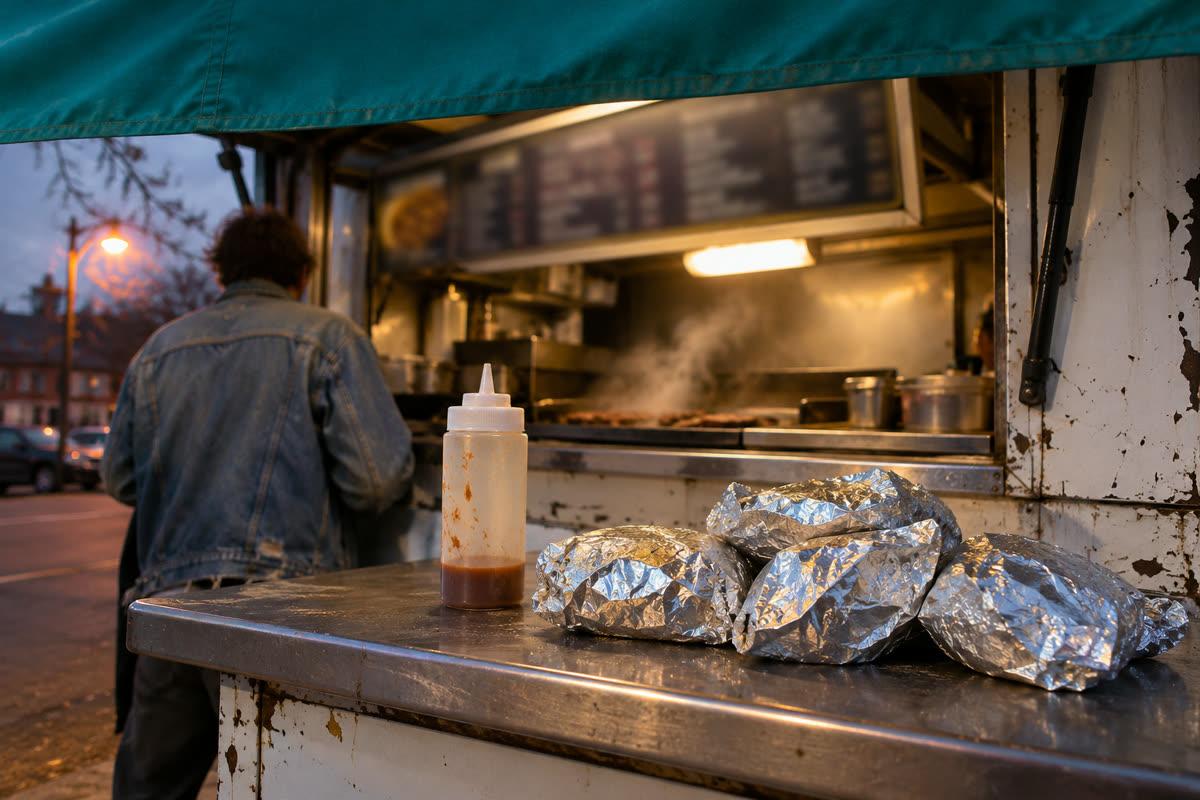 Buffets, food courts and food trucks with celiac disease: what to ask at eachHow to decide whether a buffet, food court counter or food truck is workable with celiac disease, what to ask at each stop, and what to order.
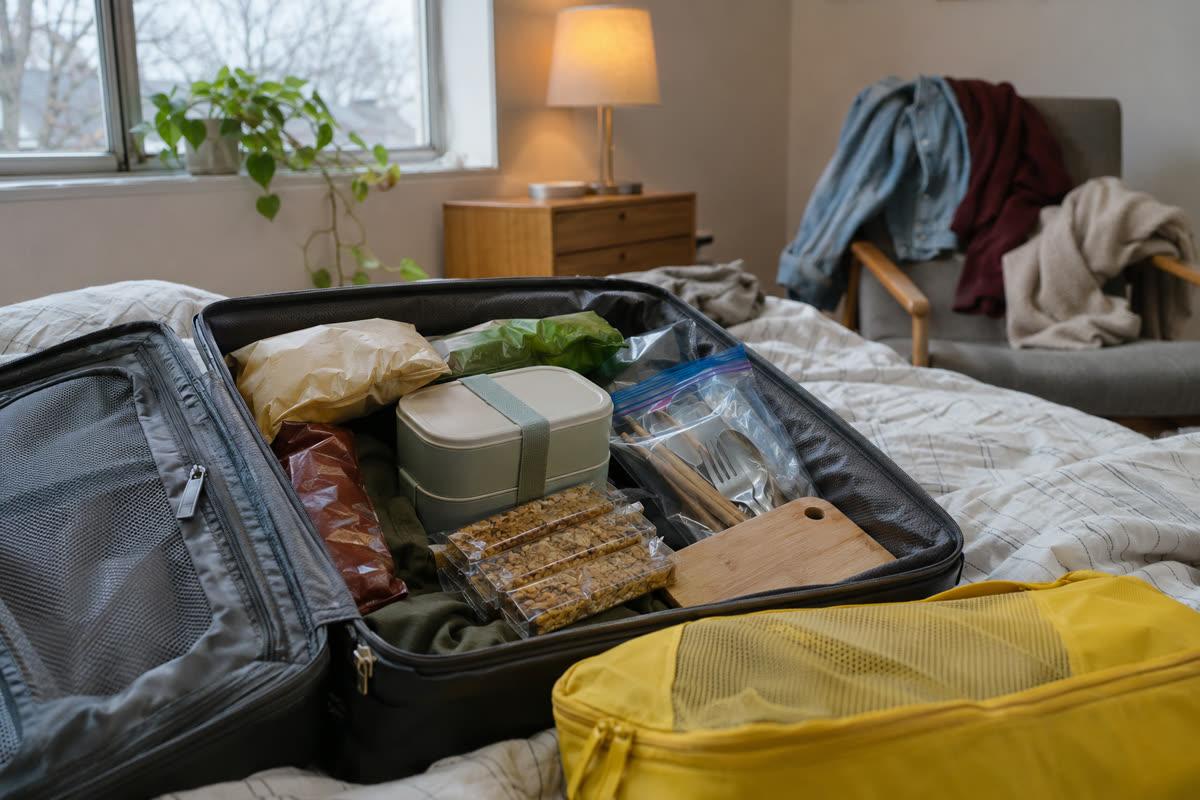 Gluten-free travel packing checklist by trip typeWhat to pack for a flight, hotel, rental kitchen or road trip, with TSA and airline limits and what sensors and enzyme pills do not show.
 What fast-food chains say about shared fryers, and what a shared-fryer study measuredEach chain's own sentence on fryer oil, with its document and date, plus what a 2026 study measured in fries and chips from shared fryers.
Sources
- [1, 2] Transportation Security Administration, What Can I Bring? Food, checked Nov 17, 2026.
- [3] Transportation Security Administration, Liquids, Aerosols, and Gels Rule, checked Nov 17, 2026.
- [4, 5] US Food and Drug Administration, Questions and Answers on the Gluten-Free Food Labeling Final Rule, checked Nov 17, 2026.
- [6] US Food and Drug Administration, Gluten and Food Labeling, checked Nov 17, 2026.
- [7, 8, 9] PubMed (American Journal of Gastroenterology), Detection of Gluten in Gluten-Free Labeled Restaurant Food: Analysis of Crowd-Sourced Data, checked Nov 17, 2026.
- [10, 11, 35] Gluten Intolerance Group (GIG), Traveling Gluten-Free, checked Nov 17, 2026.
- [12] Gluten Intolerance Group (GIG), Traveling Gluten-Free with Confidence, checked Nov 17, 2026.
- [13, 14, 15, 16, 17] Gluten Intolerance Group (GIG), Eating Out: 7 Tips For Staying Gluten-Free, checked Nov 17, 2026.
- [18, 19, 20, 36] Gluten Intolerance Group (GIG), Questions to Ask When Eating Out, checked Nov 17, 2026.
- [21, 22] Gluten Intolerance Group (GIG), Questions to ask the wait staff or management of a food service or restaurant, checked Nov 17, 2026.
- [23] National Institute of Diabetes and Digestive and Kidney Diseases (NIDDK), Eating, Diet, & Nutrition for Celiac Disease, checked Nov 17, 2026.
- [24, 25] Chipotle, Allergens, checked Nov 17, 2026.
- [26] Sweetgreen, Nutrition guide, checked Nov 17, 2026.
- [27] Sweetgreen, Nutrition guide, Bentonville location, checked Nov 17, 2026.
- [28, 29, 30] Buffalo Wild Wings, Allergen & Preparation Guide (PDF), checked Nov 17, 2026.
- [31, 32] San Francisco International Airport (SFO), What Are My Grab-and-Go Dining Options in Terminal 2?, checked Nov 17, 2026.
Read on 2026-11-17: the page lists grab-and-go places near the Terminal 2 gates; the entry for Napa Farms Market mentions gluten-free options, and no sentence on the page describes a fryer, a shared surface, cross-contact or how gluten-free items are prepared.
- [33, 34] John F. Kennedy International Airport (JFK), Port Authority of New York and New Jersey, Dine, Shop and Relax, checked Nov 17, 2026.
Read on 2026-11-17: the page names no gluten-free item, menu or kitchen practice; its only dietary statement is the sentence beginning “From quick bites to sit-down meals”.