State restaurant allergy laws: what eight states’ laws say, and what they leave out for barley and rye
Short answer
Of the eight states we read, only California (chains of 20 or more, since July 1, 2026) and Virginia (since September 10, 2026) require restaurants to put allergens in writing for menu items3, 10, 11. Massachusetts, Rhode Island, New York, Maryland and Illinois ask for a poster, a menu line or a trained manager instead23, 31, 17, 35, 37. Every list we read names wheat and none names barley or rye1, 4.
Part of Travel planning and logistics, 22 guides
Key points
- Of the eight, only California (chains of 20 or more locations) and Virginia (food establishments) require written allergen information for menu items7, 11.
- Poster, menu-line and manager-training rules tell staff and diners to talk to each other; they do not by themselves require a restaurant to list allergens35, 24, 17, 37.
- Wheat is on every allergen list we read, barley and rye on none, and gluten comes from all three grains1, 2.
- The Michigan poster and manager-training sections we read apply only until December 31, 202044, 45.
- We read eight states; a state missing from the table is a state we did not read.
What these laws say about wheat, barley and rye
Every state source we read that lists allergens names the same nine foods as FDA’s list: milk, eggs, fish, crustacean shellfish, tree nuts, peanuts, wheat, soybeans and sesame1, 4, 13, 28, 21, 36, 39. Wheat is on that list. Barley and rye are not1.
Gluten comes from all three grains: FDA says it occurs naturally in wheat, rye, barley and crossbreeds of these grains2. So an allergen rule written around the nine-food list reaches the wheat in a dish and does not name barley malt or rye flour. That is our reading of the two lists, not a statement any of these agencies makes.
The practical result for a gluten-free diner: read each law below as a rule about wheat and the other eight foods. Any help with barley and rye depends on what the staff know, not on the wording of the rule. Our guide to the Contains line covers the same gap on packaged food.
State by state, as we read each law on 2026-11-17
Eight states. Each row comes from the statute or the state agency’s own page, with the passage quoted in the source list.
| State | What the state’s source requires | Who it covers | Wheat on the state’s list? |
|---|---|---|---|
| California | From July 1, 2026, written notice of the major food allergens the restaurant knows or reasonably should know are ingredients in each menu item, on the menu or in digital form with a written alternative3, 5 | Restaurants in a chain of 20 or more locations under the same name7; not compact mobile food operations or nonpermanent food facilities6; menu items sold for fewer than 60 days a year or fewer than 90 consecutive days to test consumer acceptance are exempt, says CDPH8 | Yes; barley and rye are not listed4 |
| Virginia | From September 10, 2026, written notice of major food allergens: VDH says in packaged or unpackaged food, while the rule text we read says unpackaged food items; words, icons or numbers with a legend, a handout, or a QR code to written information9, 10, 11, 12 | Food establishments; the permit holder must notify consumers9 | Yes; barley and rye are not listed13 |
| New York | A staff allergy notice posted where food workers can see it, and a menu that carries one of three things: “If you have a food allergy or intolerance, please notify us.”; allergen information for each prepared item; or a statement that allergen information is available16, 17, 20 | Restaurants and catering halls15; the health department says the menu rules apply to all food service establishment types, including temporary and mobile ones19 | Yes; barley and rye are not listed21 |
| Massachusetts | A state-approved poster in the employee work area, a notice on printed menus and menu boards, and a certified food protection manager on staff with an allergen awareness certificate23, 24, 25 | Establishments that cook, prepare or serve food intended for immediate consumption; those that do not are exempt29, as are non-profit temporary food establishments50; the FAQ lists other exemptions we do not summarize | Yes; barley and rye are not listed28 |
| Rhode Island | A state-approved poster in the staff area, a menu notice about the customer’s duty to tell the server, and a designated manager who is knowledgeable about food allergies30, 31, 32 | Every food-service establishment33 | The section lists no allergens34 |
| Maryland | A food allergy awareness poster in the staff area, since March 1, 201435 | A food establishment35 | Yes; barley and rye are not listed36 |
| Illinois | Allergen awareness training for certified food service sanitation managers within 30 days of employment and every 3 years, with a gluten topic in the training; the section’s latest amendment took effect 1-1-2637, 38, 40 | Restaurants37; IDPH says Category I (high risk) restaurants, not Category II or III, and not multi-state businesses or franchisees that follow an approved training program; food handlers without manager certification are not required to have the training42, 41 | Yes; barley and rye are not listed39 |
| Michigan | The poster section and the manager allergen-training subsection we read apply only until December 31, 202044, 45 | Not applicable now | Not applicable now |
Massachusetts’s health department says that in 2009 it became the first state to mandate comprehensive food allergen awareness requirements for retail food establishments27.
A row says what the source we fetched says, not that every restaurant complies. Laws change: California’s notice rule began on July 1, 2026 and Virginia’s on September 10, 20263, 10.
Four kinds of rule, by what each puts in front of the diner
- Written allergen notice for menu items (California for chains of 20 or more, Virginia for food establishments). The restaurant has to put the listed allergens in writing, so the diner can read them without asking3, 11.
- A menu line (New York, Massachusetts, Rhode Island). The menu invites or tells the diner to speak up; New York lets a restaurant use the one-line request in place of item-level information17, 24, 31.
- A staff poster (Maryland, and also Massachusetts, Rhode Island and New York). It hangs in the staff area, so it is aimed at employees, not diners35, 23, 30, 16.
- Manager training (Illinois, Massachusetts, and a designated manager in Rhode Island). It sets who in the building has had allergen training, and Illinois now lists a gluten topic in that training37, 38, 25, 32.
The Celiac Disease Foundation describes Illinois’s 2026 change as adding gluten-related topics to existing manager training, with no new statewide gluten-free training requirement for all staff43.
New York’s health department also says restaurants that package food before an order, for customers to pick up themselves, must label it with any major allergens it contains22. The statute sets a civil penalty of up to $125 for each violation18.
What a law does not cover
- Barley and rye. They are not on the lists above1, 4, 13, 28, 21, 36, 39. A California notice covers allergens the restaurant knows or reasonably should know are ingredients, from the list the law defines3, 4. Our verdicts cover ingredients where barley or wheat can enter a dish: barley, malt extract, beer and soy sauce.
- May-contain wording. Virginia’s health department says retail food establishments are not required to pass on a supplier’s may-contain label, because it flags possible unintended cross-contact rather than an ingredient14.
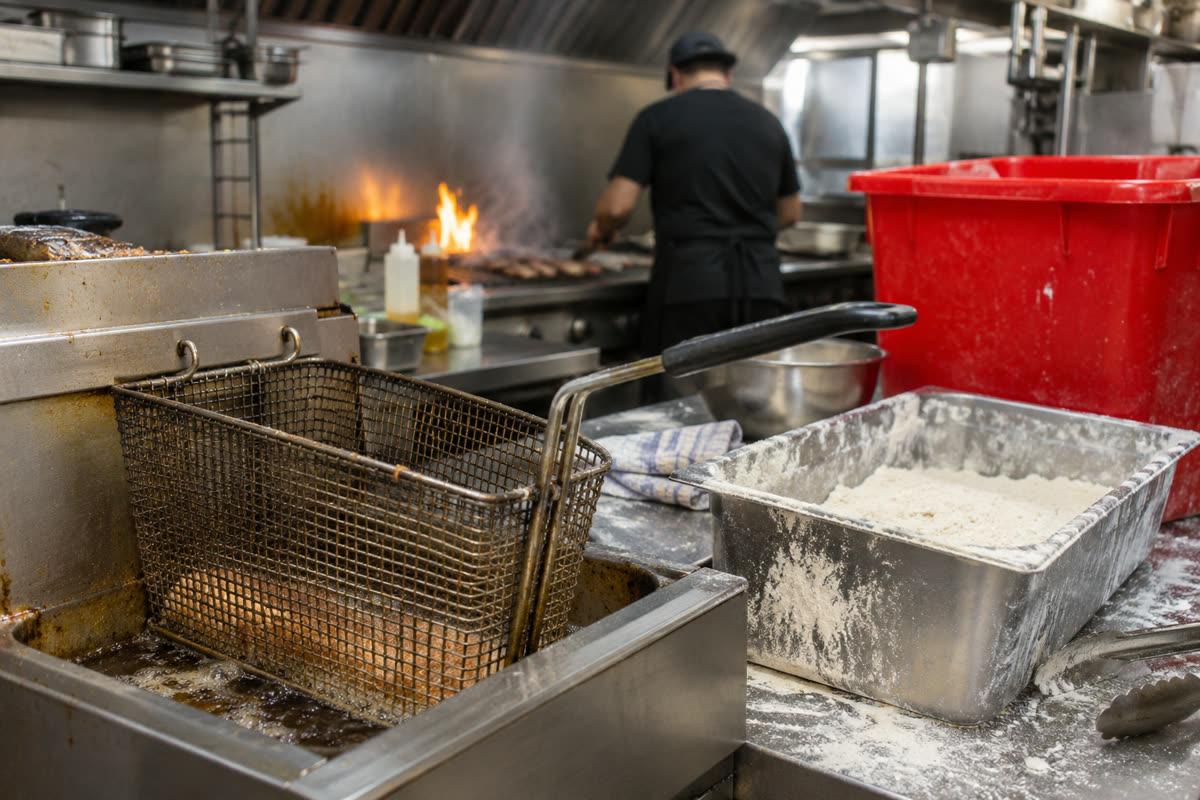
- Cross-contact in the kitchen. Massachusetts’s guidance says sanitizing alone does not fully eliminate contamination by food allergens26. The notice and poster rules above are about telling and training; none we read promises a clean fryer or a separate prep area.
- No promise about any dish. One study of crowd-sourced results from a portable gluten-detection device found gluten in 32% of restaurant foods labeled gluten-free48. The authors say the device may detect gluten at levels below 20 parts per million, which would mean exposure of unknown clinical significance49. The study does not test any law; it is one reason to read a notice rule as a rule about telling, not a promise about a plate.
For the questions that fill the gap, see where gluten hides in a restaurant kitchen and how to read a restaurant allergen chart for gluten.
States not in the table, and how to check one
We read eight states. The other 42, and cities and counties, may have rules we did not read, so a state’s absence here is not evidence it has none.
FARE says state and local governments adopt the FDA Food Code at different rates, so some places may still use an older edition47, and that the 2022 edition requires a person in charge to demonstrate knowledge of the major food allergens and the symptoms of a food allergy reaction46. Whether a state or county enforces that edition depends on its own adoption.
To check a state, search the health department’s food program page for “allergen” and read the statute it cites. If a restaurant is in a city or county with its own health department, ask that office which rules apply. Look at the date on the page; the California and Virginia rules above took effect in 2026.
What this changes on a trip
- In California (chain restaurants) and Virginia (food establishments), ask for the written allergen list. Check it for wheat, then ask the server about barley, rye and malt: the lists in those two states name wheat and not barley or rye4, 13.
- In New York, Massachusetts and Rhode Island, treat the menu line as an invitation to tell the server early, and say “gluten” along with the grain names.
- In Maryland the law asks for a staff poster35, and the Michigan sections we read stop at the end of 202044, so the question to the manager does the work. In Illinois, ask whether the manager on duty has done the allergen training.
- In any state, ask about shared fryers, grills and pasta water; no rule above settles them. Our guide to eating out with celiac disease lists the questions.
How we read each statute
For each state we fetched the statute or administrative rule where we cite one, and the state agency’s page where one exists, on 2026-11-17. For Massachusetts we read the health department’s guidance and FAQ, not the text of 105 CMR 590 itself. The table repeats what those pages say; the quotes in the source list are verbatim. We did not read pending bills, city and county rules, or the New York statute behind the packaged-food rule (we rely on the health department’s page for it), and we left law-firm and news summaries out of the evidence.
Verdicts in this guide
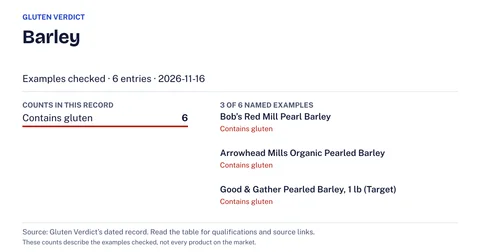 BarleyContains glutenchecked Nov 16, 2026
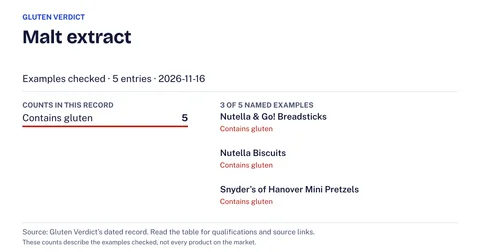 Malt extractContains glutenchecked Nov 16, 2026
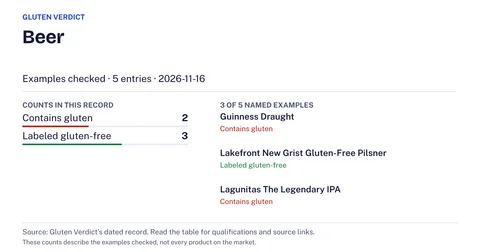 BeerDepends on the product2 of 5 products we checked contain gluten: Guinness Draught and Lagunitas The Legendary IPAchecked Nov 16, 2026
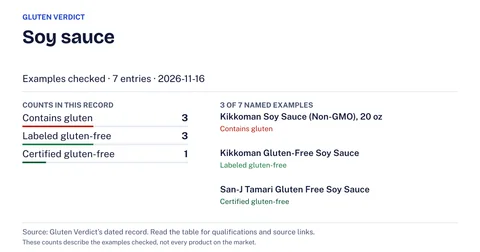 Soy sauceDepends on the product3 of 7 products we checked contain gluten: Kikkoman Soy Sauce (Non-GMO), 20 oz; San-J Organic Shoyu Soy Sauce; and Lee Kum Kee Premium Soy Sauce (No Preservatives Added)checked Nov 16, 2026
Questions people ask
Does any state require a restaurant to tell me about barley or rye?
Not in the eight states we read: the allergen lists name wheat and not barley or rye1, 4, 13, 28, 21, 36, 39. Illinois adds a gluten topic to manager training, which is not a notice to diners38, 43.
Which states require restaurants to list allergens in writing?
California, for chain restaurants with 20 or more locations, and Virginia, for food establishments7, 11.
Do these laws cover food trucks?
It varies. California’s notice rule does not apply to compact mobile food operations or nonpermanent food facilities6; we did not check which category a given truck falls in. New York’s health department says its menu rules apply to temporary and mobile food service19.
More in Travel planning and logistics
 Gluten-free dining cards in other languages: where the wording comes fromWhich gluten-free card wording comes from EU law or a celiac society, which cards are members-only, and how to hand one to a server.
 Gluten-free cruising: request channels, notice windows and port daysHow six cruise lines take a gluten-free request, the notice each page states, and what to plan around for buffets, snacks and port days.
 Setting up a gluten-free kitchen in a vacation rentalAsk the host, pack the few items that hold gluten, and wash a rental kitchen with soap and water, with each step tied to a source.
 Gluten-free airline meals: what each airline’s own page says and how to request oneWhat Delta, American, Air Canada, Qantas, Virgin Atlantic and JetBlue say on their own pages about gluten-free meals: where to ask and by when.
 Gluten-free at an all-inclusive resort: what to ask before you book and at the buffetWhat to ask an all-inclusive resort before you book, what three brands say on their own pages, and how to handle a buffet and a Spanish card.
 How to judge a city for celiac disease: three signals you can checkSize up any US city for celiac disease with three checks: a hospital celiac program, the state’s restaurant allergy law and validated restaurants.
Related guides
 Eating out with celiac disease: what to check, ask and watch forPlan a restaurant meal with celiac disease: what to check before you go, the questions to ask in order, how to read the answers, and what studies measured.
 Where gluten hides in a restaurant kitchen, and the question to ask about each sourceFryers, sauces, roux, marinades, grills, pasta water and eggs: how gluten reaches restaurant food and the question GIG lists for each source.
 The Contains line names wheat, not barley or rye: what US allergen labels coverWhat the US allergen Contains line covers, why it names wheat but not barley or rye, and which ingredient-list names stand in for them.
 Wheat, barley and rye on an ingredient list: the names to look forLook up wheat, barley and rye names on a US ingredient list, from durum to malt, and sort each as contains gluten, depends on the maker, or lookalike.
Sources
- [1] US Food and Drug Administration, Food allergies: what you need to know, checked Nov 17, 2026.
Read on 2026-11-17: the list under “What Are Major Food Allergens?” (after the sentences on the 2004 Act and the sesame law) names milk, eggs, fish, crustacean shellfish, tree nuts, peanuts, wheat, soybeans and sesame. Barley and rye are not on it.
- [2] US Food and Drug Administration, Gluten and food labeling, checked Nov 17, 2026.
- [3, 4, 5, 6] California Legislature (Senate Bill 68, 2025), SB 68 bill text: new section 114093.5, checked Nov 17, 2026.
Read on 2026-11-17: section 113820.5(a), as amended by SB 68, lists milk, eggs, fish, crustacean shellfish, tree nuts, wheat, peanuts, soybeans and sesame as major food allergens, plus a food ingredient that contains protein derived from one of them. Barley and rye are not listed.
- [7, 8] California Department of Public Health, SB 68 major food allergens page, checked Nov 17, 2026.
- [9, 10] Virginia Administrative Code, 12VAC5-421-910, other forms of information, checked Nov 17, 2026.
- [11, 12, 13, 14] Virginia Department of Health, Food regulations update 2026, checked Nov 17, 2026.
Read on 2026-11-17: the list under “Sesame has been added as one of the MAJOR FOOD ALLERGENS” names fin fish, crustacean shellfish, tree nuts, milk, peanuts, soy, wheat, eggs and sesame. Barley and rye are not on it.
- [15, 16, 17, 18] New York State Senate (Public Health Law section 1356), Section 1356, definition of a food service establishment, checked Nov 17, 2026.
- [19, 20, 21, 22] New York State Department of Health, Food allergens page: who the menu rules apply to, checked Nov 17, 2026.
Read on 2026-11-17: the list under “Menus” names three options: the statement “If you have a food allergy or intolerance, please notify us.”; allergen information for each prepared food item offered on the menu; or a statement that allergen information is available, such as “Allergen information for menu items is available. Ask an employee for details.”
Read on 2026-11-17: the list under “Major Food Allergens” names milk, eggs, fish, crustacean shellfish, tree nuts, peanuts, wheat, soybeans and sesame. Barley and rye are not on it.
- [23, 24, 25, 26] Massachusetts Department of Public Health, Retail food code standards for allergen awareness: poster, checked Nov 17, 2026.
- [27, 28, 29, 50] Massachusetts Department of Public Health, Food allergen awareness FAQs: first state, checked Nov 17, 2026.
- [30, 31, 32, 33, 34] Rhode Island General Laws, Section 23-20.12-2, poster, checked Nov 17, 2026.
Read on 2026-11-17: section 23-20.12-2 contains no list of allergens, so it does not name wheat, barley or rye.
- [35] Maryland General Assembly, Health-General section 21-330.2, checked Nov 17, 2026.
- [36] Maryland Department of Health, Food allergy awareness page: the allergen list, checked Nov 17, 2026.
Read on 2026-11-17: the list of “The nine most common food allergens” names milk, eggs, peanuts, tree nuts, fish, crustacean shellfish, soy, wheat and sesame. Barley and rye are not on it.
- [37, 38, 39, 40] Illinois General Assembly (410 ILCS 625/3.07), Allergen awareness training: who and when, checked Nov 17, 2026.
Read on 2026-11-17: the page ends with the source note “P.A. 104-90, eff. 1-1-26”.
- [41, 42] Illinois Department of Public Health, Food allergen awareness training FAQ, checked Nov 17, 2026.
- [43] Celiac Disease Foundation, Illinois allergen awareness training law: the 2026 update, checked Nov 17, 2026.
- [44] Michigan Legislature, MCL 289.6152, food allergy awareness poster, checked Nov 17, 2026.
- [45] Michigan Legislature, MCL 289.2129, allergen training for managers, checked Nov 17, 2026.
Read on 2026-11-17: the page carries the line “Subsection (2) is not applicable after December 31, 2020”, and subsection (2), which required a five-year allergen awareness component in a certified manager’s training, ends with “This subsection applies until December 31, 2020.”
- [46, 47] Food Allergy Research and Education (FARE), Food allergies and food service establishments: the Food Code, checked Nov 17, 2026.
- [48, 49] PubMed (American Journal of Gastroenterology, 2019), Detection of gluten in gluten-free labeled restaurant food: analysis of crowd-sourced data, checked Nov 17, 2026.