Gluten-free dining cards in other languages: where the wording comes from
Short answer
A card in the server’s language carries your request, but only in the words printed on it, so pair it with one plain question about the fryer and utensils1. Wording you can trace comes from EU regulation texts and from phrase sets that celiac societies in France, Switzerland, Italy, Greece and Denmark print2, 3, 4, 5, 48. Several other societies keep their cards for members or sell them6, 7, 8. We print no wording for any other language.
Part of Travel planning and logistics, 22 guides

Key points
- The EU’s gluten definition names wheat, rye, barley and oats in each of the four language versions we read: Weizen, Roggen, Gerste, Hafer in German; blé, seigle, orge, avoine in French; trigo, centeno, cebada, avena in Spanish9, 10, 11, 12.
- The same regulation fixes the claim words glutenfrei, sans gluten and sin gluten, each tied to no more than 20 mg/kg of gluten13, 14, 15.
- Of the published phrase sets we read, only a few address the kitchen: AIC’s Italian sentences name pots, spoons and reused cooking water or oil16, AFDIAG’s Italian phrase names the same work or cooking surface and utensils17, and the Danish society’s English card asks about a space where gluten is present58.
- Coeliac UK’s translated phrases sit behind a membership login, and the Swedish society’s cards are for members too6, 44, 7.
- We print no wording for a language unless a regulator or society page we opened prints it; Japanese is one we leave out.
What a card does and what it leaves to you
AFDIAG (Association Française des Intolérants au Gluten) advises preparing an explanation of celiac disease and the gluten-free diet, plus a few phrases in the language of the country you will visit18. It also tells travellers to translate and learn key words, with wheat, rye and barley as its examples19.
A card does not replace talking to the kitchen. Coeliac UK’s tips for eating out say to call ahead and ask for a manager or chef, so they understand your requirements and the risks of cross-contamination20, and to double-check that cooking methods such as the fryer and utensils are specifically used for gluten-free options1. Treat the card as the start of that conversation.
For trips outside Europe, AIC, the Italian celiac association, points to apps that translate between languages as a very good tool for talking with restaurateurs who do not speak English, and says clear questions and simple information are what prevent misunderstandings21, 22.
EU law: the grain and claim words in four languages
Regulation (EU) No 828/2014 sets the conditions for gluten-free statements25. The European Commission says its rules apply to non pre-packed food such as restaurant meals, not only to packs23, and the regulation is binding in its entirety and directly applicable in all member states24. Its definition of gluten names the grains in each language version, and its annex gives the claim word. We read the English, German, French and Spanish texts; the Italian and Portuguese texts did not open for us today, so the table stops at four.
| Language | Grains in the gluten definition: wheat, rye, barley, oats | Word the annex gives for gluten-free |
|---|---|---|
| English | wheat, rye, barley, oats9 | gluten-free25 |
| German | Weizen, Roggen, Gerste, Hafer10 | glutenfrei13 |
| French | blé, seigle, orge, avoine11 | sans gluten14 |
| Spanish | trigo, centeno, cebada, avena12 | sin gluten15 |
All four versions tie the gluten-free word to no more than 20 mg/kg of gluten25, 13, 14, 15. The English text defines wheat as any Triticum species26 and its first recital lists durum wheat, spelt and khorasan wheat as examples27, so spelt counts as wheat here; see our verdict on spelt. The definition also names oats among the grains whose protein fraction counts as gluten9; the annex’s separate condition for oats in a gluten-free food is in our EU labeling guide.
These are the words a claim may use on food as sold. They do not make a server understand a request. For Spanish and Portuguese wording from several countries’ rules, see our Spanish and Portuguese phrases guide.
Phrase sets that celiac societies print
Five sources we could open print ready-made wording. Each is quoted exactly as published, so spelling and style are the society’s, and we have not had them checked by native speakers. The Celiac Disease Foundation’s list of associations gives the sites for France, Greece, Italy, Switzerland and Denmark28.
| Source | Languages in the set | Mentions shared equipment, oil or water? |
|---|---|---|
| AFDIAG (France) | French, English, German, Spanish, Italian, Portuguese2 | Only the Italian phrase: the same work or cooking surface and utensils17 |
| Swiss society (zoeliakie.ch) | German, French, Italian, English, Spanish3 | Not in the German or French text we could read29 |
| AIC (Italy) | Italian4 | Yes: clean pots, spoons, cooking water and oil16 |
| coeliac.gr PDF | 14 country headings, in the part we read5 | Not in the paragraphs we read30 |
| Dansk Cøliaki Forening (Denmark) | Danish, English, German, French, Spanish, Italian, Greek: one PDF link each48 | Yes, in general terms: whether the food was prepared in a space where gluten is present58 |
AFDIAG, France: six languages on one page
| Language | Wording |
|---|---|
| French | “Pour des raisons médicales, je n’ai pas le droit de manger de produits à base de blé, de seigle, d’orge ou d’avoine, ni de produits panés ou épaissis avec de la farine.”31 |
| German | “Ich darf aus medizinischen Gründen keine Produkte aus Weizen, Roggen, Gerste oder Hafer essen, also auch nichts Paniertes oder Mehl-Gebundenes.”32 |
| Spanish | “Por razon médica tengo prohibido comer alimentos que deriven del trigo, avena, cebada y centeno” (the page continues from there)33 |
| Italian | “Sono celiaco. Per ragioni mediche non posso mangiare prodotti contenenti o derivati da grano, segale, orzo o avena” (the page continues from there)34 |
| Portuguese | “Por razões médicas, não posso comer produtos feitos de trigo, centeio, cevada ou aveia e nada empanado ou engrossado com farinha.”35 |
The French, German, Spanish and Portuguese phrases list grains and foods, and none names equipment, oil or utensils2. The Italian phrase adds a condition: the foods it allows must not have been in direct or indirect contact with foods containing gluten, naming the same work or cooking surface and the same utensils17. The French phrase also says what its writer can eat, including soups and sauces thickened with corn starch or potato flour31.
The Swiss society: restaurant cards in five languages
A PDF on zoeliakie.ch says the society’s office supplies copies of its restaurant cards in German, French, Italian, English and Spanish3, and further translations such as Turkish, Greek and Portuguese36. The German card opens “Ich habe Zöliakie! Aus medizinischen Gründen darf ich kein Gluten essen!”37 and the French card “Je suis atteint de la maladie cœliaque (cœliakie, intolérance au gluten). Par conséquent, je ne dois pas manger de gluten et ce pour raisons médicales !”38. Both go on to name grains and foods29.
AIC, Italy: Italian sentences written for translation apps
AIC’s page for travellers offers Italian example sentences, headed as sentences to put through instant-translation apps4. One names the grains: “Qualsiasi cibo contenente farina/amido di grano (frumento), segale, orzo, avena, farro, spelta, kamut e triticale può causarmi gravi malori.”39 Our gloss: any food containing wheat flour or starch, rye, barley, oats, farro, spelt, kamut or triticale can make me seriously ill.
Another is about contact: “Mi raccomando, anche piccole tracce di glutine sono pericolose per la mia salute! È importante quindi utilizzare pentole pulite, mescolare con cucchiai che non siano stati utilizzati per mescolare cibi con glutine, non riutilizzare l’acqua o l’olio di cottura di preparazioni con glutine.”16 Our gloss: please, even small traces of gluten are dangerous for my health; it is important to use clean pots, to stir with spoons not used for foods with gluten, and not to reuse the cooking water or oil from foods with gluten. Because these sentences are printed in Italian, for a trip to Italy they are wording the national society itself published.
A multi-language PDF on coeliac.gr
The Celiac Disease Foundation lists coeliac.gr for Greece28. A PDF there titled “Gluten Free Multi Language Labels” has one paragraph under each of fourteen headings in the part we read, from Germany to Turkey5. Its German paragraph reads “Ich habe Zöliakie, weswegen ich keine Speisen zu mir nehmen darf, die auch nur die kleinsten Mengen von folgenden Getreiden enthalten: Weizen, Gerste, Roggen, Hafer, Dinkel, Grünkern oder Kamut.”40 Its English paragraph asks “Are there any dishes on your menu without these ingredients?”41 In the paragraphs we read, none mentions a shared fryer, pan or utensil30.
Denmark: PDF cards in seven languages
The Danish society’s travel page links a PDF card for each of seven languages: Danish, English, German, French, Spanish, Italian and Greek48. We opened the English one. It asks the reader to say what contains gluten and whether the food has been prepared in a space where gluten is present58. That is a question about the kitchen in general terms, not a list of pots or utensils. A Danish/English credit-card-size card is sold in the society’s webshop8. The page also points to a private site, Celiactravel.com, that offers cards in 63 languages; we make no claim about its translations49.
The PDF does not say who checked its translations, and two paragraphs show problems: the Slovenian text has damaged characters and the Serbian and Croatian text is printed without diacritics42. We do not reproduce those two, and a native reader should check any paragraph from this PDF before you print it.
Cards whose text we could not read
Coeliac UK tells hotel and restaurant visitors to use the translations in its Travel Guides43, and each guide includes useful phrases in the local language44. Other societies also offer cards. Their pages say the following, and the right-hand column is what we could read.
| Society | What its page says | What we could read |
|---|---|---|
| Coeliac UK | The guides are downloaded after logging in with membership details6 | The Spain and Japan pages show only a prompt to join45, 46 |
| Svenska Celiakiförbundet (Sweden) | Members have translation cards for celiac disease and milk protein allergy in about 40 languages7 | The cards are in a member app or after login, not on the page47 |
| Coeliac Society of Ireland | Eating-out cards in sixteen languages50, from Arabic to Turkish, listed at € 0.0051 | Pages say to pick a country and download a card52; the card text was not in what we read |
We do not reproduce wording from card sellers or private card sites, because no regulator or society page we could open prints their text.
Languages this guide leaves out
Foreign wording appears here only where a page we opened prints it: French, German, Spanish, Italian and Portuguese from societies and EU law, and the other languages of the coeliac.gr PDF, which we leave for the reader to check at the source. For Japanese, Chinese, Thai, Korean, Arabic and every other language, we opened no regulator or society page that prints card wording, so we give none.
The Irish society lists Chinese, Arabic and Turkish among its sixteen languages51. Coeliac UK says each of its travel guides includes useful phrases in the local language44, but its Japan guide page sits behind its membership login46. For what we can source about Japan, see our Japan guide.
If you need one of these languages, the society of the country you are visiting is the place to ask. The Celiac Disease Foundation keeps a list of associations by country53.
What to put on a card, in plain English first
Write the English version first, then match each line to published wording. The sets above share a structure:
- That it is a medical reason: AFDIAG’s French, German and Portuguese phrases open this way (“Pour des raisons médicales”, “aus medizinischen Gründen”, “Por razões médicas”)31, 32, 35.
- The grains by name: wheat, rye, barley and oats9, with spelt counted as wheat27; AIC’s Italian sentence adds farro, spelt, kamut and triticale39.
- The foods that carry them and the foods you can eat, such as breaded or flour-thickened dishes against corn-starch sauces31.
- Contact: clean pots, spoons not used for gluten foods, no reused cooking water or oil16; the Danish society’s English card asks about a space where gluten is present58. AFDIAG’s French, German, Spanish and Portuguese phrases and the coeliac.gr paragraphs we read do not carry this2, 30.
- A request the kitchen can act on, such as asking whether any dishes on the menu are free of the named ingredients41.
Our advice: where a published text lacks the contact line, add it in English beside the local-language text. A card assembled from texts by different publishers has not been reviewed as a whole, so have a native speaker read it if you can.
How to hand one over
- Ask ahead if you can. Coeliac UK suggests calling and asking for a manager or chef20.
- On arrival, speak to the chef or front-of-house staff to confirm that your gluten-free meal has been arranged54.
- Hand over the card before you order and give the server a moment to read it. The Irish society says its cards can be shown or given to a waiter or chef55, so a paper copy can go to the kitchen with the order.
- Ask one plain question in simple words: does the kitchen cook my food in its own pan, with its own oil and utensils? AIC says clear questions and simple information are what prevent misunderstandings22. That question is ours, not a published card sentence; if you need it in the local language, a translation app is the tool AIC points to21.
- Wait for the answer. If it is unclear, ask for the chef, and if it stays unclear, choose another dish or venue.
Where a card stops helping
A card lists foods, and cross-contamination in the kitchen is a separate risk20. Coeliac UK’s tips name two, the fryer and utensils1. AIC’s Italian sentence names three more: pots, stirring spoons, and cooking water or oil reused from foods with gluten16. AFDIAG’s French phrase lists breaded and flour-thickened products among those its writer cannot eat31.
Where a card lists only grains, remember the foods made from them. Our verdicts cover pasta, bread, couscous, beer, soy sauce, wheat starch, malt extract and barley. For more on kitchens, see where gluten hides in restaurant kitchens.
A menu that says glutenfrei, sans gluten or sin gluten is a separate question from your card. The Commission says the claim rules cover restaurant food23; how a country enforces that is not covered here. See European restaurant allergen information rules.
Paper or phone
Societies offer both. The Danish society says its card can be shown on a phone or printed before the trip56; the Irish society describes an eating-out-cards app and a download-and-print option57; Swedish members get cards in a member app47.
Bring one printed copy that can go to the kitchen, and keep a copy on your phone as a back-up. Check that the phone copy opens without a connection before you leave.
Verdicts in this guide
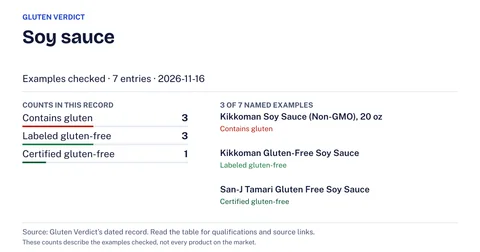 Soy sauceDepends on the product3 of 7 products we checked contain gluten: Kikkoman Soy Sauce (Non-GMO), 20 oz; San-J Organic Shoyu Soy Sauce; and Lee Kum Kee Premium Soy Sauce (No Preservatives Added)checked Nov 16, 2026
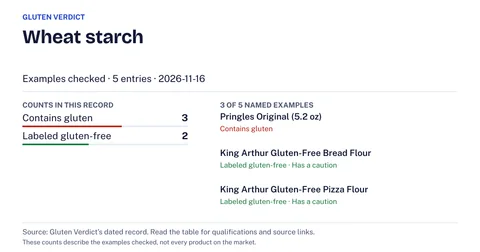 Wheat starchDepends on the product3 of 5 products we checked contain gluten: Pringles Original (5.2 oz), Jiffy Corn Muffin Mix, and Chex Mix Bold Garlic and Herbchecked Nov 16, 2026
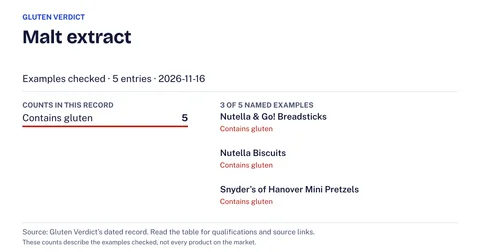 Malt extractContains glutenchecked Nov 16, 2026
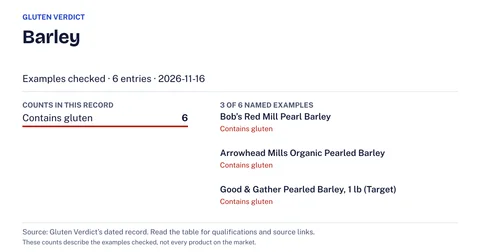 BarleyContains glutenchecked Nov 16, 2026
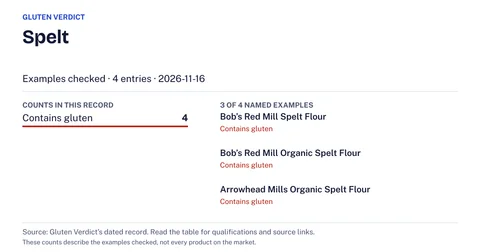 SpeltContains glutenchecked Nov 16, 2026
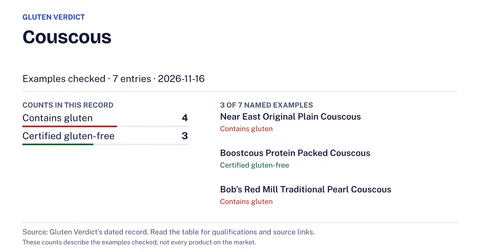 CouscousContains glutenchecked Nov 16, 2026
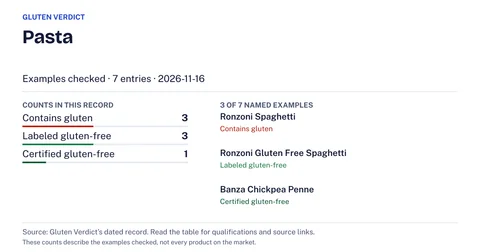 PastaContains glutenchecked Nov 16, 2026
 BreadContains glutenchecked Nov 16, 2026
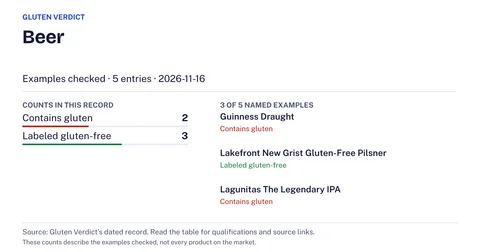 BeerDepends on the product2 of 5 products we checked contain gluten: Guinness Draught and Lagunitas The Legendary IPAchecked Nov 16, 2026
Questions people ask
Are translated celiac cards free?
It depends on the society. The Irish society’s product page lists its cards at € 0.0051, the Danish society links free PDF cards in seven languages48 and sells a Danish/English credit-card-size card in its webshop8, and Coeliac UK’s and the Swedish society’s translations are for members6, 7.
Can I read Coeliac UK’s translated phrases without joining?
The Spain and Japan guide pages we opened showed only a prompt to join45, 46, and the index says to log in with membership details to download a guide6.
Is a card in the server’s language enough?
A card says what its text says. Of the published sets we read, only AIC’s sentences (pots, spoons, reused water and oil)16, AFDIAG’s Italian phrase (shared work surface and utensils)17 and the Danish English card (a space where gluten is present)58 address the kitchen. Ask about the kitchen too1.
Does “sin gluten” or “glutenfrei” on a menu mean the same as on a pack?
EU rules fix those words as claim words with a limit of no more than 20 mg/kg of gluten13, 15, and the Commission says the rules also apply to non pre-packed food such as restaurant meals23. Whether a particular kitchen can meet that is the question to ask.
More in Travel planning and logistics
 State restaurant allergy laws: what eight states’ laws say, and what they leave out for barley and ryeWhat CA, VA, NY, MA, RI, MD, IL and MI law says about restaurant allergens, whether wheat is covered, and what is left out for barley and rye.
 Setting up a gluten-free kitchen in a vacation rentalAsk the host, pack the few items that hold gluten, and wash a rental kitchen with soap and water, with each step tied to a source.
 Gluten-free cruising: request channels, notice windows and port daysHow six cruise lines take a gluten-free request, the notice each page states, and what to plan around for buffets, snacks and port days.
 Gluten-free at an all-inclusive resort: what to ask before you book and at the buffetWhat to ask an all-inclusive resort before you book, what three brands say on their own pages, and how to handle a buffet and a Spanish card.
 Gluten-free airline meals: what each airline’s own page says and how to request oneWhat Delta, American, Air Canada, Qantas, Virgin Atlantic and JetBlue say on their own pages about gluten-free meals: where to ask and by when.
 Gluten-free food for camping and hiking: pack lists and label checksPack gluten-free camping and hiking food by trip length, check pouch meals and bars against their labels, and run a shared camp kitchen.
Related guides
 Gluten words on European food labels, language by languageFind the ingredient list, the gluten-cereal name and the gluten-free claim on a European pack in 11 languages, using words from the EU’s own texts.
 Gluten-free on a trip through several European countries: borders, trains, hostels and supermarketsA packing and shopping plan for a multi-country Europe trip: what each border lets you carry, what the EU label rule covers, and a check for each stop.
 Planning a gluten-free trip: what to arrange, in orderA gluten-free trip in order: how you will eat, what to tell hotels and airlines, which cards and notes to carry, and what food to pack.
 Gluten-free and very low gluten on EU labels, and how allergens are highlightedWhat EU “gluten-free” and “very low gluten” claims permit, how cereals containing gluten are highlighted in ingredient lists, and the rules for loose food.
Sources
- [1, 20] Coeliac UK, Essential Gluten Free Eating Out Tips, checked Nov 17, 2026.
- [2, 17, 18, 19, 31, 32, 33, 34, 35] Association Française des Intolérants au Gluten (AFDIAG), Lors de vos voyages (phrase set), checked Nov 17, 2026.
Read on 2026-11-17: the section that begins “Pour vous aider à signaler vos contraintes alimentaires à l’étranger, voici quelques phrases dans différentes langues” prints phrases in French, English, German, Spanish, Italian and Portuguese. The French, English, German, Spanish and Portuguese phrases name grains, breaded or flour-thickened foods and foods that are allowed; none of the five names equipment, cooking oil or utensils.
- [3, 29, 36, 37, 38] Zöliakie society of German-speaking Switzerland (zoeliakie.ch), Restaurant cards (Gastrokarten) PDF, checked Nov 17, 2026.
Read on 2026-11-17: in the text of the PDF that we could read, the German card names Weizen, Dinkel, Roggen, Gerste and Hafer as forbidden and Reis, Mais, Hirse, Kartoffeln, Gemüse, Früchte, Fleisch und Fisch among the foods allowed, and the French card names blé, froment, épeautre, seigle, orge and avoine; neither mentions shared fryers, pans or utensils. The PDF’s text extracts with many missing spaces, so only its clean sentences are quoted.
- [4, 16, 21, 22, 39] Associazione Italiana Celiachia (AIC), Celiachia in viaggio, checked Nov 17, 2026.
- [5, 30, 40, 41, 42] coeliac.gr (the site the Celiac Disease Foundation lists for Greece), Gluten Free Multi Language Labels (PDF), checked Nov 17, 2026.
Read on 2026-11-17: the part of the PDF we read (about the first 9,000 characters) has one paragraph under each of these headings, in Greek script: Germany, England & USA, Italy, Sweden, Norway, France, Hungary, Serbia & Croatia, Denmark, Portugal, Netherlands, Spain, Slovenia and Turkey.
Read on 2026-11-17: the paragraphs we read ask whether the menu has dishes without the named cereals, or whether the cereals can be left out (for example by not thickening a sauce with flour or not breading meat); none of them mentions a shared fryer, pan, utensil or cooking oil.
Read on 2026-11-17: in the Slovenian paragraph the PDF’s text shows damaged characters (for example “jeèmenu” and “poèutje”), and the Serbian & Croatian paragraph is printed without diacritics (for example “psenica” and “jecam”). The part we read does not say who wrote or checked the translations; its only credit is a thank-you line in German under the Slovenian paragraph, to the person who sent that translation.
- [6, 44] Coeliac UK, Travel guides, checked Nov 17, 2026.
- [7, 47] Svenska Celiakiförbundet, Resa med celiaki, checked Nov 17, 2026.
- [8, 48, 49, 56] Dansk Cøliaki Forening, Rejs med cøliaki, checked Nov 17, 2026.
Read on 2026-11-17: under the heading “Hvad hedder gluten på …” the page links one PDF per language, labelled Dansk, Engelsk, Tysk, Fransk, Spansk, Italiensk and Græsk.
- [9, 24, 25, 26, 27] European Commission (EUR-Lex), Implementing Regulation (EU) No 828/2014 on information about the absence or reduced presence of gluten (English), Article 2, checked Nov 17, 2026.
- [10, 13] European Commission (EUR-Lex), Implementing Regulation (EU) No 828/2014 on information about the absence or reduced presence of gluten (German), Article 2, checked Nov 17, 2026.
- [11, 14] European Commission (EUR-Lex), Implementing Regulation (EU) No 828/2014 on information about the absence or reduced presence of gluten (French), Article 2, checked Nov 17, 2026.
- [12, 15] European Commission (EUR-Lex), Implementing Regulation (EU) No 828/2014 on information about the absence or reduced presence of gluten (Spanish), Article 2, checked Nov 17, 2026.
- [23] European Commission, Gluten-free food, checked Nov 17, 2026.
- [28, 53] Celiac Disease Foundation, Associations Around the World, checked Nov 17, 2026.
Read on 2026-11-17: the list on the page gives “France: www.afdiag.fr”, “Greece: www.coeliac.gr”, “Ireland: www.coeliac.ie”, “Italy: www.celiachia.it”, “Sweden: celiaki.se”, “Switzerland: www.zoeliakie.ch” and “Denmark: www.coeliaki.dk”.
- [43, 54] Coeliac UK, Travelling with coeliac disease, checked Nov 17, 2026.
- [45] Coeliac UK, Travel guide: Spain, checked Nov 17, 2026.
- [46] Coeliac UK, Travel guide: Japan, checked Nov 17, 2026.
- [50, 51] Coeliac Society of Ireland, Eating Out Cards, checked Nov 17, 2026.
Read on 2026-11-17: the product page headed “Eating Out Cards” shows the price “€ 0.00” and a Language row listing Arabic, Bulgarian, Bosnian/Croatian/Serbian(BCS), Chinese, Czech, Dutch, English, French, German, Greek, Hungarian, Italian, Polish, Portuguese, Spanish and Turkish.
- [52] Coeliac Society of Ireland, Eating Out Abroad, checked Nov 17, 2026.
- [55, 57] Coeliac Society of Ireland, Travelling, checked Nov 17, 2026.
- [58] Dansk Cøliaki Forening, Sprogkort, English PDF card, checked Nov 17, 2026.