Sharing butter, jam and spreads with gluten eaters
Short answer
One way crumbs reach a shared spread is a knife that goes from bread back into the jar2; the Gluten Intolerance Group warns that designated zones and color-coded tools “are not a guarantee on their own”10.
- A clean knife for every dip, which is Coeliac UK’s minimum for shared butters, jams and spreads16.
- A squeeze bottle where the spread comes in one, which the Gluten Intolerance Group calls a simple way to reduce the chance of cross-contact7.
- A second jar, bought twice or split from a family-size jar before first use5, 6.
- A gluten-free area on a top shelf, so crumbs from gluten foods are less likely to fall onto it8.
Part of Cross-contact and the home kitchen, 19 guides

Key points
- The Gluten Intolerance Group lists double-dipping, the same knife going from bread to jar, among the most common ways crumbs reach gluten-free food2.
- For shared spreads, Coeliac UK recommends separate condiments, or at least clean cutlery16.
- One 2021 study found mayonnaise and peanut butter above the gluten-free limit after spreading with a knife used on gluten-containing bread20; a 2024 mini-review reports that, in general, shared kitchen utensils and equipment, knives among them, did not lead to significant contamination in controlled experiments21.
- The Gluten Intolerance Group says designated zones and color-coded tools are not a guarantee on their own10.
- The pages we read do not say whether to discard a spread a used knife has touched26, 27.
How do crumbs get into a shared tub?
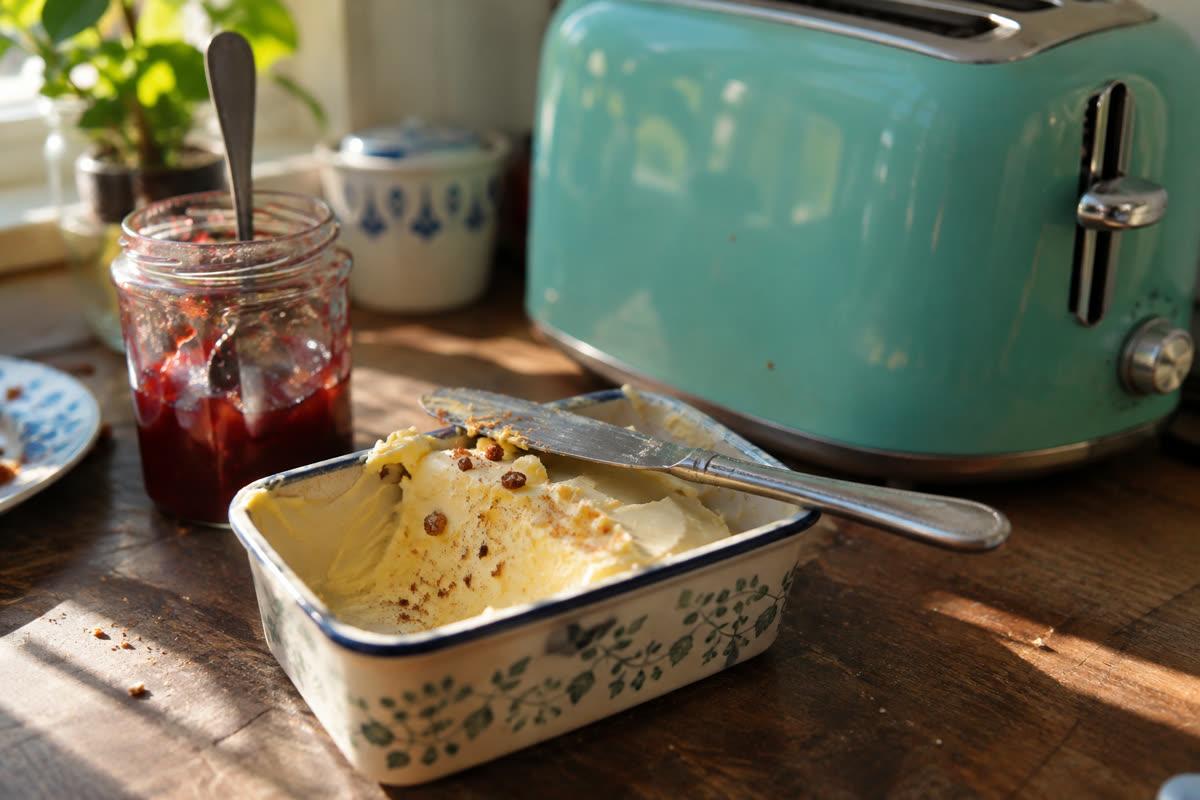
The Gluten Intolerance Group (GIG) defines cross-contact as gluten crumbs or particles getting into gluten-free food in amounts that could cause an adverse reaction1. For a shared spread the route GIG describes is double-dipping, and it lists that among the most common ways crumbs reach gluten-free food: a knife spreads mayonnaise on wheat bread, then goes back into the jar to spread gluten-free bread2.
GIG’s cohabitation article gives a peanut butter version. It names a knife used to spread regular peanut butter among the things that can leave behind enough traces to make someone with celiac disease seriously ill11.
Below, each option is set against what its source says it addresses and what it leaves open.
What do the studies show about spreads?
One 2021 study tested three kitchen practices: gluten-free food fried in a shared fryer, gluten-free bread toasted in a shared toaster, and sandwich spreads (mayonnaise, jam and peanut butter) applied with a knife used on gluten-containing bread19.
Its abstract reports small amounts of cross-contact across these practices, with most results (93.6%) showing no significant cross-contact, and names mayonnaise and peanut butter as the samples contaminated above the limit FDA designates as gluten-free20. We read the abstract only, so we cannot say how many spread samples were tested.
A 2024 mini-review of studies on shared food handling reports a different picture for utensils in general: in controlled experiments, shared kitchen utensils and equipment, knives among them, did not lead to significant contamination of samples21.
The two sources do not say the same thing, and they tested different things: the 2021 study named mayonnaise and peanut butter samples above the limit, while the review summarises controlled experiments on utensils in general. A third study, of cupcakes, looked at washing a knife. A gluten-containing cupcake was sliced with a knife, which was reused to slice a gluten-free (GF) cupcake. The knife was then washed in soap and water, rinsed in running water or cleaned with an antibacterial hand wipe before a new GF cupcake was sliced22. Cutting cupcakes with a knife used on frosted gluten-containing cupcakes was associated with low-level gluten transfer even when crumbs were visible on the icing on the knife24, and all three washing methods were effective in removing gluten23. That study used cupcakes, not spreads.
Four ways to share spreads, compared
| Option | What it addresses | What it leaves open | Cost and effort |
|---|---|---|---|
| A clean knife for every dip | Coeliac UK’s minimum for shared butters, jams and spreads is clean cutlery16. | One dip with a knife that has touched gluten-containing bread is the double-dipping GIG names2. GIG says housemates need to understand why it is not an option9. | Nothing to buy. Coeliac UK says standard washing-up liquid or a dishwasher will remove gluten17. |
| A squeeze bottle | GIG calls squeeze bottles a simple solution to reducing the chance of cross-contact7. For students sharing a fridge it suggests squeezable mustard, mayo and ketchup12. | The tip becomes the contact point: GIG says others need to know not to touch it to their gluten-containing bread13. | Only for spreads sold in a bottle. GIG says some condiments come that way7. |
| A second, labeled jar | GIG’s advice for a shared kitchen is to buy double of peanut butter, jam, mustard and mayo5. | GIG says designated zones and color-coded tools “are not a guarantee on their own”10. | A second jar, or a family-size jar divided into two containers before first use with one labeled gluten-free6. |
| A gluten-free shelf | GIG advises a gluten-free area in the fridge or pantry, preferably on a top shelf, to avoid falling crumbs or dust from gluten foods8. It also suggests asking roommates to wrap gluten-containing foods thoroughly15. | Addresses crumbs and dust falling from gluten foods8. The knife route GIG describes is a different one2. | Rearranging the fridge and pantry, and agreeing with housemates which half is whose14. |
GIG’s “7 Tips” page gives a gluten-free area8 as one step, and under its separate “Avoid double-dipping” step28 it lists doubled condiments5, divided containers6 and squeeze bottles7 together, rather than choosing between them.
Where does a knife rule work, and where does it fail?
Coeliac UK’s wording is separate condiments to avoid breadcrumbs, or at least clean cutlery for shared butters, jams and spreads16. The 2021 study tested spreads applied with a knife used on gluten-containing bread19, the case a knife rule is aimed at.
Coeliac UK says standard washing-up liquid or a dishwasher will remove gluten17, and in the cupcake study all three knife-washing methods were effective23.
Sources differ on sponges. Coeliac UK says you do not need separate cloths or sponges18. The National Celiac Association recommends dedicated gluten-free sponges, brushes and rags for hand-washing because they can get gluten stuck to them25.
A knife rule depends on everyone who shares the jar following it, which is why GIG says to make sure housemates understand why double dipping is not an option9.
How do you set up a second jar, a squeeze bottle or a shelf?
These steps come from GIG’s pages. The order is ours.
- Buy two jars of the spreads that matter most. GIG names peanut butter, jam, mustard and mayo5.
- Or buy a family-size container, divide it into two containers before first use, and label one gluten-free6.
- Label the gluten-free jar, and the shelf it lives on3, 14.
- Put gluten-free packages above gluten-containing food and keep them securely packaged4.
- Where a spread comes in a squeeze bottle, tell the household not to touch the tip to gluten-containing bread13.
- Ask roommates or family to wrap gluten-containing food thoroughly15.
For the wider kitchen, see cross-contamination at home and setting up a gluten-free kitchen.
Do butter, peanut butter, jam and mayonnaise differ?
The 2021 study’s three spreads were mayonnaise, jam and peanut butter19. Its abstract names mayonnaise and peanut butter as the samples above the gluten-free limit20. Butter was not one of the three19.
| Spread | In the 2021 study | Our verdict page |
|---|---|---|
| Mayonnaise | Tested; named as above the limit19, 20 | Mayonnaise |
| Peanut butter | Tested; named as above the limit19, 20 | Peanut butter |
| Jam | Tested19; not named among the samples above the limit20 | No page yet |
| Butter | Not among the three spreads tested19 | Butter |
| Mustard, ketchup, cream cheese, Nutella, honey | Not among the three spreads tested19 | Mustard, ketchup, cream cheese, Nutella, honey |
Whether a product is itself gluten-free is a separate question from whether a knife brought crumbs into it. Our verdict pages cover the first question.
What do the sources we read leave unanswered?
Two questions came up that no page we read about shared spreads answers:
- Whether to discard a spread after a used knife has gone in26, 27.
- How long a jar stays contaminated once it has been26, 27.
This guide therefore gives no discard rule. GIG’s advice to buy double5 or to divide a family-size container before first use6 avoids the question for a new jar.
Verdicts in this guide
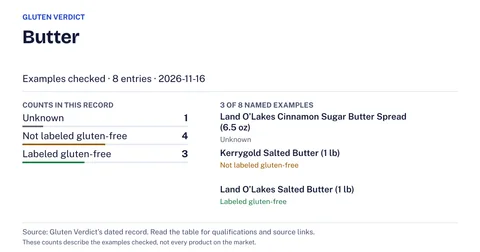 ButterNaturally gluten-freechecked Nov 16, 2026
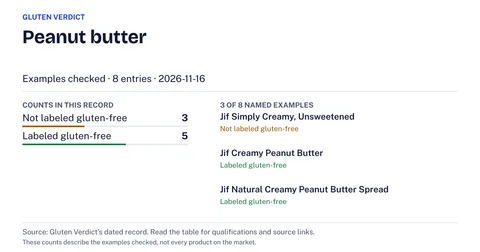 Peanut butterDepends on the productchecked Nov 16, 2026
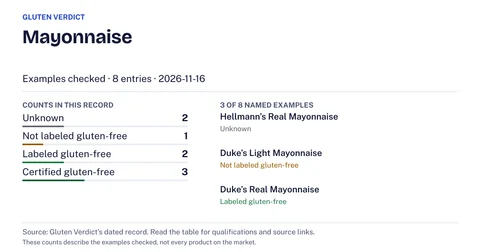 MayonnaiseNaturally gluten-freechecked Nov 16, 2026
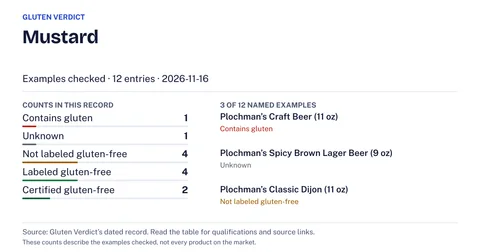 MustardDepends on the product1 of 12 products we checked contains gluten: Plochman’s Craft Beer (11 oz)checked Nov 16, 2026
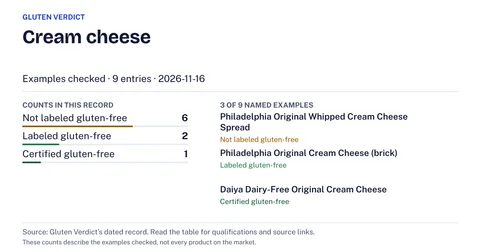 Cream cheeseNaturally gluten-freechecked Nov 16, 2026
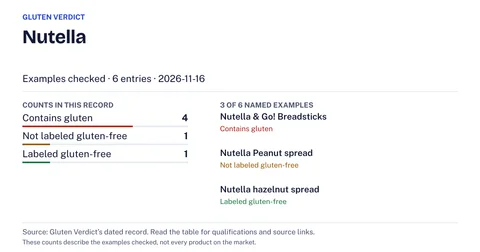 NutellaLabeled gluten-free4 of 6 varieties we checked contain glutenFerrero USA · checked Nov 16, 2026
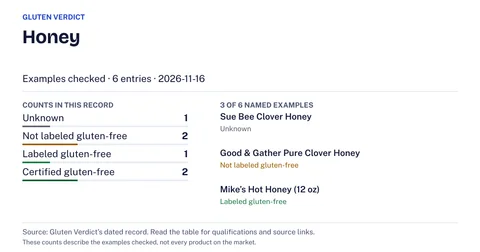 HoneyDepends on the productchecked Nov 16, 2026
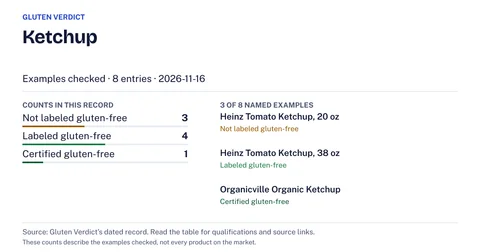 KetchupDepends on the productchecked Nov 16, 2026
Questions people ask
Is a clean knife enough for shared butter?
Coeliac UK recommends separate condiments to avoid breadcrumbs, or at least clean cutlery for shared butters, jams and spreads16. GIG lists double-dipping among the most common ways crumbs reach gluten-free food2.
Can I split one big jar into two?
GIG suggests it as a money-saving option: divide a family-size container into two before first use, and label one gluten-free6.
More in Cross-contact and the home kitchen
 Storing gluten-free food in a shared fridge, pantry and freezerWhere gluten-free food goes in a shared fridge, pantry and freezer, how to label it so everyone follows, and what the sources say and leave out.
 Gluten cross-contact at home: where it happens and what to do about itHow gluten reaches gluten-free food at home, whether to separate, wash or ask for each route, and which rules have lab data behind them.
 Setting up a gluten-free kitchen: what to replace, wash or shareWalk each kitchen zone and decide, item by item, what to replace, what to wash and what a mixed household can keep sharing, with charity sources.
 Gluten-free with roommates, partners and family: a shared-kitchen agreementHow to split a shared kitchen when one person is gluten-free: what to keep separate, what to wash and share, and how to put the rules to housemates.
 What studies measured in shared kitchens: pasta water, toasters, knives and spreadsWhat four experimental studies measured when gluten-free food met shared pots, toasters, knives and spreads: samples, results, and what went untested.
 A weekly gluten-free kitchen routine: wipe, label, restock, re-checkA one-page weekly pass for a gluten-free kitchen: what to wipe, label, restock and do with leftovers, and where the charities and small studies differ.
Related guides
 Going gluten-free: what to remove and what to keep in your pantry and kitchenSort a full pantry into foods to remove, labels to read and plain foods to keep, then decide on shared jars, toasters and pans.
 A starter gluten-free pantry: 30 shelf items and the label check for eachThirty shelf items for a first gluten-free pantry, tagged by the label check each needs, plus how to keep jars, toaster and colander apart at home.
 Reading a US label for gluten and another food allergyHow to read a US food label for gluten and a second allergen: what the Contains line, gluten-free claim and may-contain lines each cover.
 Gluten-free food through TSA security: what carries on and what goes in a checked bagWhich gluten-free foods go in a carry-on or checked bag under TSA’s own pages, and how the 3.4-ounce liquid limit applies to spreads, soups and dips.
Sources
- [1, 2, 3, 4] Gluten Intolerance Group, 25 Ways Cross-Contact Could Happen (And How to Avoid It), checked Nov 17, 2026.
- [5, 6, 7, 8, 26, 28] Gluten Intolerance Group, 7 Tips for Avoiding Gluten Cross-Contact at Home, checked Nov 17, 2026.
Read the whole page on 2026-11-17: its steps on shared kitchens, double-dipping and condiments give no instruction on discarding a spread that a used knife has touched, and no statement on how long such a jar stays contaminated.
- [9, 10, 11] Gluten Intolerance Group, Your Kitchen, Their Kitchen, Our Kitchen: Navigating Gluten-Free Cohabitation, checked Nov 17, 2026.
- [12, 13, 14, 15] Gluten Intolerance Group, College: Navigating Shared Housing & Kitchens, checked Nov 17, 2026.
- [16, 17, 18, 27] Coeliac UK, Cross contamination (cooking at home), checked Nov 17, 2026.
Read the whole page on 2026-11-17: its list of simple steps for shared butters, jams and spreads gives no instruction on discarding a spread that a used knife has touched, and no statement on how long such a jar stays contaminated.
- [19, 20] Clinical Nutrition (PubMed), Gluten cross-contact from common food practices and preparations (Parsons et al., 2021), checked Nov 17, 2026.
- [21] Nutrients (PubMed), Risk of Gluten Cross-Contamination Due to Food Handling Practices: A Mini-Review (Damasceno et al., 2024), checked Nov 17, 2026.
- [22, 23, 24] Gastroenterology (PubMed Central), Preparation of Gluten-Free Foods Alongside Gluten-Containing Food May Not Always Be as Risky for Celiac Patients as Diet Guides Suggest (Weisbrod et al., 2020), checked Nov 17, 2026.
- [25] National Celiac Association, Cross Contamination or Cross Contact, checked Nov 17, 2026.