Paleo or AIP After a Celiac Diagnosis: What the Evidence Does and Does Not Support
Short answer
The treatment these sources name for celiac disease is a strict gluten-free diet1, 21, with lifelong medical follow-up and a dietitian visit after diagnosis1, 2. The 2023 American College of Gastroenterology guideline does not mention paleo, the autoimmune protocol, corn or dairy3. “Paleo” describes a way of eating that leaves out grains, legumes and dairy4; it is not FDA’s gluten-free claim5. The guideline’s one mention of wider dietary restriction is a time-limited diet for refractory celiac disease type 16, and its nutrition section recommends gluten-free oats12.
Part of Nutrition and combining diets, 24 guides

Key points
- Beyond a gluten-free diet, the ACG guideline and the paper it cites describe one wider restriction: for refractory celiac disease type 1, a diet that removes nearly all processed foods for a defined period6, supervised by a dietitian7 and not recommended for more than three to four months8.
- On corn, the Celiac Disease Foundation said in 2016 that there is no scientific evidence that corn contains proteins that cross-react with gluten9; a 2021 lab study found IgA to maize zein in 13 of 37 newly diagnosed patients, and its authors call the question controversial10, 11.
- The guideline’s one nutrition recommendation is about oats: it recommends gluten-free oats, with monitoring for tolerance12.
- Mayo Clinic’s main concern about paleo is nutrient gaps13; the AIP review says adverse events are not well understood14 and lists no celiac disease study15.
- On a packaged paleo food, look for a gluten-free claim and read the ingredient list: “paleo” does not appear in FDA’s gluten-free regulation5.
What do paleo and AIP each remove?
Mayo Clinic describes a modern paleo diet as built on fruits, vegetables, lean meats, fish, eggs, nuts and seeds, and as leaving out the foods that became common with small-scale farming: grains, legumes and dairy products4. Its list of foods to avoid also names refined and added sugar, added salt, starchy vegetables such as corn, and highly processed foods16. It adds that recommendations vary among paleo diets17.
The autoimmune protocol (AIP) is described in a review in Metabolism Open as a personalized elimination diet that aims to find and exclude foods that might trigger immune responses18. Its elimination phase is stricter than paleo, with more foods excluded, including eggs, nuts and seeds, nightshades, food additives, refined oils, coffee and alcohol19.
Both leave out grains4, 40, and paleo also leaves out legumes and dairy4. Beyond Celiac describes a gluten-free diet as one that still includes beans, legumes and most dairy products, which are naturally gluten-free20. Taking those out is a separate choice from taking gluten out.
What do celiac guidelines say about going further than gluten-free?
The American College of Gastroenterology (ACG) guideline says current treatment requires strict adherence to a gluten-free diet and lifelong medical follow-up1, and that a visit with a dietitian after diagnosis is mandatory2. NIDDK, part of the National Institutes of Health, says celiac disease calls for a gluten-free diet and that a doctor and a registered dietitian can help plan a balanced one21.
The guideline’s nutrition section has one recommendation, and it is about gluten-free oats12. We read its full text and the words paleo, autoimmune protocol, corn, maize and dairy do not appear in it3.
For persistent or recurrent symptoms, the guideline says the evaluation includes reviewing and confirming the diagnosis, evaluating for inadvertent gluten exposure through an expert dietitian and serology, assessing for a coexisting functional disorder, and selective testing, based on clinical suspicion, for food intolerances such as lactose and fructose and for other conditions22.
The guideline’s one mention of further dietary restriction
The guideline says refractory celiac disease type 1 likely has several causes, including inadvertent gluten exposure, and may be managed with further dietary restriction, eliminating nearly all processed foods for a defined period6.
The paper behind that statement (reference 85 in the guideline) describes the gluten contamination elimination diet. It removes almost all processed foods, even those labeled gluten free23. Its authors do not recommend it for newly diagnosed celiac disease24, say it must be supervised by a knowledgeable dietitian7, and say it is not recommended for more than three to four months8.
That diet is aimed at gluten contamination, not at corn, oats or dairy. The paper removes dairy in its first phase to evaluate lactose intolerance as a culprit for some symptoms25.
What do the corn, oat and dairy claims rest on?
Corn
The usual form of the claim is that corn proteins cross-react with gluten, so corn has to go. This is what the sources we found say:
- The Celiac Disease Foundation wrote in a 2016 Q&A that there is no scientific evidence that corn contains proteins that cross-react with gluten9.
- A National Celiac Association dietitian answer, reviewed in September 2025, says corn is naturally gluten free and that the protein sometimes called “corn gluten” is not harmful to those with celiac disease26.
- A 2012 laboratory study found that IgA from some celiac patients recognized two maize zeins even after digestion by enzymes in the lab27. Its authors concluded that the use of maize in gluten-free foods must be reevaluated in some cases of celiac disease28.
- A 2021 study measured antibodies to zein in blood samples: 13 of 37 newly diagnosed celiac patients had IgA to zein10, and none of its groups had IgG to it29. Its authors say the effect of maize in celiac disease has not been well studied and call the question controversial11.
Both studies measured antibodies, not what happens to people who eat corn. The 2012 work was done in the laboratory and by computer analysis30, and the 2021 authors say they did not correlate their results with symptoms or disease activity31. We read that as an open research question, not as a rule to remove corn.
Corn can still pick up gluten in processing. The same National Celiac Association dietitian answer recommends that corn flour, cornmeal, masa and cornstarch be labeled gluten free32. Our verdicts: corn and cornstarch.
Oats
Oats are different, because the guideline addresses them. ACG recommends gluten-free oats for people with celiac disease and says gluten contamination of oats, variable toxicity in different oat varieties and a small risk of an immune reaction to the oat protein avenin require monitoring for oat tolerance12. NIDDK suggests talking with a doctor or registered dietitian about whether to include oats and how much33.
Beyond Celiac says research suggests avenin can trigger a response similar to gluten in a small portion of people with celiac disease, though it is thought to be a separate sensitivity34. A study presented at Digestive Disease Week found no related intestinal damage in those who reacted to purified avenin35; Beyond Celiac notes the results are preliminary36. Most of the concern about oats, it says, comes from mills that process oats also handling gluten-containing grains37. More in our guide on oats and celiac disease and the oatmeal verdict.
Dairy
Dairy is not a gluten source: Beyond Celiac counts most dairy products among naturally gluten-free foods20. The dairy question in celiac disease is about lactose. Beyond Celiac says lactose intolerance is often a symptom of celiac disease and usually resolves after following a strict gluten-free diet38, and the ACG guideline lists lactose among the food intolerances to test for selectively when symptoms persist22.
What risks do the sources raise?
Mayo Clinic says the main concern about paleo diets is the lack of whole grains and legumes, which it calls good sources of fiber, vitamins, proteins and other nutrients, and that low-fat dairy products are good sources of protein, calcium and vitamins. Its summary: you may not get all recommended nutrients13.
People with celiac disease start from a different baseline. The Gluten Intolerance Group says gluten-free diets can be low in fiber, iron, folate, niacin, thiamin and riboflavin, and that some people with celiac disease may have poor absorption of, and higher needs for, calcium, folate, iron and vitamins A, B12, D, E and K39. Our guide on nutrient deficiencies in celiac disease covers what clinicians check.
The AIP review says excluding grains might result in deficiencies in vitamins B1, B2 and B3, fiber and iron40, that proper implementation requires expert guidance, and that adverse events remain inadequately understood14.
Evidence in celiac disease is thin to absent in what we read. The AIP review lists four studies, in Hashimoto thyroiditis, inflammatory bowel disease and rheumatoid arthritis, and two of them list celiac disease as an exclusion criterion15. It says the research highlights the need for further clinical studies41. For paleo, Mayo Clinic says most studies were small and lasted from a few weeks to a few months42.
Does a paleo label mean a product is gluten-free?
No. A paleo label and a gluten-free claim answer different questions. Mayo Clinic defines paleo by the food groups a diet leaves out4. FDA defines “gluten-free” by ingredients and a limit: the food is inherently gluten free or contains no gluten-containing grain and no ingredient derived from one, unless the ingredient is processed to remove gluten and leaves the food under 20 parts per million (ppm); any unavoidable gluten must also be under 20 ppm43.
A food that bears the claim and fails the rule is misbranded44. The claim is voluntary45, and we read section 101.91 and the word paleo does not appear in it5. A maker can list the two as separate descriptors: Terrasoul’s coconut flour page names grain-free, gluten-free, kosher, Paleo and low-carb side by side46.
| Statement on the package | What the sources say it is |
|---|---|
| Gluten-free (also free of gluten, without gluten, no gluten) | A claim FDA defines; a food using any of the four terms has to meet the rule47. |
| Paleo | A way of eating that leaves out grains, legumes and dairy, with recommendations that vary4, 17. Not a term in the gluten-free regulation5. |
| Made with no gluten-containing ingredients | Not the same as a gluten-free claim: unless the label also says gluten-free, FDA says consumers should not assume the food meets the requirements48. |
| Made in a facility that also processes wheat | A voluntary advisory statement, which FDA allows on a food that also carries a gluten-free claim if it is truthful and not misleading49. |
A claim on one product does not cover the rest of a brand: FDA notes that a manufacturer may make foods that are gluten-free and foods that contain gluten50. Our verdicts show what the pages we read say: coconut flour, almond flour.
How do you read a packaged paleo product for gluten?
- Look for a gluten-free claim, or one of the three equivalent terms47. A food using the claim has to meet FDA’s rule44.
- If there is no claim, read the full ingredient list. The claim is voluntary45, and FDA’s answer for consumers is that people with celiac disease should read and scrutinize labels to avoid gluten ingredients51.
- Check flavorings, starches, thickeners and colorings. NIDDK says these can be made from grains that contain gluten52, and that gluten may be found in foods such as condiments, hot dogs and sausages, salad dressing and soups53. Our verdicts for sausage, bacon and honey show what the pages we read say.
- Check the brand’s other products separately, because a claim on one does not cover another50.
- If you cannot tell, NIDDK’s advice is not to eat the food when unsure and, if possible, to contact the company or visit its website54.
Our gluten scanner looks for gluten-source names in a photo of a label or in pasted text. Low-carb breads, wraps and bars are a separate case: see where wheat gluten hides in keto and low-carb products.
Almond, coconut and other flours: where cross-contact enters
Beyond Celiac lists almond meal (flour), coconut (flour), corn and cornstarch among its gluten-free alternatives55, and advises buying gluten-free grains, flours and starches labeled gluten-free, ideally certified by a third party56.
A Health Canada survey of naturally gluten-free flours and starches sold in Canada in 2010 to 2012 found 61 of 640 samples above the Codex-recommended maximum level for gluten-free products, 20 mg per kg57; among those labeled gluten-free, 3 of 268 samples were contaminated, with a range of 5 to 141 mg per kg58. It surveyed these ingredients as a group, so it shows the kind of risk, not a rate for one flour.
On corn, the sources differ on cornstarch. The Canadian Celiac Association suggests buying corn flour and meal with a gluten-free claim59, but says cornstarch, a highly processed ingredient, is at low risk of cross-contact, so a claim is not needed60. An answer on the US National Celiac Association’s site, written by a dietitian, recommends that corn flour, cornmeal, masa and cornstarch alike be labeled gluten free32. The first is a Canadian statement; the second is a US one.
Who should you talk to before cutting more foods?
The sources here that describe a wider restriction for a medical reason tie it to professional guidance: the elimination-diet paper calls for a knowledgeable dietitian’s supervision7, and the AIP review says proper implementation requires expert guidance14. ACG makes a dietitian visit after diagnosis mandatory2.
Beyond Celiac says that if you still have symptoms on a gluten-free diet, speak with your doctor and/or a registered dietitian knowledgeable of celiac disease, who can help determine whether you are accidentally eating gluten or something else may be causing the symptoms61.
Verdicts in this guide
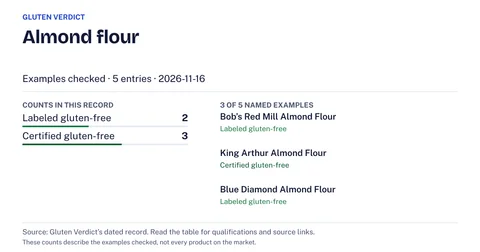 Almond flourNaturally gluten-freeBuy it labeled gluten-freechecked Nov 16, 2026
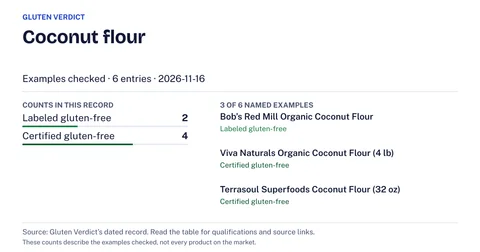 Coconut flourNaturally gluten-freeBuy it labeled gluten-freechecked Nov 16, 2026
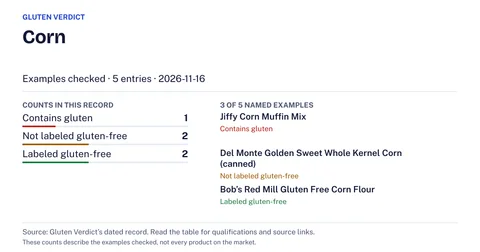 CornNaturally gluten-free1 of 5 products we checked contains gluten: Jiffy Corn Muffin Mixchecked Nov 16, 2026
 OatmealDepends on the productchecked Nov 16, 2026
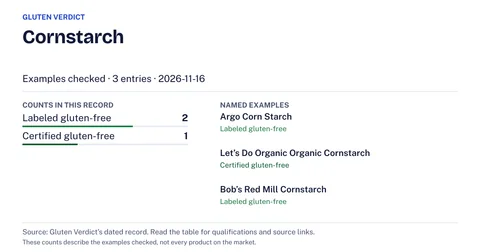 CornstarchNaturally gluten-freeBuy it labeled gluten-freechecked Nov 16, 2026
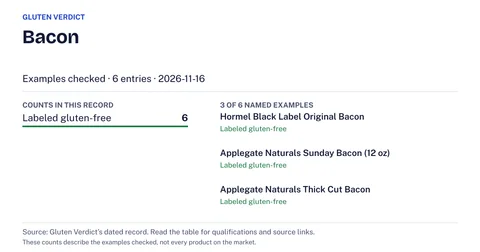 BaconDepends on the productchecked Nov 16, 2026
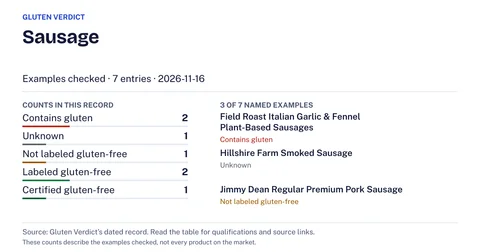 SausageDepends on the product2 of 7 products we checked contain gluten: Field Roast Italian Garlic & Fennel Plant-Based Sausages and Tofurky Plant-Based Italian Sausagechecked Nov 16, 2026
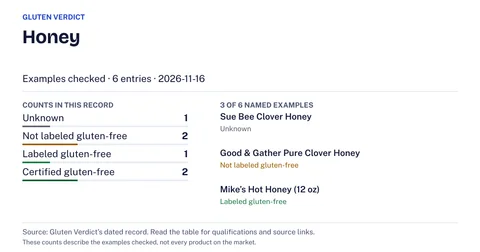 HoneyDepends on the productchecked Nov 16, 2026
Questions people ask
Is paleo the same as gluten-free?
No. Mayo Clinic’s list of foods to avoid on paleo includes grains such as wheat, oats and barley16, but the word paleo does not appear in FDA’s gluten-free regulation, which defines the “gluten-free” claim5.
Has the autoimmune protocol diet been studied in celiac disease?
In the review we read, the AIP studies listed are in Hashimoto thyroiditis, inflammatory bowel disease and rheumatoid arthritis, and two of them list celiac disease as an exclusion criterion15.
Does corn cross-react with gluten in celiac disease?
The Celiac Disease Foundation said in 2016 that there is no scientific evidence that it does9. A 2021 lab study found IgA to maize zein in 13 of 37 newly diagnosed patients, and its authors call the question controversial and say follow-up studies are needed10, 11.
More in Nutrition and combining diets
 Fiber on a gluten-free diet: where it drops and what fills the gapCheck the fiber on gluten-free breads and pastas against the US Daily Value, and see which gluten-free whole foods charities list to add more.
 Reading a US label for gluten and another food allergyHow to read a US food label for gluten and a second allergen: what the Contains line, gluten-free claim and may-contain lines each cover.
 What to eat after a celiac diagnosis: what the sources document and what they do notBone broth, collagen, glutamine or plain staples? What NIDDK, ACG and celiac charities document after a diagnosis, and what no page we read names.
 Weight gain or loss after a celiac diagnosis: what the research foundWhat two studies found about weight before and after a celiac diagnosis, what sources say about gluten-free foods, and what to bring to a dietitian.
 Gluten-free with type 2 diabetes or high cholesterol: where the plans overlapWhere a gluten-free plan and a diabetes or cholesterol plan agree, where packaged gluten-free foods cut across them, and what to ask a dietitian.
 Gluten-free high-protein foods: where gluten hides in bars, powders, jerky and marinadesCheck each protein product type for its gluten trap: seitan, jerky, bars, powders, sausage and broth, with what makers say on their own pages.
Related guides
 Nutrient deficiencies in celiac disease: what the guidance names for checkingWhich nutrients a celiac guideline and a charity's clinician page name for checking, where reported deficiency figures differ, and questions to bring.
 Oats and celiac disease: what a gluten-free oat label does and does not tell youWhat FDA’s rule covers for oats, how makers get oats to the gluten-free limit, what avenin studies found, and what to ask your doctor.
 Gluten-free and dairy-free: how to check a US label for bothUS labels treat milk and gluten under different rules. How to read for both, which makers state both claims, and what to ask when eating out.
 Keto and low-carb breads, wraps and bars: where wheat gluten hidesSome keto and low-carb breads, wraps and bars list wheat gluten. How to read the label, with named products and the makers’ own statements.
Sources
- [1, 2, 3, 6, 12, 22] American College of Gastroenterology (American Journal of Gastroenterology), ACG Guidelines Update: Diagnosis and Management of Celiac Disease (2023), checked Nov 17, 2026.
Read on 2026-11-17: the guideline's full text (abstract, recommendations, evidence sections and all 149 references) contains none of the words paleo, autoimmune protocol, AIP, corn, maize, zein or dairy, and the word restriction appears once, in the sentence on refractory celiac disease type 1.
- [4, 13, 16, 17, 42] Mayo Clinic, Paleo diet: What is it and why is it so popular?, checked Nov 17, 2026.
Read on 2026-11-17: the list headed “What to avoid” names grains such as wheat, oats and barley; legumes such as beans, lentils and peanuts; dairy products such as milk and cheese; refined and added sugar; added salt; starchy vegetables such as corn, jicama, peas and white potatoes; and highly processed foods such as chips or cookies.
- [5, 44] Electronic Code of Federal Regulations (Title 21), 21 CFR 101.91 Gluten-free labeling of food, checked Nov 17, 2026.
Read on 2026-11-17 (text current to 2026-11-13): the whole of section 101.91, covering definitions, requirements and compliance for the “gluten-free” claim and the terms “no gluten”, “free of gluten” and “without gluten”, does not contain the word paleo.
- [7, 8, 23, 24, 25] Nutrients (Leonard, Cureton, Fasano), Indications and Use of the Gluten Contamination Elimination Diet for Patients with Non-Responsive Celiac Disease, checked Nov 17, 2026.
- [9] Celiac Disease Foundation, 9 Questions About Celiac Disease, Answered (2016), checked Nov 17, 2026.
- [10, 11, 29, 31] Nutrients (Sánchez-Vargas and colleagues, 2021), The Prevalence of Anti-Zein Antibodies: A Comparative Study between Celiac Disease and Irritable Bowel Syndrome, checked Nov 17, 2026.
- [14, 15, 18, 19, 40, 41] Metabolism Open (Pardali and colleagues), Autoimmune protocol diet: A personalized elimination diet for patients with autoimmune diseases, checked Nov 17, 2026.
Read on 2026-11-17: Table 2 (“Primary studies implementing the AIP”) lists four studies, in Hashimoto thyroiditis (two), inflammatory bowel disease and rheumatoid arthritis; Table 5 (“Inclusion and exclusion criteria of the studies investigating the effects of AIP in patients with autoimmune diseases”) lists celiac disease among the exclusion criteria for the Ihnatowicz study and for the Konijeti study.
- [20, 55, 56, 61] Beyond Celiac, The Gluten-Free Diet, checked Nov 17, 2026.
Read on 2026-11-17: under “Gluten-Free Alternatives”, the list (which the page says is not exhaustive) names almond meal (flour), amaranth, buckwheat, chickpea (flour), coconut (flour), corn, cornstarch, guar gum (starch), millet, potato, quinoa, rice, sorghum and soy (flour).
- [21, 33, 52, 53, 54] NIDDK, National Institutes of Health, Eating, Diet, & Nutrition for Celiac Disease, checked Nov 17, 2026.
- [26, 32] National Celiac Association, Is there gluten in corn?, checked Nov 17, 2026.
- [27, 28, 30] Plant Foods for Human Nutrition (Cabrera-Chávez and colleagues, 2012), Maize prolamins resistant to peptic-tryptic digestion maintain immune-recognition by IgA from some celiac disease patients, checked Nov 17, 2026.
- [34, 37] Beyond Celiac, Are Oats Gluten-Free?, checked Nov 17, 2026.
- [35, 36] Beyond Celiac, A small subset of those with celiac disease react to the protein in oat, study confirms, checked Nov 17, 2026.
- [38] Beyond Celiac, Celiac Disease and Lactose Intolerance, checked Nov 17, 2026.
- [39] Gluten Intolerance Group, Healthy Gluten-Free Eating Guidelines, checked Nov 17, 2026.
- [43, 45, 47, 48, 49, 50, 51] US Food and Drug Administration, Questions and Answers on the Gluten-Free Food Labeling Final Rule, checked Nov 17, 2026.
- [46] Terrasoul Superfoods, Coconut Flour, checked Nov 17, 2026.
- [57, 58] Food Additives & Contaminants Part A (Health Canada, Koerner and colleagues, 2013), Gluten contamination of naturally gluten-free flours and starches used by Canadians with celiac disease, checked Nov 17, 2026.
- [59, 60] Canadian Celiac Association, Position statement on the consumption of corn flour, corn meal and corn starch by individuals with celiac disease (December 2022), checked Nov 17, 2026.