Fiber on a gluten-free diet: where it drops and what fills the gap
Short answer
A gluten-free diet can be low in fiber1, though studies disagree on whether labeled gluten-free breads and pastas carry less than the wheat versions2, 3, 53. To check a product and close any gap:
- Read Dietary Fiber and its %DV for one serving: FDA’s guide calls 5% DV or less low and 20% DV or more high4.
- Compare it with the wheat version at the same serving size5; FDA’s Daily Value for fiber is 28 grams a day6.
- Fill the gap with the foods the charities list: legumes, fruit, vegetables, nuts, seeds and gluten-free whole grains7, 8, 9, 10.
- Coeliac UK says to speak to a dietitian if concerned about fibre intake11; an NCA dietitian recommends one who can plan a gluten-free diet tailored to specific needs12.
Part of Nutrition and combining diets, 24 guides
Key points
- Coeliac UK says a gluten free diet can be low in fibre and wholegrains because wheat, rye and barley are removed1; the National Celiac Association says gluten-free baked goods and flour mixes are often lower in fiber than their regular counterparts13.
- Studies of gluten-free bread disagree: Spanish label data from 2012 to 2013 found lower fiber in gluten-free bread14, while a 2025 laboratory analysis found almost twice as much fiber in gluten-free breads as in gluten-containing breads15.
- The US Daily Value for fiber is 28 grams6; the Academy of Nutrition and Dietetics says most adults should aim for 14 grams of fiber for every 1,000 calories, and that exact needs can vary16.
- Gluten Intolerance Group says legumes may be the best place to focus for the highest fiber food sources7; the National Celiac Association says to pick through legumes before soaking, even when labeled gluten-free17.
Why fiber can drop when wheat goes
Coeliac UK says a gluten free diet can be low in fibre and wholegrains because the cereals wheat, rye and barley are removed1. The National Celiac Association (NCA) adds that gluten-free baked goods and flour mixes are often lower in fiber and higher in sugar and starches than their regular counterparts13.
Gluten Intolerance Group (GIG) says estimates indicate that average fiber intake among Americans is only about half the recommended level, and that intake on a gluten-free diet may be even lower18, 19. The Dietary Guidelines for Americans 2020-2025 report that more than 90 percent of women and 97 percent of men in the US do not meet recommended intakes for dietary fiber20.
The National Institute of Diabetes and Digestive and Kidney Diseases (NIDDK) says that avoiding gluten without advice from a doctor or a registered dietitian may leave a diet short of nutrients such as fiber, iron and calcium, and that some packaged gluten-free foods may be higher in fat and sugar than the same foods that contain gluten21.
Do gluten-free breads and pastas have less fiber than the wheat versions?
It depends on the product and on when the data were collected. Published data give different answers, and the data sets below come from Spain, Austria and Britain, not the US.
Our verdicts for bread and pasta cover the staples being swapped.
| Data set | What it reported on fiber |
|---|---|
| Spanish food data collected between 2012 and 2013, as reported in a 2022 paper14 | Gluten-free breads had a lower fiber content than their gluten-containing equivalents14. |
| Austrian supermarket database: 63 gluten-free products against 126 gluten-containing counterparts22 | Across all food categories, fiber did not differ between the two groups23. Of all the gluten-free products, 19% could be classed as a source high in fiber, which the authors defined as more than 6 g per 100 g24. Gluten-free pasta had higher fiber content, 7.9 ± 4.2 g per 100 g against 3.7 ± 0.7 g per 100 g for gluten-containing pasta53. |
| British food data collection from 2017, as summarized in a 2022 paper25 | The 2022 paper says the British collection reported gluten-free breads had significantly increased in fat and fiber content25, and that the fiber content of gluten-free pasta was lower as well3. |
| Laboratory analysis of 30 flours and 24 breads, published 202526 | Fiber was lower in gluten-free flours, except those from pseudocereals and legumes27. Gluten-free breads contained almost twice as much fiber as gluten-containing breads, which the authors attribute mostly to added fat- and fibre-based ingredients15. |
The 2025 authors themselves note that, for fibre, results on gluten-free breads are “not so consistent” across studies, with some studies declaring low fibre content in gluten-free bread2. That is why the panel on the package in your hand is a better guide than any average.
The same paper says that using flours from legumes or from pseudocereals such as amaranth in gluten-free products could improve the final fibre content28.
The intake figures, and who publishes them
Several figures circulate, and they are not the same number. Each row below is the publisher’s own.
| Publisher | Figure |
|---|---|
| US Nutrition Facts label (FDA) | Daily Value for dietary fiber: 28 grams6. GIG describes it as the amount the average consumer over age 4 should aim for29. |
| Dietary Guidelines for Americans 2020-2025, Appendix 1 | 14 grams per 1,000 kcal; 28 g at the 2,000-calorie level assessed for women 19-30 and 34 g at 2,400 kcal for men 19-3030. |
| Academy of Nutrition and Dietetics | 14 grams of fiber for every 1,000 calories: about 25 grams for women and 38 grams for men a day, although exact needs can vary16. |
| National Celiac Association | The same rule of thumb: at least 14 grams per 1000 calories, around 25 grams for women and 38 grams for men31. |
| Coeliac UK (UK figure) | 30 grams a day for UK adults; 15 to 25 grams for children over 2, depending on age32. |
The Dietary Guidelines for Americans 2025-2030 tells readers to prioritize fiber-rich whole grains and sets a goal of 2 to 4 servings of whole grains a day. It gives no gram figure for fiber and does not mention gluten or celiac disease33. The gram figures above come from the 2020-2025 edition and from other publishers.
The Academy says exact needs can vary16, and both Coeliac UK and the dietitian who answers on NCA’s page point readers to a dietitian11, 12.
Reading fiber on a US Nutrition Facts panel
- Find Dietary Fiber and its %DV for one serving. FDA’s general guide: 5% DV or less of a nutrient per serving is low, 20% DV or more is high4.
- Check the serving size before you compare. FDA says to use %DV to compare food products, making sure the serving size is the same5.
- Put the gluten-free product next to the label of the wheat version you used to buy, at the same serving.
- Look at the ingredient list for where the fiber comes from.
FDA gives vegetables, whole grains, fruits, cereal bran, flaked cereal and flours as foods with naturally occurring fiber34. Separately, it lists isolated or synthetic fibers that meet its dietary fiber definition, among them psyllium husk, cellulose, guar gum and pectin35. FDA intends to propose adding others, including inulin and inulin-type fructans, and until then it intends to use enforcement discretion so that makers can count them35, 36.
That matters for gluten-free bread because the 2025 laboratory paper reports that fibre ingredients and additives are more frequently used in ready-to-eat gluten-free flours and breads37. For the bread samples in that paper, the higher fibre is attributed mostly to added fat- and fibre-based ingredients and additives15. Our guide to xanthan, guar, psyllium and flax covers those binders.
Coeliac UK, a UK charity, gives wording tips: look for the wholegrain at the start of the ingredients list38; “brown” or “multigrain” does not necessarily mean the food is made from wholegrains39; and choose “wholegrain” or “fibre” rather than “white” or “brown” when you can40.
Foods that add fiber, with the amounts two charities list
GIG says legumes may be the best place to focus for the highest fiber food sources7. The amounts below are each charity’s own, in its own serving sizes, so compare foods within one source rather than across sources. GIG marks approximate amounts with a tilde41. Where we have checked a food’s gluten status, the name links to our verdict.
| Food | Amount and fiber listed | Listed by |
|---|---|---|
| Beans, most types | ½ cup: about 6 to 8 grams42 | GIG |
| Lentils | ½ cup: about 4 grams42 | GIG |
| Split peas, boiled | 1 cup: 16 grams43 | NCA |
| Green peas, cooked | 1 cup: 9 grams43 | NCA |
| Chickpeas | 80 g: 4.3 grams; red lentils, 80 g: 2 grams44 | Coeliac UK |
| Raspberries | 1 cup: 8 grams43 | NCA |
| Avocado | 1 cup: 10 grams43 | NCA |
| Apple, banana or orange | about 3 grams per piece8 | GIG |
| Cooked broccoli, Brussels sprouts, green beans or yams | 2 to 3 grams per half cup45 | GIG |
| Quinoa | ½ cup cooked: about 2.5 grams46; 1 cup cooked: 5 grams43 | GIG; NCA |
| Teff and brown rice, cooked | ½ cup of teff: 3.5 grams; ½ cup of brown rice: 2 grams46 | GIG |
| Almonds | 2 tablespoons: about 3 grams9; 1 ounce: 3.5 grams43 | GIG; NCA |
| Pumpkin seeds | ¼ cup: about 3 grams9 | GIG |
Our verdicts also cover almond flour and coconut flour.
Gluten-free whole grains, and keeping them gluten-free
GIG says whole grains provide more fiber than refined versions47. Coeliac UK lists brown rice, corn (even popcorn), amaranth, buckwheat, gluten free oats, millet, quinoa and sorghum as examples of gluten free wholegrains, with an asterisk on gluten free oats that says to check the food and drink information for suitable products48. NCA’s list also includes teff and wild rice10.
Our verdicts: quinoa, buckwheat, millet, sorghum, popcorn and oatmeal.
NCA says to eat fewer processed gluten-free foods and more gluten-free whole grains, and to make sure the grains are labeled gluten-free because many have had cross-contact with gluten-containing grains49. For legumes it says to pick through them before soaking, even if they are labeled gluten-free17. Our label guide explains the claim.
Adding fiber, and when to bring it to a dietitian
GIG’s bulletin, which it says a registered dietitian nutritionist assessed and approved50, says that increasing fiber intake too quickly can cause bloating, gas and stomach pain51. NCA’s dietitian likewise says to increase fiber gradually to avoid GI symptoms52.
NIDDK says that if a person is diagnosed with celiac disease, the doctor and dietitian can help plan a healthy gluten-free diet21. Coeliac UK says that anyone concerned about their fibre intake should speak to a dietitian11, and the dietitian on NCA’s page recommends one who can plan a gluten-free diet tailored to specific needs12.
Verdicts in this guide
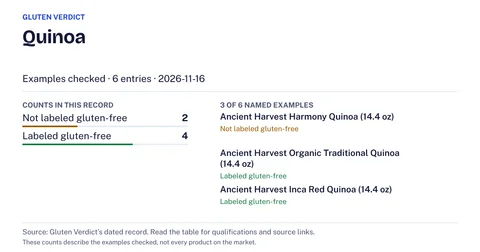 QuinoaNaturally gluten-freeBuy it labeled gluten-freechecked Nov 16, 2026
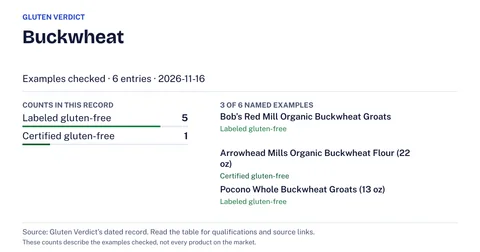 BuckwheatNaturally gluten-freeBuy it labeled gluten-freechecked Nov 16, 2026
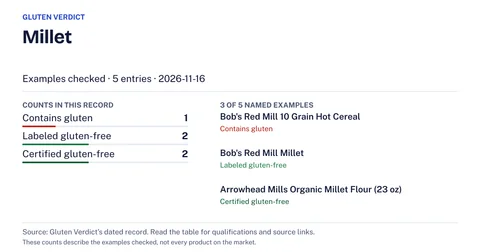 MilletNaturally gluten-free1 of 5 products we checked contains gluten: Bob's Red Mill 10 Grain Hot CerealBuy it labeled gluten-freechecked Nov 16, 2026
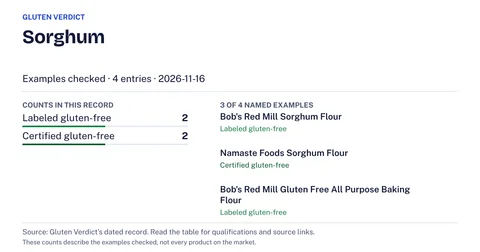 SorghumNaturally gluten-freeBuy it labeled gluten-freechecked Nov 16, 2026
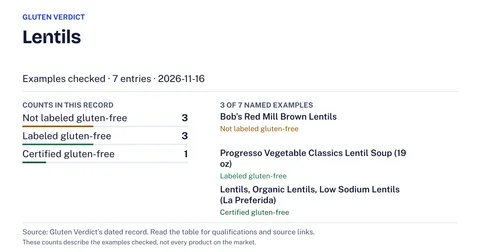 LentilsDepends on the productchecked Nov 16, 2026
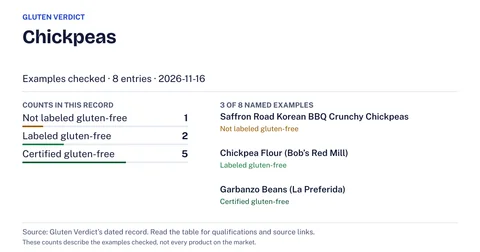 ChickpeasNaturally gluten-freechecked Nov 16, 2026
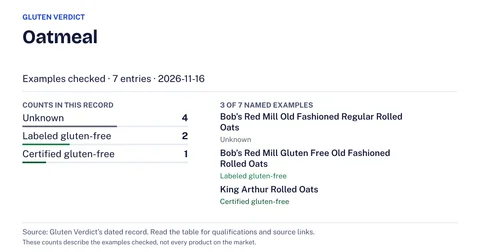 OatmealDepends on the productchecked Nov 16, 2026
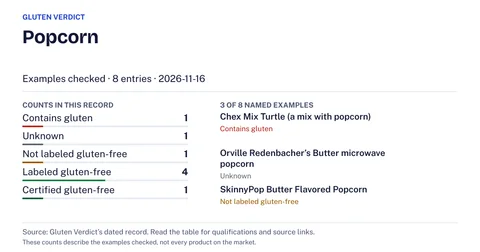 PopcornNaturally gluten-free1 of 8 products we checked contains gluten: Chex Mix Turtle (a mix with popcorn)checked Nov 16, 2026
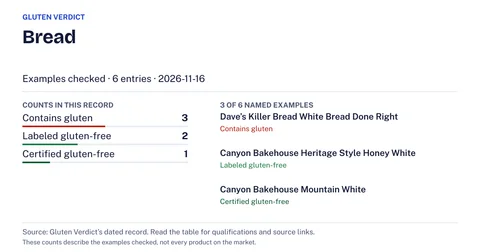 BreadContains glutenchecked Nov 16, 2026
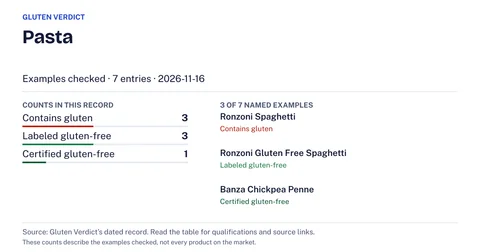 PastaContains glutenchecked Nov 16, 2026
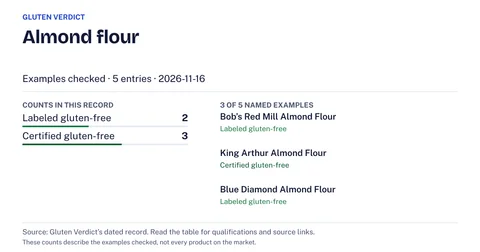 Almond flourNaturally gluten-freeBuy it labeled gluten-freechecked Nov 16, 2026
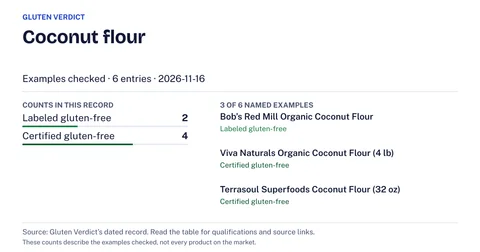 Coconut flourNaturally gluten-freeBuy it labeled gluten-freechecked Nov 16, 2026
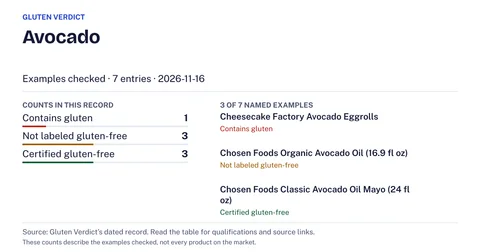 AvocadoNaturally gluten-free1 of 7 products we checked contains gluten: Cheesecake Factory Avocado Eggrollschecked Nov 16, 2026
Questions people ask
Is gluten-free bread lower in fiber than wheat bread?
Studies disagree. Spanish label data from 2012 to 2013 found lower fiber in gluten-free breads14, while a 2025 laboratory analysis found almost twice as much fiber in gluten-free breads, mostly from added fibre ingredients15. The Nutrition Facts panel of the loaf you buy answers it for that loaf.
How many grams of fiber a day is the figure?
FDA’s Daily Value is 28 grams6. The Academy of Nutrition and Dietetics says most adults should aim for 14 grams for every 1,000 calories, about 25 grams for women and 38 for men, and that exact needs can vary16. Coeliac UK gives 30 grams for UK adults32.
Do psyllium and inulin count as fiber on the label?
FDA lists psyllium husk among the isolated fibers that meet its dietary fiber definition, and says it intends to propose adding inulin and inulin-type fructans while allowing makers to count them in the meantime35, 36.
Do beans and lentils carry a gluten risk?
NCA says legumes have a risk of cross-contact with gluten-containing grains and advises picking through them before soaking, even if they are labeled gluten-free17.
More in Nutrition and combining diets
 Gluten-free with type 2 diabetes or high cholesterol: where the plans overlapWhere a gluten-free plan and a diabetes or cholesterol plan agree, where packaged gluten-free foods cut across them, and what to ask a dietitian.
 Iron, B12 and B6 on a gluten-free diet: where they come from and how to check a labelWhich foods supply iron, B12 and B6, what US enrichment standards name, and how to check whether a gluten-free flour, bread or cereal is fortified.
 Calcium and magnesium on a gluten-free, dairy-free dietWhere calcium and magnesium come from without dairy or gluten, and how to read a plant milk’s panel and ingredient list for added calcium.
 What to eat after a celiac diagnosis: what the sources document and what they do notBone broth, collagen, glutamine or plain staples? What NIDDK, ACG and celiac charities document after a diagnosis, and what no page we read names.
 Gluten-free vegetarian protein: what to check on beans, lentils, tofu and tempehWhat to read on beans, lentils, tofu, tempeh and meat substitutes when you are vegetarian and gluten-free: stray grain, added grains, sauces and batters.
 Weight gain or loss after a celiac diagnosis: what the research foundWhat two studies found about weight before and after a celiac diagnosis, what sources say about gluten-free foods, and what to bring to a dietitian.
Related guides
 Oats and celiac disease: what a gluten-free oat label does and does not tell youWhat FDA’s rule covers for oats, how makers get oats to the gluten-free limit, what avenin studies found, and what to ask your doctor.
 Is a gluten-free diet healthy if you do not have celiac disease?What a gluten-free label promises, what studies of gluten-free products and eaters report, and why testing comes before cutting gluten.
 Gluten-free and low FODMAP: what to check when symptoms continueHow gluten and FODMAPs differ, what guidelines list for persistent symptoms on a gluten-free diet, and FODMAP ingredients to look for on labels.
 Nutrient deficiencies in celiac disease: what the guidance names for checkingWhich nutrients a celiac guideline and a charity's clinician page name for checking, where reported deficiency figures differ, and questions to bring.
Sources
- [1, 11, 32, 38, 39, 40, 44, 48] Coeliac UK, Fibre and the gluten free diet, checked Nov 17, 2026.
Read on 2026-11-17: the table under “Recommended intake” lists fibre per portion, including chickpeas (80g) 4.3 g and red lentils (80g) 2 g.
- [2, 15, 26, 27, 28, 37] Foods (González et al., 2025), Determination and Comparison of Fat and Fibre Contents in Gluten-Free and Gluten-Containing Flours and Breads, checked Nov 17, 2026.
- [3, 14, 25] Foods (Mármol-Soler et al., 2022), Gluten-Free Products: Do We Need to Update Our Knowledge?, checked Nov 17, 2026.
- [4, 6] US Food and Drug Administration, Daily Value on the Nutrition and Supplement Facts Labels, checked Nov 17, 2026.
Read on 2026-11-17: the table headed “Reference Guide: Daily Values for Nutrients” lists Dietary Fiber at 28g.
- [5] US Food and Drug Administration, How to Understand and Use the Nutrition Facts Label, checked Nov 17, 2026.
- [7, 8, 9, 18, 19, 29, 41, 42, 45, 46, 47, 50, 51] Gluten Intolerance Group, Adding Fiber To Your Gluten-Free Diet, checked Nov 17, 2026.
- [10, 12, 13, 17, 31, 43, 49, 52] National Celiac Association, What can I eat to increase my fiber intake and lower my cholesterol?, checked Nov 17, 2026.
- [16] Academy of Nutrition and Dietetics, Dietary Fiber, checked Nov 17, 2026.
- [20, 30] US Department of Agriculture and US Department of Health and Human Services, Dietary Guidelines for Americans, 2020-2025, checked Nov 17, 2026.
Read on 2026-11-17: Appendix 1, “Nutritional Goals for Age-Sex Groups”, Table A1-2 (printed page 133), lists the fiber goal as 14g per 1,000 kcal, which the table gives as 28 g at the 2,000-calorie level assessed for women 19-30 and 34 g at the 2,400-calorie level assessed for men 19-30.
- [21] National Institute of Diabetes and Digestive and Kidney Diseases (NIDDK), Eating, Diet, & Nutrition for Celiac Disease, checked Nov 17, 2026.
- [22, 23, 24, 53] PeerJ (Missbach et al., 2015), Gluten-free food database: the nutritional quality and cost of packaged gluten-free foods, checked Nov 17, 2026.
- [33] US Department of Agriculture and US Department of Health and Human Services, Dietary Guidelines for Americans, 2025-2030, checked Nov 17, 2026.
Read on 2026-11-17: the “Focus on Whole Grains” box says “Prioritize fiber-rich whole grains.” and sets whole grains serving goals of 2–4 servings per day. The document gives no gram figure for fiber and does not mention gluten or celiac disease.
- [34, 35, 36] US Food and Drug Administration, Questions and Answers on Dietary Fiber, checked Nov 17, 2026.
Read on 2026-11-17: under “What isolated or synthetic fibers have FDA included in its dietary fiber definition?” the list names beta-glucan soluble fiber, psyllium husk, cellulose, guar gum, pectin, locust bean gum and hydroxypropylmethylcellulose; the list of fibers FDA intends to propose adding names mixed plant cell wall fibers, arabinoxylan, alginate, inulin and inulin-type fructans, high amylose starch (resistant starch 2), galactooligosaccharide, polydextrose, resistant maltodextrin/dextrin, cross linked phosphorylated RS4, glucomannan and acacia (gum arabic).