Oats and celiac disease: what a gluten-free oat label does and does not tell you
Short answer
Under FDA’s rule oats are not a gluten-containing grain4, so oats labeled gluten-free have to meet the same limit as any other non-gluten-containing grain: less than 20 parts per million of gluten1. The concern with ordinary oats is that they come into contact with gluten grains from the field to processing6. Whether a person with celiac disease should eat even labeled oats is a question NIDDK sends to the person’s doctor or dietitian3.
Part of Grains, flours and substitutes, 13 guides
Key points
- FDA’s definition of a gluten-containing grain names wheat, rye and barley, not oats; oats labeled gluten-free must still contain less than 20 ppm4, 1.
- Oats do not need third-party certification to carry the claim in the US, and FDA does not endorse any certification program1, 5.
- The cross-contact concern is other grains mixed in along the way, from shared fields and equipment through processing2, 6.
- One study found avenin-specific T-cell responses in 6 of 73 HLA-DQ2.5-positive participants, and a 2017 meta-analysis found no evidence of an effect on symptoms or histology but rated the evidence low in quality7, 8.
- The sources do not say the same thing: Coeliac UK says research has shown that most people with coeliac disease can tolerate gluten free oats9, while the BIDMC statement says there is no consensus10; NIDDK, GIG and the National Celiac Association all point to a doctor, dietitian or healthcare team3, 45, 49.
What FDA’s rule says about oats
The regulation behind the “gluten-free” claim, 21 CFR 101.91, defines a “gluten-containing grain” as wheat, rye or barley, or their crossbred hybrids such as triticale. Oats are not on that list4. A food labeled gluten-free also has to keep any unavoidable gluten below 20 parts per million (ppm)11, and a food that carries the claim without meeting the rule is deemed misbranded12.
FDA’s question-and-answer page applies this to oats directly: oats labeled gluten-free must contain less than 20 ppm gluten, as with any other non-gluten-containing grain1. The same page says any grain other than wheat, rye, barley or their hybrids can carry the claim when the unavoidable gluten from cross-contact is below 20 ppm13.
Two things follow. A maker does not have to make the claim: the regulation sets requirements for its voluntary use14. And oats do not need a third-party certificate to carry it1.
Why ordinary oats are the concern
FDA says crop rotation and the shared use of harvesting and transport equipment and storage silos often bring gluten-containing grains into contact with other grains, legumes and seeds that are naturally free of gluten2. The Gluten Intolerance Group (GIG) puts the concern with oats the same way: they come into contact with gluten grains from the field to processing6. It defines agricultural comingling as the inadvertent mixing of different grains through shared planting and harvesting equipment, shared transport and storage, and the activities of birds, wind and weather16.
So the same grain reaches shoppers in two ways, and the package and the maker’s page show which. Bob’s Red Mill sells both a gluten-free and a regular rolled oat. Its gluten-free page says that, unlike its regular rolled oats, the gluten-free grains are packaged in its dedicated facility17. Its regular rolled oats page makes no gluten-free statement18. Our oatmeal verdict and Quaker Instant Oatmeal verdict show what we could read for each, with the dates we checked. Quaker’s own page was blocked when we tried, so its verdict rests on other pages.
How makers get oats to the gluten-free limit
GIG describes two main ways oat processors avoid or remove comingling with gluten grains19. Some use one, some combine them, and some rely on sorting alone20.
| Method | What the sources say |
|---|---|
| Purity protocol | GIG: a method developed by Montana Gluten Free Processors and later adopted by some US and Canadian oat companies21. GIG calls its steps “non-regulated”22. |
| Mechanical or optical sorting | GIG: machines calibrated to find and remove gluten grains23. General Mills says it uses mechanical and optical sorting to remove gluten-containing grains from its oats24. |
| Testing and a dedicated facility | Bob’s Red Mill says all of the oat groats it receives undergo an R5 ELISA test to ensure they contain no more than 19 parts per million of gluten25, and that its gluten-free grains are packaged in a dedicated facility17. |
| Third-party certification | GIG: GFCO certification audits oat processing and tests oats multiple times26, and GFCO requires 10 ppm or less where FDA requires less than 20 ppm27. FDA lets makers print a certification logo if its use is truthful and not misleading28, and does not endorse any particular program5. |
General Mills adds that it tests multiple composited samples of finished product so that every production lot meets FDA’s standard for gluten-free foods29. Our verdicts for Cheerios and Honey Nut Cheerios show which of its pages make a gluten-free claim.
Each has limits that the sources name. GIG notes that products labeled gluten-free should comply with FDA’s definition, but that this is not third-party verified30. The BIDMC Celiac Center, in a statement the National Celiac Association publishes, says some manufacturers do not adequately test oats for gluten, or use sorting and testing methods that are inadequate31.
What the avenin studies found, and where they stop
Oats contain avenin, which Coeliac UK describes as a protein similar to gluten9. The National Celiac Association says a small number of celiac patients react to it32. GIG’s article says research on avenin sensitivity generally indicates that it does not cause a reaction in the majority of celiac disease patients33. Three studies follow, and each answers a different question.
An oat meal and T cells (Hardy et al., 2015)
In this study, participants with celiac disease who are HLA-DQ2.5 positive were fed oats at 100 g a day over 3 days, and the researchers measured T-cell responses to avenin peptides. There were 73 participants34. Avenin-specific responses were observed in 6 of the 73 (8%), against four closely related peptides7. After an oral barley challenge, cross-reactive avenin and hordein-specific T cells were induced in most participants, and after wheat or rye challenge they were not35. Our barley verdict covers the grain itself.
The authors conclude that the low rates of T-cell activation after a substantial oat challenge suggest that commonly consumed doses of oats are insufficient to cause clinical relapse62. That is the authors’ inference from T-cell data: the abstract reports T-cell responses in people who were all HLA-DQ2.5 positive, and no symptom scores or biopsy findings36.
Oat varieties in the laboratory (Comino et al., 2011)
The authors began from earlier, contradictory studies suggesting that oats may trigger the abnormal immune response in celiac disease37. They distinguished three groups of oat cultivars: one with considerable affinity for the G12 antibody, one with slight reactivity and one with none detectable38. They then measured immunogenicity with isolated T cells from patients with celiac disease, through cell proliferation and interferon-γ release39, and found a direct correlation between G12 reactivity and immunogenicity40. These are laboratory measurements on cells, not feeding trials39.
Pooled clinical studies (Pinto-Sánchez et al., 2017)
A systematic review and meta-analysis identified 433 studies, of which 28 were eligible: 6 randomized and 2 non-randomized controlled trials covering 661 patients, and the rest observational41. All the randomized trials used pure or uncontaminated oats42. The authors found no evidence that adding oats to a gluten-free diet affects symptoms, histology, immunity or serologic features, and added that there were few studies for many endpoints, limited geographic distribution and low quality of evidence8.
Three kinds of evidence, three different questions: a T-cell test after a large oat meal, a laboratory comparison of varieties, and pooled trials of oats in the diet. How they apply to one person is the question the sources in the next section send to a doctor or dietitian.
What the charities and physicians say, and where they differ
| Source | What it says |
|---|---|
| Coeliac UK (UK charity) | Says research has shown that most people with coeliac disease can tolerate gluten free oats with no problems9; a very small number may still be sensitive43. Gluten free oats can be introduced at any stage, and ongoing symptoms or concerns should be reviewed with a health professional44. |
| Gluten Intolerance Group (US charity) | Oats should only be introduced under the guidance of a personal healthcare team and in limited amounts45. Consumers should be cautious of oat products that are not labeled or certified gluten-free46. |
| National Celiac Association, publishing a statement of the BIDMC Celiac Center (May 2023) | There is no consensus on the type or portion of gluten-free oats, or on when or whether to introduce them10. The center’s clinicians cannot offer a standard recommendation for any particular brand, whatever its purity protocol, sorting or certification status47. |
| NIDDK (US National Institutes of Health) | Talk with a doctor or registered dietitian about whether to include oats and how much3. If you do eat oats, make sure they are gluten-free48. |
The sources do not give one answer, and Coeliac UK’s “any stage” sits beside the BIDMC statement’s “no consensus”. Several of them point to a doctor or dietitian: the National Celiac Association’s own answer to a reader says to always discuss gluten-free oats with a doctor or dietitian before introducing them49, and even a maker, Bob’s Red Mill, notes that a small percentage of people cannot tolerate even the purest of oat groats50.
The BIDMC statement also lists several reasons people may have symptoms after adding oats: more fiber, fermentable carbohydrates (FODMAPs) often found in oat bars and baked goods, or contamination with gluten51.
Reading an oat package
- Look for a gluten-free claim. On a food FDA regulates, oats carrying it must contain less than 20 ppm gluten1. Coeliac UK, writing about UK labels, says “pure oats” and “organic” do not tell you whether a product is gluten free15.
- Look for a certification mark, and know what it adds. FDA allows the logo when its use is truthful and not misleading28; GIG says GFCO’s limit is 10 ppm or less27.
- Check the exact product, not just the brand. General Mills’ Cheerios Oat Crunch Cinnamon page lists “May contain wheat ingredients.”52; check each product’s own page rather than assuming one product’s claim covers another.
- Read the maker’s page for the method: sorting, testing, a dedicated facility, or nothing stated17, 24.
The label and the maker’s page record what the maker says about its oats; whether to eat them is the medical question in the next section.
Oat milk, oat flour, granola and bars
GIG says oat milk should be assessed the same way as whole oats53, because there is a significant risk of cross-contact with gluten-containing grains during growing, transport, storage and processing54. Brands differ. Oatly says that in the US and Canada its products are made from certified gluten-free oats and labelled gluten-free, while in Europe and Asia they can contain a small amount of gluten55. Our oat milk verdict compares the brands we checked.
GIG says gluten is much easier to test for in oat flour than in whole oat groats, because any gluten grains are more evenly distributed through the flour56.
Granola and bars add other ingredients as well as oats; see our verdicts for granola and granola bars.
Some other countries differ. GIG’s article says Australia and New Zealand treat oats as a restricted grain in gluten-free products57.
Questions to take to the appointment
These questions come from what the sources above say the decision depends on. They are not advice, and the answers belong to a person’s own doctor or dietitian.
- Should I include labeled gluten-free oats at all, and how much? NIDDK tells readers to talk with a doctor or registered dietitian about both3.
- Which of my results and circumstances would you use to decide: symptoms, celiac antibodies, other health conditions, my current diet? The BIDMC statement lists these58.
- Does it matter how often I eat oats, how much, and whether it is a single-ingredient oat or a product with several ingredients? BIDMC lists these as factors59.
- If I have symptoms after eating oats, how would we tell avenin from fiber, FODMAPs or gluten contamination? BIDMC names all of these51.
- How should we follow up if I start? The BIDMC statement advises speaking to a celiac specialist dietitian or gastroenterologist and following up regularly60.
- Which kind of label do you want me to rely on: a gluten-free claim, a certification mark, or a maker’s described method? The BIDMC clinicians do not recommend a particular brand by any of them47.
GIG’s advice for anyone who thinks they are sensitive to oats is the same: consult a physician before adding oats to the diet61.
Verdicts in this guide
 OatmealDepends on the productchecked Nov 16, 2026
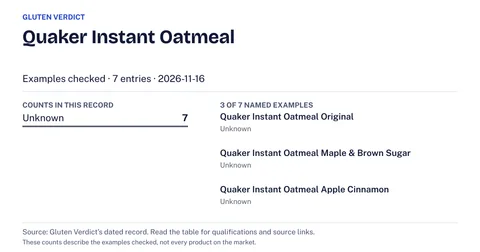 Quaker Instant OatmealUnknownThe Quaker Oats Company · checked Nov 16, 2026
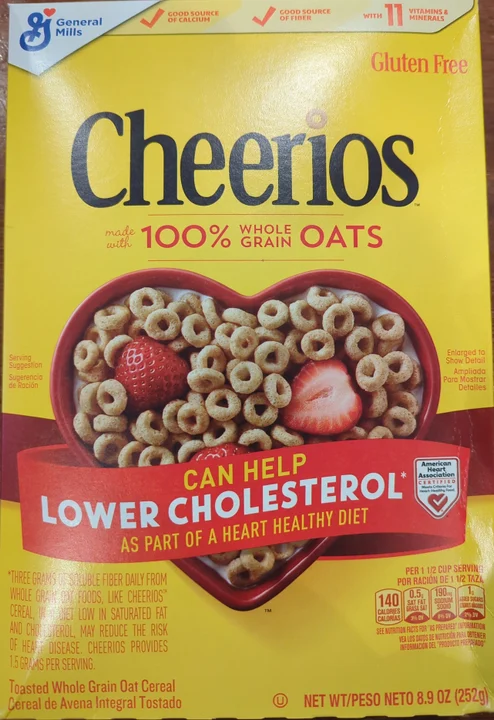 CheeriosLabeled gluten-freeWheat warning on 1 of 8 varieties we checkedGeneral Mills · checked Nov 16, 2026
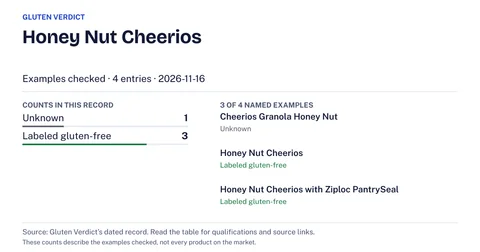 Honey Nut CheeriosLabeled gluten-freeGeneral Mills · checked Nov 16, 2026
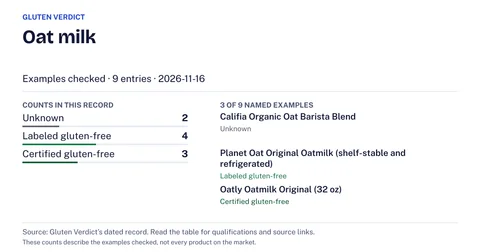 Oat milkDepends on the productchecked Nov 16, 2026
 GranolaDepends on the product1 of 6 products we checked contains gluten: Honey Bunches of Oats Honey Roasted Granolachecked Nov 16, 2026
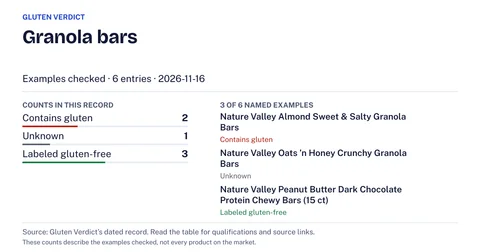 Granola barsDepends on the product2 of 6 products we checked contain gluten: Nature Valley Almond Sweet & Salty Granola Bars and Nature Valley Cinnamon Brown Sugar Soft-baked Oatmeal Squareschecked Nov 16, 2026
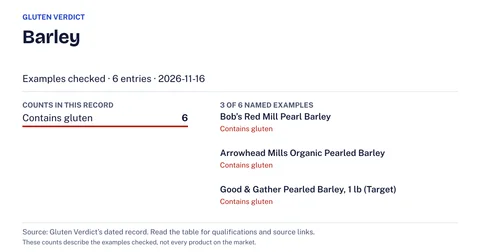 BarleyContains glutenchecked Nov 16, 2026
Questions people ask
Are oats gluten-free?
Oats are not named in FDA’s regulation defining a gluten-containing grain4, and oats labeled gluten-free must contain less than 20 ppm gluten1. GIG says oats come into contact with gluten grains from the field to processing6.
Do oats have to be certified to be labeled gluten-free in the US?
No1. FDA does not endorse any particular third-party certification program5.
What is avenin?
A protein in oats that Coeliac UK describes as similar to gluten9. The National Celiac Association says a small number of celiac patients react to it32.
Is purity protocol a regulated standard?
GIG describes the protocol as a non-regulated set of steps22.
Does a certification mark mean less gluten than FDA allows?
For GFCO, GIG says so: its limit is 10 ppm or less, against FDA’s less than 20 ppm27.
More in Grains, flours and substitutes
 Mechanically sorted or purity-protocol oats: what the makers' own pages sayTwo routes lead to a gluten-free oat label. See how to sort a pack by the maker's own words, which pages say what, and what they leave out.
 Gluten-free cereal: how to check a cereal boxCheck a cereal box in order: the gluten-free claim, malt and wheat in the ingredient list, the oats, then the maker’s own page for that flavour.
 Gluten-free breakfast: what to check on the label and in your kitchenGo through a usual breakfast item by item: what is gluten-free by nature, what needs a label check, and which kitchen habits cause trouble.
 Gluten-free substitutes: the swap for each wheat ingredient and the label check it needsA lookup table of gluten-free swaps for wheat flour, pasta, bread, soy sauce, beer and more, with the one label check each swap needs.
 Millet, sorghum, quinoa, buckwheat, teff, amaranth and wild rice: what the bag has to sayWhich grains and seeds are gluten-free plants, what makers and certifiers say about seven of them, and the cross-contact checks for bags, bins and blends.
 Spelt, farro, Kamut, bulgur, couscous and freekeh: wheat under other namesWhich shop and menu names are wheat: spelt, farro, Kamut, einkorn, bulgur, couscous, freekeh and more, and what FDA’s rules say about them.
Related guides
 Gluten-free oats by country: where the claim is allowed and where it is barredWhether oats can carry a gluten-free claim in the US, Canada, EU, UK, Australia and New Zealand, in each regulator’s own words.
 Zein, avenin and gluten: how corn and oats differ from wheatIs zein gluten? How FDA’s rule defines gluten, what “corn gluten” and avenin are, and why a gluten-free label matters for oats.
 The FDA gluten-free rule: what 21 CFR 101.91 requires and what 20 ppm measuresWhat FDA’s gluten-free rule requires, which claim words it covers, what 20 ppm means for a portion of food, and how FDA checks that a claim holds.
 Gluten-free oats vs regular oats: what the label changesTwo canisters of rolled oats, one labeled gluten-free: what the US claim means, how oats reach it, what it does not cover, and how to check.
Sources
- [1, 2, 5, 13, 14, 28] US Food and Drug Administration, Questions and Answers on the Gluten-Free Food Labeling Final Rule, checked Nov 17, 2026.
- [3, 48] National Institute of Diabetes and Digestive and Kidney Diseases, Eating, Diet, & Nutrition for Celiac Disease, checked Nov 17, 2026.
- [4, 11, 12] Electronic Code of Federal Regulations, 21 CFR 101.91 Gluten-free labeling of food, checked Nov 17, 2026.
Read 21 CFR 101.91(a)(1) on 2026-11-17: the definition of “gluten-containing grain” lists wheat, rye and barley, “or their crossbred hybrids (e.g., triticale, which is a cross between wheat and rye)”; oats are not named.
- [6, 16, 19, 20, 21, 22, 23, 26, 27, 30, 33, 45, 46, 56, 57, 61] Gluten Intolerance Group, Are Oats and Oat Flour Gluten-Free?, checked Nov 17, 2026.
- [7, 34, 35, 36, 62] PubMed (Journal of Autoimmunity), Hardy et al. 2015: oats, barley and avenin-specific T cells in celiac disease, checked Nov 17, 2026.
Read the abstract on 2026-11-17: it reports avenin-specific T-cell responses to peptides after an oat meal, in participants who were all HLA-DQ2.5 positive; it reports no symptom scores or intestinal biopsy findings.
- [8, 41, 42] PubMed (Gastroenterology), Pinto-Sánchez et al. 2017: systematic review and meta-analysis of adding oats to a gluten-free diet in celiac disease, checked Nov 17, 2026.
- [9, 15, 43, 44] Coeliac UK, Oats and the gluten free diet, checked Nov 17, 2026.
- [10, 31, 47, 51, 58, 59, 60] National Celiac Association, Oats on the Gluten-Free Diet (statement of the BIDMC Celiac Center, May 2023), checked Nov 17, 2026.
- [17, 25, 50] Bob’s Red Mill, Gluten Free Old Fashioned Rolled Oats, checked Nov 17, 2026.
- [18] Bob’s Red Mill, Old Fashioned Regular Rolled Oats, checked Nov 17, 2026.
Read the Old Fashioned Regular Rolled Oats page on 2026-11-17: its product description and ingredient list (“Whole Grain Oats.”) make no gluten-free statement; “Gluten Free” appears on the page only as a menu category and in links and labels for other products and recipes.
- [24, 29] General Mills (cheerios.com), Gluten Free Cheerios: our gluten-free process, checked Nov 17, 2026.
- [32, 49] National Celiac Association, Why can I NOT tolerate GF oats?, checked Nov 17, 2026.
- [37, 38, 39, 40] PubMed (Gut), Comino et al. 2011: differences in immunogenicity between oat varieties, checked Nov 17, 2026.
- [52] General Mills (cheerios.com), Cheerios Oat Crunch Cinnamon, checked Nov 17, 2026.
- [53, 54] Gluten Intolerance Group, Oat milk in a gluten-free diet (GIG answer), checked Nov 17, 2026.
- [55] Oatly, Oatly random answers: allergens, checked Nov 17, 2026.